Summer is almost here, which means many of us will be beach-bound. Before you slip into your swim suit and pack up the station wagon, however, we have some important reminders. Last year, the Ocean Conservancy organized it’s 26th annual International Coastal Cleanup—an enduring effort worth celebrating, but also a little depressing if you consider why it’s even necessary. The reason, of course: We’re a messy bunch. Last year, almost half a million people collected 10.2 million pieces of debris worldwide—about 15 pounds of junk each. And before you blame ocean pollution, consider this: About 64 percent of the debris came from land-based activities like beach trips, recreation, and picnics. With that in mind, here are a few easy ways to enjoy the beach this summer without contributing to the problem.
Carpool or ride your bike to the beach. Quite often parking and traffic at the beach can be a headache, so try to ride your bike, take a train, or walk. If it’s too far, carpool with your friends to reduce pollution and save on gas and money.
Go to the library. Of the many relaxing things to do at the beach, reading a book or magazine is one of the most popular. Check out a book or magazine from the library instead of buying a new one.
Pick up after yourself and others. Between the kids running around and the wind blowing, it’s easy to lose track of things and leave behind trash. So be sure to be thorough in your cleanup. Bring a separate bag for your waste in case there isn’t a trash or recycling bin available. If you see another person leave behind garbage, do mother nature a favor and pick it up
Go solar. If it’s in the budget, go for a solar mp3 player. You can use the sunshine to power and play your favorite music while also reducing your use of batteries and electricity. If you can’t spring for the solar player, start with rechargeable batteries for your portable radio.
Hydrate with a reusable bottle. Bring your own water, juice, or soda. Stainless-steel water bottles will keep your liquids cold. For a party or large group, put your beverage into a large container and bring reusable cups for everyone to fill.
Use reusable dinnerware. Bringing disposable items may make a picnic or a trip to the beach convenient, but it’s not convenient for the planet. Opt instead for lightweight plastic dinnerware that can be used, washed, and reused for years to come. These are great for parties at home too.
Carry a reusable bag or cooler. Bring your lunch, blanket, dinnerware, radio, sunscreen, and book in a reusable clothe tote or cooler. Avoid styrofoam coolers and plastic or paper bags. Of the 10 million plus pieces of debris collected last year during the coastal cleanup, over 66 percent were plastic bags, food wrappers and containers, caps, cups, lids, straws, forks, knives, spoons, plates, paper bags, and beverage bottles.
Don’t smoke at the beach (or ideally, at all). Almost 2.2 million pieces of the debris found in the coastal cleanup last year were cigarettes and cigarette filters. That’s over 21 percent of all the debris collected.
Choose chemical-free sunscreen. The chemicals in many suntan lotions are harmful to you as well as the environment. While swimming and playing, sunscreen comes off leaving behind it’s ingredients in the water and on the ground. (Check out the Environmental Working Group’s 2010 Sunscreen Guide for some suggestions.)
Grill with gas. This has been an ongoing debate for many, but according to the Environmental Impact Assessment Review, grilling with gas is better for the environment than using charcoal. The review states that the overall footprint of charcoal is almost three times that of propane. Charcoal’s production is not efficient and it’s also a contributor of “black carbon” which is a soot that floats in the upper atmosphere and to the arctic where it absorbs heat from the sun and melts the ice upon which it settles. So, this Fourth of July, opt for a propane grill as the greener choice.

Childhood activities like playing house, superheroes and villains, the floor is lava, and the classic tea party all involve imagination. We create stories and worlds with rules and roles to play.
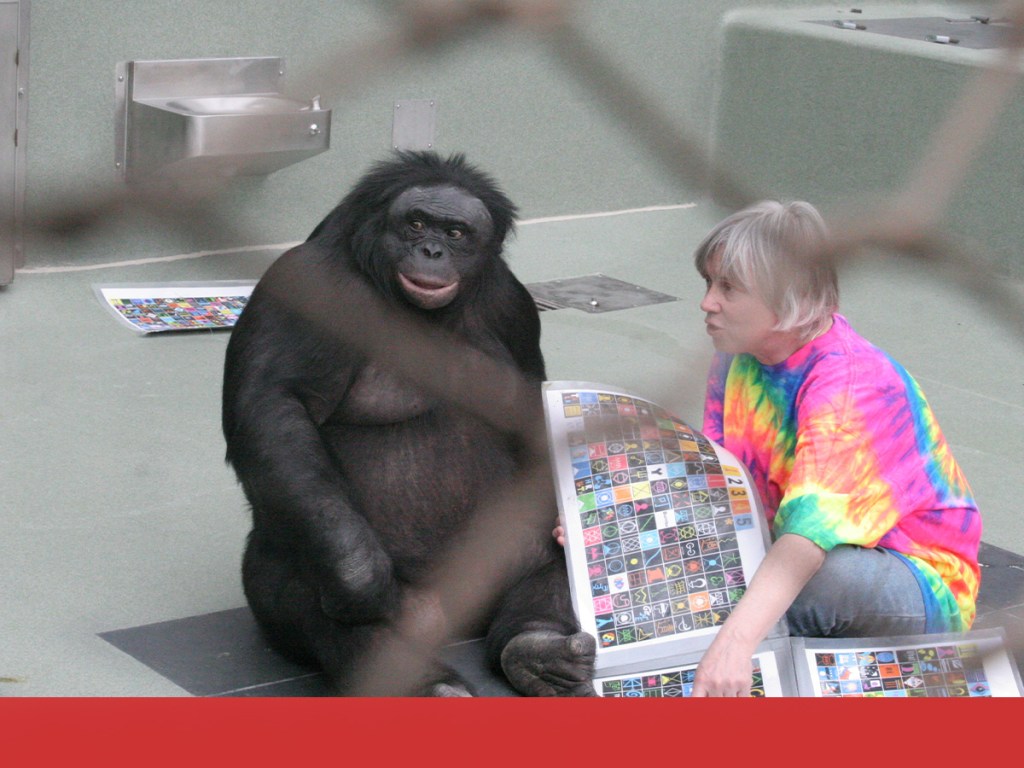
Humans want to believe that our creativity and art make us unique. But a bonobo named Kanzi was part of research that has scientists wondering how different we really are. In three evolving experiments, Kanzi correctly identified pretend objects, demonstrating that he could understand and engage in make-believe situations.
Kanzi associates words and symbols with Sue Savage-Rumbaugh. Photo by William H. Calvin, Phd/ Wikimedia Commons (Cropped)
Kanzi has a make-believe tea party
Researchers developed a simple setup using cups, a pitcher, and actions that began as real pouring and gradually shifted into pretend play. The first experiment used real liquids. The second had a combination of real and pretend liquids. The final scenario had no real liquids and relied entirely on imagination.
The scientists used gestures and make-believe to see if Kanzi would react differently depending on what he was being shown. He didn’t react the same way in each setup. His responses showed he was paying attention to more than just the objects, but also to the way the situation was presented.
Kanzi participates in an indoor test. Photo by William H. Calvin, Phd/ Wikimedia Commons (Cropped)
Animals engaging in fantasy
The experiment revealed that non-human animals can understand and follow along with imaginary situations.
“[It] shows that animals are capable of understanding pretence in a controlled experimental setting, which hadn’t been done before,” Dr. Amalia Bastos, first author of the research from the University of St Andrews, told The Guardian.
Scientists involved in the research are careful about how they describe it. They don’t treat it as proof that bonobos imagine things the same way humans do. Instead, they suggest that animals are capable of responding to situations where meaning is implied rather than directly shown.
Albert Einstein, one of the greatest scientific minds in history, is often credited with the idea that logic gets you from A to B, but imagination can take you everywhere. This study suggests that the more we learn about animals, the more it seems the difference between us may not be as great as we once thought.
Developmental research credits early social and cognitive growth in human children to imagining situations that aren’t physically present. A 2024 meta-analysis found that make-believe is not just entertainment but also directly linked to social understanding and real-world interpretation.
Researchers now describe animal play as more flexible than once believed. A 2025 study of ravens revealed that play included the manipulation of sticks, stones, and other items, suggesting social awareness and responsiveness to context rather than simple instinctive behavior.
Play and imagination may be versatile behaviors no longer seen as uniquely human traits. A broader cognitive toolkit shared across multiple species suggests the gap between humans and animals may be smaller than it once seemed. Things we’ve long believed to be uniquely human may instead exist along a spectrum of abilities expressed in different ways.
People who work from home with a cat nearby tend to recognize this moment well. The instant a laptop opens and a document appears on the screen, a cat arrives within seconds, claiming ownership of the keyboard.
It can feel like an unwelcome interruption, yet veterinarians and animal behavior specialists have identified a common pattern among domestic cats. Cats often choose to sit on objects their owners are engaged with, particularly when those things are central to human attention or activity.
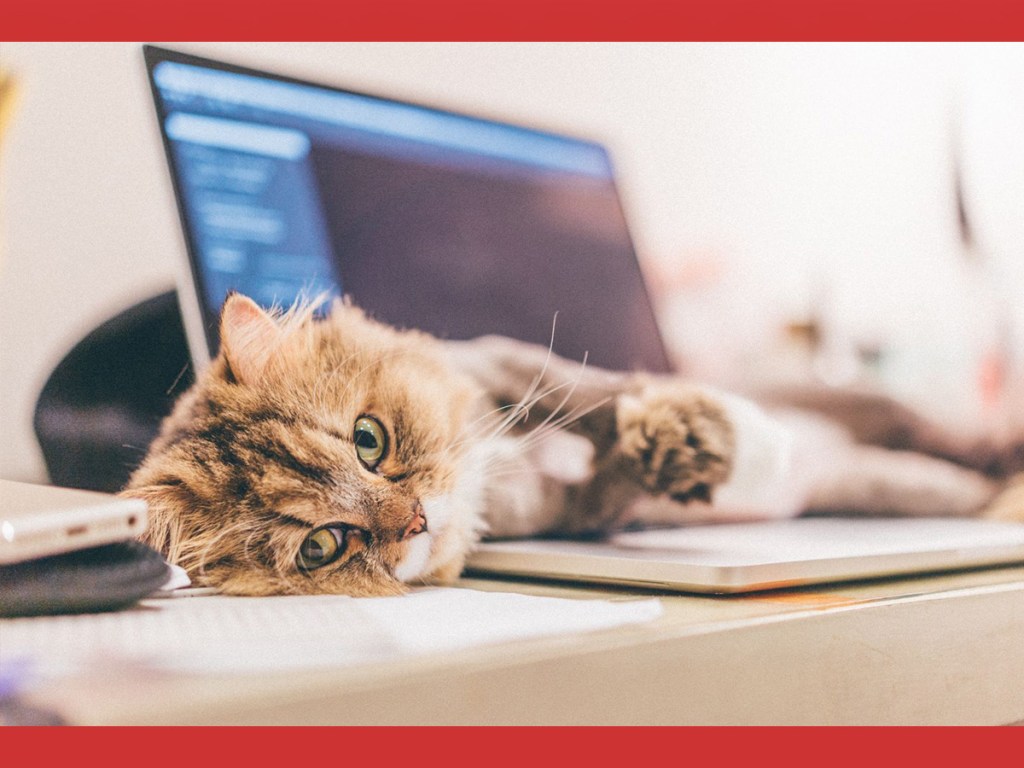
A cat with a little attitude on the computer. Photo credit: Canva
Cats aren’t trying to be a nuisance
The first, and probably most familiar, reason a cat jumps on you and the computer when you’re working is attention. Animal behavior experts at vet-reviewed sources like Catster explain that cats repeat behaviors that reliably get responses from their owners. Why work when you can play and look at me?
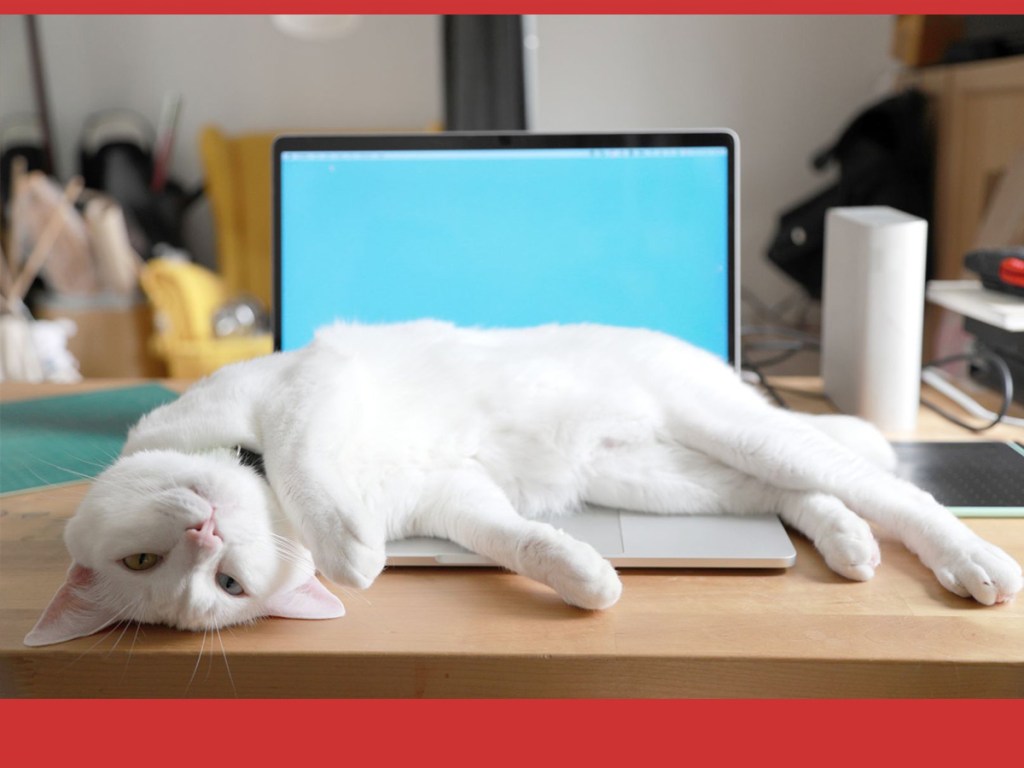
Another commonly cited explanation is simple comfort. Laptops, keyboards, and similar devices radiate heat. Cats seek out these warm surfaces for napping. Daily Paws notes that warmth is one of the practical reasons cats may choose electronics over other available spaces in the home.
And let’s face it, cats are naturally curious. They are highly responsive to human activity and tend to investigate objects their owners are focused on. The laptop, papers, and even a phone being scrolled at home become sources of fascination.
A white cat relaxes on a laptop. Photo credit: Canva
The science behind cats lying on laptops
Research suggests there is more behind this behavior than basic attention-seeking and curiosity. Physical contact with objects can shape how cats interact with their environment, especially with items frequently handled by humans. For cats, scent helps create and strengthen connections with their owners.
“Cats are very possessive individuals,” Dr. David Sands, an expert in animal psychology, told BBC Science Focus. “For them, the more they can brush past you and deposit your scent, the better!”
The laptop is not just a warm surface but also a shared space that already carries a lot of its owner’s presence.
Research from the Tokyo University of Agriculture found that cats can differentiate between familiar and unfamiliar humans using smell alone. In everyday settings, this may explain why cats often spend time on items like clothing, beds, or computers that carry their owner’s scent. These objects are strongly associated with a favorite human.
These explanations point in a similar direction. What may seem like a deliberate effort to interrupt work is more likely the result of several well-intentioned feline behaviors. The family mouser is probably not plotting against your productivity.
From seeking warmth and comfort to investigating the objects that hold our attention to interacting with surfaces carrying our familiar scents, cats have plenty of reasons to gravitate toward a laptop. These soft and cuddly family members adapt to the people and environments around them, even if that process occasionally lands them squarely on our keyboards.
George Washington knew his forces could not win the American Revolutionary War without some measure of sea power. “It follows then as certain as that night succeeds the day,” he later wrote in a letter, “that without a decisive naval force we can do nothing definitive, and with it everything honorable and glorious.”
The problem was that the American commander did not have a navy.
As a professor of early American history, I have taught courses on the American Revolution for more than 20 years and have written two books on its maritime dimensions. Washington’s solution wouldn’t come from a French shipyard or a congressional committee. It would come from a group of angry, out-of-work New England fishermen.
Supplying the army from the sea
In 1775, American ground forces managed to lay siege to the British army in Boston, but Washington needed provisions and military stores to sustain pressure on this key commercial hub. Looking out across the Atlantic Ocean, he noticed supply ships arriving in droves from Great Britain – unescorted – to supply the British army in Boston with guns and ammunition.
Unbeknownst to them, the British had already handed the American commander the ships and mariners he needed to capture those resources.
The Sons of Liberty, a network of political activists, had angered the British government by resisting taxes and commercial regulations – from the 1765 Stamp Act, which taxed printed documents, to the 1773 Tea Act, which controlled what tea leaves made their way into North American cupboards.
To punish rebels for their treason, Parliament passed the Restraining Act of 1775, banning New Englanders from fishing on the Atlantic Ocean. Overnight, thousands of skilled mariners – men who spent their lives wrestling 100-pound cod out of the freezing, storm-tossed North Atlantic – were out of a job. They weren’t just unemployed; they were furious. These fishermen left their work tools and ships behind, picked up weapons and joined the siege of Boston alongside American farmers.
Ashley Bowen, who lived and worked in Marblehead, Massachusetts, the principal fishing port in America at the time, recorded in his journal on May 22, 1775, “the fishermen are enlisting quite quick.”
A letter from a French diplomat to the foreign minister in Paris confirmed the news a couple of weeks later: “4,800 sailors seeing they were going to be deprived of their fishing rights, deserted their ships and joined their compatriots under arms.”
Washington, commissioned by Congress as commander in chief of all American armed forces in June 1775, saw an opportunity. He didn’t wait for Congress to build new frigates. Instead, he reached out to John Glover, a fish merchant from Marblehead and a commissioned officer under his command.
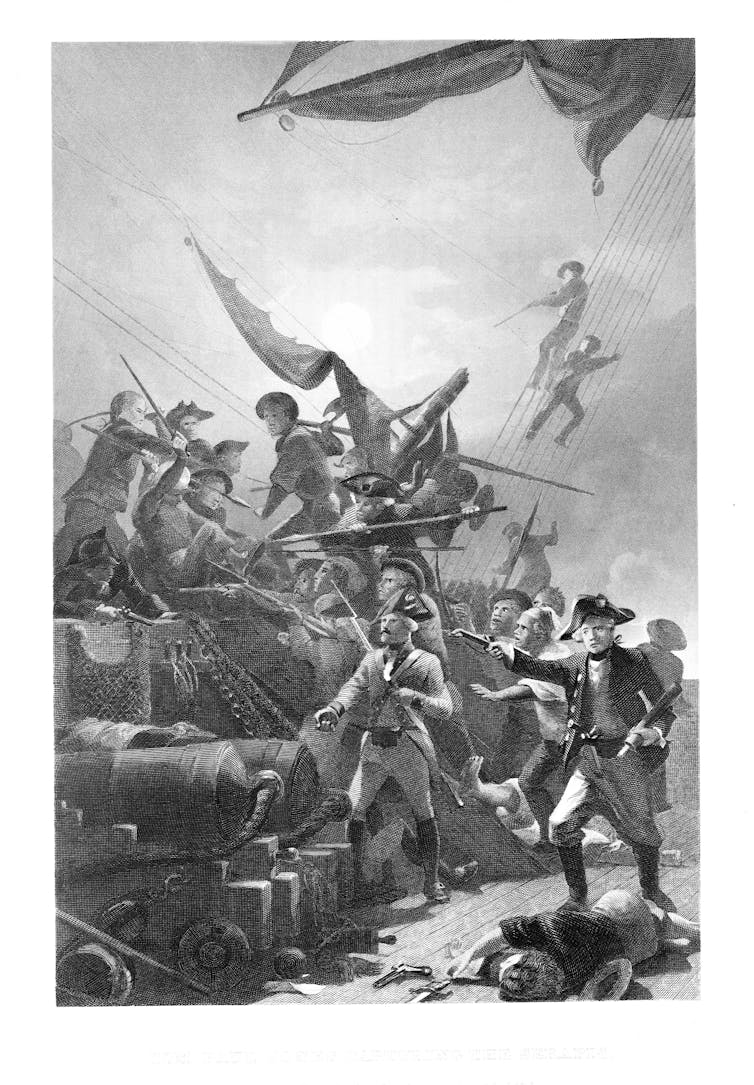
Washington’s plan was simple: Take the sturdy, salt-stained schooners used for fishing and turn them into armed, seagoing predators.
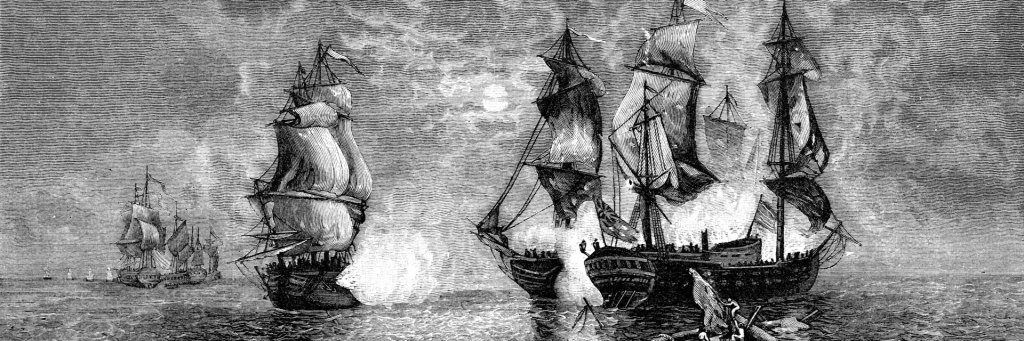
The first of these was Glover’s own fishing vessel and trade ship, Hannah. She wasn’t a formidable man-of-war but a 78-ton workhorse that spent summers at the Grand Banks and winters hauling rum and sugar from the Caribbean. Washington armed the trade ship with a few cannons, manned her with fishermen and sent her out to hijack British supply ships to help his army win the siege of Boston.
Just two days after the Hannah was underway, her crew captured the Unity, a sloop loaded with naval stores and lumber, supplies sorely needed by British forces in Boston.
Between August and October 1775, Washington outfitted a fleet of schooners at Congress’ expense to intercept British supply ships off the coast of New England. These vessels and crews, whose wages were paid by the American government, constituted what many historians consider America’s first navy. Washington reminded each captain that they sailed “at the Continental Expense.” These orders from Washington and the payments made by Congress made these ships official American warships, operating under the authority of what would become the federal government.
These recruits didn’t need nautical training; they were seasoned seafarers who had battled rough waters and gale force winds. On Oct. 13, 1775, George Washington wrote to his brother, John Augustine Washington, that the fishermen were “soldiers … who have been bred to the sea.”
In 1776, Washington informed the governor of Connecticut, who had asked to draft seamen from Washington’s regiments for his own naval expedition, that he could not spare any. “I must depend chiefly upon them for a successful opposition to the Enemy,” Washington explained.
Because the British navy was spread too thin, with too few warships available to police the Atlantic coastline, the armed fishing vessels were able to disrupt supply lines and keep the Revolution alive through its infancy. By the time the British realized the threat, the damage was done.
On Feb. 26, 1776, just a few months after Washington launched his fleet, British Admiral Molyneux Shuldham wrote in a report to his superiors that his forces in Boston were low on everything from naval supplies to weapons. What little they could find had to be purchased “at the most extravagant prices.”
The British government had not assigned military convoys to trans-Atlantic shipments at the start of the conflict in 1775. Now, Shuldham recommended arming the supply ships themselves, since valuable stores were being intercepted by rebels in small vessels, “however attentive our Officers to their Duty.”
He concluded the report with an ominous note, explaining that he simply did not have the resources to do everything that was being asked of him – support the army, blockade rebel ports and protect British ships bound for Boston: “I must beg leave to observe to you the very few Ships I am provided with to enable Me to Co-operate with the Army, Cruize off the Ports of the Rebels to prevent their receiving Supplies, or protect those destined to this place from falling into their hands.”