
Fr. Hyacinth Marie Cordell, O.P., a Dominican priest based in Philadelphia, walked into the reception hall as he normally would, having just officiated a wedding. As a highly skilled drummer—one who achieved Internet fame with his viral performance videos—he was surprised but delighted to see live musicians set up and ready to play. “I walked past the stage, and all the guys waved at me and said, ‘We follow you on Instagram,’” he tells GOOD over Zoom with a laugh. “They asked me to come up, and I played ‘Respect’ by Aretha Franklin.”
That’s just one surreal example of how Fr. Hyacinth’s life has changed since June 2024, when he posted his first drum video—a meticulous recreation of a jazzy, complex beat by Tay Dever. “For years I’d stayed away from social media,” he says, a slender and bespectacled fellow wearing a white habit and standing in front of a chalkboard. “I didn’t really understand it. I never had a Facebook account. I generally had a negative view of social media.” But he joined Instagram for two reasons: to stay in touch with a local drummer who posts frequently on the platform and to keep up with his “favorite drummer,” Dana Hawkins.
“I didn’t even look at [Instagram] that often,” he recalls. “I didn’t really know how it worked. It just seemed like these short videos of people trying to get attention. That was my first impression. [Laughs.] It just didn’t really interest me. But of course [the algorithm] learns your interests. There was one time I opened it up in June of last year, and I saw this guy Tay Dever play a really cool drum beat, and I was like, ‘Man, I’d love to be able to play something like that.’ I looked in the comments section and saw that a lot of people guessed how to play this beat [laughs], and I could see that they were all wrong.”
On his day off, Fr. Hyacinth went over to St. Patrick’s church hall, where his drum kit was set up. After some “trial and error,” he jotted down a quick drum transcription and decided to record his work—partly for the musical challenge, partly as a way of sharing his findings with the drum community. He was, of course, completely unaware how this decision would change his life. But it was admittedly a humble beginning: “I literally put my cell phone—I didn’t even have a tripod with me—on a music stand,” he says. “I just tried to angle it so it wouldn’t fall. It didn’t occur to me afterward, but I had the microphone against the bottom of the stand. It’s shaking, not great resolution, and so on. Then I had to figure out how to share both the transcription and the video. I didn’t know how to do that, but I copied the link and threw it in the comments section of Tay’s video. I said, ‘For all of you who are wanting to know how to play this: Here’s the transcription, and here’s a video of me playing it.
“And by the way, I just so happen to be a Catholic priest.’”
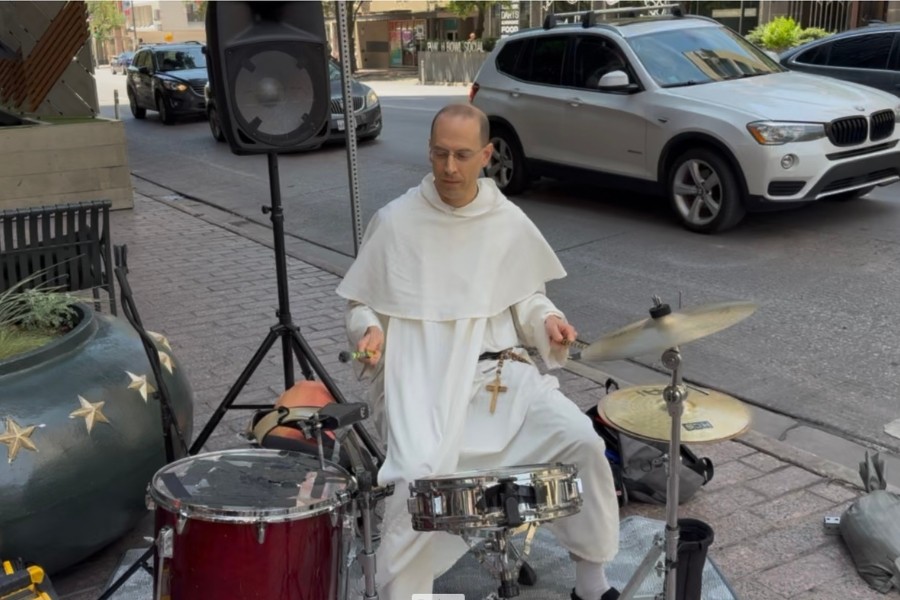
To his shock, the post started to spread, leading to mountains of followers (187,000 as of this writing), and he’s continued posting ever since—always decked out in his priestly attire, demonstrating complex polyrhythms and thunderous double-kick patterns as he explores the realms of jazz-fusion, hard rock, prog-rock, and metal. He’s made fans in every corner of the drum world, racking up press coverage and making tons of famous fans along the way. He’s also created a rare comment section where almost everyone—both famous virtuoso musicians and wide-eyed hobbyists, religious people and atheists alike—is united in their love of both the playing and his story. (The good-spirited jokes have become part of the fun—everything from “”He doesn’t play ghost notes, he plays holy spirits” to “fire from the friar.”)
But Fr. Hyacinth was never aspiring for Internet fame, and he’s using his social-media influence to lift up his hodgepodge digital parish. For most of his drum videos, he connects his rhythms and musicality to some greater ideal, whether religious or secular (Sample: “Another African-inspired 2-over-3 experiment, dedicated to the virtue of respect – #polyrhythm #drums #beat #groove #africa #respect #virtue #Catholic #christian“). GOOD spoke to the world’s most beloved priest drummer about his background, unexpected life change, and what it’s like bashing the kit in a tunic.
Tell me about your drumming background. I know you studied music at The University of North Texas one year. Did you initially hope to be a professional musician, and how did that lead to becoming a priest?
I was exposed to drums through my father when I was young. He was a professional drummer and percussionist for a while, but he was also a pilot. The music career, at least what he was doing, wasn’t great for marriage, so he basically gave up drums and got a job with an airplane insurance company. He’s from Texas, and his family moved to California. He got a job in Denver, and they transferred him to Chicago, where I was raised. When I was younger, I think he had a pad and some drum sticks laying around, and every once in a while he would borrow a drum set, just to play for a town play or something. Then he would show me some beats. I thought it was the coolest thing to have this drum set, and that got me interested in drums. In fourth grade, I took up drums and played in band and orchestra through the rest of elementary school, middle school, and high school. I got more serious going along. There was a drummer who was one year older than I was, although in the same grade, in middle school and high school who was very advanced, and I learned a lot of things through him. I was also taking drum lessons, and I subscribed to Modern Drummer magazine, so I was reading about all the greats. I tried to get all the cassette tapes—and, later, CDs—as I could, exploring the whole world of drumming and all the amazing drummers who’s influenced me. In high school, back in the days of VHS tapes, they had all these instructional videos from Dave Weckl or Terry Bozzio, and I would eat things up and try to learn from them.
So that was your dream path at the time?
I wanted to be a famous drummer and be in a band. That’s what I wanted to do with my life. I went to college for a year, but at the same time there was a spiritual journey going on, and inevitably I felt God calling me in that direction. I wasn’t exactly sure how these things would mesh, but after one year of college, I wound up going the spiritual route. I always loved drums, but in large measure I gave it up for years. I got back into it in various time windows, and then I’d give it up again. But it’s always been in me, and I’ve always been interested in great drummers and music. In the last few years in Philadelphia, a city known for the arts, I’ve made a lot of musical connections and started playing with a local Catholic artist. I needed a better drum set, so I slowly—through saving up monthly allowances, through donations from family, or people giving gifts—basically built up [the drum kit] you see today.
You’re a big fan of progressive music and have talked about how you really respond to complexity. If I were to put you on the spot, could you give me your top five progressive bands?
From the ’70s, it’s hard to say. Gentle Giant is definitely one of them. The old Rush, especially [1978’s] Hemispheres, which is my favorite Rush album, and A Farewell to Kings. I like Rush later on, but the more they get into the ’80s or ’90s, it’s like, “Eh.” I would say Yes, of course. I never got into Genesis that much, but at some point I started listening to them a little more and got to appreciate them as well. I never really got into King Crimson—every once in a while I would dabble, and I respect them. I like a lot of fusion music. When I was younger, I would gravitate toward fusion music, whether that’s in the rock realm, which is more like prog, or in the jazz realm. But anything fusion, I gravitated toward, whether it’s Chick Corea and Allan Holdsworth or Rush. I only discovered Gentle Giant a few years ago. But growing up, you had all these things that, if you advanced in music, you were expected to fit into. You either went the rock direction or jazz or classical. I loved it all, but I could never fully get into just one of those styles. It just felt so limiting. I loved the combination that is fusion. Back then, I didn’t know anybody who had those same interests. Nowadays, maybe it doesn’t sell, but it’s a huge interest out there. Drummers generally love fusion, and there are a lot of fusion and prog lovers out there. I’ve been connecting with all these people who love all this music I’ve always loved.
The response to your videos was pretty immediate, right?
I posted [the first video], and one of the first comments was, “Just commenting before this blows up.” I thought that was funny because I was like, “Yeah, right. That’s never gonna happen.” There’s a guitarist friend I have who’s on Instagram, and he was like, “You’re starting to go viral.” I was skeptical. I thought, “There’s viral and then viral and viral. If there are views, it’s going to be low-key.” I had to figure out how to look at the numbers, and I was like, “Whoa.” That was on a Friday, June 14th, but two days later, it was a busy Sunday, but I managed to sneak into the hall and thought, “I’ll just post a couple more beats.” I did [a beat by the instrumental prog-metal band] Animals as Leaders—when I saw [drummer] Matt Garstka do it some years ago, I thought, “That’s awesome!” I also did another beat I came up with, inspired by some of my favorite drummers. I didn’t even know you were supposed to space things out [on Instagram]—I think I just posted them together. I had no idea what I was doing. I did not expect at all that the Animals as Leaders video would take off. I don’t know if it was within a week or two weeks, but it now has like two million views. [Animals as Leaders guitarist] Tosin Abasi commented. I was like, “What is going on?” I’ve been posting videos since.
You’ve been embraced by the heavy-music community after playing “Bleed” by the extreme-metal band Meshuggah.
Early on, people insisted that I play “Bleed.” They didn’t realize that the Animals as Leaders song is more difficult than “Bleed.” I didn’t know why people were demanding it. It’s advanced and difficult, but a lot of drummers do it. But I thought, “Fine.” I didn’t want to just play the beat—I wanted to do something interesting with it, so I played some things over the foot ostinato. I had no idea that was going to be the most popular video. [Drummer] El Estepario even did a funny reaction video and at the end said, “Everybody follow this guy!” It was almost like it just took off in the first month or so, and I didn’t expect any of that to happen. I’ve just been trying to have fun with it. I’ve loved playing on the set and just experimenting. I’ve been doing this for a few years now where I just come up with stuff on my own. Nobody hears or cares, but I’m having fun on my day off. It’s surreal to me that people around the world like these little things I come up. Now I see the positive side of social media too—it’s a good way to connect with people, and try to have an influence toward what’s good.
One of my favorite things about your story is how it’s unified people, both religious and non-religious. The comment sections of your videos are true melting pots—you have atheist metal-heads and worship-band leaders all liking the same posts. Is that something you expected, or have you been surprised by that?
There definitely has been some negativity—I’ve had to delete comments and sometimes block people. That’s the vast minority of people, and I don’t see any avoiding that. But I am surprised. I’m amazed. The amount of followers, I don’t even know how to keep with it. But they’re all over the world—I’m connecting with people from [places like] Togo and Indonesia. Also, connecting with some of my favorite drummers has floored me. Like you said, it’s people all over the spectrum. I went into this not knowing what I was doing or what to expect, and I wasn’t looking for any of this, but it’s interesting—[I see] people who identify themselves as Jewish, Muslim, Atheist, Catholic, Protestant, Orthodox, Hindu, and so on. Of course, I welcome everyone. What I try to do is share reflections in the comments. Some of it will be from more of a Catholic perspective, and you can take it or leave it. And I’ll purposely give a reflection on something that can hopefully be for everyone, regardless of their background. I try to keep it positive. I try to avoid getting into debates—I don’t think it’s healthy, the way people debate online. If people do have questions or want to have a healthy debate, I tell them to DM me so we can set up a phone call or something like that. [In the comments], it often turns into ad hominem or attacking the person and being emotional and not respectful. Some issues have a lot of nuance and depth, and small comments in social media [aren’t conducive to that]. In my own way, I’m hoping to point people not to me but ultimately to God—to goodness, to truth, to what’s good and positive. I try to uplift people.
One of my favorite videos of yours is a beautiful New Age piano piece in 5/4. Do you have a lot of your own compositions, and have you considered recording an album of them?
Good question—I would love to. I come up with all these ideas that I think are neat, but I think the hardest thing is fashioning them into a song where there’s an arc and the transitions all work. It’s more like all these individual pieces. That’s the hard thing. I have all these ideas on guitar, but I never really learned formally and my technique is not great. I know basic theory. I do have one guitar piece that’s a full composition that I would love to record. Maybe there’s a way I could piece it together, but I’m not good enough to play it through without mistakes. When I was younger, I dove into rhythm. I have a lot of flaws in my [drumming], but people always ask, “How do you find time?” I practiced a lot when I was younger, so there are a lot of fundamentals there. Even with having years off, it’s just like riding a bike—it just takes a little bit to get back into it.
People obviously respond to your incredible drumming, but there’s also a real feeling of surprise and intrigue about seeing a priest playing drums, especially such complex music. Do you take any kind of satisfaction in breaking a stereotype?
It’s still so surreal to me. Some people thought I was a gimmick: “Why are you wearing this? You’re just trying to get views or likes.” I’m like, “No, I’m a consecrated religious. This is what I wear every day.” When I go to celebrate mass, there are all these vestments that I put on top of this. But this is medieval street clothes. I joke about being goth and all that—we were founded in the Middle Ages. [Laughs.] I’m not gonna change out of this in order to play drums. I just learn to play with it. I know it looks odd. It’s strange to me—why did God give me this gift of music but call to this [life], and somehow they go together? When I was younger, I would have seen myself as being married and in a rock group or fusion group or prog. I know it’s strange, but I’m not trying to be strange. [Laughs.] I come up with stuff I like and post it, and if people like it, great. If they don’t, OK. But I’m really not trying to do things for likes or applause. You have to be real. If you’re trying to be fake, it’s obvious. You’re not yourself. With some videos, it just seems obvious that they’re doing something very outlandish just to get attention. If there was no camera, they would never do something like this. But I’m not here to judge anybody.
In the Protestant world, you have a lot of gospel drummers, and they’re some of the best on Earth. They play during their services, but in the traditional Catholic/Orthodox liturgies, it’s not the kind of thing where you just bring in a band. It’s a different way of worshipping. That’s why we have chant—it’s text- and vocal-dominant, and all the instruments are supposed to support that. It’s contemplative and prayerful. It’s serving something sacred. That’s what’s strange about [me] being Catholic—you don’t expect a priest who loves that kind of ritual to be playing drums. There are prominent Catholics who play drums—and some priests—but I guess it’s kind of unique to see a priest getting into complex music and being out there, even though that’s not what I’m trying to do.
Did your parishioners already know about your drumming abilities? Have any of them been shocked when you suddenly became Internet-famous?
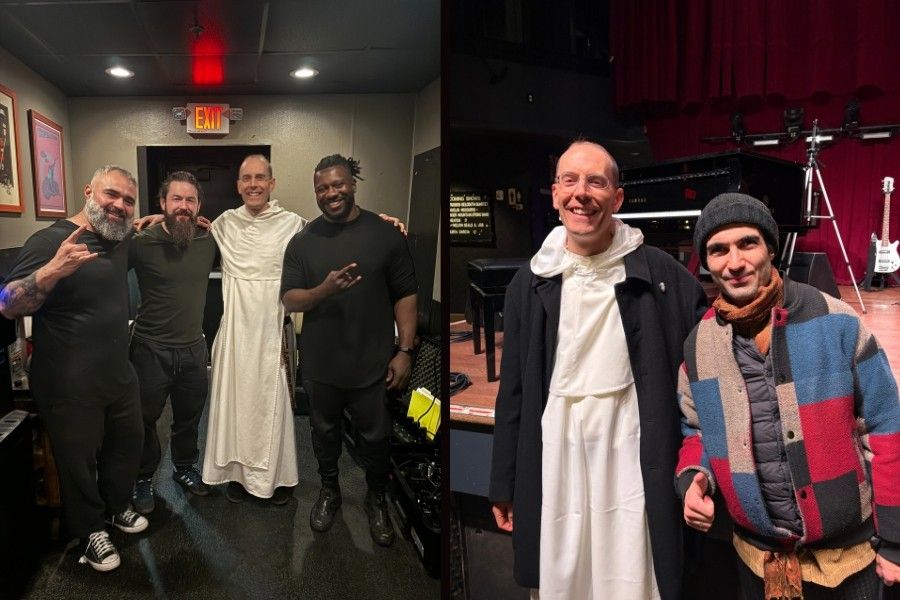
Some people are like, “That’s fine what you’re doing,” but they want to caution me against social media. I’m like, “Yeah, I’m trying to be careful.” Some are on Instagram, and some are not. But some people ask about it all the time, and they’re really excited about it: “What’s new with the Instagram thing?” We haven’t had a lot of people [come to the church after seeing his videos]. Some people have visited when they’re traveling through. It’s funny—whenever I go to a concert here in Philly, whether it’s rock or prog or whatever or even Tigran, there will be various people who come up to me: “I follow you on Instagram!” Sometimes someone will say that on the street. One time I was walking into a wedding reception, and I just hear this voice behind me: “Oh, do you play drums?” Which is a funny question to ask somebody in a white habit. [Laughs.] Some people have asked about coming to a service, but we’re not getting a ton of people. I wish we could get a ton of people coming to church! But it’s not about me, right? [Laughs.]