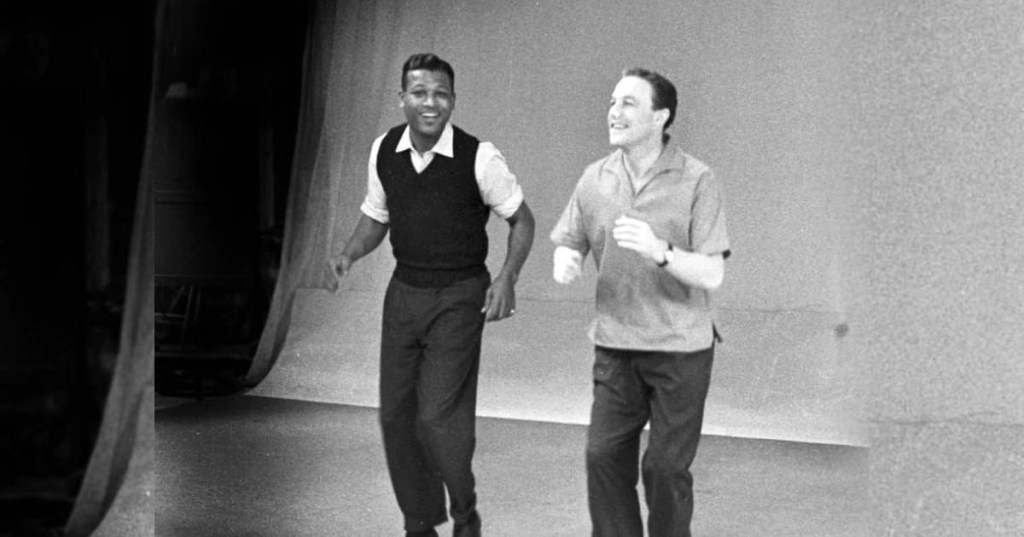
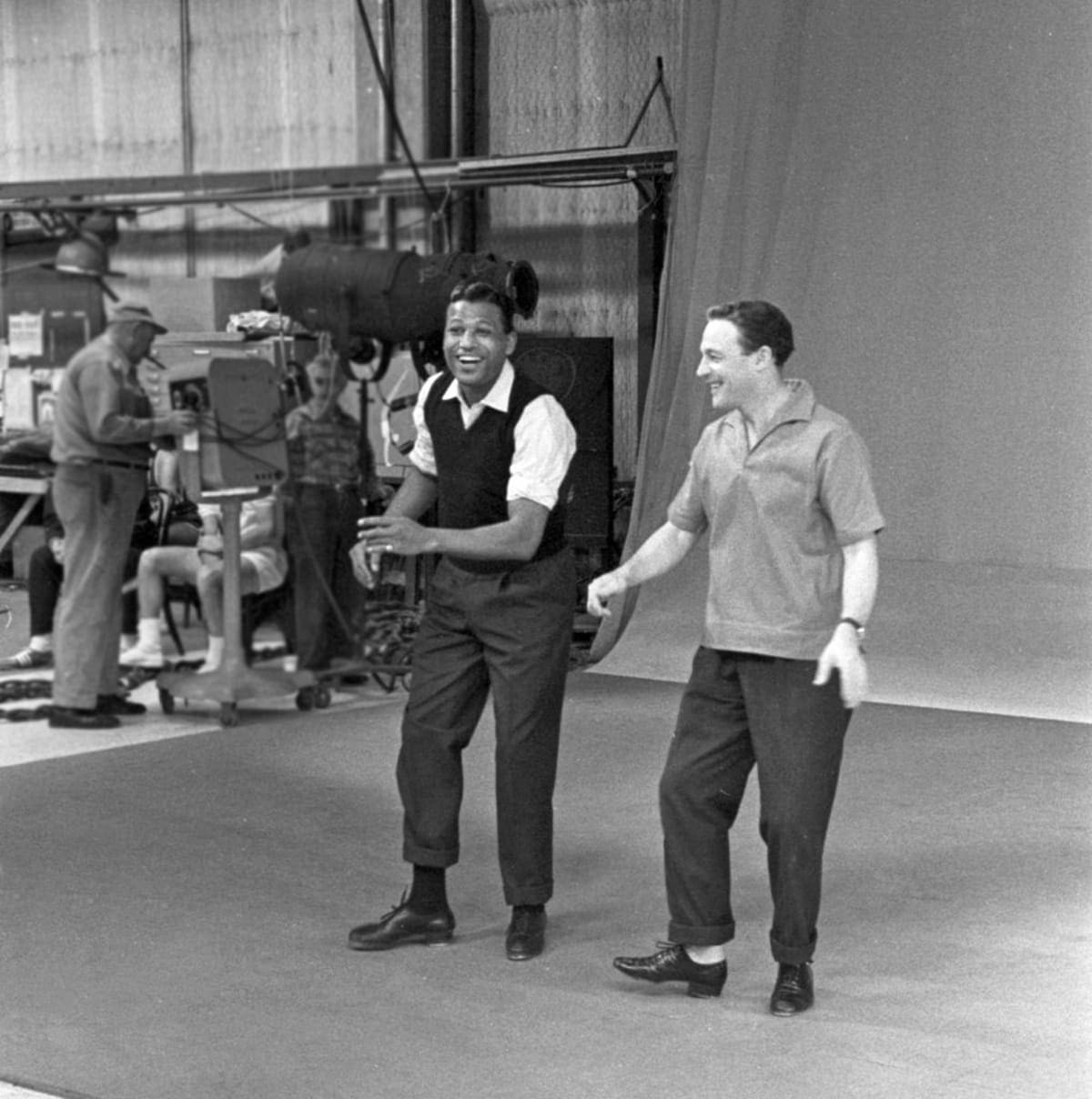
Photo credit: Boxing Legend Sugar Ray Robinson dancing with Gene Kelly for Dancing Is a Man’s Game on NBC-TV Omnibus on December 21, 1958. (Photo by Jack Mitchell/Getty Images) – Array
In the world of entertainment, we get some real gems every now and then. One classic moment was when boxing legend Sugar Ray Robinson and Hollywood icon Gene Kelly danced together on TV. The duo performed together for “Dancing Is a Man’s Game” on NBC-TV. This performance went viral on the internet after it was shared on X by @HeadExposure. The opening frames of the video show Robinson and Kelly engaging in a casual conversation when Kelly asks Robinson, “What’s the most important thing a boxer’s gotta have?” To which, Robinson responds with a single word, “Rhythm.”
Robinson’s response pushes Kelly to tap his foot in a specific rhythm, and the iconic boxer responds, “Yeah.” What happened next wowed the audience as both superstars tapped in perfect sync. Both Robinson and Kelly dazzled on the stage and got loud cheers from the crowd. The chemistry between the pair was incredible for two people with distinctly different careers.
Boxing Legend Sugar Ray Robinson dancing with Gene Kelly for Dancing Is a Man's Game on NBC-TV Omnibus on December 21, 1958. (Photo by Jack Mitchell/Getty Images)
Kino. Urlaub In Hollywood, Anchors Aweigh, Urlaub In Hollywood, Anchors Aweigh, Frank Sinatra, Gene Kelly Die beiden Seeleute Clarance (Frank Sinatra,ul) und Joseph (Gene Kelly,r) freuen sich auf vier Tage Landurlaub in Hollywood., 1944. (Photo by FilmPublicityArchive/United Archives via Getty Images)
On one hand, there was Robinson whose footwork showed his agility and on the other hand, Kelly’s smooth movements were a display of class and dexterity. It has been over six decades since this iconic collaboration saw the light of day. But now over a million people have watched it on social media.
"-What's the most important thing a boxer's gotta have? -Rhythm, man, rhythm!"
Sugar Ray Robinson and Gene Kelly’s 1958 tap dance collaboration is a perfect example of the magic that unfolds when two legends join forces to showcase their talents. The video surprised those who may not have known that Robinson took a shot at a career in the entertainment business after his time in the ring. He would eventually go on to tour with the Count Basie Orchestra and perform at Harlem’s Apollo Theater.
An X user named Scott (@Scott83355102) commented how excellent Robinson was on stage. The comment read :
Most people think they come across as helpful, engaged, and supportive in conversations. But according to one therapist, these talking habits may be sending a very different message than intended.
Jeffery, a licensed therapist on TikTok, breaks down five common conversational mistakes people make that can come across as annoying. In the post, viewers didn’t just agree with the list. They began recognizing the same behaviors in friends, family, and even themselves.
People can mistake sharing personal experiences for the perfect way to show empathy and compassion. It begins innocently enough when someone opens up about something personal. Unfortunately, the listener responds with a story of their own. Both people are trying to connect, but the focus has now completely shifted.
“When someone constantly redirects conversations back to themselves, people start feeling unimportant,” Jeffery explains. “When every story somehow becomes about you, people stop feeling listened to and start feeling dismissed.”
A 2023 experiment suggested that reciprocal disclosure increases interpersonal trust. However, an imbalance in the conversation can create feelings of one-sidedness. This “stealing of the spotlight” reduces connection.
An unhappy couple gets defensive. Photo credit: Canva
Getting super defensive
Few things shut down a conversation faster than defensiveness. Even simple misunderstandings can turn tense when people instinctively try to correct rather than understand.
“If every single piece of feedback turns into an excuse or an argument, people eventually stop being honest with you,” Jeffery points out. “Constructive feedback and even some criticism is not always an attack. Sometimes people are simply trying to improve the relationship or communicate something important to you.”
Psychologists describe this behavior as “psychological defensiveness.” Interestingly, a 2024 study found that defensiveness can be reduced if people are warned beforehand in the right way. Conversation works best when it is framed as a collaborative effort rather than an educational or teaching moment.
A woman receives a polygraph test. Photo credit: Canva
Drilling people after they apologize
There is a delicate balance between asking for clarity after an apology and turning the conversation into an interrogation.
“If someone apologizes and you accept it, but then you keep hammering them over the mistake afterward, it will become exhausting and very annoying,” Jeffery adds. “If people feel like apologizing never actually ends the conflict, they actually become less likely to take accountability in the future.”
People often mistake feedback for a personal attack on their own truth. There’s a popular statement often attributed to Marcus Aurelius claiming that much of what we perceive is shaped by interpretation rather than fact. People can share their opinions. We don’t have to defend ourselves against all of them.
Stop constantly complaining
Everyone deserves an opportunity to vent. But when every conversation circles back to frustration without change, it can become emotionally exhausting for the listener. Over time, even the most supportive friends can start to pull back.
“Talking about problems is normal,” says Jeffery. “But if almost every interaction revolves around negativity, people start associating you with emotional exhaustion. Nobody wants to leave conversations feeling drained every single time.”
This pattern of constant, dissatisfied venting has even found its way into pop culture. Maybe you remember the infamous George Costanza from the award-winning show Seinfeld. His nonstop stream of complaints was a running joke about negativity. It’s fun to watch and laugh at, but far less enjoyable to encounter in real life.
A conversation turns to comparison. Photo credit: Canva
One-upping people’s negative emotions
Sometimes, someone takes a risk and shares a particularly challenging experience. In an attempt to show empathy, saying “I get it” might land more like “that’s not a big deal.” It’s important to offer emotional validation rather than comparison.
“If someone opens up about something painful and your immediate reaction is to explain how you had it worse, it can make the other person feel completely invalidated,” Jeffery says. “They just want to feel heard and emotionally supported in that moment.”
A 2023 study revealed that someone trying to relate can sometimes redirect attention away from the original speaker. People feel more supported when their emotions are directly acknowledged instead of reframed or one-upped.
Many people said Jeffrey’s list felt immediately familiar, whether in conversations with friends or in their own behavior. These annoying habits became surprisingly relatable once someone pointed them out. Here are some of those thoughts:
“silently reposting this for one of my friends to find”
“The first one has ended relationships for me, not because I do it, but because they did it. It’s absolutely exhausting.”
“I know one of my friends are gonna tag me in this later”
“I’ve noticed over the years that my annoying personality will surface when I’m trying to protect myself..”
“I have such a hard time with #1 and I am so aware of it sometimes but I find it so difficult to not do when talking to someone.”
“I do all of these maybe I should go back to therapy”
What might be surprising is that many of these habits are things people slip into without realizing it. Jeffrey’s list doesn’t suggest people are intentionally difficult. He points out that annoying conversations can arise from good intentions, too. Allowing a person to be heard can matter more than offering advice that might fix the problem.
Being fit used to mean getting enough sleep, drinking more water, and moving your body, perhaps in a daily walk. With the explosion of social media and digital self-help trends, finding an acceptable level of wellness can feel like stepping into a full-time job with daily performance reviews.
For many women, what started as self-care has slowly become another exhausting form of self-optimization. And increasingly, they’re pretty much done with it. According to Women’s Business Daily, one of the biggest wellness shifts happening right now is a move away from extreme routines. Women want habits that actually fit into real life.
Instead of chasing perfection, more women are choosing what can be described as a more realistic approach to wellness, incorporating sustainable routines built around balance and emotional well-being rather than climbing a never-ending ladder of constant improvement.
The shift comes after a solid decade of what many refer to online as “optimization culture.” This exhausting idea assumes that every part of life needs to be carefully measured, improved, and optimized.
Experts believe this mindset is not only making people miserable; it’s unsustainable.
A backlash against the “always improve yourself” culture
A recent article in Psychology Today found that “wellnessmaxxing” trends turn self-care into another form of anxiety. This is especially true when routines become so demanding that people feel more guilt than relief. As creators post TikToks showing themselves “maxing out” in some kind of self-congratulation, they spread unhelpful expectations that no longer promote self-care.
Verywell Health explains that these influencers broadcast an all-consuming performance metric. People now face a painful realization that they can never do enough. It’s hard to miss the irony that wellness has begun to feel unhealthy.
Women are increasingly embracing low-pressure routines instead of overly aspirational ones. Think walks instead of cross-training, and a morning meditation instead of a week-long stay at a Tibetan monastery. It’s okay to just eat more vegetables instead of a perfectly balanced daily nutrition plan of 150 grams of protein, wheatgrass smoothies, and specifically rated pH-balanced alkaline water.
After all the extreme exercises, self-help books, and sophisticated meal plans, it’s time to get back to basics. Here’s one version of a realistic plan: drink some water, get outside, and try to sleep a little better.
A beauty editor writing for Who What Wear documented her attempt to follow a social-media-inspired wellness reset. With all the expensive and complicated habits she hoped would unlock the “incredibly high-functioning, ultra-productive version” of herself, she came away understanding that she should stick with the basics.
Modern life already asks women to juggle careers, caregiving, appearance standards, finances, and relationships. Somewhere along the journey, wellness became just one more category to add to the pile.
Maintaining a perfect life balance. Photo credit: Canva
Women are choosing simple, sustainable routines
Finding realistic wellness is a trend that reflects a growing desire for community-centered wellness rather than isolated self-improvement. Instead of wellness looking like a solo pursuit for an achievement award, many women are leaning toward connection: walking groups, shared meals, accountability with friends, and being honest about feeling burned out on all of it.
The Times reports that people feel walking groups are less intimidating and more emotionally supportive. People don’t just want fitness; they want to belong to something.
A 2025 study in Frontiers in Psychology focused on the benefits of women finding social support groups. Programs that incorporated women’s preferences into their daily lives were more likely to be enjoyed and maintained.
Wellness cultures have told women the answer is to do more: more discipline, more self-reflection, more perfect sleep, more work dedication, more family direction, more effort.
Making life more enjoyable and realistic can help well-being feel easier to maintain. A joyful life is better lived “in” than constantly measured “against” unrealistic expectations.
Photo credit: MoMo Productions/DigitalVision via Getty Images – Emphasizing the sounds of certain words to young children can help them retain language, not confuse them about speaking properly.
Many parents have heard the warning: Don’t use baby talk with babies and toddlers. Instead, caregivers are often encouraged to speak properly and use adultlike language, out of concern that simplified speech could confuse children or delay language development.
But my research, which I highlighted in in my new book, “Beyond Words,” suggests the opposite is true. The sing-song voice many adults instinctively use with infants, sometimes called “baby talk” but more accurately known as “parentese” or infant-directed speech, actually helps children learn language.
Far from confusing babies, exaggerating phrases like “Loooook at the doggie!” capture their attention, help them detect patterns in speech and strengthen social bonding.
And the funny mistakes children make along the way, such as saying “goed,” instead of “went,” or “mouses” instead of “mice,” are not signs that children are learning language incorrectly. They are evidence that children are actively working out the rules of language for themselves.
When many people think of baby talk, they imagine nonsense phrases like “goo goo ga ga” or made-up words like “num nums.” But that’s not what linguists and developmental psychologists mean by parentese.
Parentese uses real words and grammatically correct sentences, but with exaggerated intonation, a higher pitch, stretched-out vowels and a slower rhythm. Think of the way a caregiver might naturally say: “Hi, baaaaby! Are you huuungry?”
There is little evidence that occasional playful nonsense words harm children’s language development. But studies suggest that parentese in particular helps babies pay attention to speech, recognize patterns and engage socially.
Adults across cultures tend to speak this way to infants instinctively. Even people who swear they never use baby talk often slip into it around babies.
Researchers have found that infants actually prefer listening to parentese over regular adult speech. The exaggerated sounds and slower pacing make language easier to process. Babies are better able to pick out individual sounds, notice word boundaries and recognize patterns. In other words, parentese helps tune babies into language.
It also strengthens emotional connection. Language learning does not happen in isolation. Babies learn through warm, responsive interaction with caregivers during feeding, play, bath time and everyday routines.
Interestingly, humans are not the only ones who respond to this style of communication. Studies have even shown that cats react more positively when people use a baby-talk voice with them.
Babies are not passive learners
Children do not learn language simply by copying adults word for word. They actively test hypotheses about how language works. That is why toddlers make predictable and surprisingly logical mistakes.
One common example is overgeneralization. A child learns that people form the past tense of many verbs by adding “-ed,” so they produce forms like “goed,” “eated” or “comed.”
These are not random errors. In fact, they show that the child has understood a grammatical rule and is trying to apply it consistently. The problem is simply that English is full of irregular exceptions. The same thing happens with plurals. Children may say “foots” instead of “feet” or “mouses” instead of “mice.” Again, the logic behind these errors is sound.
Linguists sometimes say that children are little scientists, constantly testing patterns and revising their understanding as they receive more input from the world around them.
A toddler might learn the word “dog” and then use it for every four-legged animal they encounter. Linguists call this overextension. On the flip side, some children use words too narrowly. A child may use “dog” only for the family pet and not recognize that other dogs belong in the same category. Linguists call this tendency underextension.
These mistakes reveal how children organize and categorize the world around them. They are gradually mapping words onto objects, people and experiences.
Pronouns are another tricky area. Small children often confuse “me” and “you” because these words constantly shift depending on who is speaking. If a parent says, “I’ll pick you up,” the child hears themselves called “you.” But when they try to repeat the sentence, they may not yet understand that the labels switch from speaker to speaker.
This is why toddlers sometimes say things that sound unintentionally cute or confusing. But beneath the confusion is a sophisticated learning process.
Even the Cookie Monster gets it wrong
Children’s speech errors are so recognizable that they often appear in popular culture. Sesame Street’s character Cookie Monster famously says things like “Me want cookie,” while Elmo often refers to himself in the third person: “Elmo wants this.” These speech patterns mirror real stages of child language development. Young children commonly confuse pronouns or refer to themselves by name before mastering forms like “I,” “me” and “mine.”
Despite occasional complaints from adults, there is no evidence that hearing this kind of speech harms children’s language development. If anything, it reflects the natural experimentation children go through.
Pronunciation develops gradually too. Young children often simplify difficult sounds and groups of consonants. “Spaghetti” becomes “pasketti,” “rabbit” becomes “wabbit” and “yellow” may come out as “lellow.”
Speech-language specialists call these simplifications phonological processes. They are a normal part of development because some sounds are physically harder to produce than others. Sounds such as r, th, sh and ch tend to develop later because they require more precise control of the tongue and mouth.
Most children naturally outgrow these pronunciation patterns as their speech matures. However, persistent difficulties can sometimes signal a speech or language disorder, which may require professional support.
Parents are often under enormous pressure to do everything right, including helping their children learn to speak a language. But children do not learn language by avoiding mistakes. They learn through interaction, experimentation and repetition.
Parentese helps babies focus on speech and engage socially. The funny mistakes toddlers make reveal that they are actively piecing together the complex system of language and are often signs of normal development. Language acquisition is messy, creative and remarkably sophisticated.
Speaking in an exaggerated sing-song voice to a baby is not something parents and caregivers need to feel embarrassed about.
Far from harming language acquisition, it may help lay the foundation for it.