Back in 2008, environmental activists saw two possible paths to pressure the U.S. government on carbon emissions. The international climate talks at Copenhagen, the 15th time leaders had met to discuss the issues issues, posed an opportunity for a real agreement to restrict greenhouse gases. It also seemed possible that Congress would pass a cap-and-trade bill that would put a price on carbon and de-incentivize its use.
Now we know that neither path resulted in an agreement to cut down on carbon emissions and begin to address climate change. Activists began reconsidering their strategy, asking themselves what they could do in the absence of government action. In the fall of 2010, leaders including writer and climate campaign Bill McKibben and the Rainforest Action Network’s Becky Tarbotton came up with one answer: “Mass direct action must play a bigger role in this movement,” they wrote.
This past weekend, they made their first big push in that direction. Starting on Saturday, protesters camped out in front of the White House in opposition to the Keystone XL pipeline, which will pump tar sands oil from Alberta, Canada, down to Texas refineries. Extracting and processing tar sands oil produces dramatically more carbon than conventional oil production: a Canadian environmental agency has estimated that in the next decade, carbon emissions from tar sands production will be equivalent to twice the country’s total carbon savings. Protesters plan to sit outside the White House every day for two weeks in hopes of persuading President Obama to stop the pipeline. Over the weekend, 110 people were arrested, and 2,000 people in total have committed to risking arrest over the course of the protest.
The protest organizers say part of the goal of the protest is “reclaiming civil disobedience,” says Jamie Henn, who works with McKibben at 350.org and is acting as a spokesperson for the event. “Breaking the law for something you believe in has become something it seems only far-out radicals or professional activists engage in,” Henn wrote to GOOD.
The tar sands protest is meant to demonstrate that people fighting against climate change aren’t members of fringe groups, but average citizens. Organizers asked participants to wear business clothes in order to set the tone for the protest.
The arrests over the weekend showed that authorities are taking this action more seriously than a routine protest. The U.S. Park Police originally told organizers that anyone who was arrested would be fined $100 and released, as per usual procedures, but dozens of protesters arrested on Saturday remained in jail on Monday morning, waiting for a 2 p.m. hearing.
Over the next two weeks, more groups of unconventional protesters will take their turn at civil disobedience. Today, landowners and farmers in Nebraska, who would see the tar sands oil pipeline cut through their home state, will risk arrest. Activists from Montana, Appalachia, and the Gulf Coast are slated to protest as well. At the end of the two weeks, organizers are planning a larger rally for people who’d rather not risk arrest. As activists’ frustration with government leaders mounts, “we think a mass sit-in like this is the most pragmatic thing we can do,” Henn says. And given the overall goals that McKibben and Tarbotton have outlined, the Keystone XL protest may well be the first of many.
Lecturer of Art, Rochester Institute of Technology
Glass as a material is full of contradictions. Depending on the form and use, glass can be fragile or strong, opaque or transparent, rough or smooth. The studios my colleagues and I teach and learn in, as glass instructors, echo this abundance of physical opposites. These environments are simultaneously immersive, complex, seductive and demanding.
When the studio is in action, you might hear glass breaking, hot metal being quenched in water, glassblowing pipes rolling on the workbench rails, and some good tunes on the stereo. You might smell hot beeswax and burning newspaper. You might feel a bit of waste glass under your shoe or the intense heat from the furnaces and a breeze from a well-placed fan. Glassblowers learn to listen, to feel and to find some focus within and among the kinetic.
The constant stimuli of the glass studio may not seem anything like a sterile science lab, and yet glass artists need to accrue knowledge of physics and chemistry to achieve any kind of control with this dynamic material. They must choose a material with the desired properties and during the process judge factors such as heat and malleability.
Glass as a material
At Rochester Institute of Technology, where I help run the glass program, we primarily use two types of glasses. In our hot glass studio we melt “soft” glass. This glass is specifically formulated to be melted in a furnace and used by the glassblower. It’s a combination of fine mesh silica sand, soda ash and lime, with small amounts of a few additional ingredients that keep the glass beautiful when it’s at its top temperature of 2,200 degrees Fahrenheit (1,204 degrees Celsius).
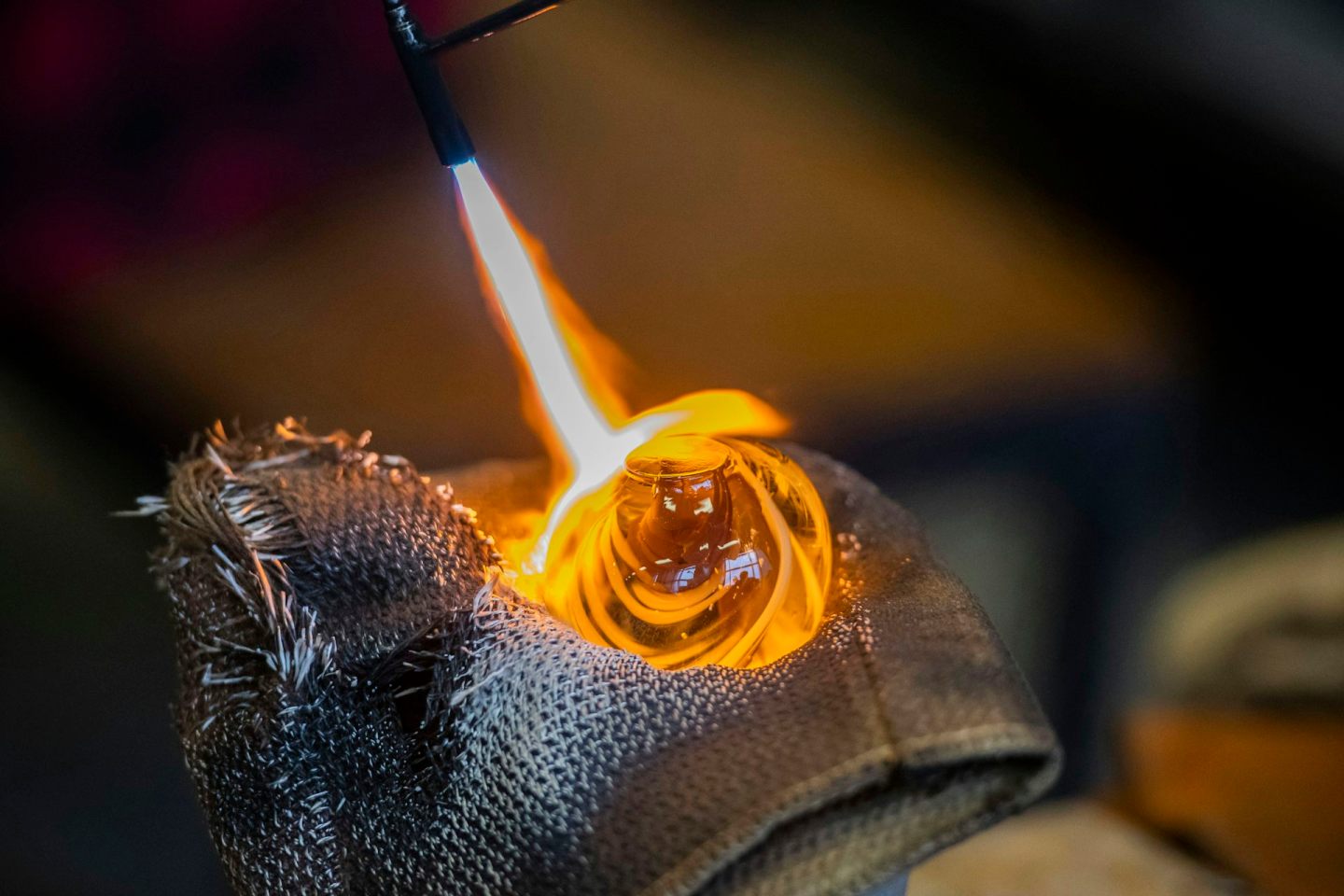
In our flameworking studio, we use a borosilicate glass. You might recognize this glass as the brand Pyrex made in Corning, New York. This is a super heat-resistant glass. It melts at a higher temperature than soft glass and arrives to our students in preformed rods that they can melt and shape by torch in our flameworking studio. The differences in chemistry really change how these glasses look and behave.
Pyrex cookware is made out of a specially formulated, heat-resistant type of glass called borosilicate.Picofluidicist/Wikimedia Commons
Glass, from a material science perspective, is categorized as an amorphous solid, meaning that glass’s molecules are arranged in a near-random pattern and there is no sharp melting point. Rather, glass gradually softens over a wide temperature range.
Gathering glass
Once you’ve adjusted to the chaos of the studio, it’s time to start working.
We have two furnaces in our hot glass studio, where we work with soft glass, so anytime during the school year there is between 700 to 1,200 pounds of glass. It’s kept in the furnace at its molten state (2,200 degrees F or 1,204 degrees C), ready to be gathered and transformed.
Glass artists heat up their glass in a furnace so that it’s molten and easy to mold.AP Photo/Keith Srakocic
When we work with the material, transforming it with tools and breath and heat, it needs to be kept in a workable heat zone – probably between 1,100 and 2,000 F (593 and 1,094 C). When the glass dips below that range, we perceive it as solid, though at the molecular level it is still dynamic and acting more like a liquid.
To make anything – a sculpture, a tumbler, a celestial magical orb or a pumpkin – you start by gathering glass out of the furnace on a metal rod. Once you’ve gathered your glass, you start making decisions.
An artist works in the Glass Hot Shop at RIT. When glass is in its molten state, the artist can shape it and blow into it.Elizabeth Lamark/RIT
You might ask yourself: What tools do I need to begin to shape and transform this glass into the object I have in mind? If you wait too long and the glass begins cooling down, you’ll need to reheat it to reintroduce malleability, allowing you to continue working it without breaking it.
A big part of glasswork is moving between the reheating chamber and the bench, where the artist uses tools to move and stretch the molten glass into the desired shape. You’ll need to alternate between these two stations many times.
Glassblowing is a team activity. I have physical and intellectual support from my colleagues: breath from their lungs, protection from the heat, additional bits of glass brought from the furnace to add to my object. We almost never work alone.
So, say I want to make a very basic clear tumbler. This is a simple conceptual object – utilitarian, domestic and intimate. It is also a tricky one to make well: too heavy and it feels bad in the hand, too thick at the lip and it dribbles when you drink, too thin at the bottom and it will break before it is complete.
Maybe I want to design it so it is slightly conical: wider at the bottom than the top, so it’s less likely to tip over. Maybe I want it to have a little indent for the user’s thumb as a gentle invitation to her hand. First I make my design: I draw it. I share it with my team so they can predict the process and the object’s needs. Then we begin.
Working with physics
I gather glass out of the furnace, let it cool a bit, then introduce a bubble in the glass by blowing into the pipe, the hollow rod that attaches to the object I’m making. I reheat, sit at the bench and begin to shape the glass using both gravity and the Jills, a cooling and shaping tool. The Jills is kind of like a large pair of tongs. It hasn’t changed much in design for 2,000 years.
I ask for some air from my teammate, and she blows into the pipe while I’m shaping the glass. The bubble transforms into a pill shape, slightly wider at the bottom. I constrict the area right in front of the pipe. I’m focusing on shape and heat, taking care to not let the glass get too cold. If the glass drops to about 1,000 F (538 C), it enters a danger zone. If it’s not yet finished, it needs to be warmed up in the reheating chamber; or if it is done, put away in a kiln to cool slowly.
If glass cools too quickly, the molecules freeze into a chaotic pattern, which causes stresses that result in fracture. To combat this volatility, when the glass object is done and ready to be cooled, we place the object in an annealer: a kiln set to a resting temperature of 930 F (500 C).
This temperature is like a Goldilocks zone for our glass: It’s not so hot that the glass will deform, but not so cool that the glass will stress and break. Once the kilns are full, a computer guide takes them down to room temperature over about 10 hours.
As I continue to work on my cup, I get more heat, focusing on the very end of the bubble – the part that will be the base of the cup. I then sit down and have another member of my team flatten the bottom with a wooden paddle while I tool the glass with the Jills to keep its shape. The cycle continues on and on.
The process is quick, but also there are so many little steps that it would take nearly a full-length book to describe them all. When asked how long it takes to make a tumbler, I’ll often answer, “About 10 years or 10 minutes, depending on how you think about time and material knowledge.” This is both glib and true. Glass demands attention, dedication and a willingness to make connections between physics and chemistry and your observable experiences. It is a highly challenging and equally rewarding material to work with and alongside. I count myself very lucky.
School recess has long been considered a standard part of children’s education in the United States. But it’s more than just a fun break from sitting at a desk.
Daily recess is necessary for supporting young children and adolescents’ learning, as well as their physical and mental health.
It’s so important that the American Academy of Pediatrics notes that reducing the amount of time set aside for playing, running and exploring in order to fit in more academic work could actually be counterproductive.
But in recent decades many schools have cut back on recess, which many states do not require.
As a scholar who researches childhood play, I have studied and witnessed the benefits of play in children’s lives, including the significant social, emotional and cognitive impacts it has on students’ overall well-being.
The U.S. Centers for Disease Control and Prevention recommends that children and adolescents get at least 60 minutes of physical activity per day.
The CDC also defines recess as a “regularly scheduled period in the school day for physical activity and play that is monitored by trained staff or volunteers.”
Recess can look different across various schools – while some kids play outside on play structures or in grassy fields, others might play indoors during inclement weather.
Research also shows, for example, that children living in lower-income communities have fewer opportunities than their peers in higher-income communities to play outside.
Unlike physical education classes or participating in organized sports, recess gives students the time to engage in physical activity and interact with their peers however they like.
This time for unstructured play can offer much-needed relief from the mental focus that students need to maintain throughout the school day. It can also support their cognitive development and overall emotional and physical well-being.
Research also consistently shows that giving children breaks each day for recess has immense benefits for their mental health and the executive functioning skills that support academic achievement.
Most states do not mandate that schools have recess every day or spell out a minimum amount of time students must spend moving their bodies.
A 2025 report from the Johns Hopkins Bloomberg School of Public Health found that 11 states have laws addressing school recess. This ranges from Arizona’s requirement for 40 minutes of daily recess to Georgia, Indiana and Kentucky all requiring recess, but with no minimum duration.
Massachusetts is one of the nearly 40 states without any laws regarding recess time. A recent article in The Boston Globe reported schools in Cambridge having 25 minutes of recess, while other schools across the state had only 15 minutes per day.
Overall, there has been an uptick in state legislation aimed at preserving mandated daily school recess time, thanks partly to a new parent-led advocacy group called Say Yes to Recess. This group is pushing for schools across the country to provide a minimum of 60 minutes of protected school recess time each day.
Started by three Tennessee moms, Say Yes to Recess has also helped advocate for Tennessee legislation that increased the state’s mandated daily school recess time from 15 to 40 minutes in July 2025.
A moving target
During the 2001-02 school year, elementary school students from 349 school districts spent on average 36.8 minutes per day at recess.
By 2025, the CDC found that students were spending 27 minutes on average in recess each day.
It’s also hard to track how much physical activity students get at school because public school districts and private schools often do not record and report this information.
While the benefits of recess are not just isolated to young children, a 2026 international study showed that the amount of daily recess time across U.S. schools declines from a mean of 39.3 minutes per day for 6- to 7-year-olds to 24.5 minutes per day for 12- to 18-year-olds.
Making way for play
I conducted research at the Project Zero research center for creativity, ethics and the arts at Harvard University and highlighted the significance of play and the arts within urban public schools.
This 2024 study showed how play with materials supports both children’s and teachers’ creative learning. As someone who designs and studies children’s play spaces, I worry about what could happen if schools continue to reduce school recess because of staffing issues, budget cuts or prioritization of students’ preparation for high-stakes tests focused solely on literacy and numeracy.
Research shows that this trend of not prioritizing recess could have significant effects on children’s and adolescents’ mental health, cognitive development and overall enjoyment of school.
For some schools, reduced staffing and the costs of maintaining outdoor play equipment to meet safety requirements have made it difficult to offer school recess.
For other schools, an assumption that more time for instruction equals a higher-quality education may be driving decisions to minimize or eliminate time for unstructured play.
Another factor that influences recess is when schools deny students recess time as a form of punishment – a policy that some scholars and educators are trying to block through legislation.
As childhood health, social and cognitive research demonstrates, the amount of time school recess is given matters in children’s development as whole human beings. I believe it is up to schools, districts and parents to advocate for and ensure children’s right to protected school recess time every day.
Assistant Professor of Management and Organizations, Boston College
If you need to participate in video meetings for work, you’ve probably experienced more than one disruption, whether it’s kids darting around or home renovation noise.
Meetings that use Zoom and similar software are a fixture of remote work, which surged during the COVID-19 pandemic and remains prevalent. As of August 2026, 36% of American workers in management, professional and related occupations did at least some of their work from home, according to the U.S. Bureau of Labor Statistics.
I’m a management scholar who studies how, when and where people work. Before the pandemic began, I was studying a professional services company. That made it possible for me to follow how its staff transitioned from primarily working in person to mostly remote through 2024, which gave me more insight into how remote work has changed people’s lives.
The study included 275 interviews and about 330 hours of observation. Most people in the groups I followed ended up working from home four or five days a week, joining meetings by video. What I found was the opposite of what I expected.
Learning more about colleagues
Rather than pulling colleagues apart, remote work brought them closer and made them more willing to be open with one another. The findings were peer-reviewed and will be published in an upcoming issue of the management journal Organization Science.
Before the shift to remote work, I assumed – consistent with the predictions made by many prominent researchers of workplace relationships – that moving people out of the office would break down social connections. But I was wrong.
In the office, before the shift to remote work, I found that people primarily viewed one another as work colleagues rather than whole people. Reflecting this relationship, workers sometimes said they felt uncomfortable sharing with one another aspects of their lives that might limit their ability to do work.
For example, one worker I interviewed, Patrick, was afraid to tell his colleagues he could not work late one night because he was helping his mom. All the names I’m mentioning are pseudonyms to protect the privacy of the people involved and their employer.
“Even though you didn’t sleep last night, you’re expected to show up and smile and be fine,” said Tamara, an exhausted parent with two young children, when she was still commuting regularly to the office.
Surprisingly, people told me that they learned a lot more about one another once they began to work remotely instead of being together in an office. During my research, I heard about children yelling in the background and pets wandering in front of cameras. A spouse arriving home from work stopped to say hello on screen.
In team chat channels, people posted photos of their children, their animals and the meals they had cooked.
“Everyone has noises in the background, or they have something going on or whatever, and so we get to know each other quicker and on a deeper level than we would otherwise,” Tamara told me. In some cases, this increased sense of closeness happened to people who had known each other for years prior to switching to remote work.
When you’re a remote employee, you may get more quality time with your pets.Moment/Getty Images
Growing psychological safety
Psychological safety is the sense that you can take an interpersonal risk at work, such as admitting a mistake, asking for help or raising a problem, without being judged negatively.
Decades of management research tie psychological safety to important outcomes for both workers and organizations, including learning, creativity and speaking up.
Over time, working remotely seemed to improve psychological safety for many of these co-workers.
People became “less afraid to talk about the interface of their personal and professional lives,” Leah said. Before, she added, no one would have volunteered that a breakup was affecting them and that they needed a day off to decompress.
After the company went remote, people told me they felt more comfortable sharing their own challenges as they tried to juggle their work and the challenges they faced in their personal lives.
Supporting work and nonwork activities
And as people started sharing these problems with their co-workers, they also told me they felt as if they could then better support one another.
When one worker’s father fell ill, his colleague, Brooke, took over the tasks the two had planned to do together.
“I’m just going to take this over for you right now,” Brooke told him. “And then, whenever you can, come back and swoop in.”
The colleague was able to dedicate time to caring for his father. And importantly, because help circulated this way, Brooke said, a task no longer “stopped dead in the water” when one person could not get to it.
This deeper collaboration did not seem to come at the expense of getting tasks completed. As an employee I’m calling Charles explained, having co-workers sharing details about their personal lives has “helped us to work more effectively in a lot of ways.”
Crucially, these improvements were experienced by people with many different living arrangements – young and old, those with and without kids or partners, men and women. And these benefits were positively reinforcing. For instance, sharing more meant learning more about others, which further reinforced psychological safety.
My findings suggest that remote work can be a benefit that employers and employees may overlook. Rather than treating time out of the office as a cost to social connection among employees, they might treat it as a way to grow personally and get to know co-workers better.