Over the last few decades, Brooklyn as a “brand” has become shorthand for young, creative, and talented. One design group that’s managed to stand out in this landscape already saturated with innovative ideas and individuals is Greenpoint’s Tri-Lox studio and millworks. Known in both the fabrication and fine art communities for turning discarded resources—like wood from old barns and demolished buildings—into stunning, handmade designs, their diverse client base ranges from art museums to restaurants to pop stars. One of their most recognizable projects thus far has been a series of interiors for NYC’s fast expanding cult burger joint Shake Shack that, beginning next month, will include a bespoke wood-paneled room for a new London location.


The group consists of childhood friends from Minneapolis: Ellis Isenberg, Alexander Bender, Tim Knight, and Sam Welch, collaborating with Ohio-born fabricator Graham Steffen. Before forming Tri-Lox, Isenberg worked as a manager at Build It Green! NYC (BIG!NYC), a Queens refurbishing center and local institution, giving life to broken and discarded furniture and interiors. On the weekends, Bender would join him in the workshop to tinker. Starting out with smaller projects, they first opened Tri-Lox in 2011 with Welch. After enlisting Knight, they began to turn excess wood-–often culled from decaying barns in Connecticut and upstate New York—into coffee tables, museum installations, and even a chair for Lady Gaga. In the process, Tri-Lox created something akin to the craftsmen’s guilds of medieval and Renaissance times, providing a promise of quality rarely seen in our current pre-fab era, and expanding a network of local artisans on speed dial.

Though they’ve worked on a wide range of projects, their most popular by far has been the Skyline Collection, interiors and industrial design items made from demolished water towers. Recently we chatted with the team about the collection in their studios, located in what’s become known as the “fabrication center” of Northern Brooklyn—a series of industrial backstreets that act as a barrier between residential Greenpoint and the shipping docks of nearby Newtown Creek. We sat in their main office, high above the still bustling mill, sharing a post-work Budweiser, and as the sawdust settled, Bender discussed the popularity of the Skyline series.

“I think people can really identify with [the collection] because the water towers provide such an iconic image. They’re an important and highly recognizable part of the NYC infrastructure.” In New York City, buildings higher than six stories need water towers for cooling and hydration distribution and, over the last century or more, they’ve become as much a part of the New York skyline as the Empire State Building. Since plastic or metal towers would be significantly pricier, and harder to maintain, wood has always been the default material. Water towers need to be refurbished every 30 to 35 years, creating a surplus of the discarded, rare, high-quality wood (often California redwood and Alaskan cedar) that is highly prized for furniture design even once it’s lost its construction value.

Building upon their experience with BIG!NYC, Bender and Isenberg learned how to source these precious materials, even creating a mill and kiln within their Greenpoint studio. Often, the team will go on mini “road trips” throughout the Northeast, gathering up rare, discarded wood and deciding how it will be repurposed. Because they are one of few studios in the country to hone in on this highly recyclable wood, they also provide bulk orders to other design businesses.

At the core of Tri-Lox’s success has been the group’s long-term friendship, and mutual respect. “The friendship we have has been very important to how we developed our design sensibility,” says Bender. Both Bender and Ellis come from highly creative families, their mothers first met during art education residencies at the Minneapolis College of Art and Design, Isenberg’s as a drawing instructor and Bender’s as a sculptor working with bronze and hot patina. Welch, whose father has maintained a top cabinetry shop in Minneapolis for decades, apprenticed as a cabinet-maker throughout high school. According to Isenberg, “everybody sort of grew up around design and building.” The team was curious and inventive from the beginning. “We were in the basement, making and trying different things out, and going to the hardware store and learning about construction—messing around as kids is sort of the origin of our working together.”

Their related backgrounds have provided fertile ground for the development of projects. Knight, who helped build TV and commercial sets in Minneapolis, works with custom project manufacturing and set design; Welch is in charge of production on the mill and custom project fabrication; Isenberg and Bender have honed their previous experiences with BIG!NYC to co-ordinate, often managing the workshop’s complex construction initiatives. “The fact that we all have a different skill-set, and different strengths, allows us to lean on each other,” says Isenberg, whose experience also includes time spent at Columbia University’s Graduate School of Architecture and Planning.

Rather than straining their longtime relationships, working together has brought the group much closer. “There’s conventional wisdom that believes ‘you don’t start a business with your friend. If you go into business with your friends, you won’t be friends for long,’” says Isenberg. “But I think the more open and organized you are—it doesn’t necessarily have to be that way. Starting a business with your friends can even strengthen your friendship. The better you understand your own role, and your own strengths, the more fruitful those relationships will be.” This bond also provides a foundation for projects that could easily overwhelm a less cohesive team. “We don’t clock in and clock out,” says Isenberg. “The flexibility to call each other, and work out any type of issue we have with a project, or even float an idea whenever you need to, is huge. One of the things I always say is, try to put together a really strong team, because there’s no idiot’s guide to starting a company. The fact that we know essentially everything about each other, and understand each other’s motivations and fears and habits is just a huge asset.”

Along with their work on Shake Shack International, they are also involved in several other initiatives, including local restaurants, a new Rag & Bone clothing store on Long Island, and a composting and design program with the Queens Botanical Garden slated for later this year. One of the most exciting projects, however, will be the introduction of an in-studio retail space with drop-in hours. Starting this spring, Tri-Lox workshop and mill will welcome visitors, potential collaborators, and even customers interested in commissioning small batch and artisanal projects. Those visiting will be able to tour the giant kiln, learn about reuse and recycling of materials, and even buy goods like homemade textiles and décor items, created by the group’s vast network of makers and artists. And if you’re lucky enough catch them in between road trips, you might even be able to grab a Bud and spend some time with this dynamic group of friends.

To see Tri-Lox at work, watch this video by Brooklyn Spotlight:

[vimeo ratio=”0.5625″ position=”standard” ][vimeo https://vimeo.com/50152285 expand=1][/vimeo]
  • People are cheering woman’s refusal to accept the latest trend in hotel bathrooms
    Sadie has declared war on non-private hotel bathrooms.Photo credit: @bring_back_doors

    People are cheering woman’s refusal to accept the latest trend in hotel bathrooms

    “I HATE how hotels started thinking going to the bathroom is a shared experience.”

    It can be frustrating seeing change for change’s sake in the world. To be more specific, changes that are said to be done in the name of innovation and design, but are in truth ways for companies to save a buck.

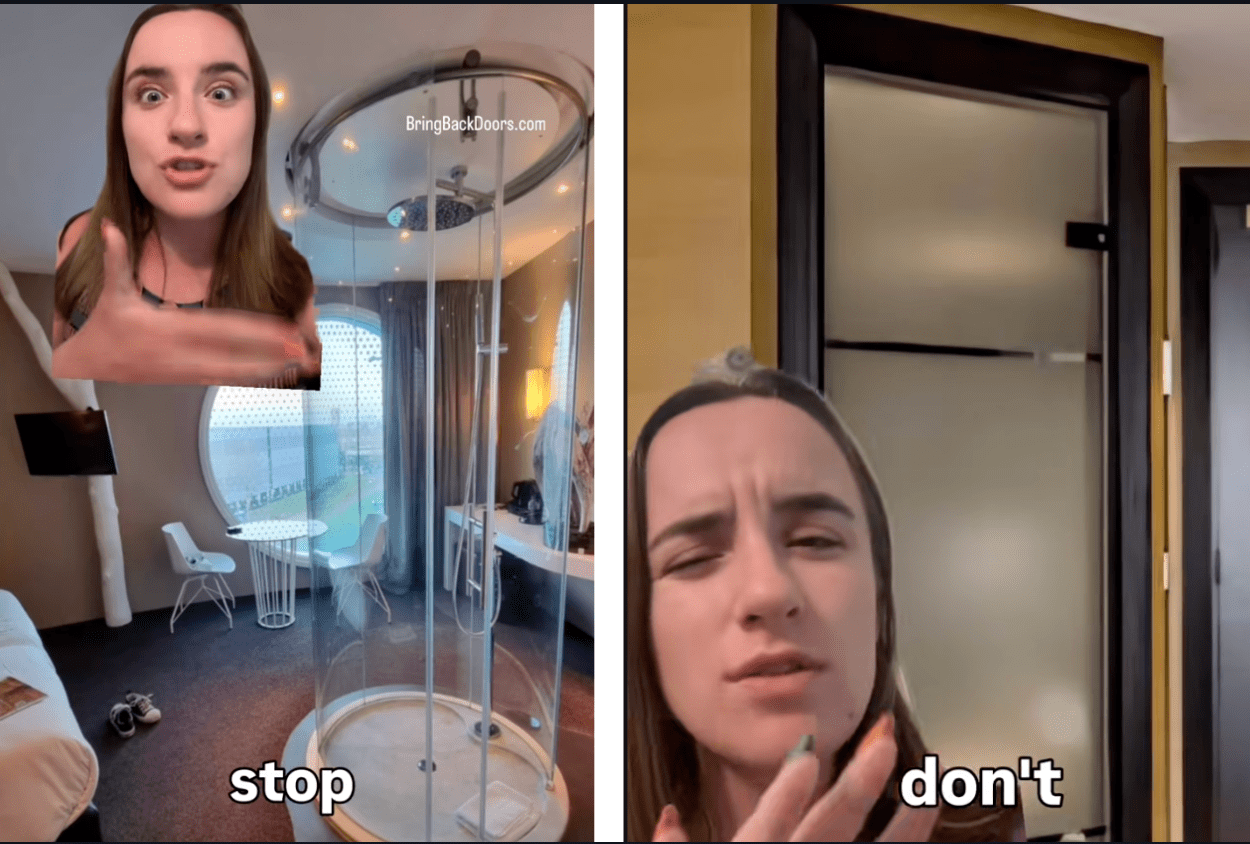
    One example that is getting attention is the bathroom doors in hotels… or the lack thereof, actually. One TikToker has had enough and has taken it upon herself to save regular bathroom doors in hotels and to point out why open-space bathrooms and glass doors just don’t cut it.

    On her @bring_back_doors TikTok account, Sadie has a collection of videos highlighting the flaws in hotel bathroom designs, with the most prominent being the lack of a regular door to the bathroom. In one viral TikTok, Sadie discussed a hotel that reached out to her, explaining that they have “foggy” glass doors to their bathroom to provide privacy. She was quick to point out that it still doesn’t provide adequate privacy. “Yes you can see through these,” Sadie said, adding that “glass doors do not close properly.”


    @bring_back_doors

    Hotel name: Alexander Hotel, Noordwijk aan Zee, Netherlands I need to be clear. Glass doors are not private. And making them foggy does not make them private. I am once again sitting here saying screw you to all bathroom doors that are not solid and close fully. And I am providing alternative hotels with guaranteed doors at bringbackdoors.com Check your hotels door situation before you book or risk your privacy. Door submitted by @mmargaridahb, DM me to submit your own bad doors. #bathroomdoors #hotel #travel #fyp Bathroom doors | bathroom design | hotel design | bad hotel design | travel fail | travel memories | travel inspo | door design | hotels with privacy

    ♬ original sound – Bring Back Bathroom Doors

    The comments rallied behind Sadie’s bathroom-door crusade

    The commenters joined in with Sadie, demanding the return of solid, closing, and lockable doors to bathrooms in hotels:

    “I HATE how hotels started thinking going to the bathroom is a shared experience.”

    “I hate how you can’t turn the bathroom light on without disturbing the other person in the room.”

    “The foggy ones are almost worse, you just get a hazy fleshy silhouette hunched over on the crapper like some kind of sack of ham.”

    “I just don’t get it, NOBODY wants this, even couples. I won’t be more likely to book two separate rooms for me and my friend/sibling/parent, I’ll just book another hotel.”

    “Love this campaign, I do not want a romantic weekend listening to the other person poo.”


    @bring_back_doors

    Hotel Names⬇️⬇️ Citizen M South Hotel (first pics) and Fletcher Hotel (third pic) both in Amsterdam. As part of this project, I’ve been emailing hotels around the world to put together an easy to reference list for people to find hotels with guaranteed doors at BringBackDoors.com And I did notice that in Amsterdam a lot of hotels were saying they don’t have doors. It wasn’t the worst city (that honor goes to Barcelona, so far I’ve only found TWO that have said yes to all doors), but it was still bad. Then I went into the comments. And kept getting people mentioning these hotels in Amsterdam. And I realized that clearly the city has a designer or architect on the loose who has a thing for test tubes. It’s horrible. Luckily, I was able to find 6 hotels in Amsterdam that all have bathroom doors in every room and have them all listed on BringBackDoors.com These hotels were submitted by so many people I couldn’t name them all. But to submit your own bad hotel bathroom send me a DM with hotel photo, name, and location! #hotel #bathroom #hoteldesignfail Bathroom doors | hotel bathrooms | hotel privacy | no privacy | travel problems | hotel issues | travel | hotel design | hotel design fail | hotel designers | design fail | hotel concept | bathrooms | Citizen M | Hotel Fletcher | Hotels in Amsterdam | Visit Amsterdam | Amsterdam

    ♬ original sound – Bring Back Bathroom Doors

    A great way to save a buck—er, I mean, ‘create a modern look’

    As many commenters asked, why do hotels have glass doors — or, worse, no doors at all—in their bathrooms? Well, this has been a growing trend in modern hotels over the past decade as a means to create a sleek aesthetic and to allow glass partitions to bring more daylight into otherwise darker sections of the room.

    At least that’s what’s being promoted to the customer. In reality, skimping on solid doors for glass ones or none at all gives the illusion that the room is bigger than it is while requiring fewer building materials. It does bring in more daylight, but mostly with the hope that you’ll cut down on electricity use for lights in an otherwise enclosed space. These reasons are also why some hotels don’t have solid walls around their bathroom areas at all.

    TikTok · Bring Back Doors

    TikTok u00b7 Bring Back Doors www.tiktok.com


    Tired of the lack of privacy? Check out the database

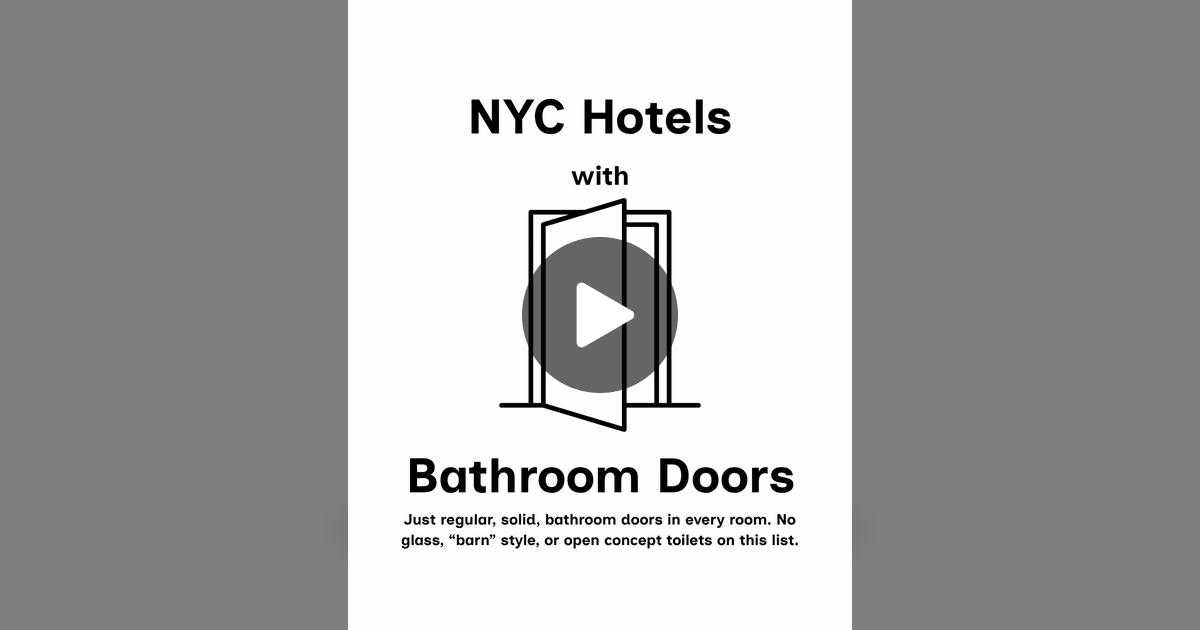
    To combat this trend, Sadie has developed a database at bringbackdoors.com for her and her followers to report which hotels have true, solid, private bathrooms in their accommodations and which ones do not, so people can properly plan where to stay and have true privacy during their most vulnerable moments.

    “I get it, you can save on material costs and make the room feel bigger, but what about my dignity?,” Sadie wrote on her website. “I can’t save that, when you don’t include a bathroom door.”

    Over time, the hope is that sanity and dignity can be restored as hotels realize that their glass “features” don’t have any real benefit when they don’t allow basic privacy.

  • MIT’s super-fast camera can capture light as it travels
    ArrayPhoto credit: assets.rebelmouse.io

    MIT’s super-fast camera can capture light as it travels

    It has a resolution rate of one frame per trillionth of a second.

    A camera developed at MIT can photograph a trillion frames per second. Compare that with a traditional movie camera which takes a mere 24. This new advancement in photographic technology has given scientists the ability to photograph the movement of the fastest thing in the Universe, light. In the video below, you’ll see experimental footage of light photons traveling 600-million-miles-per-hour through water.

    The actual event occurred in a nano second, but the camera has the ability to slow it down to twenty seconds. For some perspective, according to New York Times writer, John Markoff, “If a bullet were tracked in the same fashion moving through the same fluid, the resulting movie would last three years.”


    It’s impossible to directly record light so the camera takes millions of scans to recreate each image. The process has been called femto-photography and according to Andrea Velten, a researcher involved with the project, “There’s nothing in the universe that looks fast to this camera.”


    This article originally appeared seven years ago.

  • Kelsey Wells’ Side-By-Side Photos Prove That Weight Doesn’t Equal Health
    ArrayPhoto credit: assets.rebelmouse.io

    It’s super easy for most people to get hung up on the number on their scales and not how they actually look or, most importantly, feel. People often go on diets in hopes of reaching an ideal weight they had when they graduated high school or got married, but they’re often disappointed when they can’t attain it.

    But a set of photos by fitness blogger Kelsey Wells is a great reminder for everyone to put their scales back in storage. Welles is best known as the voice and body behind My Sweat Life, a blog she started after gaining weight during pregnancy. To lose the weight, she started the Bikini Body Guide (BBG) training program and after 84 weeks she shared three photos on her Instagram account that prove the scale doesn’t matter.

Explore More Design Stories

Design

People are cheering woman’s refusal to accept the latest trend in hotel bathrooms

Design

MIT’s super-fast camera can capture light as it travels

Articles

Kelsey Wells’ Side-By-Side Photos Prove That Weight Doesn’t Equal Health

Articles

No one noticed what this woman was staring at when they chose her for their label