

Imagine going to the hospital for a bacterial ear infection and hearing your doctor say, “We’re out of options.” It may sound dramatic, but antibiotic resistance is pushing that scenario closer to becoming reality for an increasing number of people. In 2016, a woman from Nevada died from a bacterial infection that was resistant to all 26 antibiotics that were available in the United States at that time.

The U.S. alone sees more than 2.8 million antibiotic-resistant illnesses each year. Globally, antimicrobial resistance is linked to nearly 5 million deaths annually.

Bacteria naturally evolve in ways that can make the drugs meant to kill them less effective. However, when antibiotics are overused or used improperly in medicine or agriculture, these pressures accelerate the process of resistance.

As resistant bacteria spread, lifesaving treatments face new complications – common infections become harder to treat, and routine surgeries become riskier. Slowing these threats to modern medicine requires not only responsible antibiotic use and good hygiene, but also awareness of how everyday actions influence resistance.

Since the inception of antibiotics in 1910 with the introduction of Salvarsan, a synthetic drug used to treat syphilis, scientists have been sounding the alarm about resistance. As a microbiologist and biochemist who studies antimicrobial resistance, I see four major trends that will shape how we as a society will confront antibiotic resistance in the coming decade.

1. Faster diagnostics are the new front line

For decades, treating bacterial infections has involved a lot of educated guesswork. When a very sick patient arrives at the hospital and clinicians don’t yet know the exact bacteria causing the illness, they often start with a broad-spectrum antibiotic. These drugs kill many different types of bacteria at once, which can be lifesaving — but they also expose a wide range of other bacteria in the body to antibiotics. While some bacteria are killed, the ones that remain continue to multiply and spread resistance genes between different bacterial species. That unnecessary exposure gives harmless or unrelated bacteria a chance to adapt and develop resistance.

In contrast, narrow-spectrum antibiotics target only a small group of bacteria. Clinicians typically prefer these types of antibiotics because they treat the infection without disturbing bacteria that are not involved in the infection. However, it can take several days to identify the exact bacteria causing the infection. During that waiting period, clinicians often feel they have no choice but to start broad-spectrum treatment – especially if the patient is seriously ill.

Amoxicillin is a commonly prescribed broad-spectrum antibiotic.
Amoxicillin is a commonly prescribed broad-spectrum antibiotic. TEK IMAGE/Science Photo Library via Getty Images

But new technology may fast-track identification of bacterial pathogens, allowing medical tests to be conducted right where the patient is instead of sending samples off-site and waiting a long time for answers. In addition, advances in genomic sequencing, microfluidics and artificial intelligence tools are making it possible to identify bacterial species and effective antibiotics to fight them in hours rather than days. Predictive tools can even anticipate resistance evolution.

For clinicians, better tests could help them make faster diagnoses and more effective treatment plans that won’t exacerbate resistance. For researchers, these tools point to an urgent need to integrate diagnostics with real-time surveillance networks capable of tracking resistance patterns as they emerge.

Diagnostics alone will not solve resistance, but they provide the precision, speed and early warning needed to stay ahead.

2. Expanding beyond traditional antibiotics

Antibiotics transformed medicine in the 20th century, but relying on them alone won’t carry humanity through the 21st. The pipeline of new antibiotics remains distressingly thin, and most drugs currently in development are structurally similar to existing antibiotics, potentially limiting their effectiveness.
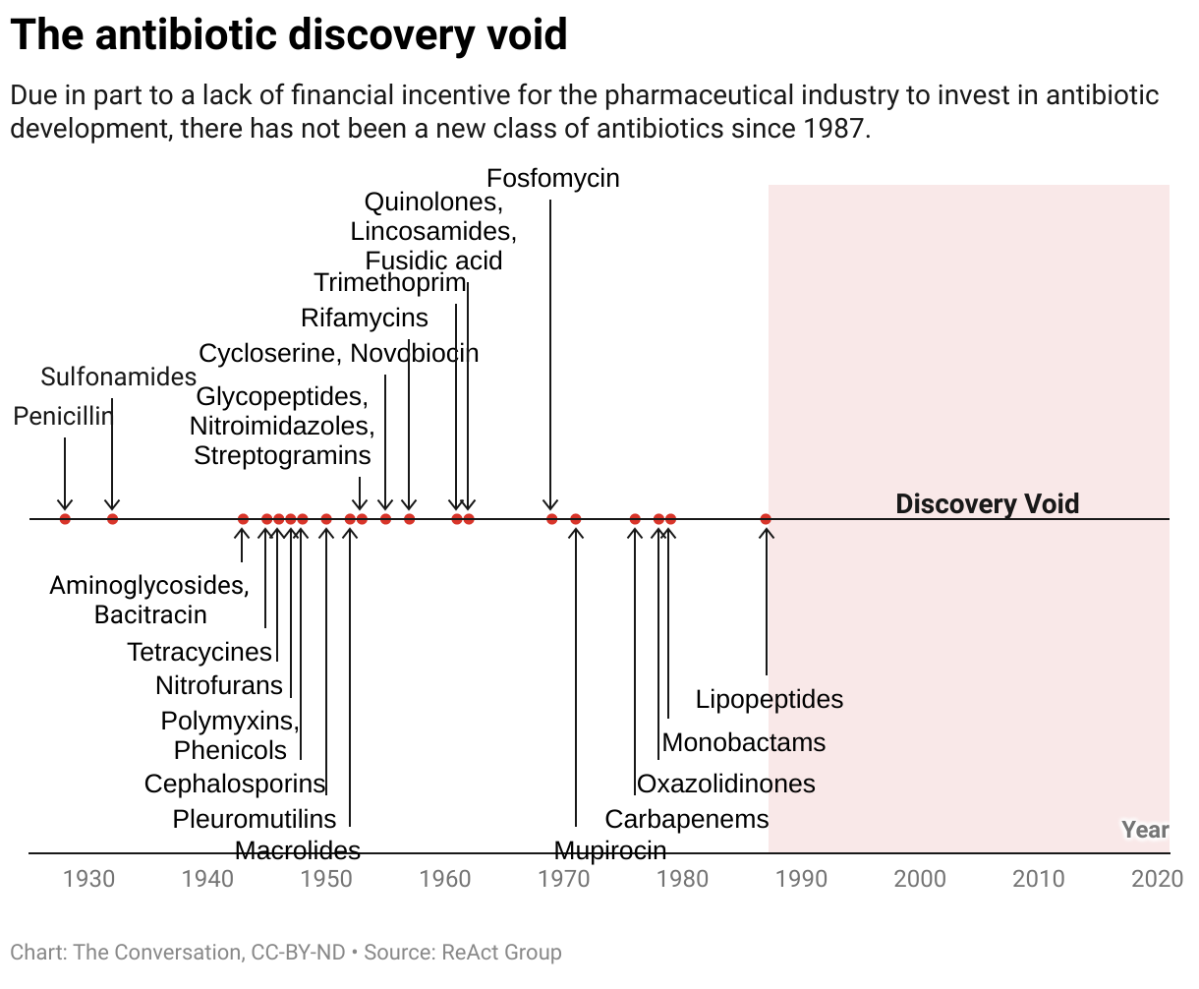
Chart: The Conversation, CC-BY-ND ReAct Group

To stay ahead, researchers are investing in nontraditional therapies, many of which work in fundamentally different ways than standard antibiotics.

One promising direction is bacteriophage therapy, which uses viruses that specifically infect and kill harmful bacteria. Others are exploring microbiome-based therapies that restore healthy bacterial communities to crowd out pathogens.

Researchers are also developing CRISPR-based antimicrobials, using gene-editing tools to precisely disable resistance genes. New compounds like antimicrobial peptides, which puncture the membranes of bacteria to kill them, show promise as next-generation drugs. Meanwhile, scientists are designing nanoparticle delivery systems to transport antimicrobials directly to infection sites with fewer side effects.

Beyond medicine, scientists are examining ecological interventions to reduce the movement of resistance genes through soil, wastewater and plastics, as well as through waterways and key environmental reservoirs.

Many of these options remain early-stage, and bacteria may eventually evolve around them. But these innovations reflect a powerful shift: Instead of betting on discovering a single antibiotic to address resistance, researchers are building a more diverse and resilient tool kit to fight antibiotic-resistant pathogenic bacteria.

3. Antimicrobial resistance outside hospitals

Antibiotic resistance doesn’t only spread in hospitals. It moves through people, wildlife, crops, wastewater, soil and global trade networks. This broader perspective that takes the principles of One Health into account is essential for understanding how resistance genes travel through ecosystems.

Researchers are increasingly recognizing environmental and agricultural factors as major drivers of resistance, on par with misuse of antibiotics in the clinic. These include how antibiotics used in animal agriculture can create resistant bacteria that spread to people; how resistance genes in wastewater can survive treatment systems and enter rivers and soil; and how farms, sewage plants and other environmental hot spots become hubs where resistance spreads quickly. Even global travel accelerates the movement of resistant bacteria across continents within hours.

Together, these forces show that antibiotic resistance isn’t just an issue for hospitals – it’s an ecological and societal problem. For researchers, this means designing solutions that cross disciplines, integrating microbiology, ecology, engineering, agriculture and public health.

4. Policies on what treatments exist in the future

Drug companies lose money developing new antibiotics. Because new antibiotics are used sparingly in order to preserve their effectiveness, companies often sell too few doses to recoup development costs even after the Food and Drug Administration approves the drugs. Several antibiotic companies have gone bankrupt for this reason.

To encourage antibiotic innovation, the U.S. is considering major policy changes like the PASTEUR Act. This bipartisan bill proposes creating a subscription-style payment model that would allow the federal government up to US$3 billion to pay drug manufacturers over five to 10 years for access to critical antibiotics instead of paying per pill.

Global health organizations, including Médecins Sans Frontières (Doctors Without Borders), caution that the bill should include stronger commitments to stewardship and equitable access.

Still, the bill represents one of the most significant policy proposals related to antimicrobial resistance in U.S. history and could determine what antibiotics exist in the future.

The future of antibiotic resistance

Antibiotic resistance is sometimes framed as an inevitable catastrophe. But I believe the reality is more hopeful: Society is entering an era of smarter diagnostics, innovative therapies, ecosystem-level strategies and policy reforms aimed at rebuilding the antibiotic pipeline in addition to addressing stewardship.

For the public, this means better tools and stronger systems of protection. For researchers and policymakers, it means collaborating in new ways.

The question now isn’t whether there are solutions to antibiotic resistance – it’s whether society will act fast enough to use them.

This article originally appeared on The Conversation. You can read it here.

  • Social media before bedtime wreaks havoc on our sleep − a sleep researcher explains why screens alone aren’t the main culprit
    Photo credit: Adam Hester/Tetra Images via Getty ImagesSocial media use before bedtime can be stimulating in ways that screen time alone is not.

    “Avoid screens before bed” is one of the most common pieces of sleep advice. But what if the real problem isn’t screen time − it’s the way we use social media at night?

    Sleep deprivation is one of the most widespread yet overlooked public health issues, especially among young adults and adolescents.

    Despite needing eight to 10 hours of sleep, most adolescents fall short, while nearly two-thirds of young adults regularly get less than the recommended seven to nine hours.

    Poor sleep isn’t just about feeling tired − it’s linked to worsened mental healthemotion regulationmemoryacademic performance and even increased risk for chronic illness and early mortality.

    At the same time, social media is nearly universal among young adults, with 84% using at least one platform daily. While research has long focused on screen time as the culprit for poor sleep, growing evidence suggests that how often people check social media − and how emotionally engaged they are − matters even more than how long they spend online.

    As a social psychologist and sleep researcher, I study how social behaviors, including social media habits, affect sleep and well-being. Sleep isn’t just an individual behavior; it’s shaped by our social environments and relationships.

    And one of the most common yet underestimated factors shaping modern sleep? How we engage with social media before bed.

    Emotional investment in social media

    Beyond simply measuring time spent on social media, researchers have started looking at how emotionally connected people feel to their social media use.

    Some studies suggest that the way people emotionally engage with social media may have a greater impact on sleep quality than the total time they spend online.

    In a 2024 study of 830 young adults, my colleagues and I examined how different types of social media engagement predicted sleep problems. We found that frequent social media visits and emotional investment were stronger predictors of poor sleep than total screen time. Additionally, presleep cognitive arousal and social comparison played a key role in linking social media engagement to sleep disruption, suggesting that social media’s effects on sleep extend beyond simple screen exposure.

    I believe these findings suggest that cutting screen time alone may not be enough − reducing how often people check social media and how emotionally connected they feel to it may be more effective in promoting healthier sleep habits.

    How social media disrupts sleep

    If you’ve ever struggled to fall asleep after scrolling through social media, it’s not just the screen keeping you awake. While blue light can delay melatonin productionmy team’s research and that of others suggests that the way people interact with social media may play an even bigger role in sleep disruption.

    Here are some of the biggest ways social media interferes with your sleep:

    • Presleep arousal: Doomscrolling and emotionally charged content on social media keeps your brain in a state of heightened alertness, making it harder to relax and fall asleep. Whether it’s political debates, distressing news or even exciting personal updates, emotionally stimulating content can trigger increased cognitive and physiological arousal that delays sleep onset.
    • Social comparison: Viewing idealized social media posts before bed can lead to upward social comparison, increasing stress and making it harder to sleep. People tend to compare themselves to highly curated versions of others’ lives − vacations, fitness progress, career milestones − which can lead to feelings of inadequacy and anxiety that disrupt sleep.
    • Habitual checking: Social media use after lights out is a strong predictor of poor sleep, as checking notifications and scrolling before bed can quickly become an automatic habit. Studies have shown that nighttime-specific social media use, especially after lights are out, is linked to shorter sleep duration, later bedtimes and lower sleep quality. This pattern reflects bedtime procrastination, where people delay sleep despite knowing it would be better for their health and well-being.
    • Fear of missing out, or FOMO: The urge to stay connected also keeps many people scrolling long past their intended bedtime, making sleep feel secondary to staying updated. Research shows that higher FOMO levels are linked to more frequent nighttime social media use and poorer sleep quality. The anticipation of new messages, posts or updates can create a sense of social pressure to stay online and reinforce the habit of delaying sleep.

    Taken together, these factors make social media more than just a passive distraction − it becomes an active barrier to restful sleep. In other words, that late-night scroll isn’t harmless − it’s quietly rewiring your sleep and well-being.

    How to use social media without sleep disruption

    You don’t need to quit social media, but restructuring how you engage with it at night could help. Research suggests that small behavioral changes to your bedtime routine can make a significant difference in sleep quality. I suggest trying these practical, evidence-backed strategies for improving your sleep:

    • Give your brain time to wind down: Avoid emotionally charged content 30 to 60 minutes before bed to help your mind relax and prepare for sleep.
    • Create separation between social media and sleep: Set your phone to “Do Not Disturb” or leave it outside the bedroom to avoid the temptation of late-night checking.
    • Reduce mindless scrolling: If you catch yourself endlessly refreshing, take a small, mindful pause and ask yourself: “Do I actually want to be on this app right now?”

    A brief moment of awareness can help break the habit loop.

    This article originally appeared on The Conversation. You can read it here.

  • It’s more than OK for kids to be bored − it’s good for them
    Photo credit: Richard Lewisohn/Connect Images via Getty ImagesWhen children experience boredom, it can result in a brain boost that can push them to explore new activities.

    Boredom is a common part of life, across time and around the world. That’s because boredom serves a useful purpose: It motivates people to pursue new goals and challenges.

    I’m a professor who studies communication and culture. I am currently writing a book about modern parenting, and I’ve noticed that many parents try to help their kids avoid boredom. They might see it as a negative emotion that they don’t want their children to experience. Or they might steer them into doing something that they see as more productive.

    There are various reasons they want to prevent their children from being bored. Many parents are busy with work. They’re stressed about money, child care responsibilities and managing other parts of daily life. Making sure a child is occupied with a game, a TV show or an arts and crafts project at home can help parents work uninterrupted, or make dinner, without their children complaining that they are bored.

    Parents may also feel pressure for their children to succeed, whether that means getting admitted to a selective school, or becoming a good athlete or an accomplished musician.

    Children also spend less time playing freely outside and more time participating in structured activities than they did a few decades ago.

    Easy access to screens has made it possible to avoid boredom more than ever before.

    Many parents needed to put their children in front of screens throughout the pandemic to keep them occupied during work hours. More recently, some parents have reported feeling social pressure to use screens to keep children quiet in public spaces.

    That is to say, there are various reasons why parents shy away from their kids being bored. But before striving to eliminate boredom completely, it’s important to know the benefits of boredom.

    A young girl with dark hair lays on her stomach on a couch with her arms and legs splayed out.
    Even very young children could benefit from experiencing boredom in short spurts. Oscar Wong/Moment via Getty Images

    Benefits of boredom

    Although boredom feels bad to experience in the moment, it offers real benefits for personal growth.

    Boredom is a signal that a change is needed, whether it be a change in scenery, activity or company. Psychologists have found that the experience of boredom can lead to discovering new goals and trying new activities.

    Harvard public and nonprofit leadership professor Arthur Brooks has found that boredom is necessary for reflection. Downtime leaves room to ask the big questions in life and find meaning.

    Children who are rarely bored could become adults who cannot cope with boredom. Boredom also offers a brain boost that can cultivate a child’s innate curiosity and creativity.

    Learning to manage boredom and other negative emotions is an important life skill. When children manage their own time, it can help them develop executive function, which includes the ability to set goals and make plans.

    The benefits of boredom make sense from an evolutionary perspective. Boredom is extremely common. It affects all ages, genders and cultures, and teens are especially prone to boredom. Natural selection favors traits that offer a leg up, so it is unlikely that boredom would be so prevalent if it did not deliver some advantages.

    Parents should be wary of treating boredom as a problem they must solve for their children. Psychologists have found that college students with overly involved parents suffer from more depression.

    Other research shows that young children who were given screens to help them calm down were less equipped to regulate their emotions as they got older.

    Boredom is uncomfortable

    Tolerating boredom is a skill that many children resist learning or do not have the opportunity to develop. Even many adults would rather shock themselves with electricity than experience boredom.

    It takes practice to learn how to handle boredom. Start with small doses of boredom and work up to longer stretches of unstructured time. Tips for parents include getting kids outside, suggesting a new game or recipe, or simply resting. Creating space for boredom means that there will be some stretches of time when nothing in particular is happening.

    Younger children might need ideas for what they could do when bored. Parents do not need to play with them every time they are bored, but offering suggestions is helpful. Even five minutes of boredom is a good start for the youngest children.

    Encouraging older children to solve the problem of boredom themselves is especially empowering. Let them know that boredom is a normal part of life even though it might feel unpleasant.

    It gets easier

    Children are adaptable.

    As children get used to occasional boredom, it will take them longer to become bored in the future. People find life less boring once they regularly experience boredom.

    Letting go of the obligation to keep children entertained could also help parents feel less stressed. Approximately 41% of parents in the U.S. said they “are so stressed they cannot function,” and 48% reported that “most days their stress is completely overwhelming,” according to a report from the U.S. surgeon general in 2024.

    So the next time a kid complains, “I’m bored!” don’t feel guilty or frustrated. Boredom is a healthy part of life. It prompts us to be self-directed, find new hobbies and take on new challenges.

    Let children know that a little boredom isn’t just OK – in fact, it’s good for them.

    This article originally appeared on The Conversation. You can read it here.

  • A dementia patient and his wife got their lives back thanks to a ‘coat rack-like’ robot
    Photo credit: Canva/Hello RobotStretch 4 could be one of many options for advanced senior care.

    Brenda and Brian Marquis are part of a growing senior population with mental and physical ailments. In particular, Brian has dementia from a brain injury he sustained in 2012. Brenda would help Brian remember to wash himself, eat lunch, and other tasks. On top of that, both live with other physical, cognitive, and emotional disabilities that make day-to-day living difficult. Then came “Robbie.”

    “Robbie” is the robot that helps the Marquis family with their daily routines at home. Resembling a coat rack, the robot was presented to the Marquis family after Brenda sent an email to the University of New Hampshire inquiring about robotic service dogs. Booker T. Bones, the family’s service dog, had passed away and Brenda was looking for similar support. The university saw this as an opportunity for its computer science center to experiment with “socially assistive” robots.

    “Our goal is not to replace a human caregiver but to use technology such as robots to provide complementary care,” Sajay Arthanat, a professor in UNH’s Department of Occupational Therapy told WMUR. “We know that caregivers often have to perform a lot of repetitive, mundane tasks.”

    What exactly is “Robbie”?

    “Robbie” is a Stretch 4 robot model invented by Hello Robot. While a very simple in design, the robot is able to help Brian with a number of tasks. It reminds him to eat meals at specific times, fetches items such as water bottles out of the fridge, reads the fine print of prescription medications, and more. Stretch 4 also has prompts that activate when he enters certain rooms of the home, such as the bathroom.

    “I was never into technology,” Brian Marquis said to Sentinel Colorado. “Then I realized I can’t remember to wash my face and my armpits. So, it just really kind of set me free almost.”

    Robbie hasn’t just helped Brian live more independently, but Brenda as well. She doesn’t have to be by Brian’s side 24/7. Now, she can go out and play mahjong with her friends without worrying about leaving Brian alone for several hours.

    A growing issue for older Americans

    Per the Department of Health and Human Services, the majority of older adults are projected to need long-term care and service. This could range from basic needs to extreme health cases. In addition, a 2025 report released by the Bureau of Labor Statistics found that 38.2 million people provided unpaid elder care. Around 28% of those people provided nearly four hours of unpaid elder care per day.

    The number of people who need such help is projected to grow exponentially. By 2030, the number of Americans over 65 is expected to surpass the number under 18 for the first time in U.S. history. The number of Americans over 65 years old is projected to reach 82 million, a 40% growth from 2022.

    This is, in part, why there has been such massive investment in robots and A.I. specializing in caring for elderly people. It’s not just to ensure that the elderly have the assistance they need for day-to-day tasks. Eldercare robots also boost their patient’s confidence by allowing them to live as safely and independently as they can. In addition to task-oriented robots like Stretch 4, there are also robots to assist with mobility.

    Robotics are helping improve the lives of the elderly as a new and exciting care option. With the help of medication, personal care from a human, community, and more, the growing elderly population can thrive through their golden years. For more eldercare resources, visit the National Institute on Aging.

    Whether through use of a robot or not, finding solutions to aid and care for our older populations ultimately benefits society as a whole.

Explore More Health Stories

Health

Social media before bedtime wreaks havoc on our sleep − a sleep researcher explains why screens alone aren’t the main culprit

Health

It’s more than OK for kids to be bored − it’s good for them

Care

A dementia patient and his wife got their lives back thanks to a ‘coat rack-like’ robot

Health

Who are hospital ethics consultants, and why should you care?