In September 1939, the Nazis invaded Poland. By April 1940, the gates closed on the Lodz Ghetto, the second largest in the country after Warsaw.
Throughout the war, over 210,000 people would be imprisoned in Lodz.
He photographed Nazi atrocities and buried the negatives. The unearthed images are unforgettable.
In September 1939, the Nazis invaded Poland. By April 1940, the gates closed on the Lodz Ghetto, the second largest in the country after Warsaw.
Throughout the war, over 210,000 people would be imprisoned in Lodz.
advertisement
From Thanksgiving dinner to Hollywood disasters, this bird’s name has quite a history.
Professor of English, Rutgers University – Newark
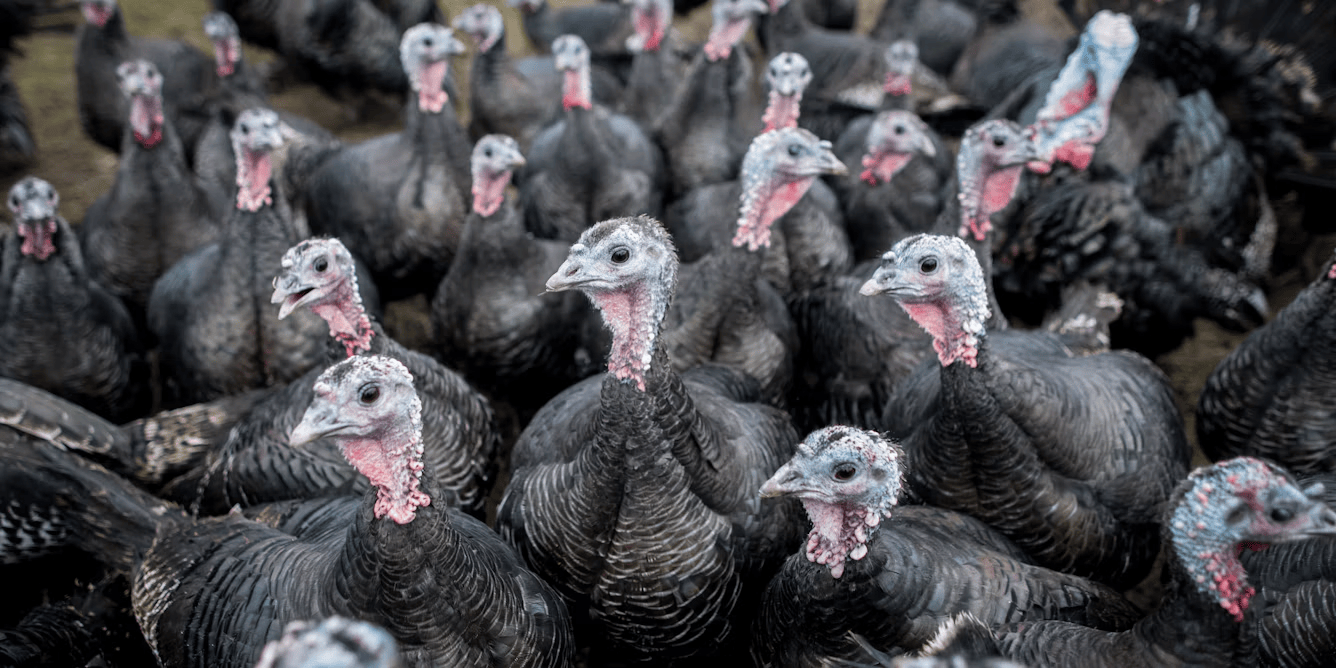
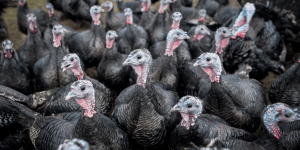
“Meleagris Gallopavo Day” is a bit of a mouthful. Which may be why this Thanksgiving, most people will opt for the less ornithologically precise “Turkey Day.”
And just as turkey is a versatile meat – think of those leftover options! – so too is the word “turkey,” which can refer to everything from the bird itself to a populous Eurasian country to movie flops.
As a scholar who studies word origins, I love “talking turkey” – not only how the bird came to be named, but also how the word has evolved over time. But let’s start with what has become the centerpiece of most Thanksgiving Day dinners.
The North American turkey – the kind that many families will be carving up this Thanksgiving – was being domesticated in Mexico some 2,000 years ago.
Europeans glimpsed their first turkeys around 1500, when Spanish explorers arrived in the Americas and brought them back to the mother country. By the 1520s, turkeys were being bred in Spain, and soon the delicacy was appearing on rich people’s tables across Europe.
But what to call the new import? Europeans in the New World were overwhelmed by the new plants and animals they saw, and often used familiar names for unfamiliar species. The Spanish, for instance, thought turkeys looked like peacocks, so they used the Spanish word “pavos.” The French called them “poules d’Indes,” or Indian chickens, later shortened to “dinde.”
To the English, the newly discovered American birds looked like the guineafowl – a bird native to Africa but which was introduced into Europe by Arab and Turkish traders in the 14th and 15th centuries.
And it is this point in the story that the modern-day turkey gets its name.
The Ottoman Empire was then at its height. Ethnic Turks, based in Constantinople (now Istanbul), ran the empire that spanned the Near East, Middle East and North Africa. As a result, to many Europeans, anyone from “the East” was a “Turk.”
Because Ottomans dominated trade in the eastern Mediterranean, a lot of produce coming to Europe was seen as “Turkish.” So a precious stone from Persia was named “Turkey stone,” and the French version of that name, “pierre turquoise,” gave us the word “turquoise.”
In the same way, African guineafowl, introduced by Turkish traders, became a “turkey-cock” or “turkey-hen.” Over time, this was shortened to just “turkey.”
For as long as the New World turkeys have been in Europe, they’ve been featured in celebratory meals. The English word first appears in print in an account of a banquet hosted by politician John Prideaux in 1555: The menu included 38 red deer, 43 pheasants, 50 quince pies, 63 swans, 114 pigeons, 120 rabbits, 840 larks, 325 gallons of Bordeaux wine and “Turkies 2. rated at 4s. a piece.”
History’s most famous turkey dinner, though, was served in Plymouth Plantation in 1621, as 50 Pilgrims who survived a year of brutal hardship joined 90 Native Americans for a three-day feast. Turkey wasn’t the only dish being served. Writing in his History of Plymouth Plantation, Governor William Bradford noted that Native Americans brought “codd, & bass, & other fish,” and others brought “water foule” and venison. But he was especially impressed with the “great store of wild Turkies.”
The bird has become so associated with harvest-time celebratory dinners that we’ve been calling Thanksgiving “Turkey Day” since at least 1870.
Meanwhile, the word has continued to find new uses, showing up with dozens of meanings. In 1839, the Southern Literary Messenger – a magazine edited by Edgar Allen Poe – reported on a new kind of dance, called the “turkey-trot” from its jerking motions.
In 1920, New York’s Department of Health reported that “Some addicts voluntarily stop taking opiates and ‘suffer it out’ … which in their slang is called taking ‘cold turkey.‘”
The turkey’s reputation for stupidity prompted other meanings. The legendary gossip columnist Walter Winchell told readers of Vanity Fair in 1927 about some new showbiz slang: “‘A turkey,’” he reported, “is a third rate production.”
Since then, movies that flop with the critics or at the box office have been called turkeys.
Another disparaging sense arrived in the 1950s, when turkey became a name for “a stupid, slow, inept, or otherwise worthless person.” That, in turn, probably led to the rise of the “jive turkey,” which first showed up in African American speech in the early 1970s, defined by slang lexicographer Jonathon Green as “an insincere, deceitful, dishonest person.”
And what about “talk turkey”? Well, that can mean quite contradictory things.
One dictionary from 1859 defines it as “To talk in a silly manner, talk nonsense.” A similar meaning is attached to another turkey-related word, “gobbledygook.”
Another definition found in the 1889 “Americanisms, Old & New” had “talking turkey” meaning “To use high-sounding words, when plain English would do equally well or better.”
The most familiar meaning of “talking turkey,” in which it is a stand-in for “straight talk,” is often said to come from a once popular joke. A white man and an American Indian, the story goes, spend a day hunting together and manage to bag a turkey and a somewhat less bountiful buzzard. The devious white man proposes a “heads-I-win-tails-you-lose” division of the spoils. “I’ll take the turkey, and you the buzzard,” he says, “or, if you prefer, you take the buzzard, and I’ll take the turkey.” The frustrated American Indian replies – usually in some version of would-be comic pidgin English – “You talk all buzzard to me, and don’t talk turkey.”
Those who study word histories are skeptical of stories like this, since most are invented after the fact. More likely, “talk turkey” came from pleasant conversation at Thanksgiving dinner, or maybe negotiations between Native Americans and European colonists over the cost of poultry. Whatever the origin, though, when we “talk turkey,” we’re engaging in the kind of straightforward, honest speech the scheming hunter denied his hunting partner.
This article originally appeared on The Conversation. You can read it here.Making a simple tumbler takes heat, teamwork and a surprising amount of science.
Lecturer of Art, Rochester Institute of Technology
Glass as a material is full of contradictions. Depending on the form and use, glass can be fragile or strong, opaque or transparent, rough or smooth. The studios my colleagues and I teach and learn in, as glass instructors, echo this abundance of physical opposites. These environments are simultaneously immersive, complex, seductive and demanding.
When the studio is in action, you might hear glass breaking, hot metal being quenched in water, glassblowing pipes rolling on the workbench rails, and some good tunes on the stereo. You might smell hot beeswax and burning newspaper. You might feel a bit of waste glass under your shoe or the intense heat from the furnaces and a breeze from a well-placed fan. Glassblowers learn to listen, to feel and to find some focus within and among the kinetic.
The constant stimuli of the glass studio may not seem anything like a sterile science lab, and yet glass artists need to accrue knowledge of physics and chemistry to achieve any kind of control with this dynamic material. They must choose a material with the desired properties and during the process judge factors such as heat and malleability.
At Rochester Institute of Technology, where I help run the glass program, we primarily use two types of glasses. In our hot glass studio we melt “soft” glass. This glass is specifically formulated to be melted in a furnace and used by the glassblower. It’s a combination of fine mesh silica sand, soda ash and lime, with small amounts of a few additional ingredients that keep the glass beautiful when it’s at its top temperature of 2,200 degrees Fahrenheit (1,204 degrees Celsius).
In our flameworking studio, we use a borosilicate glass. You might recognize this glass as the brand Pyrex made in Corning, New York. This is a super heat-resistant glass. It melts at a higher temperature than soft glass and arrives to our students in preformed rods that they can melt and shape by torch in our flameworking studio. The differences in chemistry really change how these glasses look and behave.

Glass, from a material science perspective, is categorized as an amorphous solid, meaning that glass’s molecules are arranged in a near-random pattern and there is no sharp melting point. Rather, glass gradually softens over a wide temperature range.
Once you’ve adjusted to the chaos of the studio, it’s time to start working.
We have two furnaces in our hot glass studio, where we work with soft glass, so anytime during the school year there is between 700 to 1,200 pounds of glass. It’s kept in the furnace at its molten state (2,200 degrees F or 1,204 degrees C), ready to be gathered and transformed.

When we work with the material, transforming it with tools and breath and heat, it needs to be kept in a workable heat zone – probably between 1,100 and 2,000 F (593 and 1,094 C). When the glass dips below that range, we perceive it as solid, though at the molecular level it is still dynamic and acting more like a liquid.
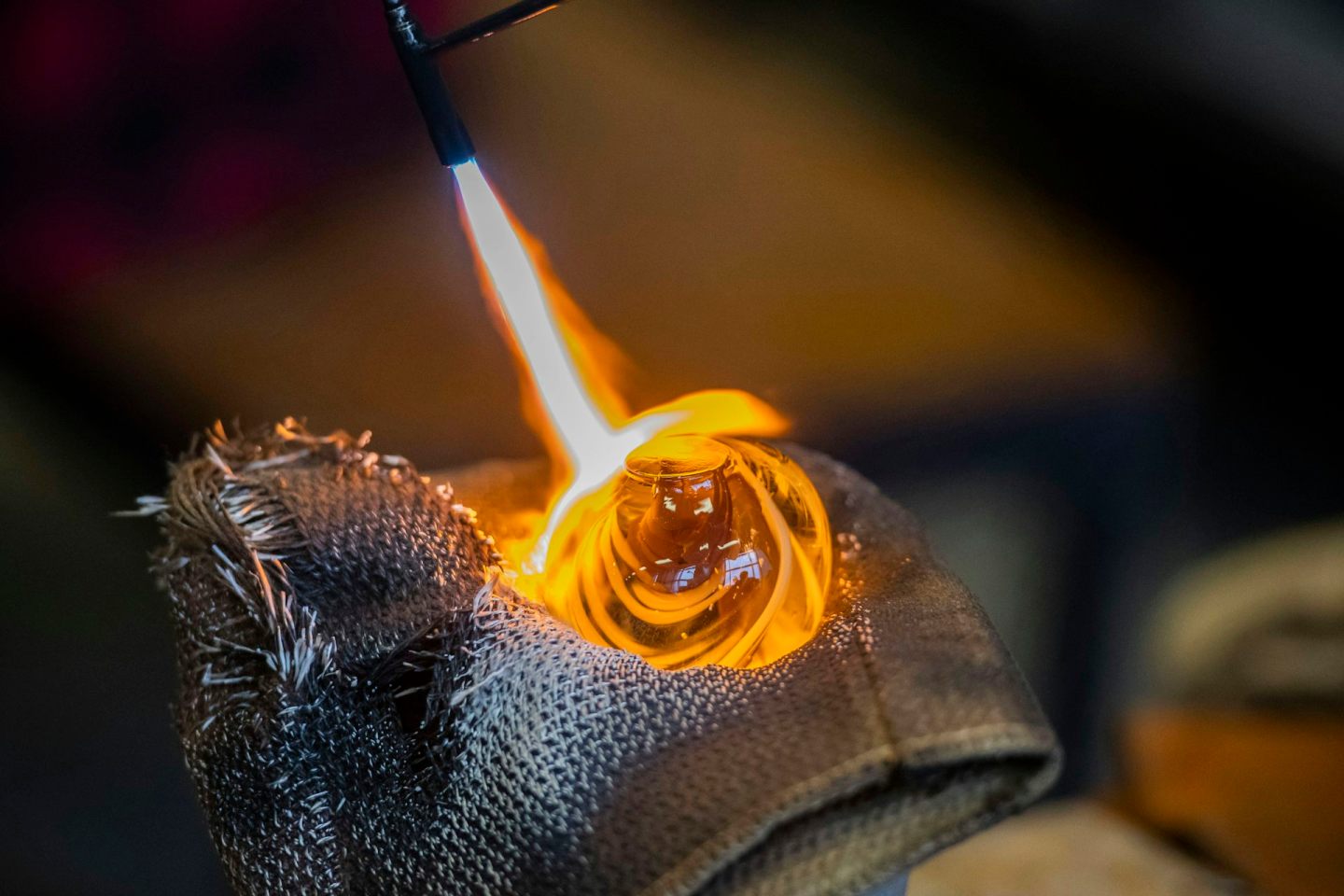
To make anything – a sculpture, a tumbler, a celestial magical orb or a pumpkin – you start by gathering glass out of the furnace on a metal rod. Once you’ve gathered your glass, you start making decisions.

You might ask yourself: What tools do I need to begin to shape and transform this glass into the object I have in mind? If you wait too long and the glass begins cooling down, you’ll need to reheat it to reintroduce malleability, allowing you to continue working it without breaking it.
A big part of glasswork is moving between the reheating chamber and the bench, where the artist uses tools to move and stretch the molten glass into the desired shape. You’ll need to alternate between these two stations many times.
Glassblowing is a team activity. I have physical and intellectual support from my colleagues: breath from their lungs, protection from the heat, additional bits of glass brought from the furnace to add to my object. We almost never work alone.
So, say I want to make a very basic clear tumbler. This is a simple conceptual object – utilitarian, domestic and intimate. It is also a tricky one to make well: too heavy and it feels bad in the hand, too thick at the lip and it dribbles when you drink, too thin at the bottom and it will break before it is complete.
Maybe I want to design it so it is slightly conical: wider at the bottom than the top, so it’s less likely to tip over. Maybe I want it to have a little indent for the user’s thumb as a gentle invitation to her hand. First I make my design: I draw it. I share it with my team so they can predict the process and the object’s needs. Then we begin.
I gather glass out of the furnace, let it cool a bit, then introduce a bubble in the glass by blowing into the pipe, the hollow rod that attaches to the object I’m making. I reheat, sit at the bench and begin to shape the glass using both gravity and the Jills, a cooling and shaping tool. The Jills is kind of like a large pair of tongs. It hasn’t changed much in design for 2,000 years.

I ask for some air from my teammate, and she blows into the pipe while I’m shaping the glass. The bubble transforms into a pill shape, slightly wider at the bottom. I constrict the area right in front of the pipe. I’m focusing on shape and heat, taking care to not let the glass get too cold. If the glass drops to about 1,000 F (538 C), it enters a danger zone. If it’s not yet finished, it needs to be warmed up in the reheating chamber; or if it is done, put away in a kiln to cool slowly.
If glass cools too quickly, the molecules freeze into a chaotic pattern, which causes stresses that result in fracture. To combat this volatility, when the glass object is done and ready to be cooled, we place the object in an annealer: a kiln set to a resting temperature of 930 F (500 C).
This temperature is like a Goldilocks zone for our glass: It’s not so hot that the glass will deform, but not so cool that the glass will stress and break. Once the kilns are full, a computer guide takes them down to room temperature over about 10 hours.
As I continue to work on my cup, I get more heat, focusing on the very end of the bubble – the part that will be the base of the cup. I then sit down and have another member of my team flatten the bottom with a wooden paddle while I tool the glass with the Jills to keep its shape. The cycle continues on and on.
The process is quick, but also there are so many little steps that it would take nearly a full-length book to describe them all. When asked how long it takes to make a tumbler, I’ll often answer, “About 10 years or 10 minutes, depending on how you think about time and material knowledge.” This is both glib and true. Glass demands attention, dedication and a willingness to make connections between physics and chemistry and your observable experiences. It is a highly challenging and equally rewarding material to work with and alongside. I count myself very lucky.
This article originally appeared on The Conversation. You can read it here.
Behind some unforgettable hauntings are memories of exploitation, violence and people whose stories official histories overlooked.
Professor of English, University of Maine
Along with the pumpkins and costumes, the candles and cobwebs, Halloween is all about storytelling. From tales of haunted houses to accounts of demonic possession, ghost stories are part of the holiday’s appeal.
As a professor at the University of Maine who specializes in ghost stories, I’ve thought a lot about what makes one unforgettable. My field research has taken me from the coast of Maine to the Amazon jungle, but some factors remain constant in an unforgettable tale.
One factor is what I call “creep value,” which includes the scare factor but also the elements of a story that might be simply unsettling or uncanny.
Take, for starters, the ghost of Catherine’s Hill along the Blacks Woods Road in Maine. The story warns that, against all intuition, even a lone driver at night must always stop and offer the phantom woman a ride. If not, as the story goes, she will appear when least expected in the back seat of the car to cause a fatal accident.
But there is more to account for than creep value in an unforgettable ghost story. These stories can keep alive the memory of a dark past. In my research I have come across tales that preserve memories of injustices that might otherwise have been forgotten.
One story, about a ghost ship that can be heard but never seen, preserves the little-known history of the smuggling of enslaved people.

The legend goes that on foggy nights, during the full moon, those standing at the Cooksey Drive Overlook in Seal Harbor, just outside Acadia National Park, can hear the slaves in the hold of a sinking ship crying for help.
The story goes back to the Pride of the Seas, a ship that smuggled enslaved Africans into the United States after the trans-Atlantic slave trade had been abolished but slavery remained legal. The account specifies that the smugglers scuttled the ship to evade the law. In ghost stories that circulate by word of mouth on Mount Desert Island, the screams of those left behind can still be heard.
Pennsylvania coal miners offer another example of past grievances passed down in the form of ghost stories. At the sites of deadly accidents, people have reported the sound of a pickaxe or the groans of a dying man. An extensive archive contains multiple accounts of coal miners witnessing ghostly knocking, disembodied voices and apparitions of mangled men. One story involves an innocent coal miner, condemned to death in 1877, who left a handprint in his cell at the Carbon County Jail that no amount of sanding or paint has been able to erase.
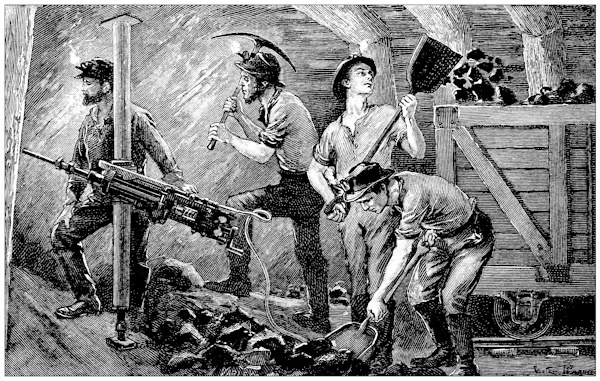
Today, it is widely known that coal miners of the 19th and early 20th centuries experienced ruthless exploitation and hazardous working conditions. Years ago, their plight went unrecognized in official histories and government policies, but ghost stories helped keep these experiences in the collective memory.
When I collected ghost stories in South America, the same pattern held true: Some tales preserved history that would otherwise be lost.
In the Amazon jungle of northern Brazil, I traveled to a gloomy site where people, over several generations, have claimed to see the spirits of young men in the murky water. These stories keep alive injustices from the 19th century involving enslavement of Indigenous people. The location was a former sugarcane plantation notorious for cruelty, and accounts of apparitions in the water are a reminder of this history.
In Rio de Janeiro a well-known ghost story involves the apparition of a young girl in a mansion known as the Castelinho do Flamengo. All the accounts of her story agree that this young heiress, named Maria de Lourdes Fernandes, witnessed the deaths of her parents; her guardian then locked her up and drove her to suicide to get her inheritance.
Her soul is said to remain in the mansion she tried to escape. The tale is not just about an individual tragedy but one that exposes inequities involving the mistreatment of juveniles and the corrupting influence of power.
Ghost stories don’t simply recount memories – they can revive them and bring the past back into the present.
The unsolved 1898 murder of a 52-year-old woman, Sarah Ware, in Bucksport, Maine, illustrates how ghost stories can have historical significance and flood the present with the past.
In the 1980s a woman and her daughter began having nightmares about a long-haired woman in a long dress struggling to rise from the bottom of a lake. When they realized they were having the same recurring dream, they partnered with an author, and their research led them to a conclusion that the apparition was the ghost of Ware.
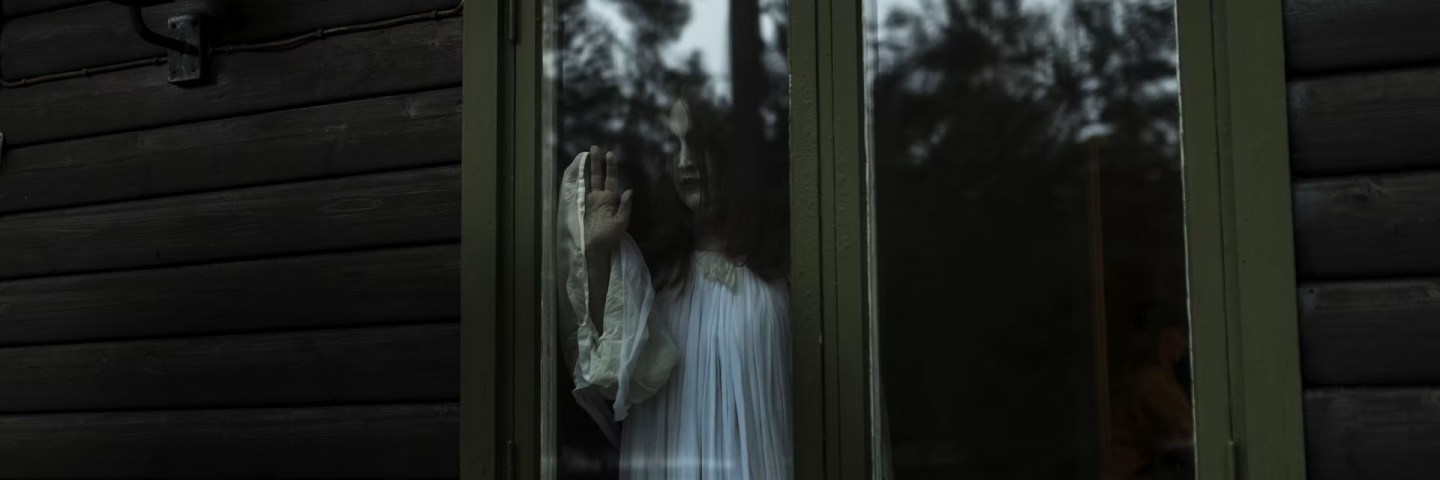
Official records document that when Ware’s body was recovered it was badly decomposed and her head had completely detached. Her head remained in the courthouse until the 1990s, when it was buried in Ware’s grave. According to local lore, however, Ware’s headless body is not in that grave but instead in her original grave, now located at the bottom of Silver Lake. In the oral history of the area, workers moved only the tombstones when they flooded the paupers’ graveyard – the cemetery for the poor – to make a reservoir in the 1930s.
Ware’s ghost is believed to have appeared again in 2006. When a young woman went scuba diving in Silver Lake in Bucksport, she reported seeing a woman in a long dress struggling to rise from the bottom of the lake. When she swam over to help, the figure’s hair floated back with the movement of the water to reveal she was a faceless apparition. The sighting of the faceless ghost revived the history of the unsolved murder all over again.
Ware’s case highlights the violence and injustice and their connection to gender and social class in 19th-century Maine. Missing evidence and recanted testimonies suggest that powerful men might have interfered with the investigation to hide their own complicity in the murder. As an independent woman of the time, Ware was the subject of gossip, and the treatment of her body shows how social class affects even the honoring of the dead. As a ghost story, the history of Sarah Ware is not past but rather part of the here and now.
So when you’re out and about telling ghost stories this Halloween, remember that the unforgettable ones are all about creep value in the context of a dark history that flows back in again like the tide.
This article originally appeared on The Conversation. You can read it here.advertisement
By subscribing, you accept beehiiv's Terms of Use & Privacy Policy. Our site's Privacy Policy applies.
Advertisement