

magine being asked to sit alone in a quiet room for 15 minutes with nothing to do – no phone, no music, no external distraction. In a well-known 2014 study, many participants found that task so challenging that they chose to press a button to give themselves an unpleasant electric shock instead of continuing to sit with their thoughts and sensations.

Because being with their own thoughts, emotions and bodily sensations can be so difficult, people often turn away from them. Smartphones offer constant distraction from boredom or stress, allowing users to disengage from their present-moment sensations and thoughts with a quick swipe or tap.

But avoiding unpleasant internal experience can backfire. Studies show that doing so is associated with a range of mental health problems, including anxiety and depression.

We are psychological scientists who study mindfulness and how it affects stress, health and well-being.

Mindfulness is a mental state that people can learn to cultivate through training. When people are mindful, they direct their attention toward their moment-to-moment bodily sensations, emotions and thoughts, and they meet those experiences with an attitude of curiosity and open acceptance.

Mindfulness can be cultivated through “mindful moments” in daily life, moments in which people intentionally stay present with what they do, hear, see or feel. However, formal mindfulness meditation involves sustained practice that systematically trains attention and acceptance. Our research shows that training acceptance during mindfulness meditation can substantially improve your emotional well-being.

Tuning into experience can be hard – and helpful

Popular culture often portrays mindfulness as a way of relaxing. But we’ve found that mindfulness practice can often feel surprisingly difficult. In one of our studies, participants who directed their attention to their thoughts and feelings during a 20-minute mindfulness meditation noticed six times more unpleasant experiences than pleasant ones.

This doesn’t mean they were doing it wrong. Turning your attention inward can feel challenging. Often, it brings you into contact with experiences that you normally try to push away, such as feeling bored, uncomfortable or agitated. However, we’ve also found that facing difficult experiences during mindfulness training can have positive effects.

In particular, adopting an accepting attitude toward your experiences seems to drive many of the positive effects of mindfulness. Our research shows that developing the capacity for acceptance through mindfulness meditation can reduce feelings of loneliness and increase positive emotions, such as happiness. It also reduces stress hormones and helps people notice more positive experiences during stressful situations.

In these studies, we have found that acceptance is the critical driver. When acceptance is removed from mindfulness training, these benefits largely disappear.

The power of learning to accept experience

A key part of mindfulness practice involves turning toward difficult experiences, such as like stress, boredom and pain, rather than seeking distractions or pushing those experiences away. It means noticing feelings and thoughts as they arise, sensing how they show up in the body, and approaching them with an attitude of acceptance rather than judgment or resistance.

A helpful way to think about this comes from the “two arrows” metaphor, which is rooted in East Asian Buddhist traditions. It teaches that there are two types of suffering, which can be likened to being struck by two arrows.

The first arrow is the unavoidable unpleasant experience that comes with being human – for example, feeling exhausted after a poor night’s sleep. The second arrow is how we react to that unpleasantness: tensing up, resisting it, replaying it in our mind, criticizing ourselves or trying to escape it. Often this second arrow adds more suffering than the original unpleasant experience.

In mindfulness practice, the goal is not to stop having unpleasant sensations and feelings. Instead, mindfulness helps people accept the unavoidable difficulties of that first arrow and to soften the second arrow by letting go of struggle with those experiences and reactions that make them worse.

For example, let yourself feel bored without immediately reaching for distraction. Acknowledge anxiety, sadness or grief with openness, instead of trying to suppress those feelings or fueling them with harsh self-criticism.

Practicing mindfulness in everyday life

One way to cultivate this attitude is to treat thoughts, emotions and sensations as guests in your inner landscape. Instead of fighting them or clinging to them, notice when they arise. Acknowledge and welcome them, and when they naturally change, let them go. Some people find it helpful to imagine holding a difficult feeling as they would a crying baby, with a touch that’s steady, supportive and kind.

If you want to try this in daily life, the next time you feel a challenging experience, pause and open to the experience for a moment. Notice what you are feeling. Where does it show up in your body – a tightness in the chest or heaviness in the stomach? Can you allow it to be there, even briefly, without trying to fix it or distract yourself from it?
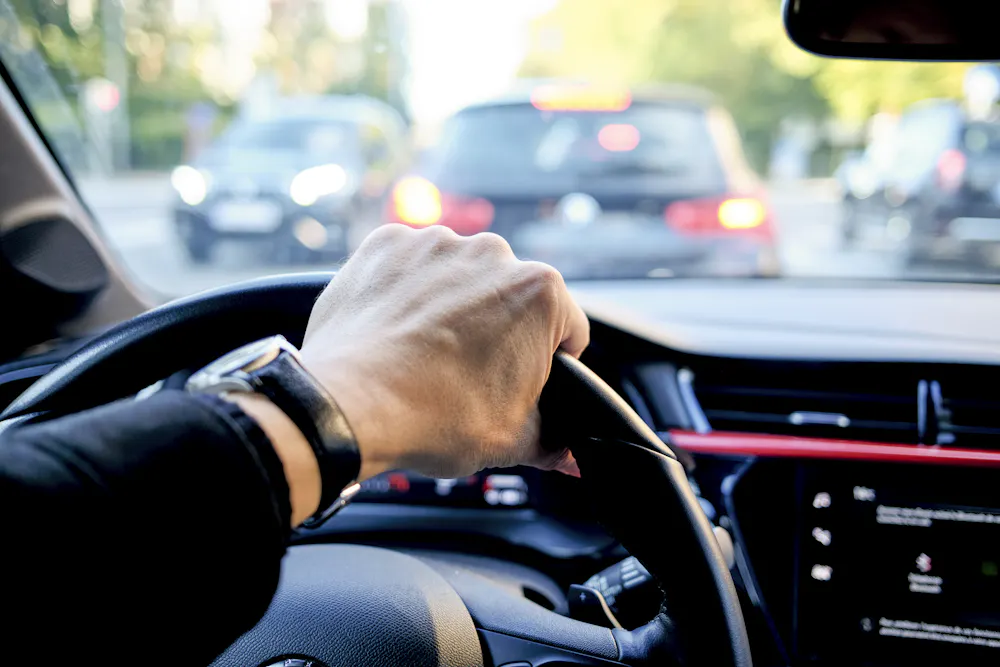
A driver's hand tightly grips a steering wheel with traffic visible ahead.
Mindfulness means acknowledging and accepting challenging feelings, such as stress and frustration from unexpected delays. LB Studios/Connect Images via Getty Images

Then observe what happens. Does the challenging experience change over time in any way? Do your reactions shift or soften with repeated practice? Remember that a brief practice is unlikely to produce instant relief, and expecting quick results can actually make it harder to stay open to your experience as it is.

Rather, our findings suggest that meaningful change comes through consistent, ongoing practice. Every small step matters. Over time, brief moments of responding to stress or discomfort with mindfulness can reshape how you relate to challenges and provide greater resilience and ease.

In the study where people chose electric shocks over sitting alone with their thoughts, being with their inner experience felt almost intolerable. Mindfulness offers a different path: not escaping that experience but learning to stay with it. In doing so, what once felt unbearable can become something you can meet with greater emotional balance and well-being.

This article originally appeared on The Conversation. You can read it here.

  • A pet‑friendly homeless shelter pilot reduced the rate of homelessness among the people it helped in California
    Photo credit: Mario Tama/Getty Images A homeless woman in Los Angeles holds her dog after a free veterinary visit in 2024.
    ,

    A pet‑friendly homeless shelter pilot reduced the rate of homelessness among the people it helped in California

    A California program suggests pets can play a bigger role in helping people find stability.

    When homeless shelters allow people to stay with their dogs and other pets, more unhoused people become more willing to stay in a shelter.

    That’s what my team at the University of Southern California’s Homelessness Policy Research Institute learned when we evaluated California’s Pet Assistance and Support Program.

    California’s Department of Housing and Community Development established this pilot program in 2019. Its goals were straightforward: to make homeless shelters more accommodating to people with pets – mostly dogs – so that people living on the streets don’t have to choose between staying in shelters or abandoning their pets.

    The program disbursed US$15.75 million between 2020 and 2024 to 37 organizations across the state. The funding allowed shelters to build kennels or other pet-friendly spaces, provide pet food and supplies, and offer basic veterinary care. It also covered the costs of staffing and maintaining insurance required to operate pet-friendly shelters.

    Evaluating the program

    We did this evaluation in collaboration with My Dog Is My Home, a nonprofit that supports pet-inclusive housing and services for the homeless, and the American Society for the Prevention of Cruelty to Animals.

    By all accounts, the program was a success.

    We found that the program helped 4,407 people experiencing homelessness keep their pets while getting support. Many were able to enter shelters, and their animals received needed veterinary care. A total of 886 people ultimately moved into permanent housing with their pets – a higher success rate than the statewide average for homeless people in California.

    Theoretically, this funding should have reduced the number of pet owners living on the streets. Yet since 2019, the year the program began, the number of homeless people in Los Angeles with dogs and other pets has increased.

    A homeless man walks a dog toward a group of tents lining a sidewalk.
    A homeless man walks a dog toward a group of tents lining a Los Angeles sidewalk in 2026. Qian Weizhong/VCG via Getty Images

    I’ve seen this change firsthand.

    Since 2017, I’ve led the USC research team that produces the annual homeless count estimates for Los Angeles. The U.S. Department of Housing and Urban Development requires this exercise for any city seeking federal funding for homelessness services.

    One of the questions my team asks when interviewing thousands of homeless people each year is whether they have any pets.

    Before the pandemic, we generally found that roughly 1 in 8 people did. We also found that nearly half of homeless pet owners had been turned away from a homeless shelter because it couldn’t accommodate their animal.

    Despite programs like California’s Pet Assistance and Support program, my research team has found that the share of people living on the streets of Los Angeles who say they have a pet increased to roughly 1 in 5 by 2025.

    Need for more pet-friendly programs

    We still don’t know why the share of homeless people with pets has gotten so much larger.

    It could be that rising housing costs, which is the main driver of homelessness, is pushing more pet owners into homelessness. Or, perhaps more homeless are adopting pets to deal with their social isolation and loneliness, two common conditions for people with nowhere to go.

    An apartment building with a rectangular green space is shown.
    The Weingart Tower, where some of Los Angeles’ formerly homeless people reside and receive social services, has a small dog park. Grace Hie Yoon/Anadolu via Getty Images

    Either way, proposed cuts by the federal government to affordable housing and homeless services will only make matters worse.

    The number of homeless people in Los Angeles has fallen by more than 4% since 2023 to just over 72,000 people in 2025. But based on my research findings, I would expect the number of people living on the city’s streets – with and without pets – to rise over time unless more affordable housing becomes available.

    And growth in the homeless population may be hard to avoid without more efforts like California’s Pet Assistance and Support Program – on a larger scale than the pilot we studied.

    This article originally appeared on The Conversation. You can read it here.

  • ‘Eternal Loop’ question asks how you’d spend eternity if you could only do one thing over and over
    Photo credit: Canva(Left) Woman enjoys a beautiful sunset and (Right) a woman looks in the mirror.

    What if you were stuck in a time loop of doing the same thing over and over again for eternity? What would you want that thing you’re doing to be? This idea was posed by @jaredraygilmore on his Instagram. Jared Ray Gilmore suggests this question is a quick and easy way to get to know a person on a date, in work relationships, and even with friends.

    He believes the answer provides a lot of information about both a person’s value system and the things they don’t like. As thousands of people shared their responses, what flooded back suggests a seemingly harmless question quickly shifts once you actually imagine living it.

    Frederick Nietzsche’s philosophical thought experiment

    The premise offered by Gilmore holds deep and powerful roots in historical philosophy. Friedrich Nietzsche was a 19th-century German philosopher who shared profound critiques about morality, individualism, God, and conventional values.

    In his book The Gay Science, Nietzsche proposed the idea that a person’s entire life could repeat infinitely, playing out the same way each time. This thought experiment, called “eternal recurrence,” he considered a metaphysical fact and one of his most important philosophical discoveries.

    eternal recurrence, Frederick Nietzsche, infinity, thought experiment, metaphysical
    A repetition of self.
    Photo credit Canva

    People ponder positive memories versus living an undeniable nightmare

    As people began to share their own thoughts about Gilmore’s proposed topic, many comments reflected pleasant nostalgia and appreciation for life’s simple loves.

    “First thing that came to mind was having breakfast with my husband in our breakfast nook, the side window open for the cat, and the dog resting at our feet.”

    “Garden, I’d be in the garden. Spring, Summer, Autumn, Winter, repeat.”

    “Going to the beach and enjoying the waves, laughing with my fiance and friends”

    “Have deep conversation with people that are making groundbreaking advancement in their field of passion.”

    Yet, others rejected the premise immediately and found the whole idea somewhat horrifying.

    “Whatever you’re choosing, even if that’s THE thing you’re absolutely fan of, is gonna be an absolute nightmare to do at one point.”

    “pushing a rock up a hill”

    “I’m legitimately at a loss for what would be my ideal loop because everything that comes to mind scares me a bit.”

    “This would be just hell to me as a person with ADHD. I love my hobbies but I could never do one on a loop for eternity.”

    daily routines, variation, predictable patterns, lack of meaning
    Daily routines.
    Photo credit Canva

    The paradox of routine vs variation

    People rely heavily on routines because they offer stability. A 2025 study in Springer Nature Link found that individuals use routines to gain more than pleasure. The small sense of control over their lives creates a comforting predictability for what to expect during the course of a day. Repetitive behavior reduces cognitive workload.

    A 2024 article in WebMD revealed that routines create structure, reduce stress, and improve mood. A lack of routine generates more behavioral and emotional difficulties. Giving the brain predictable patterns reduces fatigue from daily decision-making.

    However, people find the idea of living even a perfect day over and over, difficult. A 2025 study in Sage Journals showed that repeating the same day yields feelings of boredom and a lack of meaning. An eternal loop doesn’t feel infinite. A repeated experience will eventually collapse into a dull distortion of time.

    self-reflection, life significance, therapy, self identification
    Self-reflection.
    Photo credit Canva

    The value of thought experiments like the “eternal loop”

    Hypothetical questions can be interesting to explore. Especially when they’re big, existential questions about life and the universe. A 2025 study in Frontiers showed people like to think about meaning in life and feeling influential. However, it was difficult to measure whether a person felt their life was actually significant.

    A 2024 study in the National Library of Medicine found existential questions about life, purpose, and death are considered important. This was consistent whether people found them uncomfortable or helpful.

    Gilmore’s “eternal loop” question rapidly split responses. While some imagined it comforting, others found it unsettling. Science demonstrates that routines are beneficial, but people adapt quickly to repeated experiences. Something that feels great at first can eventually lose its meaning. At the same time, studies show that existential questions like this can help people identify what matters most to them.

  • Controversy over Reese’s ingredients reveals standard food industry practices most consumers never notice
    Photo credit: Garrett Aitken/iStock/Getty Images Plus via Getty Images A ‘triangle test’ involves mixing up two of the original products with one of the new reformulation – or vice versa – to see whether taste testers notice the difference.

    Controversy over Reese’s ingredients reveals standard food industry practices most consumers never notice

    A family fight over Reese’s ingredients reveals how often food companies quietly change recipes.

    Springtime in Pennsylvania is peanut butter egg season. This year some consumers may taste the eggs a bit more critically and scrutinize the ingredients and label more carefully.

    Reese’s, a Hershey brand, is known for combining chocolate and peanut butter in delicious and iconic ways. Reese’s products come in a variety of formats, called “line extensions.” These include everything from peanut butter chips for baking and chocolate peanut butter popcorn for snacking to limited-time offers for holidays – such as the popular Reese’s Peanut Butter Eggs for Easter.

    On Feb. 14, 2026, Brad Reese, grandson of the founder, issued an open letter criticizing the Hershey Company for introducing line extensions – in this case, mini hearts for Valentine’s Day, with the flavors familiar to Reese’s lovers but made with cheaper ingredients, such as “chocolate candy” and “peanut butter creme.”

    Ingredients like these seem similar but do not meet the FDA standards of identity for milk chocolate and peanut butter, the key components of the original Reese’s cups. For example, the FDA standard for milk chocolate requires at least 10% chocolate liquor.

    Hershey responded in a statement: “As we’ve grown and expanded the Reese’s product line, we make product recipe adjustments that allow us to make new shapes, sizes and innovations that Reese’s fans have come to love and ask for, while always protecting the essence of what makes Reese’s unique and special: the perfect combination of chocolate and peanut butter.”

    I am a certified research chef and food and hospitality professor in Philadelphia, where I founded the Drexel Food Lab, a culinary innovation and food product development lab. I am also a huge fan of Reese’s Peanut Butter Cups. When my older daughter was a toddler, learning her colors and shapes, I trained her to organize her trick-or-treat loot by separating the orange squares for dad.

    As someone with decades of experience in product formulation, I am not surprised that the ingredients for some Reese’s products have changed over the years. One of my first jobs as an intern in corporate R&D was formulating cost reductions for existing products and later developing cost-effective line extensions building on the brand equity of the original product. What Hershey is doing with the Reese’s brand is Consumer Packaged Goods Marketing 101.

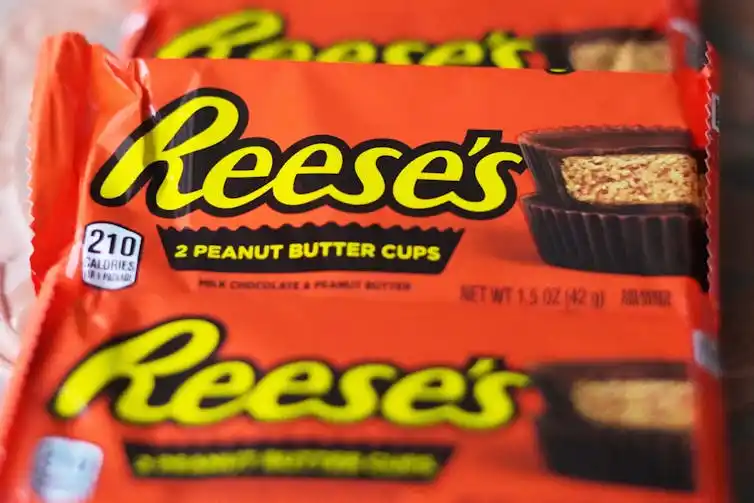
    Three wrapped packages of Reese's peanut butter cups
    Reese’s recently introduced some variations of its classic peanut butter cups that use ‘chocolate candy’ compound coatings and ‘peanut butter creme’ instead of real chocolate and peanut butter. AP Photo/Gene J. Puskar

    How food manufacturers deal with rising costs

    Much has changed in the marketplace since Reese’s Peanut Butter Cups were developed by H.B. Reese in 1928 in Hershey, Pennsylvania, about two hours northwest of Philadelphia.

    Inflation, tariffs, labor costs, fuel costs, employee benefits, competition and the vulnerability of climate-threatened crops, such as cacaovanilla and sugar – none of which are produced anywhere near Pennsylvania – have made the confectionery business increasingly challenging.

    When faced with rising costs, food manufacturers have three options:

    1. Shrink the product. Reese’s Peanut Butter Cups have gradually shrunk from 0.9 ounce in the 1980s to 0.75 ounce today. That’s a 17% reduction. This phenomenon has been dubbed “shrinkflation.”

    2. Raise prices. There is certainly a market for premium peanut butter cups, but how much will a consumer pay for the Reese’s brand? $5? $10? I suspect most consumers expect a single serving to be a couple of bucks at most.

    3. Lower costs. While the company can improve operational efficiencies, changing the formula to reduce or eliminate high-cost ingredients is a standard industry practice to keep prices consistent for consumers in the midst of a dynamic supply chain. This phenomenon has been dubbed “skimpflation” and is Brad Reese’s main complaint.

    Reformulations are common in the food industry. In addition to prices rising in general, a supplier could go out of business or have a shortage. A regulatory change or shift in consumer sentiment might prohibit the use of an ingredient. Warstariffs or climate change can raise costs temporarily or permanently.

    Reformulations can be done well

    Sensory and food science tools that we teach in our Drexel culinary and food science programs help ensure little market disruption and a consumer mostly unaware of the changes.

    For example, a consumer discrimination test that food product developers love is a called the triangle test. Two samples from the original formula and one sample from the new formula – or vice versa – are presented to the consumer. If the consumer can identify the different one, the product developer did a poor job in preserving the beloved brand through the reformulation. But if consumers can’t tell the difference, the reformulation may be able to move forward.

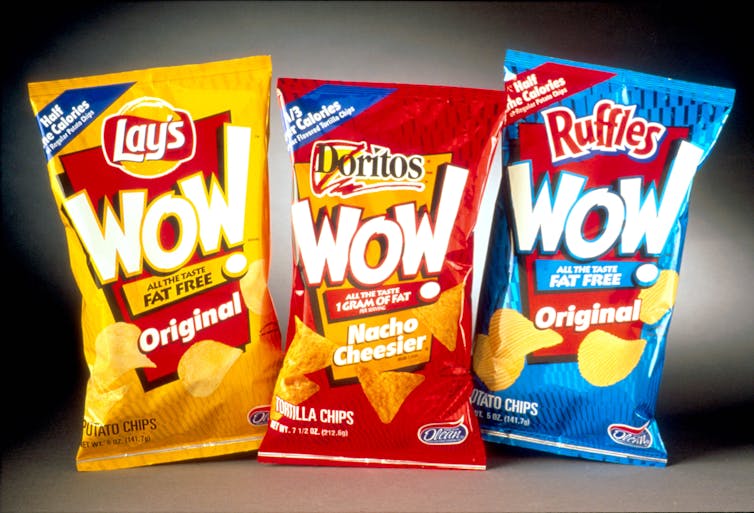
    Three bags of chips -- Lay's potato chips, Doritos and Ruffles potato chips
    In 1998, Frito-Lay reformulated some of its signature products using a synthetic fat called olestra – with the brand name Olean – that could cause unpleasant side effects, including anal oil leakage. John T. Barr/Hulton Archive via Getty Images

    Sometimes product developers get it wrong in introducing a new formulation. Some of us are old enough to remember Crystal Pepsi, the McLean Deluxe burger or Doritos made with olestra. These products failed, respectively, due to lack of defined consumer benefit, misalignment with the brand, and bad press due to digestive side effects.

    But most reformulations go unnoticed – the good work of food technologists who strive to keep food safe, affordable and delicious for consumers.

    So, are these new Reese’s products inferior to the original? Maybe. Like with taste in art or wine, if it tastes good to you, it’s good. If not, vote with your wallet, or send the company a note like Brad Reese did.

    This article originally appeared on The Conversation. You can read it here.

Explore More Well-being Stories

Well-being

Happiness expert’s refreshing take that the best friendships are useless

Well-being

She was afraid that becoming paralyzed would end her marriage. He refused to leave.

Well-being

Can’t stop endlessly scrolling? Tips to help you take back control

Health

I’m a philosopher who tries to see the best in others – but I know there are limits