

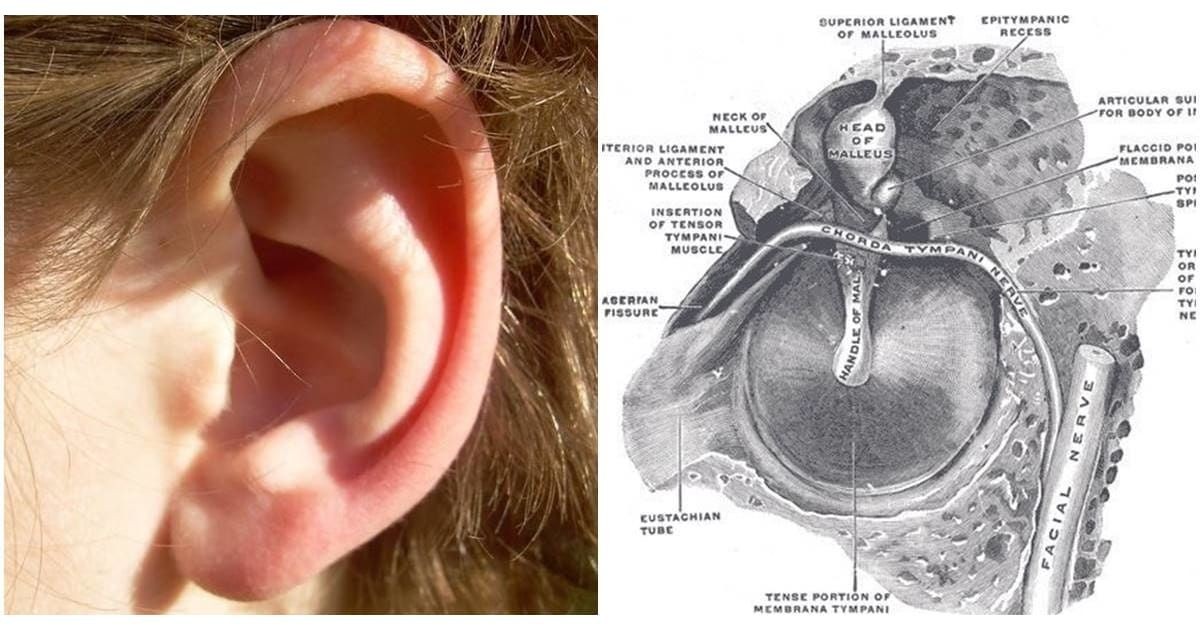
There are no two human beings who are exactly alike. One of the funny quirks of evolution is that some of us can do things with our bodies we think are routine but are impossible for others. Some people can wiggle their ears, others can’t. Some can wiggle their nose like Samantha from “Bewitched” while others just look really silly when making an attempt.

Not everyone can lick their elbow but most wouldn’t attempt to do so in public.

A Twitter user named Massimo dropped some knowledge last month about a skill that not everyone has and even fewer discuss: ear rumbling.

Those of us who can do it know exactly what it is, while it’s a mystery to those who cannot.

People who can ear rumble have the ability to control the tensor tympani, a muscle within the ear. Contracting the muscle creates a rushing, rumbling sound that, if flexed enough, can drown out a significant amount of noise.

This can be useful when someone is saying something that you don’t want to hear but don’t want to be rude and cover your ears. It can come in real handy if someone is about to spoil your favorite TV show or if you live with someone who can’t stop nagging.

Some people cannot voluntarily create the rumbling sound but hear it when they let out a large yawn.

There’s a Reddit sub-forum just for ear rumblers with over 60,000 people. Here’s how some of them get rumblin’.

“I just squeeze the muscle in my ears I guess,” melvinthefish

“When I flex and hold whatever I’m manipulating to do that, I get my rumble,” ttywzl

“I get a mild rumble just doing the usual flex, but i can make it a bit louder by bringing my top lip up to my nose,” Willmono7

“The best way I can describe it is I ‘squint my ears,’” SteeleIT

Wiggling ears.
Talent Ear GIF from Giphy. | Wiggling ears.

The muscle exists to mask-low frequency sounds so we can focus on those at a higher frequency. It also works to mute sounds we create ourselves such as eating potato chips or coughing. It’s a way that helps us from becoming annoyed with our own bodies.

Unfortunately, the muscle has a rather slow reaction time so it cannot prevent us from hearing loud sudden noises like a gunshot or a book slamming on the ground.

Massimo’s tweet caused quite a stir on the platform.

Although scientists have known about ear rumbling since at least the 1800s, there doesn’t appear to have been too much research on the topic. We know that some can rumble and others cannot, but it’s unclear how it breaks down percentage-wise or if it’s more prevalent in certain groups.

The good news is that the word is starting to get out and people who’ve been rumbling all their lives suddenly don’t feel so alone.

This article originally appeared five years ago.

  • How window‑mounted heat pumps can give tenants efficient heating and cooling
    Photo credit: Spencer Platt/Getty ImagesMany U.S. apartments have individual heating and cooling systems that are less efficient than current technology.

    People who rent their homes, or don’t have enough money to make major upgrades to their homes, have for many years been left out of a major shift in heating and cooling technology that can improve efficiency, save money and be better for the global climate: heat pumps.

    Heating and cooling buildings consumes 35% of all the energy used in the United States each year. Many homes and businesses are converting their fossil fuel-powered heating and cooling systems to electric-powered heat pumps, which use electricity not to generate hot or cold air but to move heat into spaces needing warmth and out of spaces needing cooling.

    Until recently, that process has required a significant amount of sizable and expensive equipment to be permanently installed in a building, which needs a professional contractor and can cost as much as US$10,000 just for the installation – in addition to the actual equipment. Often called mini-splits, these systems usually have a condenser outside the building that exchanges heat with the outdoor air and an evaporator inside that exchanges heat with the indoor air.

    A woman stands in a room looking at a boxy piece of equipment in her window.
    The New York City Housing Authority has been installing window-mounted heat pumps in apartments, like this one in Queens. AP Photo

    But now window heat pumps are becoming available in the U.S. Much like a window air conditioner, these self-contained devices can be installed without professional help and plugged into a wall outlet. Unlike window air conditioners, though, they can provide heat as well as cooling. They cost much less than a permanent system – between $3,000 and $4,000 – and can be moved to a new property if the owner relocates.

    There aren’t many options commercially available yet, and those on the market can’t heat or cool very large spaces on their own. And they work less efficiently when heating homes in places with extremely cold outdoor temperatures. A few models are available on the market that are even cheaper, but they don’t have efficiency ratings, don’t work when outdoor temperatures are very cold, and are louder when running.

    I have designed and evaluated a wide range of building energy efficiency technologies; here’s how these window heat pumps work, and why they may allow apartment dwellers and residents of older houses to easily and relatively inexpensively make significant improvements to their homes’ heating and cooling systems. Federal subsidies for this type of equipment expired in 2025, but some utility companies, states and local governments may still offer money to help pay the costs.

    Two window heat pumps available now are very similar

    Moving heat from one place to another

    Heat pumps use a reversible refrigeration cycle and can provide similar heating and cooling as electric-powered space heaters, furnaces and baseboard heaters, while using less than half the electricity.

    The most common heat pumps transfer heat between air indoors and outdoors, but other systems can exchange heat with the ground or with bodies of water, such as lakes.

    Heat pumps’ capacities are defined by the amount of heat they can transfer in a particular period of time. A heat pump serving an entire home may need a capacity of 12,000 to 60,000 British thermal units (about 12,660 to 63,300 kilojoules) – but the window units’ capacities are much lower, getting up to only about 9,000 Btu (9,500 kJ).

    Performance varies based on the conditions outdoors, where the unit is either sending excess heat to cool the indoors or gathering heat to warm the indoors. In cooling mode, heat pumps are rated by their seasonal energy efficiency ratio, a figure that indicates how much cooling is achieved per unit of electricity used. The corresponding measurement for heating is called heating seasonal performance factor. In general, the larger these numbers are, the better they will perform. The U.S. Department of Energy has established minimum standards for those figures.

    While these units operate even when outdoor temperatures are -13 degrees Fahrenheit (-25 degrees Celsius), their heating output is reduced to almost half of its rated capacity, and their energy efficiency falls to one-third of its rated performance at that temperature.

    Apartment climate control costs less with a window unit

    In addition to their low cost compared to conventional split heat pumps, packaged window heat pumps meet heating and cooling needs with lower energy demands and costs. But each window unit serves just one room, while a more common split unit can serve multiple rooms.

    Packaged window heat pumps are easy and inexpensive to install and offer all-in-one heating and cooling options for apartments and older homes, with higher energy efficiency performance than traditional systems. Their main limitations include their low capacities and reduced energy efficiency in extremely cold climates or conditions.

    This article originally appeared on The Conversation. You can read it here.

  • Solar-powered boat feasts on trash and could solve the ocean’s plastic waste problem
    Photo credit: Ocean Cleanup on YouTubeThe Interceptor boat-barge could significantly clean our waters.

    Our oceans have a plastic problem. While it’s difficult to put a 100% accurate number on it, scientists estimated about 4.8 to 12.7 million metric tons of plastic waste entered the ocean in 2010 alone according to the journal Science. This issue has caused scientists and engineers to create a boat-barge in Los Angeles that skims the oceans to gobble up the plastic we leave behind.

    Devised by the non-profit Ocean Cleanup organization, the garbage-gulping Interceptor boat-barge is actually a smaller platform nestled within a larger boat. A floating barrier moves collected trash into the device onto a conveyor belt. An automatic shuttle then collects the trash from the conveyor to send it to a separate barge where there are six dumpsters to hold it. The solar-powered system can hold up to 20,000 lbs. of garbage. The trash is then separated into different categories (plastics, metal, etc.) so they can be disposed of responsibly.

    Catching ocean trash from the source

    Ocean Cleanup hopes to make a dent cleaning the Great Pacific Garbage Patch in the Pacific Ocean. However, they decided to first attack the plastic ocean problem at its source: rivers. When it rains, a lot of trash from the hills and valleys washes down into the nearest river. While there is significant ocean trash taken from beaches, they have found that the lion’s share of garbage that floats into our oceans actually comes from rivers and tributaries that lead into it. Essentially, the plan is to get ocean trash before it even enters the ocean.

    “We have to turn the faucet off before we can scoop the ocean, or else all we’re doing is taking out legacy trash to replace it with new trash,” James Patterson, the operations manager of Ocean Cleanup said to The Guardian. “Before you can clean out the Great Pacific Garbage Patch, you really need to turn off the source.”

    How the Interceptor is helping Los Angeles and beyond

    There is an Interceptor already doing its work at the mouth of Ballona Creek in Culver City, California. Since 2025, the Interceptor has prevented 143,710 lbs. of trash from entering the ocean via the creek. As a bonus, the Interceptor’s trash sweeping has lowered government budgets for beach grooming. Since there is less trash, the beach doesn’t need to be cleaned as often.

    There are two more Interceptors planned to be at the mouths of the San Gabriel River and the Los Angeles River. This can help clean up the rivers for the upcoming 2028 Summer Olympics for aquatic events.

    There are currently 21 Interceptor systems throughout the globe. Countries using them include Indonesia, Vietnam, Jamaica, Guatemala, the Dominican Republic, and Malaysia.

    If this is an issue that speaks to you, you can help even if you don’t live near an ocean. There may be a nearby river or creek that could benefit from volunteer cleanups. Do some research to find an organization near you to volunteer. If you can’t locate one, groups like River Cleanup can help you organize your own group. Much like how a small drop contributes to a large ocean, a small pick-up can make a big difference.

  • A bonobo’s make-believe tea party has scientists rethinking whether imagination belongs only to humans
    Photo credit: CanvaAn adorable baby bonobo.

    Childhood activities like playing house, superheroes and villains, the floor is lava, and the classic tea party all involve imagination. We create stories and worlds with rules and roles to play.

    Humans want to believe that our creativity and art make us unique. But a bonobo named Kanzi was part of research that has scientists wondering how different we really are. In three evolving experiments, Kanzi correctly identified pretend objects, demonstrating that he could understand and engage in make-believe situations.

    primate research, behavior, bonobo study
    Kanzi associates words and symbols with Sue Savage-Rumbaugh.
    Photo by William H. Calvin, Phd/ Wikimedia Commons (Cropped)

    Kanzi has a make-believe tea party

    Researchers developed a simple setup using cups, a pitcher, and actions that began as real pouring and gradually shifted into pretend play. The first experiment used real liquids. The second had a combination of real and pretend liquids. The final scenario had no real liquids and relied entirely on imagination.

    The scientists used gestures and make-believe to see if Kanzi would react differently depending on what he was being shown. He didn’t react the same way in each setup. His responses showed he was paying attention to more than just the objects, but also to the way the situation was presented.

    bonobo play, animal imagination, Kanzi bonobo, apes
    Kanzi participates in an indoor test.
    Photo by William H. Calvin, Phd/ Wikimedia Commons (Cropped)

    Animals engaging in fantasy

    The experiment revealed that non-human animals can understand and follow along with imaginary situations.

    “[It] shows that animals are capable of understanding pretence in a controlled experimental setting, which hadn’t been done before,” Dr. Amalia Bastos, first author of the research from the University of St Andrews, told The Guardian.

    Scientists involved in the research are careful about how they describe it. They don’t treat it as proof that bonobos imagine things the same way humans do. Instead, they suggest that animals are capable of responding to situations where meaning is implied rather than directly shown.

    Why scientists care about pretend play

    Albert Einstein, one of the greatest scientific minds in history, is often credited with the idea that logic gets you from A to B, but imagination can take you everywhere. This study suggests that the more we learn about animals, the more it seems the difference between us may not be as great as we once thought.

    Developmental research credits early social and cognitive growth in human children to imagining situations that aren’t physically present. A 2024 meta-analysis found that make-believe is not just entertainment but also directly linked to social understanding and real-world interpretation.

    Researchers now describe animal play as more flexible than once believed. A 2025 study of ravens revealed that play included the manipulation of sticks, stones, and other items, suggesting social awareness and responsiveness to context rather than simple instinctive behavior.

    Play and imagination may be versatile behaviors no longer seen as uniquely human traits. A broader cognitive toolkit shared across multiple species suggests the gap between humans and animals may be smaller than it once seemed. Things we’ve long believed to be uniquely human may instead exist along a spectrum of abilities expressed in different ways.

Explore More Science Stories

Environment

Solar-powered boat feasts on trash and could solve the ocean’s plastic waste problem

Science

A bonobo’s make-believe tea party has scientists rethinking whether imagination belongs only to humans

Environment

As climate change causes flooding in London, experts found an effective, low-cost solution: beavers

Technology

Privacy isn’t dead – it’s just that tech companies have made it inconvenient