
Foreign aid may not improve how recipients view donor countries – but it can set off a chain of goodwill that spreads far beyond the original act of giving.

That is what a colleague and I found when we studied how South Koreans responded to COVID-19 vaccines donated by the United States.

The South Korean government reserved donated Johnson & Johnson vaccines for military reservists and, for medical reasons, excluded anyone under 30. As a result, we could compare the views of South Koreans just above and below that threshold.

We found that the donated vaccines did not improve people’s views of the United States. South Koreans who received American vaccines reported similar views of the U.S. as those who had not been vaccinated.

Yet the results were striking in another way. Those who received donated American vaccines became more supportive of their own government sending aid abroad. Recipients shifted from neutrality on the matter to expressing moderate support for foreign aid, scoring about one point higher on a seven-point scale than those who didn’t make the eligibility cutoff.

There is also evidence that these effects extend beyond direct recipients. South Koreans who were simply told that the U.S. was providing vaccine aid to developing countries also became more supportive of their own government doing the same – though this effect was concentrated among political moderates.

Together, these patterns point to what social scientists call “generalized reciprocity” – the impulse not to repay kindness directly but to pass it on. In this way, one act of aid can prompt another, and spread across borders.

Why it matters

From Washington and London to Berlin and Tokyo, foreign aid budgets have been cut. In November 2020, former U.S. Agency for International Development Administrator Samantha Power invoked a common assumption when she argued that providing vaccines abroad would restore American leadership – that the value of aid lies in the goodwill it generates toward the donor.

Our findings suggest this is one way aid can matter, but not necessarily the most important.

Instead, aid may foster a form of international cooperation that does not depend on treaties or direct reciprocity between nations but emerges from ordinary people’s willingness to pass on goodwill.

A nurse administers a vaccine shot to an elderly lady.
A South Korean woman receives a COVID-19 vaccine on April 1, 2021. Chung Sung-Jun/Getty Images

If aid can trigger chains of giving across borders, then how we assess its value may need to change. Current frameworks tend to emphasize donor nations’ direct returns or strategic benefits, but the cooperative effects we identify are largely invisible to those metrics.

This suggests that current cuts may be shutting down effects that policymakers have not yet learned to measure – a form of international cooperation that, once set in motion, can generate cascading effects well beyond what any single donor nation could achieve alone.

What we don’t know

Important questions remain: Do similar patterns emerge with other forms of aid – such as disaster relief, food assistance or long-term development programs? And how long do these effects last?

There are also hints that the threshold for triggering this response may be lower than previously thought. The effect persisted even when using eligibility for donated vaccines, rather than actual receipt, as the measure – suggesting proximity to aid, not just receipt, may be enough to activate the impulse to give.

If evidence that past recipients of aid have themselves become donors strengthens public support for giving in donor countries, then aid may be more self-sustaining than critics assume – reinforced not just by its immediate effects, but by the example it sets.

This article originally appeared on The Conversation. You can read it here.
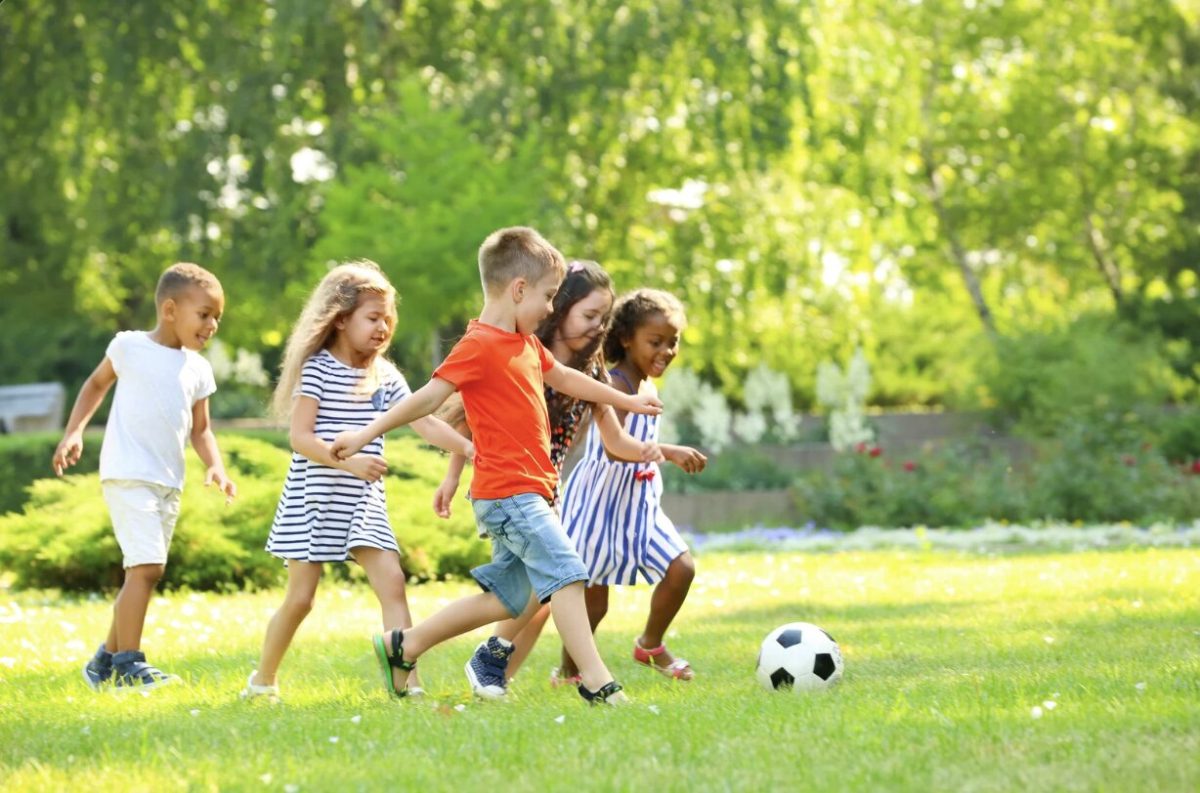
  • Oakland officials open ‘play-lending library’ to offset the cost of equipment for youth sports
    Photo credit: CanvaOakland is providing free sports equipment so kids can just play.

    Playing sports has been a common childhood experience that has led to lifelong hobbies, exercise, and forming lasting friendships. However, it’s gotten less common in recent years. Sign-up fees, uniforms, and many other expenses have led to most low-income families unable to afford to have their kids play. With that in mind, the city of Oakland, California believes they found a solution: a library. No, not the book kind.

    Officials are letting children check out soccer balls, footballs, yoga mats, tennis equipment, and other sports supplies at their newly opened Park Play Lending Library. Kids can also check out board games and card games like UNO as well. Using this library located at the Larry E. Reid Sports Center is absolutely free to anyone.

    “Every child deserves the opportunity to play, learn, and thrive,” said Maribel Lopez, City of Oakland Recreation Supervisor said in a press release. “The Park Play Lending Library is an investment in our community and a step toward ensuring that all Oakland residents have access to the recreational resources they enjoy, regardless of their financial situation.”

    Encouraging kids to socialize, play, and grow

    Oakland residents and officials welcome this sports equipment library for a myriad of reasons. It’s not just to allow access to certain activities, but to help address the lack of third places and areas for children to play overall. Whether it’s through sports or games, face-to-face playing helps children’s social skills, combats loneliness, and expands the immediate world around them.

    “We’re aware that sports can lead to social mobility,” Lopez told SFGate. “When kids are familiar with golf, tennis, soccer, and other, you know, games or sports that are more socially mobile, then they have access to different communities, different friend groups, different neighborhoods, and we want to be a vehicle for that. We want kids to be able to speak each other’s language and connect through sports.”

    Expenses in youth sports has become a federal government issue

    Children being priced out of local sports programs due to expense has been a rising issue across the country. It’s to the point where the federal government is looking to intervene.

    Representatives of both Congress and the Senate have introduced the Let Kids Play Act bill to their peers. The purpose of the bill, according to Congressman Pat Ryan and Senator Chris Murphy among other authors, is to limit or outright remove private equity firms’ involvement in youth sports. The representatives state that the cost to participate in youth sports rose by 46% over the last five years. They also claim that many families are paying more than $5,000 per kid so they can play. By removing private equity involvement, the hope is to cut down on junk fees, stay-to-play schemes, data mining, and other issues that are making it harder for families to allow their kids to participate in local organized youth sports.

    While the federal government debates on this issue, a local library or park allowing children access to sports equipment to have pick-up games may be a great first step to renew what was a common American childhood experience.

  • After a field trip for 100 low-income kids was canceled, police officer rents a whole movie theater for them
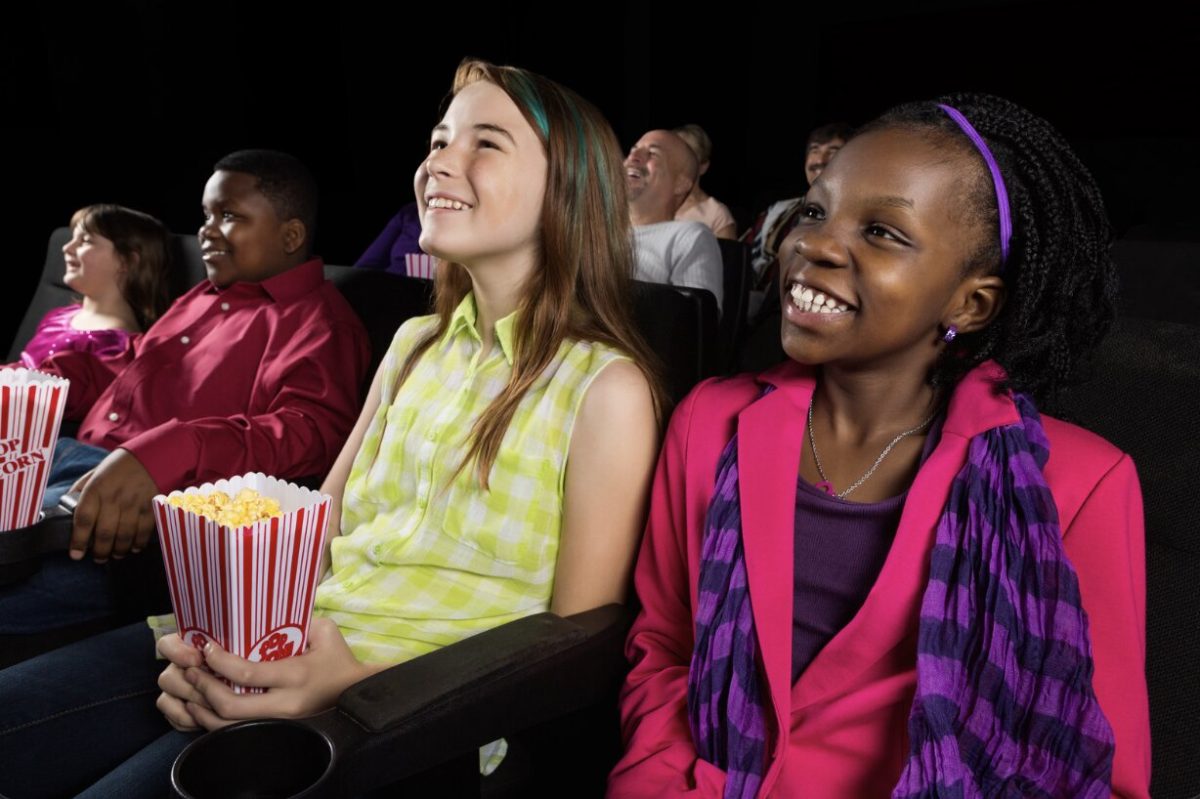
    Photo credit: CanvaOfficer Reavie opened his wallet and his heart to help kids enjoy a movie in the theater.

    Arizona middle schoolers that were a part of Greenway Middle School’s “After the Bell” summer program were really looking forward to their field trip. However, funding for their end-of-summer field trip fell through. That’s when School Resource Officer Sean Reavie stepped in.

    Using money from his own pocket, Reavie rented out all 144 seats at a local movie theater so the kids could enjoy a screening of Toy Story 5. The movie, the snacks, the sodas, all on him. For many of the kids, it would be their first time ever watching a movie in a theater.

    An act of generosity, an act of community

    After being contacted by the program director, Katie Jenkins, Reavie didn’t hesitate to spend his own money on the theater rental and treats. The cost added up to nearly $2,000.

    “If they needed more, I would have given them more,” Reavie said to 12 News. “You can’t break a promise to a child. They come here knowing that there’s a reward at the end.”

    Reavie understood that this trip to the movies was more than it seemed. Greenway Middle School is a Title one school, meaning that the majority of the students came from low-income households. Several of the students qualified for free breakfast and lunch daily from the school. Going to a movie theater was a luxury that most of the kids’ families cannot afford.

    “Some of them live in a different life than most of us would comprehend, and they just haven’t seen a lot of good things with their own eyes,” said Reavie. “Their family doesn’t have a car. Parents, if they have two, work multiple jobs. Half of them have never been to a water park before. They’ve never been across the other side of the highway before.”

    Prior to the movie, after Officer Reavie explained that he would take care of all expenses, he made just one request to the kids.

    “As you get older in life, help other people, as a payback to me,” he told them. “Would you do that? That’s all I ask of you.”

    Reavie is a superhero (well, dresses like one sometimes)

    This isn’t the first time Reavie helped fund a great experience for local school kids. In 2025, he spent more than $3,000 to take students to Hurricane Harbor water park.

    Reavie spent the early years of his police career as a child crimes detective for six years before taking on his current role. Along with that, Reavie started a superhero-inspired charity that supports teen youth programs and child advocacy.

    “It dawned on me that little kids who were scared responded to superheroes,” he said. “So I started a superhero-based foundation called Put On The Cape: A Foundation For Hope.”

    The Put On The Cape organization has officers and “causeplayers” dress up as superheroes to host events to raise money for children’s causes. Their homepage reads,”Our mission fills the toy closet, food pantry, and clothing wardrobe to the children and their families. This takes the burden off the center so they can focus on healing the child from the trauma they’ve endured.”

    With or without a cape, Officer Reavie is setting a great example of giving in order to plant hope in a generation that could grow up to give back tenfold.

  • People thought cats lay on laptops to get in the way. The real reason is surprisingly sweet. 
    Photo credit: CanvaA kitty decides when it's time to work.

    People who work from home with a cat nearby tend to recognize this moment well. The instant a laptop opens and a document appears on the screen, a cat arrives within seconds, claiming ownership of the keyboard.

    It can feel like an unwelcome interruption, yet veterinarians and animal behavior specialists have identified a common pattern among domestic cats. Cats often choose to sit on objects their owners are engaged with, particularly when those things are central to human attention or activity.

    pets, psychology, curiosity, scent
    A cat with a little attitude on the computer.
    Photo credit: Canva

    Cats aren’t trying to be a nuisance

    The first, and probably most familiar, reason a cat jumps on you and the computer when you’re working is attention. Animal behavior experts at vet-reviewed sources like Catster explain that cats repeat behaviors that reliably get responses from their owners. Why work when you can play and look at me?

    Another commonly cited explanation is simple comfort. Laptops, keyboards, and similar devices radiate heat. Cats seek out these warm surfaces for napping. Daily Paws notes that warmth is one of the practical reasons cats may choose electronics over other available spaces in the home.

    And let’s face it, cats are naturally curious. They are highly responsive to human activity and tend to investigate objects their owners are focused on. The laptop, papers, and even a phone being scrolled at home become sources of fascination.

    cat owners, remote work, home life, domestic cats
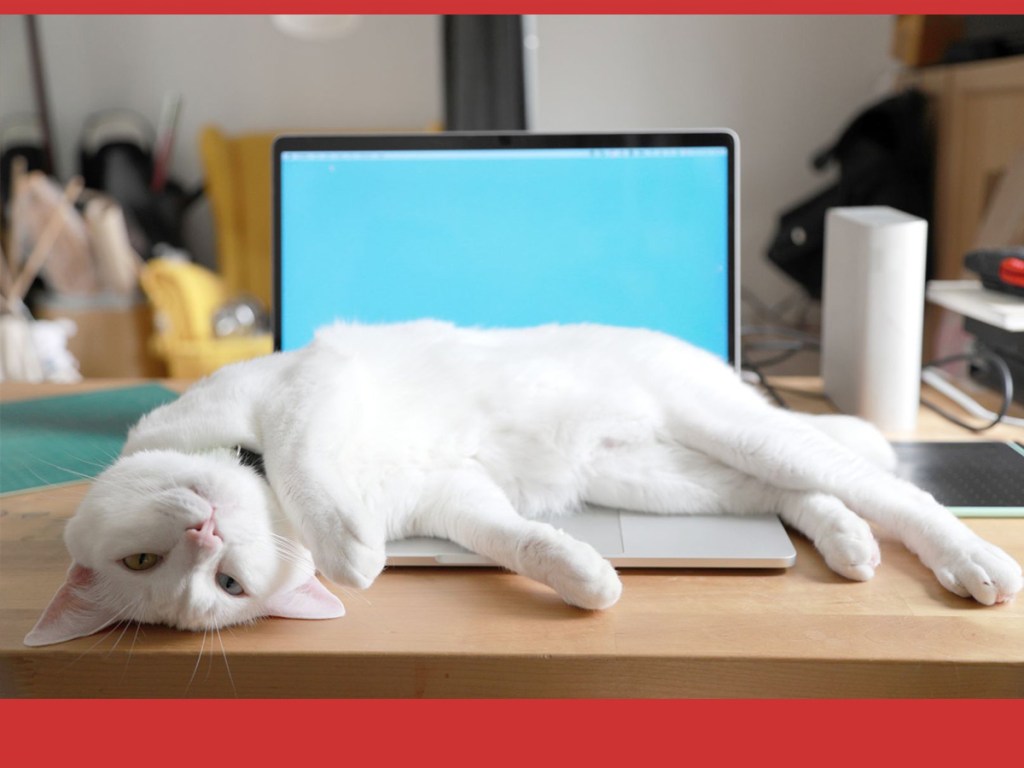
    A white cat relaxes on a laptop.
    Photo credit: Canva

    The science behind cats lying on laptops

    Research suggests there is more behind this behavior than basic attention-seeking and curiosity. Physical contact with objects can shape how cats interact with their environment, especially with items frequently handled by humans. For cats, scent helps create and strengthen connections with their owners.

    “Cats are very possessive individuals,” Dr. David Sands, an expert in animal psychology, told BBC Science Focus. “For them, the more they can brush past you and deposit your scent, the better!”

    The laptop is not just a warm surface but also a shared space that already carries a lot of its owner’s presence.

    Research from the Tokyo University of Agriculture found that cats can differentiate between familiar and unfamiliar humans using smell alone. In everyday settings, this may explain why cats often spend time on items like clothing, beds, or computers that carry their owner’s scent. These objects are strongly associated with a favorite human.

    animal science, feline behavior, pets,  animal bonds
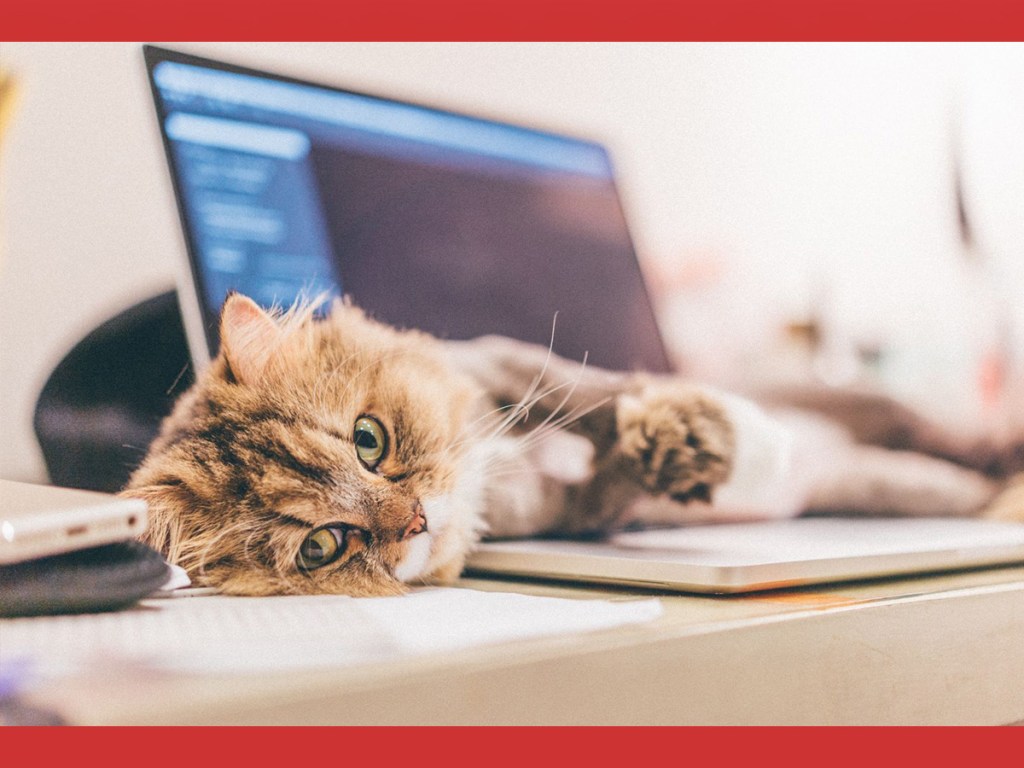
    A kitty on a laptop.
    Photo credit: Canva

    Cats want to be close to their owners

    These explanations point in a similar direction. What may seem like a deliberate effort to interrupt work is more likely the result of several well-intentioned feline behaviors. The family mouser is probably not plotting against your productivity.

    From seeking warmth and comfort to investigating the objects that hold our attention to interacting with surfaces carrying our familiar scents, cats have plenty of reasons to gravitate toward a laptop. These soft and cuddly family members adapt to the people and environments around them, even if that process occasionally lands them squarely on our keyboards.

Explore More Society Stories

Public Good

Oakland officials open ‘play-lending library’ to offset the cost of equipment for youth sports

Public Good

After a field trip for 100 low-income kids was canceled, police officer rents a whole movie theater for them

Work

In 1947, a car executive said lazy people are just smart. 79 years later, science backs him up.

Society

America’s friendliest states