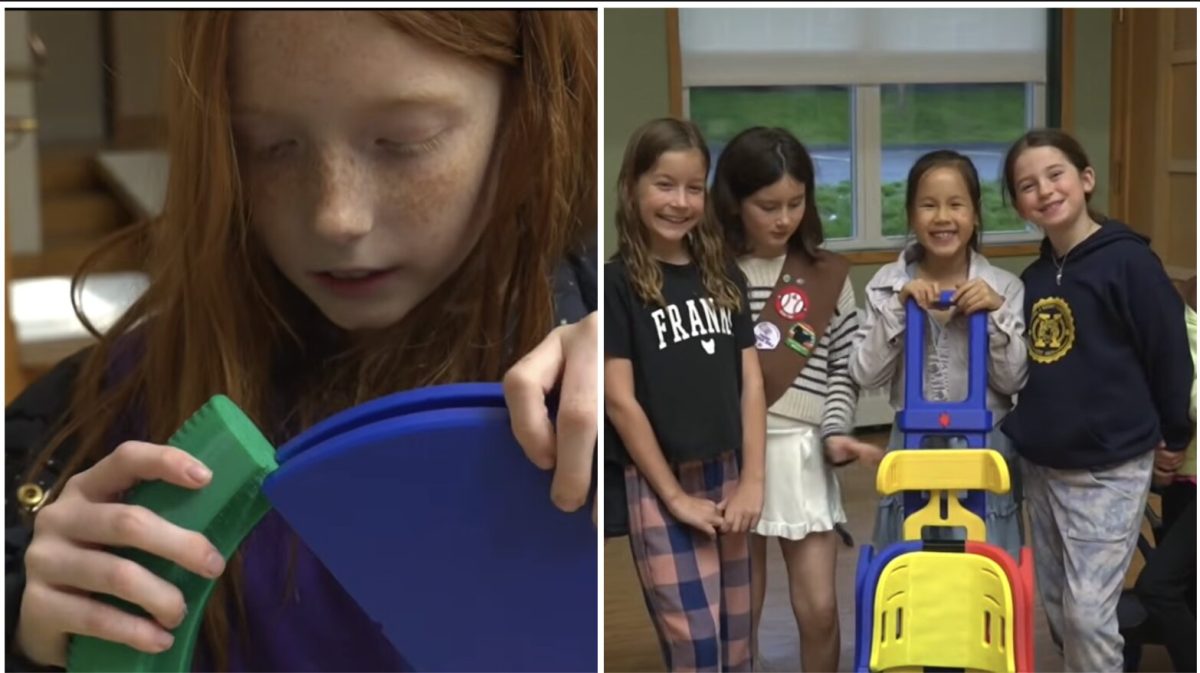
When people buy Girl Scout cookies, it’s typically known that the proceeds would go to programs and activities for that particular troop and the organization as a whole. However, for eight third-graders in Dorchester, MA, the money was paid forward to another cause. They used the funds to purchase a 3D printer to make wheelchairs for younger children.

Along with their troop leader, Corinne Curran, the girls spent nearly $200 of the cookie profits on the supplies. It took about 200 hours for the pediatric wheelchair parts to be fully printed and less than an hour for the group to build it. 

Kids helping kids

“They were so excited,” Curran said to ABC News. “One of the cool parts about Girl Scouts is they know they earn this money and they can see where it’s going and how they can use it to do good, make the world a better place.”

Curran said that the troop was inspired to build wheelchairs for fellow kids after a visit to Curran’s employer, The Boston Home. The Boston Home is a residential care center for adults with neurological conditions. After seeing the wheelchairs in use at the center, the girls wanted to provide such mobility to their peers.

How to 3D print a wheelchair

With this mission in mind, the troop discovered a design for a 3D printed toddler mobility trainer wheelchair through MakeGood. MakeGood is a non-profit organization that aims to provide more accessibility for those who need assistive technology. They do this by offering 3D printer designs for such devices to those who want to build them. They are also willing to pick up and deliver finished 3D printed devices to a person in need free of charge. 

Items like toddler wheelchairs can be incredibly expensive, especially for those without health insurance coverage. According to a 2022 report by the World Health Organization and UNICEF, almost one billion children and adults need a form of assisted technology such as wheelchairs, but lack access. Because of the expense and growing need, many have turned to 3D printing to create those devices on their own. It should be noted that because these 3D printed devices are made from volunteers and aren’t regulated or clinically-approved medical equipment.

The girl scouts are excited to be a part of this movement to help others, and are eager to make more wheelchairs for kids.

“We do what the girls want to do, and this was a huge project for them. They were so excited about it,” Curran said. “They want to make another one that is multiple shades of violet. And they also said that they want to build [a power wheelchair].”

If Girl Scouts can make a difference with something as important as free wheelchairs, many more can. You can contribute to those in need of assistive technology locally and globally via different resources available online. The Wheelchair Foundation also has a list of relevant organizations to consider.

  • Window washer’s free cleanings are saving struggling Kansas City restaurants through social media
    Photo credit: CanvaA window washer's social media is helping boost local business.

    No matter where you hang your hat in today’s world, a social media presence can impact your business. Former social media content manager turned window cleaner Davis Roethler knows this more than most. But he isn’t just using social media to boost his Window Wolf cleaning service. He’s actually highlighting other local businesses along the way.

    Knowing that the restaurant industry is one of the hardest to break even, Roethler wanted to help out struggling eateries in Kansas City. Wearing his Meta glasses, Roethler eats from a local restaurant and offers to clean their windows for free. While washing the windows, he records video from his Meta glasses to make a quick profile to promote the eatery. 

    A small video led to huge impact

    The restaurant owners aren’t only thankful for the free window cleaning, but also for the boost in foot traffic that Roether’s covert videos have provided. Yeyo’s Bakery is one of them.

    “He offered to clean our windows for free, and my wife was like, ‘Sure, why not?’” said Pedro Sagrero, co-owner of Yeyo’s Bakery to KCTV 5. “For the last two or three weeks [after Roethler posted a video], we’ve been noticing our sales are increasing tremendously. From, I would say, a hundred per day to four hundred.”

    Another restaurant, Tasty African Food KC, was struggling with an incorrect address listed on Google and low attendance. About 24 hours after Roethler cleaned their windows and posted a video about them, the restaurant’s address was corrected online and they had a line form before they opened.

    “By Friday at 9:30, and I was like, ‘Why are they out there? What’s going on?’ and so I finally just flagged one of them and said, ‘What’s going on?’” said Florence Muni of Tasty African Food KC. “I haven’t seen this much traffic since we’ve been here for two weeks, and he’s like we’re just waiting for the restaurant to open.”

    Social media creating local community

    “When you just look at the data, opening up a restaurant, from a business standpoint, it’s a terrible idea. It’s a huge risk. The numbers are not on your side,” Roethler told the Kansas City Star. “When you realize that, you realize that there’s so much opportunity in KC to help out these small businesses to make sure that they’re not part of that statistic of closing down.”

    While Roethler is a businessman, the focus on the videos was from a community perspective. While he would give a good review of the food, his videos provided a window into the people who prepared it.

    “What’s missing is like the story behind the owner and the person and the magic behind the food,” Roethler said to KCTV 5.  “But ultimately, I know it’s right when I show up and you’ve got mom or dad behind the register and you’ve got their kids working in there…that’s where I’m like, all right, they deserve the limelight.”

    The success that Roethler brings to local businesses isn’t mere social media marketing. His Instagram account has less than 10,000 followers. That number is meager compared to true influencers. But it’s the local community that does follow him that shows up to enjoy good food and uplift one another.

  • Parents trust report cards more than test scores, with consequences for kids
    A school report card showing straight A's.

    Jill Barshay for The Hechinger Report

    Parents trust report cards more than test scores, with consequences for kids

    Most parents want to help their children succeed. We check report cards, ask about homework and try to help our kids study. When that fails, we sometimes hire tutors. But in an era of rising grades, it’s easy to be misled.

    A new study reviewed by The Hechinger Report found that parents often assume everything is fine when their child’s report card shows mostly A’s, even when standardized test scores slide. That assumption may underestimate the help and guidance their child needs.

    In an online experiment, researchers at Oregon State University and the University of Chicago created hypothetical fifth graders, whom they called Stacey and Robert, and asked more than 2,000 parents how they would advise the children’s parents to respond to different scenarios of grades and test scores. Test scores were expressed as percentile ranks on standardized tests, such as the annual state tests that public school children take each spring, so that parents could compare Stacey and Robert with those of other children nationwide. And study participants were given an imaginary $100 per week to “spend” however they wished. Options included enrolling the child in an after-school program, hiring a tutor or saving the money for a vacation or bills. They could also invest their own time, such as helping with homework or reading together.

    Parents advised increasing time and money spent when both grades and test scores were low. Parents were less likely to provide extra help or resources when grades were high and only test scores were low. The researchers found that parents were more likely to step in when grades were low but test scores were higher.

    More than 70% of the parents said they trust grades more than tests for making decisions about their own child, and fewer than 9% said they had more confidence in tests.

    The findings appear in a draft paper that has not yet been published in a peer-reviewed journal and may still be revised. It was publicly circulated by the Becker Friedman Institute for Economics at the University of Chicago this month.

    As test scores have fallen nationwide while grades have risen, the researchers believe that parents may be underinvesting in their children. “Parents are the key to children’s success,” said Ariel Kalil of the University of Chicago. “What you need is for parents to be making investments in their kids’ skill development, and you need that parental effort to be happening early and often. Anything that depresses parent investment is a problem.”

    Kalil is concerned that this underinvestment in children is more pronounced in low-income communities, where, she said, high grades are often issued for below-grade-level skills. After the COVID-19 pandemic, schools struggled to persuade families to enroll in free tutoring and summer programs to make up for months of disrupted instruction. Many report cards showed solid grades, reducing the urgency for parents to act.

    Paired with other recent research on long-term academic and economic consequences, this study strengthens the case that grade inflation isn’t harmless. Inflated grades may feel encouraging, but they can send false signals both to students, who may study less, and to parents, who may see less reason to step in. Ultimately, it not only hurts individuals but also American labor force skills and future economic growth, the researchers argue.

    Kalil, a behavioral scientist, believes that parents have more confidence in grades because they are familiar and easier to understand. Meanwhile, score reports are complicated, and even many well-educated parents are confused about scaled scores and percentile rankings.

    A survey that accompanied the online experiment revealed that a sizable share of parents don’t trust standardized tests. Forty percent of the parents in the study said that tests were biased. Almost 30% thought student scores were a reflection of family income. Fewer than 20% of parents thought tests captured their children’s skills.

    Kalil says there’s another psychological phenomenon at play even for parents who understand and value standardized tests: the tendency to ignore bad news when it is paired with good news. “If the report card is all A’s, there’s a cognitive bias towards sticking your head in the sand and rejecting the bad information,” said Kalil.

    There were hints in the data that Hispanic families were most trusting of grades and least trusting of test scores, while Asian families were more willing to heed test results. But few Hispanic and Asian parents participated in the survey, so these patterns were not statistically significant. (Almost 70% of the respondents were white and 20% Black.) Parents with at least a bachelor’s degree also paid more attention to standardized exams.

    Solving the problem won’t be easy. The researchers say schools can do more to explain what test scores measure and how to interpret them, but better communication alone may not shift parents’ instincts. Reversing grade inflation would be the most direct solution, but that would require a broader shift across schools — something that is unlikely to happen quickly.

    In the meantime, the burden is on parents to read report cards with a critical eye. When grades and test scores don’t align, it’s worth asking why. A strong report card can be reassuring, but it may not always tell the full story of what a child knows — or what help they might need.

    This storywas produced by The Hechinger Report, a nonprofit, independent news organization focused on inequality and innovation in education, and reviewed and distributed by Stacker.

  • Spanish town shaded from punishing summer heat thanks to senior knitters and their colorful blankets
    Photo credit: GreatBigStory/YouTubeElderly knitters are helping their community fight summer heat waves.

    The Spanish coastline during the summer can have unbearable heat, especially due to rising temperatures caused by climate change. As a result, towns such as Alhaurín de la Torre are bombarded with dangerous levels of heat for residents and tourists. However, there is relief in the town’s shopping district thanks to a growing group of knitting grannies.

    In 2019, Eva Pacheco partnered with the Senior Citizens’ Social Center to knit a multi-quilt awning to shade the popular Malaga Street from the sun. The heat had been a growing issue for Spain’s tourist industry, especially along the coast. It was important to protect citizens and visitors alike from sunburn, heat stroke, or worse.

    A different kind of community project

    Every Wednesday, 40 elderly women from the community would gather, socialize, knit, and crochet for three hours. They would then stitch all of their creations together to create a colossal quilt. In the end, they created a 500-square-foot awning so residents and tourists could shop on Malaga Street while being protected from the sun. To say it was a success would be an understatement.

    The shade provided by the giant blanket lowered the temperature by as much as ten degrees. It also shielded folks underneath from harmful UV rays. Since the knitted awning was primarily made from water-resistant synthetic yarn, it wouldn’t absorb water during rainy days.

    Lastly, it was reusable. The awning could be taken down after the summer months. This way, it could be washed, repaired, and reinstalled every year.

    The awning that keeps giving

    It not only improved the lives of the shoppers outside, but also those of the knitters and crocheters. The majority of the team that created the massive quilt were older widows who didn’t have many social outlets for making friends. Along with that, according to AARP, knitting can also help stave off Alzheimer’s, among other health benefits.

    Since its initial creation, the colorful, shade-producing blanket has dramatically increased in size. It is currently over 13,000 square feet and features many more colorful designs. In 2024, the group started creating knitted blankets and quilts featuring the faces of celebrities like Tom Cruise, Antonio Banderas, and many others. While intended to protect tourists while shopping, the awning has become a tourist attraction itself.

    Other places take notice

    Their success has since inspired many other communities to create their own quilted canopies to provide shade. The residents of the nearby city of Coín have also created quilt barriers to protect against the sun’s heat. La Línea de la Concepción has a similar series of canopies, but they are made of mandalas rather than blankets. It has also inspired New Iberia, a sister city of Alhaurín de la Torre, to make its own “crochet ceilings.”

    Over time, there will hopefully be other methods to cool down our streets. There is something to be said for the fact that it took creativity, community, and a little bit of fun to come up with a quality solution.

Explore More Public Good Stories

Public Good

Window washer’s free cleanings are saving struggling Kansas City restaurants through social media

Public Good

Parents trust report cards more than test scores, with consequences for kids

Public Good

Spanish town shaded from punishing summer heat thanks to senior knitters and their colorful blankets

Society

What makes a good teacher? Ask a Republican and a Democrat, and they are likely to agree