For centuries, sailors have told wild tales of whales ramming ships. Reports of a sperm whale smashing and sinking the Essex in 1820 inspired Herman Melville to write Moby-Dick. Scientists had never witnessed it themselves—until now.
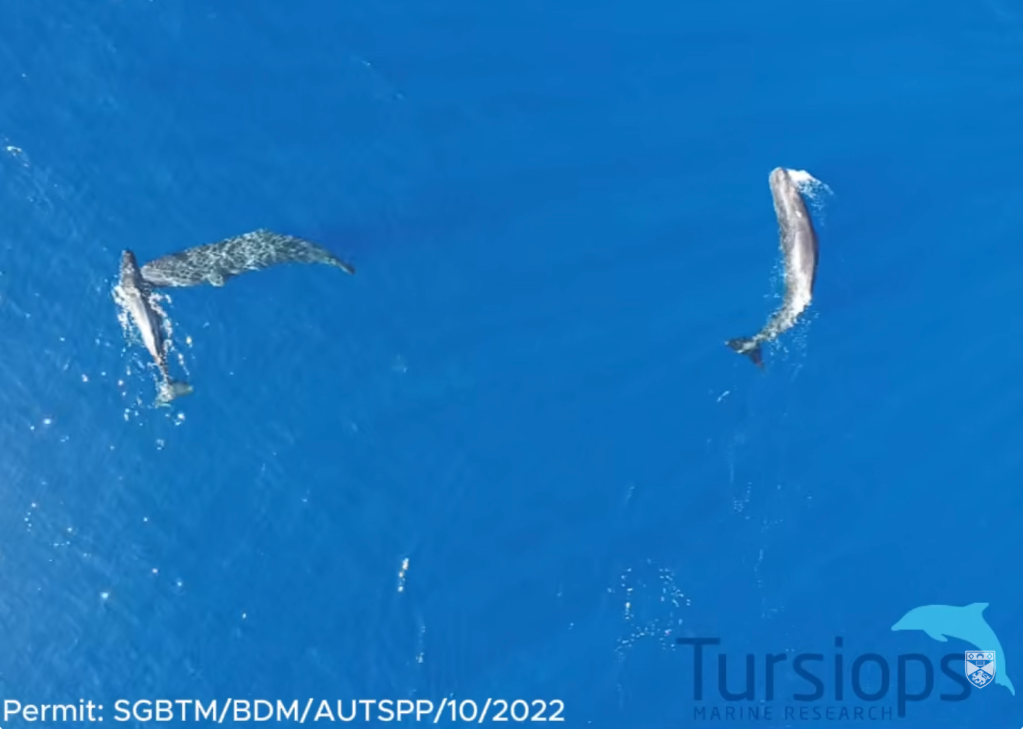
Researchers have captured the first-ever drone footage of sperm whales headbutting each other. During fieldwork off the coast of the Balearic Islands, they recorded three separate incidents between 2020 and 2022.
Drone footage captures sperm whales headbutting
The new study was published in the journal Marine Mammal Science. Using drones, researchers from the University of St Andrews, the University of the Azores, and Asociación Tursiops captured video evidence of sperm whales headbutting. They found that most of the whales were young, immature males. In one incident, a young male circling near a female suddenly charged and slammed into her, knocking her off course. After the impact, she broke away from the group and did not return.
The researchers estimated impact speeds ranging from 1.8 to 8 miles per hour, with collisions generating forces of up to 20 tons of pressure. The impacts captured on video were not necessarily considered aggressive. In fact, researchers believe the behavior reflects rough play or forms of mock combat. Similar behaviors can be seen in other mammals, like dolphins and lions.

Photo credit: Canva
Observations of sperm whale behavior
Using their large heads, sperm whales have been reported by whalers to strike and move objects since the 19th century. “It was really exciting to observe this behaviour, which we knew had been hypothesised for such a long time, but not yet documented and described systematically,” said Dr. Alec Burslem, lead author of the study.
“It’s exciting to think about what as-yet unseen behaviours we may soon uncover, as well how more headbutting observations may help us to shed light on the functions the behaviour may serve,” Burslem added.
Documented, unprovoked attacks on humans by sperm whales are exceedingly rare, with most occurring during historical whaling incidents. Research indicates that sperm whales do not naturally exhibit aggression toward humans. While they can be curious, they often avoid vessels and observers. Historical accounts of whales ramming ships are likely defensive reactions rather than predatory attacks.

Photo credit: Canva
Language and cultural identities
Whales use clicks like letters, combining them into sequences that function like words in a complex form of communication. A 2024 study found that sperm whales use a highly sophisticated communication system with structures resembling a phonetic alphabet. These audio cues are used for coordination, caregiving, and social interaction.
A 2022 study found that specific click patterns serve as symbolic markers that help establish cultural identities within sperm whale pods. Researchers identified seven distinct clans, each with its own unique dialect. This provided quantitative evidence of whale social structures known as identity codas.
Studying this new drone footage offers fresh insights into whale social groups and behavior. While the headbutting may look aggressive, researchers interpret it as rough play. With technologies like drones giving scientists unprecedented access to these interactions, it’s exciting to think of what discoveries are yet to be made.