According to a new study published in this month’s issue of Psychological Science, apologies are decent mile-markers in people’s arguments but they don’t really make the receivers feel much better.
Using a test in which subjects were slighted by being shorted money, researchers were able to ascertain that people who imagined getting an apology from their betrayers were notably happier than people who actually got an apology. What’s more, those who envisioned apologies themselves were more likely than counterparts who’d received an apology to trust their partners in a subsequent test. In essence, soothing yourself works great, but relying on others to soothe you is a bad idea.
“The expectations for an apology to make us feel better and even forget about the bad things that have happened are overestimated,” says study co-author David De Cremer of the Rotterdam School of Management, Erasmus University. “In light of fraud cases, the financial crisis, the moral escalation that people seem to witness in contemporary society, there is a cry for apologies, such that we seem to live in an apology culture.”
The only consistent real benefit to apologies, the study found, is that they are reliable ways to restore social order. Apologies and the acceptance of apologies are largely a scripted dance in today’s society, so people often feel compelled to go along with them whether or not they honestly feel better about anything.
Maybe we should focus on sincerity more than simply whether or not someone says the words “I’m sorry.”
Some doctors now believe you should be spending even LESS time in the shower than previously thought. Admittedly, I was already shocked when I found out a while back that the average shower should take only eight minutes. But upon reflection, it made sense. While hot showers can feel relaxing, we obviously need to be conscious of our resources, no matter where we live in the world.
But a recent piece by Pang-Chieh Ho called “You Could Be Showering Too Long,” published in Consumer Reports, claims that showers should really only be around five minutes, seven at the most. Just shaving off a couple of minutes can help tremendously with conservation. “For people in the U.S., the average shower lasts about 8 minutes, according to the Environmental Protection Agency. That’s 20 gallons for every average shower, given that the standard showerhead uses around 2.5 gallons of water per minute.”
Experts say your shower might be too long
A woman washing her hair in the shower. Photo credit: Canva
And it’s not just because of the environment. Our skin can dry out more quickly than some might think. Dermatologist Lisa Akintilo, MD, is cited as saying, “It’s true that long, hot showers may feel restorative, but they can dry and irritate the skin.”
An article in Time magazine, “How Much Do You Actually Need to Shower?” by Angela Haupt, reveals that some doctors say you can skip even the five-minute daily shower, though they admit, “there’s no one-size-fits-all equation.” Dermatologist at NYU Langone Health, Dr. Mary Stevenson, suggested, “Ideally, I think people should shower at least every other day. Most people, by day two or day three, are not clean. But it’s a little bit personal.” She later added, “In general, you really only need soap in your armpits, your groin, and your feet.”
“You probably don’t need to be in the shower as long as you are. You’re no cleaner—it’s just for your psychological health or for your routine.”
– Philadelphia dermatologist Dr. Jules Lipoff
Some people on Reddit disagree. In a thread called “On average, how long do you take to shower?” many admitted that long showers are a guilty pleasure. A few people answered 45 minutes to an hour. One even claimed they showered for “light years,” though someone quickly pointed out that “light year” was a measurement of distance, not time.
One noted that there are variables in play. “Depends on how many shower beers.”
Another measures the length of time in music. “Two Spotify songs,” they insisted.
People online still love their long showers
A bearded man singing in his shower with a microphone. Photo credit: Canva
One Reddit user got vulnerable about the mental benefits of a hot shower. “The mean and the median probably differ quite a lot for me. The vast majority of my showers do not exceed 20 minutes, but I’ve had some depression showers or anxiety showers or whatever you wanna call them where I stayed in for over an hour.” Another commenter put it less delicately: “Until I can no longer feel the pain of life.”
And lastly, this person didn’t mince words but mentioned the temperature variable. “If it’s a hot shower, no less than 30 minutes. If it’s a cold shower, I scrubba dubba the F out of there in less than three.”
This article originally appeared two years ago. It has been updated.
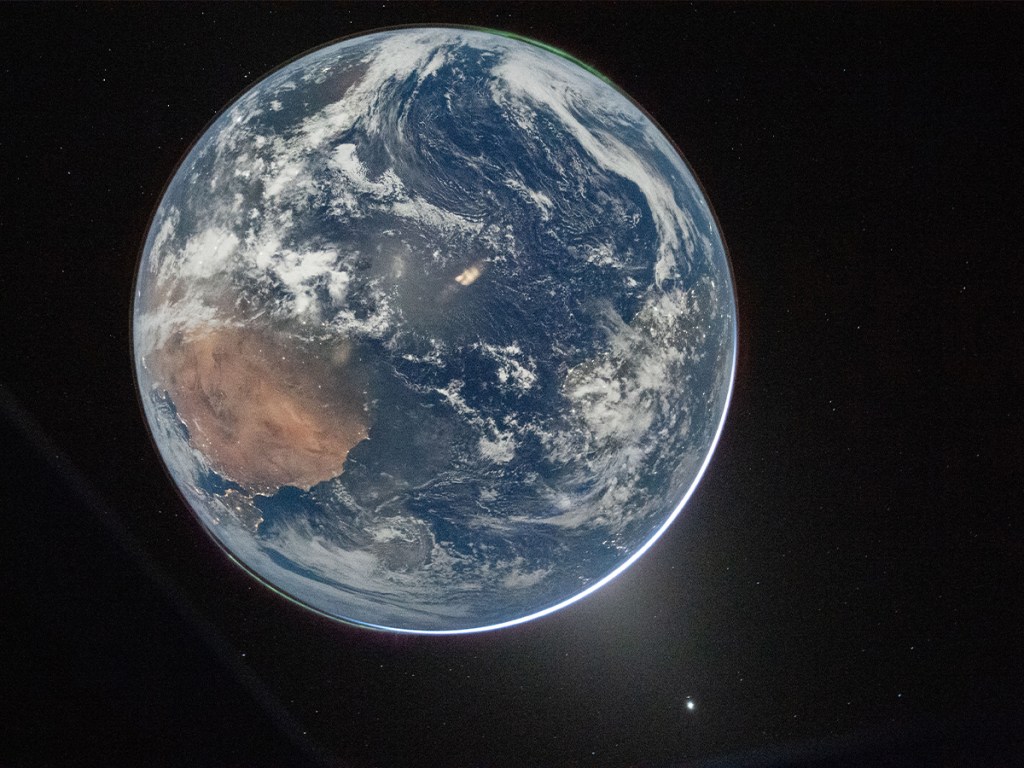
Commander Reid Wiseman’s photo, taken from Artemis II as it pushed away from Earth and races toward the Moon, reveals the majestic blue planet we all call home. NASA released the image shortly after liftoff, instantly turning it into one of the defining visuals of the mission so far.
It’s been more than 50 years since man last traveled to the moon on Apollo 17 in 1972. For younger generations, the Artemis II flyby and the eventual Artemis IV landing, might be the first time space exploration feels less like science and more like a shared human experience.
Artemis II has a simple yet extremely complicated mission to fly around the moon. Expected to take around 10 days, the crew of 4 will fly aboard NASA’s Orion spacecraft.
After orbiting twice around the Earth to ensure everything is working properly, they will perform a propulsion move called the transluna injection burn. This will send the Orion 4,600 miles beyond the far side of the moon. During the rest of the journey, the crew will test emergency procedures, conduct some science experiments, evaluate the radiation shelter, and observe the Moon.
For the return leg home, the Orion spacecraft will rely on Earth’s gravity to pull them back. Orion is scheduled to splash down in the Pacific Ocean on April 10th. There, it will be picked up by the U.S. Navy.
NASA shared in their Mission Overview, “Through Artemis, NASA will explore more of the Moon than ever before and create an enduring presence in deep space, while simultaneously preparing to land the first astronaut – an American – on Mars.”
For many Americans, this is the first time humanity has ventured this far from Earth in their lifetime. The Artemis II mission feels less like a run-of-the-mill space mission and more like the return of a dream we had quietly abandoned.
A 2025 study in Frontiers showed that experiencing awe about space can make people feel more like “science people,” sparking their curiosity about learning more science in the future. During the total 2024 solar eclipse, when the moon completely blocks the sun, people remained in awe and felt inspired even 6 months later.
Nature Reviews Psychology shared a 2024 study that showed experiencing awe can make people feel smaller in a good way. Individuals become less focused on themselves and more connected to the world. Awe has a positive influence upon thinking, motivation, social interactions, and well-being.
This most recent mission by NASA proves that humanity can still commit to projects bigger than the daily news cycle. Some achievements are worth pursuing not for immediate gratification, but because they expand the young minds that will shape our future.
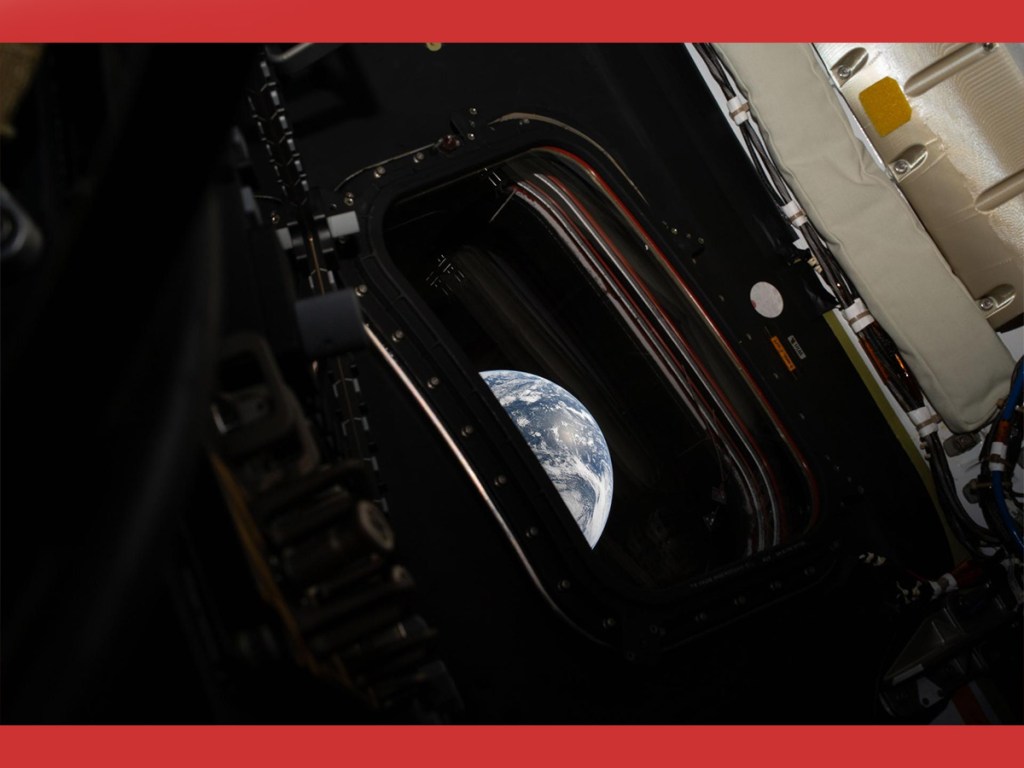
Image from Artemis II window looking back to Earth. Image Credit: NASA
People are inspired to talk about Artemis II
A Reddit post, First photo taken from Artemis commander Reid Wiseman had people excitedly sharing on the momentous achievement. Several people seemed inspired, others tried to be funny, and many seemed appreciative of the experience itself. These are a small collection of thoughts from the comments:
“In outer space you develop an instant global consciousness, a people orientation, an intense dissatisfaction with the state of the world, and a compulsion to do something about it.’
“You think any astronaut at one point did the finger pinchy thing where they’re crushing the planet?”
“Unlike watching from near-Earth orbit, this image has not been seen by human eyes in over fifty years. Mankind is able to do great things, when we all work together!”
“Lot of water/earth in front of me on that photo”
“That’s here. That’s home. That’s us. On it everyone you love, everyone you know, everyone you ever heard of, every human being who ever was, lived out their lives.”
“HELLO WORLD !!!”
“Flat-earthers gonna be upset. Lol”
“That beautiful silver line of the atmosphere the shines across the border of the globe is so surreal. Literally looks like a magic border in fantasy novels…”
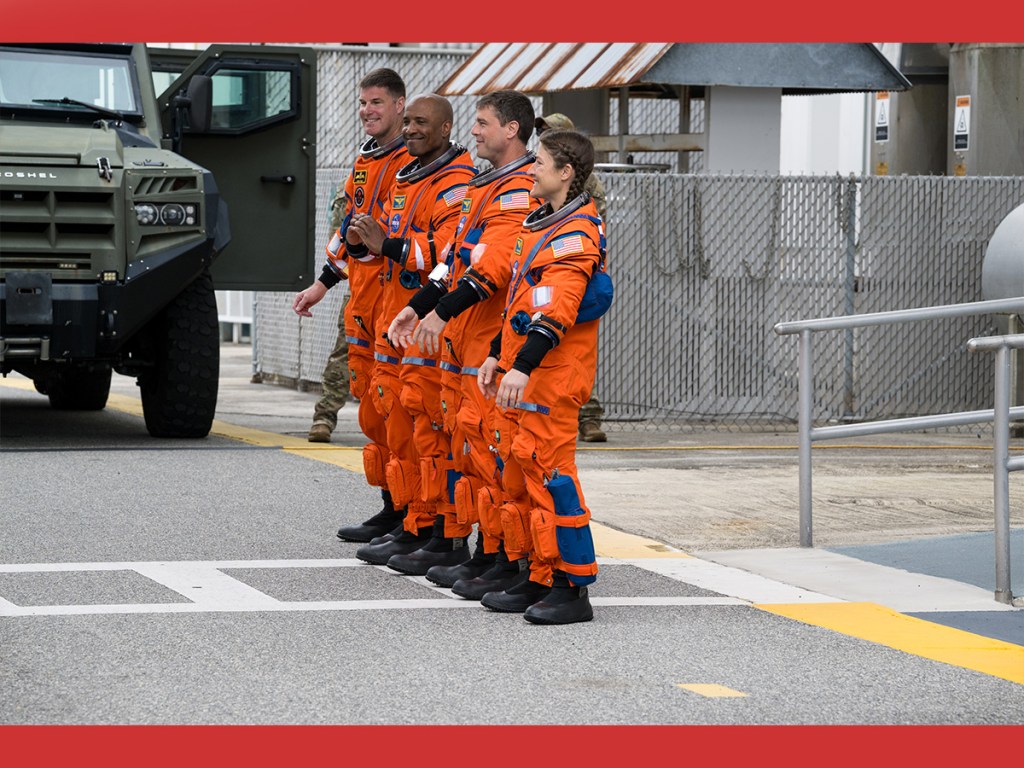
From right to left, NASA astronauts Christina Koch, mission specialist; Reid Wiseman, commander; Victor Glover, pilot; and CSA (Canadian Space Agency) astronaut Jeremy Hansen. Image Credit: NASA
10 days to bring our astronauts home
NASA’s 4 astronauts are only beginning the long journey that carries hope, wonder, and promise of future space discoveries. Mission specialist Christina Koch, commander Reid Wiseman, pilot Victor Glover, and fellow astronaut Jermey Hansen are already gathering information that can lead to eventual Moon landings and even a trip to Mars.
Weisman’s photo so beautifully captures the fragile yet powerful planet we live on. It’s a spectacular image that highlights so much of a planet most of us will see far too little of in our lifetimes. Mission specialist Koch expressed the effect of witnessing Earth from space, saying,
“… you see the Earth as it exists with the whole universe in the background. You see the thin blue line of the atmosphere, and then when you’re on the dark side of the Earth, you actually see this very thin green line that shows you where the atmosphere is. What you realize is every single person that you know is sustained and inside of that green line and everything else outside of it is completely inhospitable. You don’t see borders, you don’t see religious lines, you don’t see political boundaries. All you see is Earth and you see that we are way more alike than we are different.”
As Americans have become more tribal, isolated, and downright lonely, the need for quality friendships is at an all-time high. Yet, some of the most important relationships begin when we aren’t looking for them. Sometimes something seemingly insignificant, like a simple hobby or a mutual love, slowly grows into a real connection.
Dr. Arthur Brooks shared his insights into friendships on the Mighty Pursuit podcast. He explains that there are three types of friendships, and the one that matters most is a useless friendship.
Aristotle believed friendship was the secret to happiness
(Discussion begins at 1 hour into the video.) Brooks traces the value and importance of friendship back to the famous philosopher Aristotle. He explains that Aristotle believed the ultimate secret behind a happy life was friends. Brooks says, “In the Nicomachean Ethics, he [Aristotle] said there’s three levels of friendship that bring more happiness. And if you get stuck at lower levels, it’s going to be a problem for your life.”
The first type of friendship is transactional. These are people with whom you do business or have a casual acquaintance. You don’t really know them on a personal level. The relationship is friendly, but if business or a reason for interacting stops, so does the friendship.
Brooks describes transactional friendships, saying, “There’s nothing wrong with it, it’s just incomplete.” He continues, “If that’s all you have you’re going to be hopelessly lonely.”
The second type is friendships of beauty. They are chosen out of admiration. These are people we want to be around. Brooks describes it as, “You’re magnetic. It could be because of your physical beauty, your sense of humor, your intelligence, or your success.”
Relationships built on admiration are better than transactional, but Brooks warns, “If that beauty goes away, so does that friendship.”
Aristotle described the friendship that brings the most satisfaction as Atelic, meaning it has no specific end or goal. Brooks calls it “Useless. It’s cosmically, beautifully useless. And so if you want to be happier, you need more useless people you just love.”
Describing the characteristics of this type of friend, Brooks shares, “you’re walking together, shoulder to shoulder, into the future and looking at something you both love mutually.” He continues, “There’s always a third love in these perfect friendships.”
Examples offered by Brooks might be a couple loving their children or best friends who love a sports franchise. Brooks says, “It can be dumb, or it can be cosmic. But the whole point is that third love is the glue that makes that, that useless relationship beautiful and perfect to you.”
Research supports Aristotle’s belief that having a friendship without an agenda makes for a richer and happier life. A 2023 study in Frontiers found that friendships valued for the stimulating companionship and shared activities predicted higher well-being, life satisfaction, and personal growth. Best friends aren’t based on networking or usefulness.
A 2024 study in the National Library of Medicine found that high-quality best friendships lowered loneliness and boosted self-esteem. Meaningful relationships can begin with a shared love, but over time, become a part of who the friends actually are.
A 2022 study at Cornell University revealed that repeated physical proximity and similar interests strongly increased the likelihood of friendship formation regardless of background or social differences. Activities like walks, hobbies, sports, and creative interests offered a shared space where even unlikely friendships grow.
Brooks suggests the most important friends come from connecting over the smallest things. They don’t happen because we need them; more so, they exist for their own sake. These “useless friendships” are grounded in mutual joy and common loves. They may seem small or incidental at first, but the Atelic relationship shapes our happiness the most.