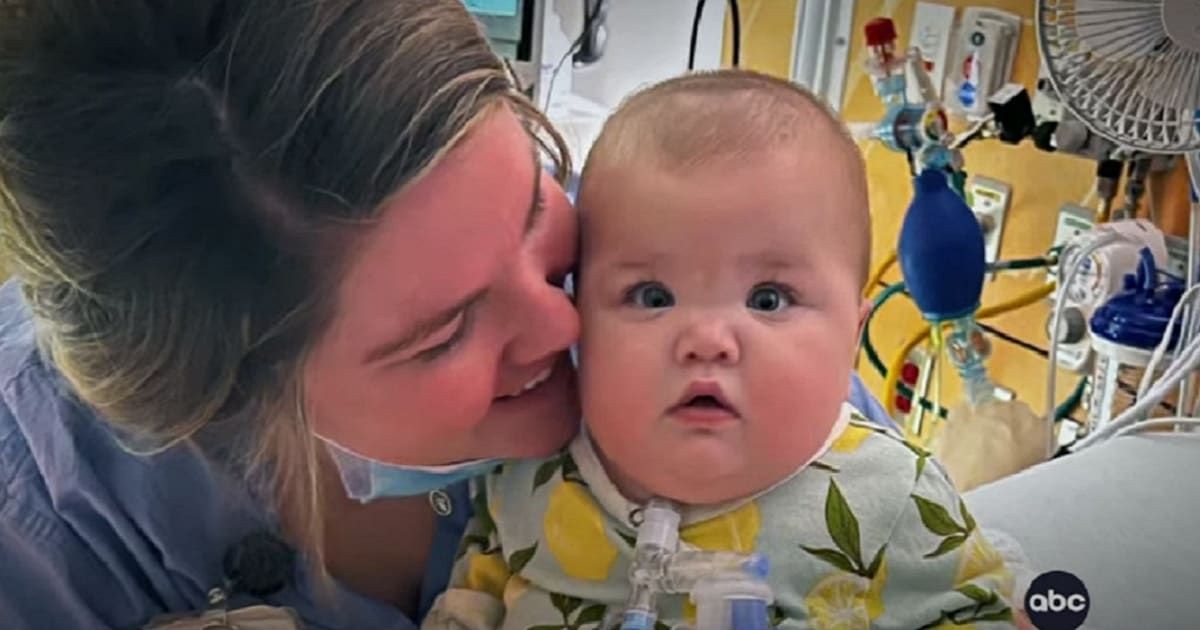
The world might not have changed when Taylor and Drew signed the adoption papers on National Adoption Day 2023. However, this simple act did change the world of little Ella, the girl adopted by the couple. Taylor and Drew both, are registered nurses at the neonatal intensive care unit (NICU) at Methodist Women’s Hospital in Omaha, Nebraska. Ella was amongst the thousands of babies they cared for. Interestingly, the three became a family only through their encounter at the NICU premises.

The couple had met each other while working in overnight shifts at the NICU, in 2017. They tied the knot in 2020 and soon encountered a newborn they became attached to. When Ella was admitted into the NICU in May 2021, she was 23 weeks old and weighed 1 pound, 2 ounces. “I knew I kind of wanted that challenge as a nurse to be able to take care of her and see where things would go and what she would do,” Taylor Deras told Good Morning America. It would be a long journey for Ella, because as Drew Deras added, “She was at the very edge of being able to survive, essentially.”
Taylor also added that the baby was immediately intubated and needed multiple blood transfusions. “There were good days, and then there were days I would leave work and get in the car with Drew and say, ‘I’m not going to see her again. She’s going to pass away tonight,’” Taylor recalls. By the summer of 2021, Ella began to recover and gain strength.

Representative Image Source: Pexels | nila racigan
As per People, Ella’s biological mother had stopped seeing her in the care unit. Taylor and Drew worried about where Ella would go after she was discharged. Both of them had become emotionally attached to her.

In December 2021, the courts deemed Ella a “ward of the state.” According to the Legal Information Institute, the term “ward of the state” means a child who, as determined by the State where the child resides, is a foster child, is a ward of the State, or is in the custody of a public child welfare agency. So, Taylor and Drew were concerned about what would happen to the medically sensitive infant in the foster care agency. Ella had a tracheostomy, a surgically created hole in her windpipe that provided an alternative airway for breathing. She also ate through a feeding tube. Thinking of all this, the couple decided to become Ella’s foster parents.

Representative Image Source: Pexels | Cottonbro Studio
They were approved for her fostering in April 2022. Finally, on November 18, 2023, they signed Ella’s adoption papers in the courtroom. Today, the Derases say Ella is a vibrant 2-year-old. The little girl is thriving, and her health continues to improve as she works through weekly speech therapies and other treatments.
The Derases feel overjoyed and fulfilled after adopting Ella. They also offer their views for other couples willing to adopt a child, “Don’t give up during the process because the adoption process is very challenging,” Taylor says. “If it’s something that’s on your heart, I would say go for it and don’t steer away, because there are many kids that need adoption.”
When Maria looked at herself in the mirror for the first time after her mastectomy, she stood very still.
One hand rested on the bathroom counter. The other hovered near the flat space where her breast had been. The scar was raw and angry. The loss was quiet but enormous. Her body felt foreign.
In moments like these, people are often urged to be resilient – which can feel like being told to show no weakness, to push through no matter what. Or they imagine resilience as bouncing back: returning somehow unscathed to be the person you were before.
But standing in that bathroom, Maria knew there was no going back. And toughness wouldn’t change what had happened. The real question was how she could move forward, carrying this experience into her new reality.
Maria’s story, one I came to know personally, is far from unique. Loss, trauma and illness often bring the same wrenching questions of identity and the painful uncertainty of what comes next.
Moments like Maria’s reveal something important: The way people tend to talk about resilience often doesn’t match how people actually live through adversity.
But across research, clinical practice and lived experience, resilience is something far more nuanced, raw and human.
It’s not a personality trait that some people simply have and others lack. Decades of research show resilience is a dynamic process. It’s shaped by the small, everyday decisions and adjustments individuals make as they adapt to significant adversity while maintaining, or gradually regaining, their psychological and physical footing over time.
And importantly, resilience does not mean the absence of distress.
Research on people facing serious life disruptions shows that distress and resilience often coexist. For example, in my study of adolescent and young adult cancer survivors, participants reported being upset about finances, body image and disrupted life plans, while simultaneously highlighting positive changes, such as strengthened relationships and a greater sense of purpose.
Resilience, in other words, is not about erasing pain and suffering. It is about learning how to integrate difficult experiences into a life that continues forward.
How resilience really works
At one point, Maria told me she had started avoiding mirrors, intimacy, even conversations that made others uncomfortable.
“Well, you’re strong,” people would tell her. “Just stay positive. This too shall pass.”
But strength, she said, felt like a performance.
What ultimately shifted for Maria was not an increase in toughness. It was permission to grieve.
She began speaking openly about the loss of her breast; not just as a medical procedure but as a symbolic loss tied to identity, sexuality and womanhood. She joined a support group. She allowed herself to feel anger alongside gratitude for survival.
This kind of emotional processing turns out to be central to resilience.
My colleagues and I have found that people who actively process loss, rather than suppress it, demonstrate better long-term adjustment. Tamping down negative feelings may provide short-term relief, but over time it is associated with greater stress on your body and more difficulty adapting.
In other words, resilience is not about sealing the wound and pretending it no longer aches. It is about learning how to carry the wound without letting it consume your entire story.
Neuroscience supports this integration model. When people engage in meaning-making – reflecting on their experiences and incorporating them into a coherent life narrative – brain networks associated with emotional regulation and cognitive flexibility become more active. The brain, quite literally, reorganizes as you adapt to new realities.
Maria described the change simply.
“I don’t like what happened,” she told me. “But I’m not at war with my body anymore.”
If resilience is about integration rather than toughness and bouncing back, how can you cultivate it? Research across psychology, neuroscience and chronic illness points to several evidence-based strategies:
Allow emotional complexity: Resilient people are not relentlessly positive. They allow space for the full range of emotions, such as gratitude and grief, hope and fear. Paying attention to your feelings through strategies such as reflective writing or psychotherapy have been linked to improved psychological adaptation.
Build a coherent narrative: Human beings are storytellers. Trauma can shatter one’s sense of self, but constructing a narrative that acknowledges loss while identifying continuity and growth supports adaptation. The goal is not to spin suffering into silver linings, but to situate it within a broader life story. For example, someone might say, “Cancer derailed my plans and changed my body, but it also clarified what matters to me and how I want to move forward.”
Lean into connection: Isolation magnifies suffering. Social support is one of the strongest predictors of how well people are able to cope and move forward after illness or trauma. For Maria, connection with other women who had had mastectomies normalized her experience and reduced shame.
Practice deliberate pauses: Intentionally give yourself some time to breathe. Mindfulness and contemplative solitude can strengthen your ability to regulate emotions and recover from stress. Pausing allows experience to be processed rather than avoided.
Expand identity: Illness, loss and trauma reshape how you think of yourself. Rather than clinging to who you were, resilience often involves expanding who you are becoming. Research on post-traumatic growth shows that people often report deeper relationships, clarified priorities and renewed purpose – not because trauma was good, but because it forced reevaluation. Maria no longer describes herself simply as a breast cancer patient. She is a survivor, yes, but also an advocate, a mentor, a woman whose sense of femininity is self-defined rather than dictated by her anatomy.
Resilience is not about returning to who you were before illness, loss or trauma. It is about becoming someone new: someone who carries the scar, remembers the loss and still chooses to engage with life.
Maria still pauses when she sees her reflection. But she no longer turns away.
“This is my body,” she told me recently. “This is my story.”
Resilience is not forged in the denial of vulnerability, but in its acceptance. Not in bouncing back, but in integrating what has happened into who you are becoming.
And that, I believe, is where real strength lives.
Photo credit: SDI Productions/E+ Collection/via Getty Images – When someone is badly hurt, their potential for survival often depends on what happens in the first minutes after they arrive at the hospital.
When a trauma patient enters the emergency department, their potential for survival often depends on what happens within the first minutes after their arrival. After studying trauma resuscitation teams at UPMC Presbyterian in Pittsburgh, the largest major trauma center in Pennsylvania, it’s clear that trauma teams aren’t organized ahead of time – they’re formed on the fly. Some team members may have worked together many times before, while others may be meeting for the first time.
Those minutes can be chaotic, fast-paced and high-stakes. The patient is usually rolled in on a stretcher, bleeding, barely breathing and surrounded by alarms and shouting. At the bedside are emergency physicians, anesthesiologists, surgeons, nurses and respiratory therapists – a large team of dedicated health care providers. Everyone has a job. Everyone is moving fast. When it works well, it looks almost effortless. When it doesn’t, small delays can have big consequences.
This knowledge gap motivated us to get together to study this issue. One of us is an intensive care unit physician and the other is an organizational scientist who studies teams in a variety of settings. We based our approach on a classic concept from behavioral science called transactive memory systems.
Traumatic injuries, such as car crashes, falls and gunshot wounds, are the leading cause of death for young people worldwide. Across all ages, trauma is one of the top killers. Because trauma is widespread, even small adjustments to how emergency teams coordinate can help save lives and shorten recovery periods for patients.
This is where transactive memory systems, TMS, come in. TMS are a shared understanding within a team of who knows what and who is good at what. A team doesn’t succeed because everyone knows everything, but because people rely on one another’s expertise. The team works best when each person knows what they are responsible for, what other team members are experts in, and whom to turn to when a specific problem comes up.
Team familiarity shapes outcomes
Think of a group of friends playing basketball. The best basketball teams aren’t the ones where everyone has the same skills. They’re the ones where one person is great at rebounding, one person can shoot from a long distance, and another is good at dribbling the ball up the floor. Importantly, everyone knows each other’s skills, so when a certain skill is needed, they know whom to go to.
In trauma care, this kind of knowledge could save lives. When seconds matter, the team needs to instantly know who would be best at placing a breathing tube and who would be best at reading the ultrasound. Strong TMS means fewer questions, less hesitation and smoother coordination.
For each trauma patient, we measured three things: shared team experience, transactive memory systems and patient outcomes, based on how long patients stayed in the ICU and in the hospital overall. We were looking for teamwork that showed good coordination, trust in expertise and clear division of responsibility.
The science behind ‘who knows what’
Our results were striking. First, teams with more shared experience had stronger transactive memory systems. The more often people had worked together before, the better they seemed to know each other’s skills and coordinate their tasks. If you add up how many times two team members had worked together on a previous resuscitation and divide by the number of dyads, or pairs, on the team, the average in our study was 10 times. As that number increased, transactive memory systems became stronger.
Second, stronger transactive memory systems were linked to better patient outcomes. These improvements were substantial: Patients cared for by teams that were well above average in their transactive memory systems stayed in the hospital about three fewer days and spent nearly two fewer days in the ICU.
Third, TMS explained why shared experience mattered. It wasn’t just that experienced teams were better, but that shared experience helped teams build a clearer mental “map” of each other’s expertise. That map is what helped patients get better faster.
Trauma care is unpredictable – you can’t always control who is on a team or how often people work together. But it may be possible to design training procedures and work schedules that help teams build transactive memory faster.
More broadly, our study suggests that improving health care isn’t just about developing new technology or training better doctors. It’s about leveraging the power of teams, helping people quickly understand and trust each other’s strengths when it matters most. For us, one coming from the bedside and the other from organizational science, that’s the exciting next step: turning the science of teamwork into practical tools that help trauma teams save lives.
As health care costs rise, patients aren’t just shouldering higher bills. They’re bearing more and more responsibility for getting information.
Americans are facing a health care affordability crunch on multiple fronts. In 2025, the Republican-controlled Congress approved a sweeping tax law that scaled back premium subsidies for Americans accessing care through the Affordable Care Act starting in 2026. As a result, millions on ACA plans now face much higher premiums, with many dropping out or expecting to drop out and risk going uninsured as premiums surge. By March 2026, about 1 in 10 people on ACA plans had dropped out, and that share is expected to rise.
Nearly half of U.S. adults now report difficulty affording health care. Together, these shifts are accelerating the “consumerization” of health care. Patients now have the ability to comparison shop, evaluate options and manage costs – but often without clear pricing. In this environment, knowing how to ask the right questions may be one of the most important tools patients have.
We are professors who study how perceptions of health care costs shape patients’ decisions about their care. Our research examines how factors such as price-transparency regulations influence patient choices. Across our work, we consistently hear from patients about rising costs and how conversations about price with their providers too often never happen.
Why speaking up about cost matters
When one of us took our child to the doctor for pink eye, the pediatrician quickly sent a prescription for antibiotic drops to the pharmacy. At the pickup, the pharmacist dropped the news that the drops would cost more than US$300. A follow-up phone call to the doctor’s office, however, yielded important information: A generic version of the same medication offered the same treatment and the same results, but at a fraction of the price.
That quick phone call saved her a lot of money. It also raised a broader question: Why don’t more people have these conversations about cost? In fact, one study shows that cost conversations occur in only about 30% of medical visits.
These discussions aren’t just for medications. They can be crucial when a recommended procedure has multiple alternatives; when out-of-pocket costs might affect whether you follow through on care; or when a sudden medical bill could create financial strain. Speaking up about price can help patients stay healthier and avoid the all-too-common trade-off between medical care and household expenses.
The study mentioned above also found that doctors and patients identified ways to reduce out-of-pocket costs – such as switching to a generic drug or adjusting the timing of care – in nearly half of those cases. Importantly, these conversations were typically brief and did not compromise the quality of care, the researchers found.
Patients actually prefer doctors who bring up costs, other research has found. Still, most patients remain hesitant. While a majority say they want to discuss cost, only a minority actually do, often waiting until a bill arrives – often when it’s too late to consider alternatives. That’s why it’s important that consumers feel empowered to ask the right questions. Here are three that can help make care more affordable.
One of the simplest ways to reduce drug costs is to ask whether a less expensive option is available. Brand-name medications can cost significantly more than generics, even when they are equally effective. One industry survey estimated that 90% of all prescriptions filled in 2024 were generic or biosimilar, but these accounted for only 12% of drug spending.
In many cases, physicians can substitute a generic drug or recommend a similar treatment that achieves the same outcome at a lower price. And when no direct generic exists, there may be therapeutic alternatives worth considering. For example, if a brand-name eye drop or inhaler isn’t available in generic form, doctors can often prescribe a different medication in the same class that works just as well but costs far less. Research on physician–patient cost conversations shows that switching to lower-cost, clinically similar alternatives within the same drug class is a common strategy for reducing out-of-pocket spending without compromising care.
Is there any financial assistance available?
Some hospitals and large health systems have specific programs aimed at making care more affordable for lower-income patients. In many states, government programs address this same goal. These programs often offer discounts on care, but they can be complex to navigate and require significant paperwork. Many health care offices have staff who are knowledgeable about these programs and can help patients determine eligibility and sometimes even assist with applications, although the Trump administration has cut funding.
Patients can often find these programs through hospital or health system websites, which typically include financial assistance or “charity care” pages outlining eligibility and how to apply. State Medicaid offices and insurance marketplaces are also key entry points for coverage and subsidy programs. Nonprofit organizations and patient advocacy groups may also offer or list assistance tailored to specific conditions or medications.
It’s also important to remember that for prescription medications, what you’re quoted isn’t always the final price. Many medications come with options to reduce costs, including manufacturer coupons, copay assistance programs and patient assistance programs. Doctors’ offices and pharmacists may also know practical ways to save money, such as using a different pharmacy, switching to mail order or adjusting how a prescription is written. Asking about these options can uncover savings that aren’t immediately obvious.
What will this cost me, and are there other options?
Health care pricing is often opaque, and costs can vary widely depending on where and how care is delivered. Asking up front about your expected out-of-pocket cost can help you avoid surprises later.
This question also opens the door to alternatives. For example, patients may be able to choose a lower-cost imaging center, opt for outpatient rather than hospital-based care, or delay nonurgent services until insurance coverage improves.
Speaking up is part of taking care of your health
Health care decisions shouldn’t feel like a choice between your well-being and your wallet. A brief, honest conversation about cost can lead to more affordable and more sustainable care.
Physicians can’t address financial concerns they don’t hear about, and most want to help their patients access care they can realistically follow through on. As costs continue to shift toward the patient’s burden, asking these questions isn’t just helpful – it’s essential.
The next time you’re handed a prescription or a referral, remember: One simple question about price could make all the difference.