It was like watching a coloring book come to life. For Art’s Birthday last January, Prague-based music-light duo ®udi22 played at the Papírna art space in Pilsen, Czech Republic.


Splashes of light filled the stage as the musicians used their handheld, pen-sized light sticks to pluck the laser strings. It was all in time with the minimal beats, as lasers shot out from the stage with one light-filled square dancing behind the musicians. They drew on the crisscrossing lasers, turning blue squares to green scribbles and red slogans, all while changing the sound pitch.

I turned around. The audience was mesmerized. Everyone was recording with their phones. If this were a purely audial musical performance, it would be a totally different story.

Are non-tacky, abstract light shows the future of electronic music? Put anything snap-worthy on a stage and the same old DJ-behind-a-laptop formula becomes extinct. There is an ever-increasing demand to be interesting, quirky or have a gimmick. But is light, especially when it isn’t VJ screen work, the answer?

“I think that emphasis on the visual is more significant in the case of instrumental compositions where it substitutes text,” said David Vrbik, who leads the Prague-based musical duo with musician Jan Burian, who hails from the Kyklos Galaktikos music project. While Vrbik played the light string treble, Burian played the light string bass.

“We do all the programming and make [the] toys ourselves,” he said.

Vrbik has been on the Czech music scene since 1998, though his “laser strings” instrument premiered in Brussels in 2008. It made its way to the spotlight in 2012 during the opening of the Olympic Games in London, where he performed at the Czech Olympic House.

Light design has become as important as sound. Take Squarepusher, who balance an audio-visual performance by adding a light show. Big Gigantic have toured in blue-lit pod booths and Skillrex has played in a sci-fi mothership. None of this is new, but it’s worth mentioning because ®udi22 are taking the basics to the next level. And there is an audience for this, both on a temporary and permanent level. Every October, the Luna Light Music and Arts Festival in Darlington, Maryland brings together light art and music with a pair of “light designers,” Brian McGregor and Randy MacCaffrie, who manage the installations.

Light, they say, is a material, like, wood, steel or mirrors. It isn’t just video projections, but the medium itself, which creates an atmosphere or a mood. LED lights, neon lamps or even fluorescent tubing are materials that hail back to the 1960s, harnessed in the minimal sculptures of Dan Flavin or even German light artist Otto Piene, who experimented with projections. While one could draw a parallel to color field paintings by Barnett Newman or Mark Rothko, Vrbik is influenced by more contemporary sound artists like Ryoji Ikeda and Carsten Nicolai.

“I have always been fascinated by sound visualization,” said Vrbik, who has been working for Prague’s contemporary music venue, the Archa Theatre, as well as a dance theatre for over 10 years.

“While composing music for dance performances, I would use a laser projector not only as a visual means but also as a source of synchronous sound. The laser string was another step.”

Vrbik works on an audio-visual, screen-based projection project called SPAM—a collaboration with Czech rapper Vladimir 518—which includes light installations. One SPAM video, “Interpretation of Black and White Structures of Zdeněk Sýkora,” pays homage to the titular Czech abstract painter, a well-known pioneer of computers art in the 1960s. Abstract patterns, inspired by the Kyklos Galaktikos music project’s work, are mixed with animations that call to mind the video game “Pong,” heightened by a spaced out soundtrack and a didactic-sounding Czech narrative.

®udi22 came about as a side project, which brings together improvisational sets alongside written tracks. The signals pass through Ableton Live and Max MSP software.

“We use a laser beam as the source of light,” said Vrbik.

“The audio chain begins with a light-stick that converts the changes of light intensity to an audio signal. We can program its oscillation frequency and use the Pangolin software or our own protocol for controlling the laser.”

To Vrbik, it’s about the balance of an interactive performance combined with screen-based projections.

“Interaction is not a priority here, it is about the propriety of the instrument (string) itself,” he said. “But I like both, the narrative of a projection, as well as the adventure of improvising on interactive instruments.”


  • People are cheering woman’s refusal to accept the latest trend in hotel bathrooms
    Sadie has declared war on non-private hotel bathrooms.Photo credit: @bring_back_doors

    People are cheering woman’s refusal to accept the latest trend in hotel bathrooms

    “I HATE how hotels started thinking going to the bathroom is a shared experience.”

    It can be frustrating seeing change for change’s sake in the world. To be more specific, changes that are said to be done in the name of innovation and design, but are in truth ways for companies to save a buck.

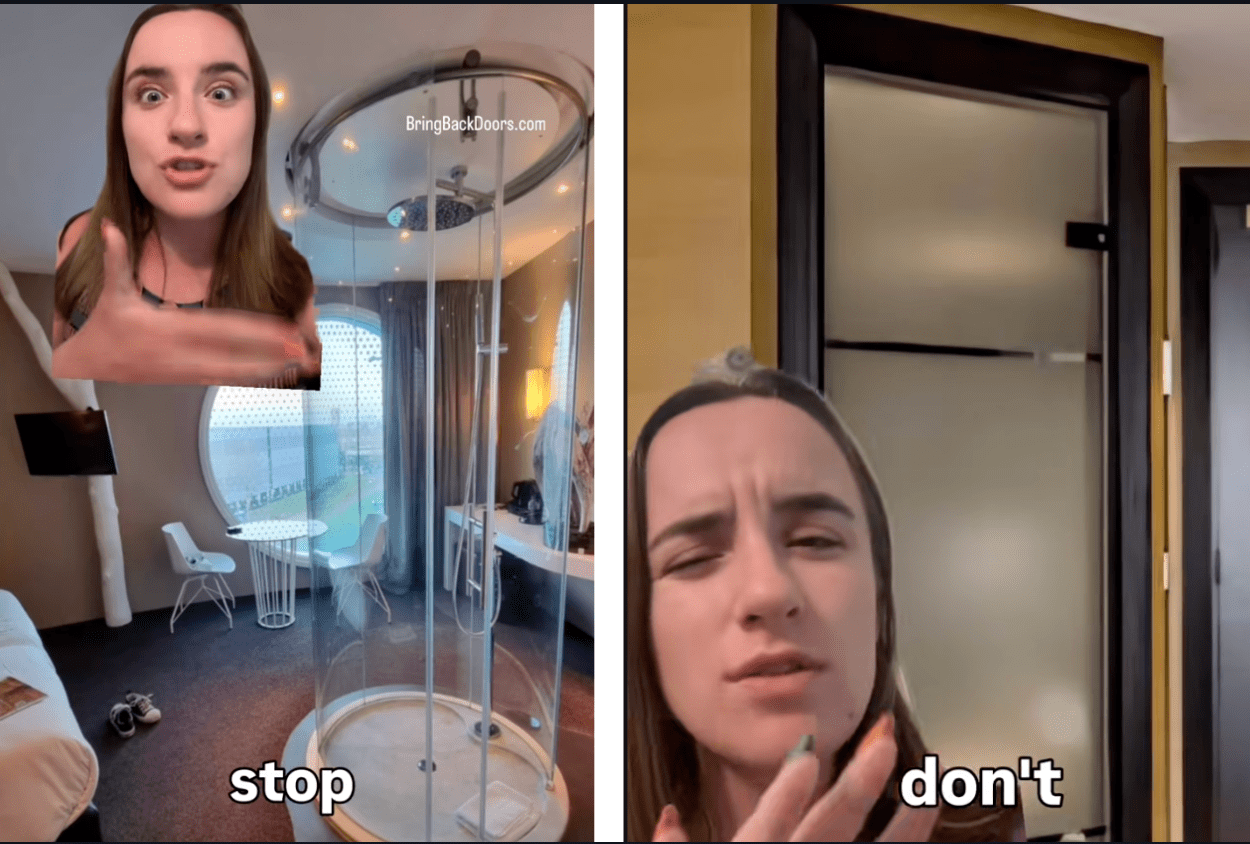
    One example that is getting attention is the bathroom doors in hotels… or the lack thereof, actually. One TikToker has had enough and has taken it upon herself to save regular bathroom doors in hotels and to point out why open-space bathrooms and glass doors just don’t cut it.

    On her @bring_back_doors TikTok account, Sadie has a collection of videos highlighting the flaws in hotel bathroom designs, with the most prominent being the lack of a regular door to the bathroom. In one viral TikTok, Sadie discussed a hotel that reached out to her, explaining that they have “foggy” glass doors to their bathroom to provide privacy. She was quick to point out that it still doesn’t provide adequate privacy. “Yes you can see through these,” Sadie said, adding that “glass doors do not close properly.”


    @bring_back_doors

    Hotel name: Alexander Hotel, Noordwijk aan Zee, Netherlands I need to be clear. Glass doors are not private. And making them foggy does not make them private. I am once again sitting here saying screw you to all bathroom doors that are not solid and close fully. And I am providing alternative hotels with guaranteed doors at bringbackdoors.com Check your hotels door situation before you book or risk your privacy. Door submitted by @mmargaridahb, DM me to submit your own bad doors. #bathroomdoors #hotel #travel #fyp Bathroom doors | bathroom design | hotel design | bad hotel design | travel fail | travel memories | travel inspo | door design | hotels with privacy

    ♬ original sound – Bring Back Bathroom Doors

    The comments rallied behind Sadie’s bathroom-door crusade

    The commenters joined in with Sadie, demanding the return of solid, closing, and lockable doors to bathrooms in hotels:

    “I HATE how hotels started thinking going to the bathroom is a shared experience.”

    “I hate how you can’t turn the bathroom light on without disturbing the other person in the room.”

    “The foggy ones are almost worse, you just get a hazy fleshy silhouette hunched over on the crapper like some kind of sack of ham.”

    “I just don’t get it, NOBODY wants this, even couples. I won’t be more likely to book two separate rooms for me and my friend/sibling/parent, I’ll just book another hotel.”

    “Love this campaign, I do not want a romantic weekend listening to the other person poo.”


    @bring_back_doors

    Hotel Names⬇️⬇️ Citizen M South Hotel (first pics) and Fletcher Hotel (third pic) both in Amsterdam. As part of this project, I’ve been emailing hotels around the world to put together an easy to reference list for people to find hotels with guaranteed doors at BringBackDoors.com And I did notice that in Amsterdam a lot of hotels were saying they don’t have doors. It wasn’t the worst city (that honor goes to Barcelona, so far I’ve only found TWO that have said yes to all doors), but it was still bad. Then I went into the comments. And kept getting people mentioning these hotels in Amsterdam. And I realized that clearly the city has a designer or architect on the loose who has a thing for test tubes. It’s horrible. Luckily, I was able to find 6 hotels in Amsterdam that all have bathroom doors in every room and have them all listed on BringBackDoors.com These hotels were submitted by so many people I couldn’t name them all. But to submit your own bad hotel bathroom send me a DM with hotel photo, name, and location! #hotel #bathroom #hoteldesignfail Bathroom doors | hotel bathrooms | hotel privacy | no privacy | travel problems | hotel issues | travel | hotel design | hotel design fail | hotel designers | design fail | hotel concept | bathrooms | Citizen M | Hotel Fletcher | Hotels in Amsterdam | Visit Amsterdam | Amsterdam

    ♬ original sound – Bring Back Bathroom Doors

    A great way to save a buck—er, I mean, ‘create a modern look’

    As many commenters asked, why do hotels have glass doors — or, worse, no doors at all—in their bathrooms? Well, this has been a growing trend in modern hotels over the past decade as a means to create a sleek aesthetic and to allow glass partitions to bring more daylight into otherwise darker sections of the room.

    At least that’s what’s being promoted to the customer. In reality, skimping on solid doors for glass ones or none at all gives the illusion that the room is bigger than it is while requiring fewer building materials. It does bring in more daylight, but mostly with the hope that you’ll cut down on electricity use for lights in an otherwise enclosed space. These reasons are also why some hotels don’t have solid walls around their bathroom areas at all.

    TikTok · Bring Back Doors

    TikTok u00b7 Bring Back Doors www.tiktok.com


    Tired of the lack of privacy? Check out the database

    To combat this trend, Sadie has developed a database at bringbackdoors.com for her and her followers to report which hotels have true, solid, private bathrooms in their accommodations and which ones do not, so people can properly plan where to stay and have true privacy during their most vulnerable moments.

    “I get it, you can save on material costs and make the room feel bigger, but what about my dignity?,” Sadie wrote on her website. “I can’t save that, when you don’t include a bathroom door.”

    Over time, the hope is that sanity and dignity can be restored as hotels realize that their glass “features” don’t have any real benefit when they don’t allow basic privacy.

  • MIT’s super-fast camera can capture light as it travels
    ArrayPhoto credit: assets.rebelmouse.io

    MIT’s super-fast camera can capture light as it travels

    It has a resolution rate of one frame per trillionth of a second.

    A camera developed at MIT can photograph a trillion frames per second. Compare that with a traditional movie camera which takes a mere 24. This new advancement in photographic technology has given scientists the ability to photograph the movement of the fastest thing in the Universe, light. In the video below, you’ll see experimental footage of light photons traveling 600-million-miles-per-hour through water.

    The actual event occurred in a nano second, but the camera has the ability to slow it down to twenty seconds. For some perspective, according to New York Times writer, John Markoff, “If a bullet were tracked in the same fashion moving through the same fluid, the resulting movie would last three years.”


    It’s impossible to directly record light so the camera takes millions of scans to recreate each image. The process has been called femto-photography and according to Andrea Velten, a researcher involved with the project, “There’s nothing in the universe that looks fast to this camera.”


    This article originally appeared seven years ago.

  • Kelsey Wells’ Side-By-Side Photos Prove That Weight Doesn’t Equal Health
    ArrayPhoto credit: assets.rebelmouse.io

    It’s super easy for most people to get hung up on the number on their scales and not how they actually look or, most importantly, feel. People often go on diets in hopes of reaching an ideal weight they had when they graduated high school or got married, but they’re often disappointed when they can’t attain it.

    But a set of photos by fitness blogger Kelsey Wells is a great reminder for everyone to put their scales back in storage. Welles is best known as the voice and body behind My Sweat Life, a blog she started after gaining weight during pregnancy. To lose the weight, she started the Bikini Body Guide (BBG) training program and after 84 weeks she shared three photos on her Instagram account that prove the scale doesn’t matter.

Explore More Design Stories

Design

People are cheering woman’s refusal to accept the latest trend in hotel bathrooms

Design

MIT’s super-fast camera can capture light as it travels

Articles

Kelsey Wells’ Side-By-Side Photos Prove That Weight Doesn’t Equal Health

Articles

No one noticed what this woman was staring at when they chose her for their label