
Climate experts believe that reducing greenhouse gas production will not be enough to limit the effects of climate change. We must also remove a large amount of carbon dioxide from the atmosphere that we have already released.

Besides planting trees, one way to remove CO2 from the atmosphere is through direct air capture systems (DACs). Operate by stripping CO2 from the air and then either burying it underground or using it to manufacture products such as concrete or aviation fuel.

Currently, there are 19 DAC systems operating worldwide that capture around 10,000 tons of CO2 annually. To completely cancel out the total amount of CO2 produced each year, we’d need to sequester 20 billion tons of CO2 annually. 

Solving climate change through DAC seems like an overwhelming, impossible task. Still, a new development in West Texas could prove that DAC is a viable solution that can easily be scaled to remove millions, if not billions, of tons of CO2 annually.


https://youtube.com/watch?v=PliBJI8b8ew%3Fsi%3D1XYvRKIkrc509Jmo

Last year, Occidental Petroleum Corp. broke ground on the STRATOS DAC plant in West Texas, which, when operational, could remove up to 500,000 tons of CO2 from the atmosphere every year. The plant is the first of what the company hopes to be 100 of its kind. The original budget was $800 billion, but it has blown up to $1.3 billion, bringing a $500 million investment from BlackRock.

BlackRock’s investment is a big vote of confidence in the efficacy of DAC technology and the STRATOS project’s financial viability.

“We are excited to partner with BlackRock on this transformative facility that will provide a solution to help the world reach net zero,” Occidental Petroleum Corp Vicki Hollub said in a statement. “This joint venture demonstrates that Direct Air Capture is becoming an investable technology and BlackRock’s commitment in STRATOS underscores its importance and potential for the world. We believe that BlackRock’s expertise across global markets and industries makes them the ideal partner to help further industrial-scale Direct Air Capture.”

via 1pointfive.com
via 1pointfive.com

According to BlackRock CEO and Chair Larry Fink, the new DAC facility “represents an incredible investment opportunity for BlackRock’s clients” and “underscores the critical role of American energy companies in climate technology innovation.”

The STRATOS project is 30% complete and when it is fully operational in 2025, it will generate revenue by selling carbon credits. It has already inked deals with Amazon, All Nippon Airways, and TD Bank. Companies purchase climate credits to offset their carbon footprint.

On an altruistic level, carbon credits allow companies to say they’ve removed the carbon from the atmosphere that they’ve produced through manufacturing, shipping, or harvesting materials. They also purchase them to meet their net-zero goals, align with the targets of the Paris Agreement, follow industry trends, create a positive image of the company through PR, or meet customer demand for environmentally sound businesses.

If all goes well with STRATOS, Occidental hopes to expand globally like a McDonalds or Starbucks. “Instead of expecting to build 100 of these, then we can start to get into the hundreds of them and potentially the thousands that are going to be needed to be built,” she said, according to Freethink.

If Occidental and its partners can get thousands of STRATOS DACs up and running worldwide, it could significantly reduce annual CO2 production by millions of tons and provide hope that we can one day get to a net-zero world.

  • How D.C.’s ‘humanure’ fertilizer creates lush gardens and big profits while improving the environment
    Photo credit: CanvaWhat you flush away could help your garden grow.

    The District of Columbia Water and Sewer Authority—now known as D.C. Water—has long provided water and sewer services to Washington, D.C. But for the past decade, the utility has also had an unexpected side hustle: turning human wastewater into fertilizer with flourishing results.

    At most wastewater treatment plants, flushed water is cleaned, while the remaining solid matter is hauled away for disposal. Over time, transporting and disposing of that waste can cost millions of dollars while increasing carbon emissions from the trucks carrying it. A decade ago, however, D.C. Water decided to invest in transforming the solid waste into “humanure” rather than throwing it away.

    Growin’ grass and makin’ gas

    At the end of the wastewater treatment process, the collected human waste solids are processed into biosolid fertilizer using technology developed by Norwegian company Cambi. The process doesn’t just produce high-quality fertilizer—it also generates biogas that can be put to good use.

    “So you get up to 40% more biogas,” Cambi CEO Eirik Fadnes said. “That biogas can be used to generate electricity to be used elsewhere in the wastewater-treatment plant or put on the grid and sold.”

    D.C. Water sells the biosolid fertilizer under the brand name Bloom, and it’s already proving to be a success. Bloom has been used throughout the Washington, D.C., area by customers including Catholic University, Mount Olivet Cemetery, and the Franciscan Monastery. It’s also used on numerous lawns, school grounds, community gardens, and golf courses.

    Success by the numbers

    The numbers underscore D.C. Water’s success. To date, nearly 400,000 tons of Bloom have been sold across Washington, D.C., Maryland, Pennsylvania, and Virginia, generating $13.6 million in revenue. D.C. Water originally estimated it would take 20 years for Bloom to pay off its investment. But thanks to strong demand from institutions, landscapers, and local garden centers, the utility is now on pace to recoup that investment in just 12 years.

    Bloom is also helping D.C. Water meet its environmental goals. By turning waste into a useful product instead of hauling it away for disposal, the utility has reduced its carbon footprint by roughly 50,000 metric tons of CO₂ emissions each year—the equivalent of taking more than 11,700 gas-powered cars off the road annually. The process also produces biogas, which can be converted into electricity to help offset the energy costs of wastewater treatment.

    Human waste works wonders

    None of this would matter if human biosolids weren’t effective at improving soil. “Humanure,” a term coined by Joseph Jenkins, refers to compost made from properly treated human waste. Because human feces can contain disease-causing pathogens, it must be handled carefully. After all, we call it “waste” for a reason.

    When human waste is composted correctly, naturally occurring microbes break down the organic material while generating enough heat to destroy harmful pathogens. Over time, the result is a nutrient-rich compost that can improve soil health. Some farmers even build specialized outdoor composting toilets to create humanure for use on their land.

    Should D.C. Water continue on this path of simultaneous profitability and environmental improvement, it’s likely other wastewater treatment plants will follow its lead.

  • A Spanish park has been free of wildfires for over a decade thanks to 18 donkeys
    Photo credit: CanvaDonkeys and other livestock could help prevent mass wildfires.

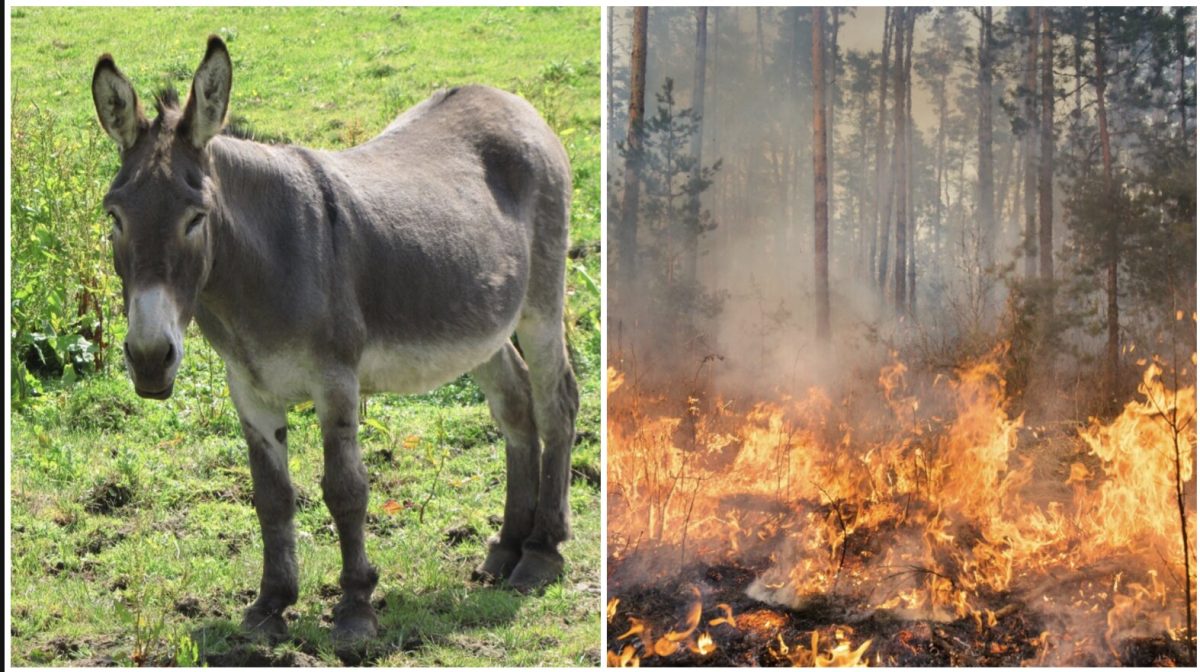
    According to NASA, wildfires have doubled worldwide due to climate change. Throughout the globe, governments and environmentalists have been trying to find ways to curb the fires. One particular national park in Spain has found a solution that has been keeping them fire-free for over a decade: donkeys.

    Since 2014, the Firefighting Donkey Battalion unit consisting of 18 donkeys has been preventing wildfires in Doñana National Park in Doñana, Spain. The mission these donkeys do is simple: eat the dry brush that usually sparks and fuels wildfires. The donkeys spend up to seven hours a day using their voracious appetites to graze and clear a 130 by 50 feet area of dried grass, scrub, and other vegetation.

    Why donkeys?

    While humans can do this type of clearing out of dry brush, using donkeys for this work is arguably more effective. While it is a slower process, it is consistent and thorough. Donkeys are able to quietly patrol in areas that are inaccessible to vehicles. In exchange for the feasting, the donkeys get about eight gallons of water and rest. No money or fuel needed.

    The donkeys’ bodies are also pretty much built for this kind of environmental work, too. Their stomachs are built to eat the same rough and dry grass repeatedly without issues. These daily grazings slowly but surely remove potential origin sources for fires. As a bonus, the donkeys are naturally disposing of the dried vegetation whereas humans would have to find a different way to dispose of it.

    Having donkeys or other livestock graze in such areas was once more common in agriculture prior to modern farming. Some argue that the machinization of farming and urbanization have reduced the number of grazing animals. This in turn allows more vegetation growth that become dry spots for more wildfires to occur.

    The method expands

    This method has been so successful that other areas of Spain have adopted it. In 2020, Tivissa launched the Burros Bomberos project with three donkeys to so much success they’ve expanded. They now have 40 donkeys grazing and clearing nearly 400 hectares of land.

    The Andrea Association in Allariz uses a team of donkeys to clear and maintain nearly 1,000 hectares of a biosphere reserve. Using GPS to monitor the donkeys’ activity, the group of grazers travel 19 kilometers per day to feed. Similar initiatives have since started in Basque Country, Catalonia, and Galicia, too.

    Other ways to combat wildfires

    In the United States, California has been using goats in a similar function. The group Fire Grazers Inc. has been contacted throughout California to bring hundreds of goats to eat dried vegetation. Much like donkeys, goats are built to eat rough and dry brush. This includes certain plants such as star thistle that are painful for human hands to grab.

    It’s important to note that donkeys or other animals that eat dry scrub are the primary solution to wildfires. The same folks behind these initiatives also advocate proper forest planning and land management. This includes reducing the amount of easily flammable species of plants and trees such as pine. It takes thought, care, work, and maybe a bunch of donkeys to make a difference.

  • Beyond birds and mice, free‑ranging cats eat a surprising number of insects
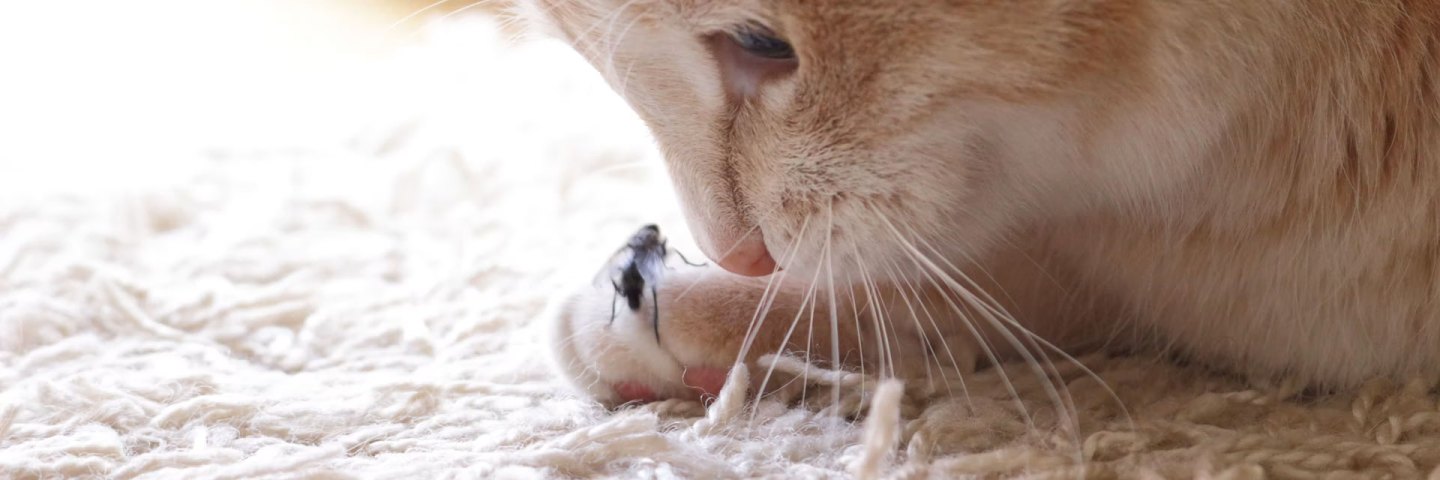
    Photo credit: SKashkin/iStock / Getty Images PlusDoes that look tasty?

    It’s pretty commonly known, and not very startling, that free-ranging cats eat birds and small rodents. But the degree to which they eat insects might surprise you.

    We are biologists who for many years have been trying to figure out what feral or outdoor-roaming pet cats eat outside.

    When domesticated cats – Felis catus – live freely in the wild or are allowed to hunt outside the homes where their owners live, they are an invasive species, which live in every ecosystem of the world except the continent of Antarctica. We wanted to know all of the species they eat – and to what degree free-ranging cats are eating endangered or threatened species.

    Examining reams of research

    Over the past two decades, we have evaluated hundreds of scientific findings, including searching through Google Scholar and Web of Science using the keywords “cat predation,” “feral cat,” “cat diet” and “Felis catus.” For each item we found, whether peer-reviewed or not, we evaluated whether it contained conclusive evidence of cat diet or predation. We also reviewed each one’s reference section for additional unique articles or databases pertaining to cat diet and predation, and included those in our search.

    Overall, we identified 533 unique publications – books, journal articles, theses and agency reports – that reported specific animal species consumed by cats. Cats’ plant-eating habits are occasionally, but haphazardly, noted in studies, so we did not include them in our analysis.

    Our initial work focused on an overall assessment of what free-ranging cats eat around the world. Published in 2023, this paper analyzed the 533 studies on cat diet or predation events published over more than a century and found that cats ate nearly 2,100 different species of animals, including invertebrates.

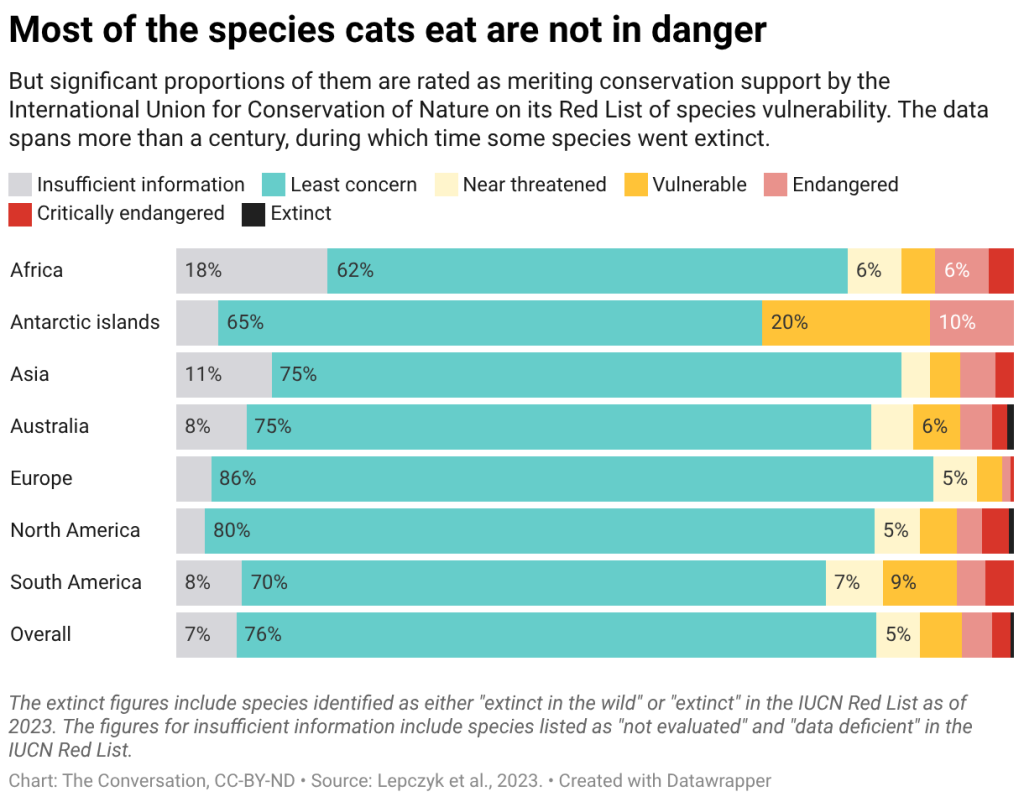
    Of those 2,100, the International Union for Conservation of Nature’s Red List of Threatened Species listed 347 as “near threatened,” “vulnerable,” “endangered,” “critically endangered” or “extinct” in 2023. Some of the species went extinct during the many decades covered by the data.

    Most of the species cats eat are not in danger

    Insects and the like

    Most of the species cats ate were vertebrates – mostly birds, followed by mammals and reptiles. But the data also indicated that at least 7% of the species cats eat are insects and other invertebrates, particularly beetles, and less frequently crustaceans, arachnids, centipedes, snails and slugs, and millipedes.

    Many of the cat studies we reviewed did not report on how many individuals of a given species cats ate, so it was unclear what the total amount of insects was or how many calories cats are deriving from insects.

    Invertebrates make up more than 70% of all terrestrial animal species and are important pollinators, predators and herbivores in virtually every nonmarine ecosystem. Many invertebrates are in decline globally due to urbanization, habitat destruction, increases in both light and pesticide pollution, and climate change. So we dug deeper into the data to understand what invertebrates cats are eating.

    While a little more than one-third of all the studies we analyzed included invertebrates as part of cats’ diet, most of those failed to identify specific species of invertebrates. But we were able to find identifications of 148 invertebrate species.

    Of those, two are considered endangered by the International Union for Conservation of Nature: the Aldabran grasshopper (Pternoscirtus aldabrae) in Seychelles and the Tasmanian giant freshwater crayfish (Astacopsis gouldi), which can grow up to 13 pounds (6 kilograms). Two others are considered vulnerable: wētāpunga (Deinacrida heteracantha), an insect native to New Zealand that can be about the size of a mouse, and the common yabby (Cherax destructor), a freshwater crayfish native to southeastern Australia. One other, the Canary Islands horned beetle (Arhopalus pinetorum), is listed as “near threatened.”

    A cat licks its lips while crouching over a dead mouse.
    Not surprising: Cat eats mouse. Julian Stratenschulte/picture alliance via Getty Images

    Effects on populations

    We have not found formal research evaluating how cats’ eating habits affect invertebrate populations. And for many species, they are likely not as significant a factor as wide-scale pesticide use.

    But it’s possible that cats could be significant contributors to the deaths of rare species or in specific locations.

    Cats require a large amount of protein, as much as one-third of their daily diet, and invertebrates are good sources of protein.

    In many places, invertebrates provide an easy source of food. Whether in an urban backyard or on a remote island, cats are unlikely to turn a blind eye to available prey. And some cats may find it entertaining to chase, catch and eat insects even if they don’t need their nutrition.

    A challenge of researching this question is that many invertebrates are relatively small, which makes direct observation in the field harder and can require more analytical approaches in the lab. And they have soft bodies, without distinguishing characteristics that could be easily recognized in scat or stomach contents.

    However, molecular technologies can identify species using trace amounts of DNA left in the environment by animals. Promising new studies are beginning to identify what cats eat by analyzing the DNA found in their stomachs and scat. That research may help explore in even more detail what cats are eating in the outdoors, and how it’s affecting various species and the environment as a whole.

    This article originally appeared on The Conversation. You can read it here.

Explore More Environment Stories

Environment

How D.C.’s ‘humanure’ fertilizer creates lush gardens and big profits while improving the environment

Environment

A Spanish park has been free of wildfires for over a decade thanks to 18 donkeys

Environment

Beyond birds and mice, free‑ranging cats eat a surprising number of insects

Environment

The University of Cambridge found a way to reduce plastic waste and create clean hydrogen energy at the same time