Pueblo Jones is out on a mission to track down indigenous artifacts that were stolen through colonization. His adventure-filled quests won’t stop until he has reclaimed the objects and returned them to their rightful owners: the communities where they were taken from.


This Indiana Jones-esque tale comes from the mind of Lee Francis, an educator, writer, publisher, and bookstore owner with roots in the Laguna Pueblo tribe of New Mexico. Francis wants to subvert the stereotypical depictions of indigenous peoples through the creation and support of Native American comics. And, not unlike the character he created, he wants to put the power to own one’s narratives and culture back in the hands of the originators.

[quote position=”full” is_quote=”true”]We can foster a different understanding of Native identity.[/quote]

For Francis, the graphic novel provides the perfect platform for shifting and flipping Indigenous narratives. “That’s the best strategy on how to change hearts and minds. Give me something exciting to read and we can foster a different understanding of native identity,” Francis says.

Francis grew up with a father whose prolific career as an educator and advocate for Native writers meant moving back and forth between coasts. But one constant remained for him — his summers were always spent in New Mexico. It was there that, with his father’s encouragement, Francis picked up comics at a local drug store. He gravitated to the visually engaging grandeur of Marvel’s stories. “What really engaged me is the superhero, and the narrative arc, and the epic scale,” he describes.

[quote position=”full” is_quote=”true”]The visuals are so important because it’s how you perpetuate how indigenous people are seen.[/quote]

After receiving his doctorate in education and following in his father’s footsteps as an educator (with a particular focus on workshops around writing, public speaking, and theater for Native youth) Francis returned to that childhood passion for the comic book. He founded Native Realities, a publishing and distribution company he describes as “an indigenous imagination company.”

Through Native Realities, he produces and distributes graphic novels and comics created for, and by, indigenous peoples around the world. A year ago, he opened Red Planet Comics, perhaps the only bookstore in the world dedicated solely to indigenous-penned graphic novels and comics. In addition to the publishing endeavors, Francis also created Indigenous Comic-Con, which happens once a year in Albuquerque.

For the self-proclaimed “Indigenerd,” being a proponent of Native-created comics goes beyond a childhood hobby — it’s about taking ownership of narratives that have been co-opted and distorted by mainstream media for far too long.

It’s also a way to imagine new realities and create vehicles for identity formation at time when Native youth lack culturally appropriate representation. Due to the inherent visual nature of these books, it’s a perfect medium to subvert and complicate the typical representation of Native peoples.

[quote position=”full” is_quote=”true”]It’s for Native kids to see themselves as superheroes.[/quote]

“Comics marry the visual with the story. The visuals are so important because it’s how you perpetuate how indigenous people are seen,” Francis explains. “If you keep seeing the shaman, or the Native on a horse, if that’s all you see, then no matter what it’s already an uphill struggle.” Because comics are mass media product, it’s an effective medium for reaching a wide-audience with disruptive stories. “The idea is to access the market in the exact same way, whether it’s for Native kids to see themselves as superheroes or non-Native kids and how they see their friends and Native identity in the U.S.,” Francis says.

Indigenous cultures have a rich history of both visual and oral storytelling that has survived thousands of years despite systems of forced assimilation. Often acting as a form of survival, storytelling could be used to share pertinent information and preserve culture. “With the visual medium, it allows us to draw back to traditional stories, to our stone stories, our petroglyphs — those are the first comic books,” Francis says. The comic or graphic novel medium allows current indigenous storytellers to borrow from those traditions while engaging with modern themes and styles. “We came back and told the stories over and over again, and as we build a new narrative, we expand and build on those traditional stories [in a way] that makes sense for the modern world we live in.”

[quote position=”full” is_quote=”true”]These comics create complex narratives that blend tradition, history, and futurism while often commenting on current issues.[/quote]

Red Planet Comics distributes books like “Tales of the Mighty Code Talkers” which details and expands the stories of Native American Code Talkers who used their languages to safely deliver classified information during the wars of the 21st century. “Deer Woman: A Vignette” comments on violence against Native women through an empowering narrative where Deer Woman, a mythical woman who lures and kills men with her hooves, defends victims of sexual assault. The digital comic is available for free and includes self-defense techniques for women. “Tribal Force,” one of the first Native comics, delves into the Dine belief of parallel universes through the eyes of a young woman. Futurism and tradition blend as the young Dine girl is tasked with saving civilization by using the powers that afford her the ability to see various realities and outcomes. These comics create complex narratives that blend tradition, history, and futurism while often commenting on current issues.

By owning all aspects of creation from production to distribution, Francis is able ensure the stories being perpetuated are representational and don’t fall into shallow tropes. As he explains, oftentimes Native creators are told to “make things more Native,” which typically translates to adding stereotypical elements like feathers, shamans, and tragedy. Native Realities, and its physical extension Red Planet Comics, affords creators the opportunity to tell stories on their own terms without having to worry about distilling their narratives for wide audiences.

These platforms serve as one alternative to the problems of representation. Through these graphic novels, Native youth can relate to and be inspired by these inclusive narratives. “Kids need as many options to enforce their identity and who they are. We need to create the alternative because if we are not doing that, then we can’t change the other,” Francis says. “They’re not just passive consumers, they get to be inspirited by the work and tell their own stories. They get to be the superhero of their stories.”

  • People are cheering woman’s refusal to accept the latest trend in hotel bathrooms
    Sadie has declared war on non-private hotel bathrooms.Photo credit: @bring_back_doors

    People are cheering woman’s refusal to accept the latest trend in hotel bathrooms

    “I HATE how hotels started thinking going to the bathroom is a shared experience.”

    It can be frustrating seeing change for change’s sake in the world. To be more specific, changes that are said to be done in the name of innovation and design, but are in truth ways for companies to save a buck.

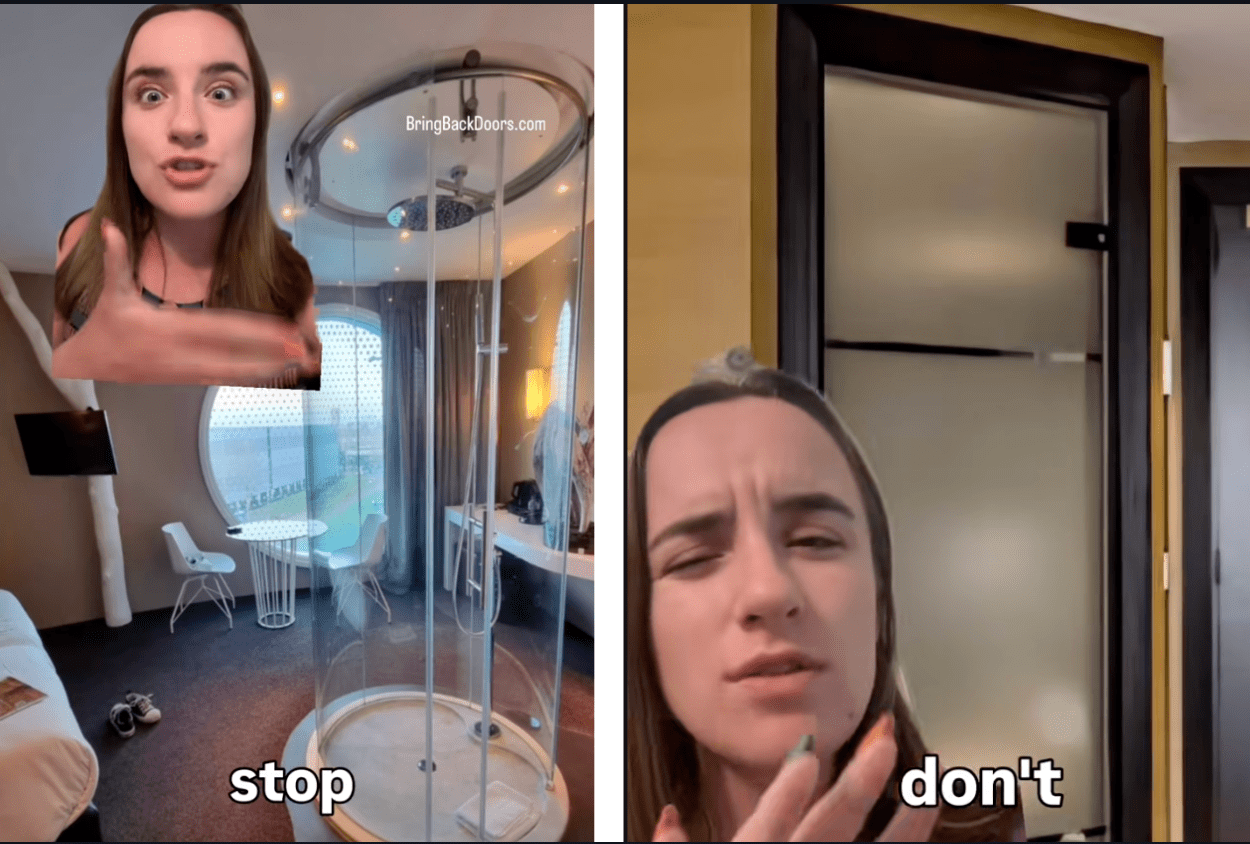
    One example that is getting attention is the bathroom doors in hotels… or the lack thereof, actually. One TikToker has had enough and has taken it upon herself to save regular bathroom doors in hotels and to point out why open-space bathrooms and glass doors just don’t cut it.

    On her @bring_back_doors TikTok account, Sadie has a collection of videos highlighting the flaws in hotel bathroom designs, with the most prominent being the lack of a regular door to the bathroom. In one viral TikTok, Sadie discussed a hotel that reached out to her, explaining that they have “foggy” glass doors to their bathroom to provide privacy. She was quick to point out that it still doesn’t provide adequate privacy. “Yes you can see through these,” Sadie said, adding that “glass doors do not close properly.”


    @bring_back_doors

    Hotel name: Alexander Hotel, Noordwijk aan Zee, Netherlands I need to be clear. Glass doors are not private. And making them foggy does not make them private. I am once again sitting here saying screw you to all bathroom doors that are not solid and close fully. And I am providing alternative hotels with guaranteed doors at bringbackdoors.com Check your hotels door situation before you book or risk your privacy. Door submitted by @mmargaridahb, DM me to submit your own bad doors. #bathroomdoors #hotel #travel #fyp Bathroom doors | bathroom design | hotel design | bad hotel design | travel fail | travel memories | travel inspo | door design | hotels with privacy

    ♬ original sound – Bring Back Bathroom Doors

    The comments rallied behind Sadie’s bathroom-door crusade

    The commenters joined in with Sadie, demanding the return of solid, closing, and lockable doors to bathrooms in hotels:

    “I HATE how hotels started thinking going to the bathroom is a shared experience.”

    “I hate how you can’t turn the bathroom light on without disturbing the other person in the room.”

    “The foggy ones are almost worse, you just get a hazy fleshy silhouette hunched over on the crapper like some kind of sack of ham.”

    “I just don’t get it, NOBODY wants this, even couples. I won’t be more likely to book two separate rooms for me and my friend/sibling/parent, I’ll just book another hotel.”

    “Love this campaign, I do not want a romantic weekend listening to the other person poo.”


    @bring_back_doors

    Hotel Names⬇️⬇️ Citizen M South Hotel (first pics) and Fletcher Hotel (third pic) both in Amsterdam. As part of this project, I’ve been emailing hotels around the world to put together an easy to reference list for people to find hotels with guaranteed doors at BringBackDoors.com And I did notice that in Amsterdam a lot of hotels were saying they don’t have doors. It wasn’t the worst city (that honor goes to Barcelona, so far I’ve only found TWO that have said yes to all doors), but it was still bad. Then I went into the comments. And kept getting people mentioning these hotels in Amsterdam. And I realized that clearly the city has a designer or architect on the loose who has a thing for test tubes. It’s horrible. Luckily, I was able to find 6 hotels in Amsterdam that all have bathroom doors in every room and have them all listed on BringBackDoors.com These hotels were submitted by so many people I couldn’t name them all. But to submit your own bad hotel bathroom send me a DM with hotel photo, name, and location! #hotel #bathroom #hoteldesignfail Bathroom doors | hotel bathrooms | hotel privacy | no privacy | travel problems | hotel issues | travel | hotel design | hotel design fail | hotel designers | design fail | hotel concept | bathrooms | Citizen M | Hotel Fletcher | Hotels in Amsterdam | Visit Amsterdam | Amsterdam

    ♬ original sound – Bring Back Bathroom Doors

    A great way to save a buck—er, I mean, ‘create a modern look’

    As many commenters asked, why do hotels have glass doors — or, worse, no doors at all—in their bathrooms? Well, this has been a growing trend in modern hotels over the past decade as a means to create a sleek aesthetic and to allow glass partitions to bring more daylight into otherwise darker sections of the room.

    At least that’s what’s being promoted to the customer. In reality, skimping on solid doors for glass ones or none at all gives the illusion that the room is bigger than it is while requiring fewer building materials. It does bring in more daylight, but mostly with the hope that you’ll cut down on electricity use for lights in an otherwise enclosed space. These reasons are also why some hotels don’t have solid walls around their bathroom areas at all.

    TikTok · Bring Back Doors

    TikTok u00b7 Bring Back Doors www.tiktok.com


    Tired of the lack of privacy? Check out the database

    To combat this trend, Sadie has developed a database at bringbackdoors.com for her and her followers to report which hotels have true, solid, private bathrooms in their accommodations and which ones do not, so people can properly plan where to stay and have true privacy during their most vulnerable moments.

    “I get it, you can save on material costs and make the room feel bigger, but what about my dignity?,” Sadie wrote on her website. “I can’t save that, when you don’t include a bathroom door.”

    Over time, the hope is that sanity and dignity can be restored as hotels realize that their glass “features” don’t have any real benefit when they don’t allow basic privacy.

  • MIT’s super-fast camera can capture light as it travels
    ArrayPhoto credit: assets.rebelmouse.io

    MIT’s super-fast camera can capture light as it travels

    It has a resolution rate of one frame per trillionth of a second.

    A camera developed at MIT can photograph a trillion frames per second. Compare that with a traditional movie camera which takes a mere 24. This new advancement in photographic technology has given scientists the ability to photograph the movement of the fastest thing in the Universe, light. In the video below, you’ll see experimental footage of light photons traveling 600-million-miles-per-hour through water.

    The actual event occurred in a nano second, but the camera has the ability to slow it down to twenty seconds. For some perspective, according to New York Times writer, John Markoff, “If a bullet were tracked in the same fashion moving through the same fluid, the resulting movie would last three years.”


    It’s impossible to directly record light so the camera takes millions of scans to recreate each image. The process has been called femto-photography and according to Andrea Velten, a researcher involved with the project, “There’s nothing in the universe that looks fast to this camera.”


    This article originally appeared seven years ago.

  • Kelsey Wells’ Side-By-Side Photos Prove That Weight Doesn’t Equal Health
    ArrayPhoto credit: assets.rebelmouse.io

    It’s super easy for most people to get hung up on the number on their scales and not how they actually look or, most importantly, feel. People often go on diets in hopes of reaching an ideal weight they had when they graduated high school or got married, but they’re often disappointed when they can’t attain it.

    But a set of photos by fitness blogger Kelsey Wells is a great reminder for everyone to put their scales back in storage. Welles is best known as the voice and body behind My Sweat Life, a blog she started after gaining weight during pregnancy. To lose the weight, she started the Bikini Body Guide (BBG) training program and after 84 weeks she shared three photos on her Instagram account that prove the scale doesn’t matter.

Explore More Design Stories

Design

People are cheering woman’s refusal to accept the latest trend in hotel bathrooms

Design

MIT’s super-fast camera can capture light as it travels

Articles

Kelsey Wells’ Side-By-Side Photos Prove That Weight Doesn’t Equal Health

Articles

No one noticed what this woman was staring at when they chose her for their label