
There’s a dilemma women face that most men will never understand. When a woman is nice to a man she has just met, they often misconstrue her kindness for a sign of sexual attraction. A study published in Psychological Science found that men who are shown pictures of women misidentify their body language and facial expressions as sexually suggestive 12% of the time.

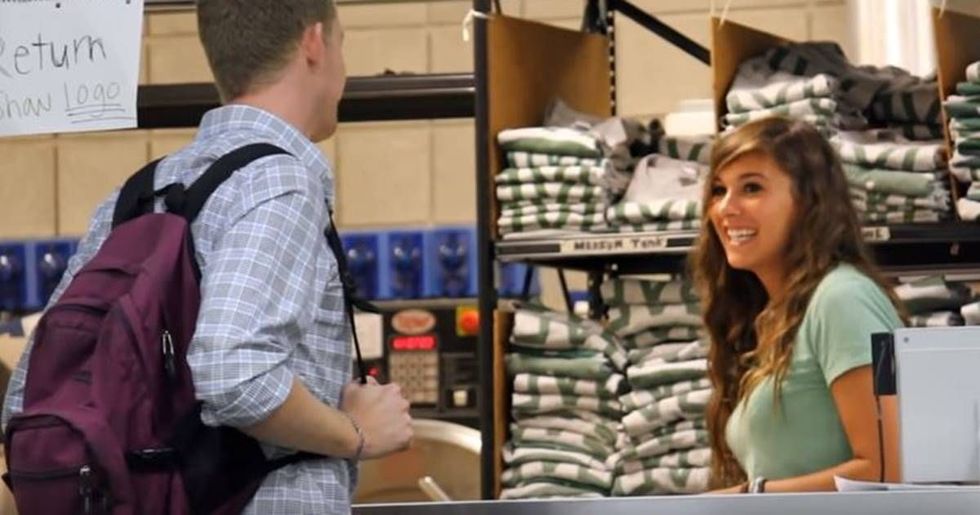
This poses a huge problem for women in customer service. Reddit user XochiquetzalRose was having such a problem with men misinterpreting hr kindness for flirting, she asked the online forum for help. And boy did they deliver.

“I work at a grocery store. I have excellent customer service and im really empathetic. Im kind and i try to make every 30 second – 5 minute interaction with a person a good experience for them, she wrote. “I’m starting to feel a little upset though because some of my regular men… older, sick, sad… have become too comfortable with me. They needed a kind ear but now they seem to feel it means more. They make comments about going out, or do i have a boyfriend or nothing sexual” but”can we be friends, can i have your number?” When i know the nothing sexual” isn’t their true intention.”

“It hurts my feelings because, can’t i just be kind? Can’t we just be humans in this together? Why must it turn down that path. Do any of you experience these sort of interactions? I don’t want to close myself off from being an empathetic person, but the way the tides have been turning… it’s becoming exhausting.”

The post was a huge hit on Reddit attracting nearly 6,000 responses . More importantly, it provides some great advice for women who want to be kind to men but don’t want them to think they’re are being flirtatious.

flirting, men, women, sexism, harassment, communication, customer service
Customer service workers give smiles and thumbs up Image via Canva

Here are the 11 best responses:

1. “I’m very much like you, but I don’t work in retail anymore (thank god). My optimistic take on it, is to be honest and gentle. ‘I’m flattered but I don’t give out my number. Thank you for the compliment though!’

“If you want, you can hide behind imaginary boyfriends, or store policy, or not owning a phone, etc. But for me, owning my right to say no, without needing an excuse or an apology was very liberating.”

“You don’t owe them anything. You don’t even owe them a thank you for hitting on you. ( I only say thanks when the person is really polite and it genuinely flatters me) . And if it seems daunting at first, practice what you’d say in front of a mirror, say the words aloud and listen how it sounds. Find phrases you like and repeat them until you own them.”

“There’s no need to compromise.”

“Edit: spacing + when I say gentle, I mean at first, and for those polite and genuine. If someone insists, you can tell them you’ve already answered, and they should respect that, and don’t hesitate to call them out on their harassment. Being nice and being meek are two very different things.”
dating, flirting, parties, stalking, harassment, sexism
A woman pushes away a man Image via Canva

2. “God, this is so real. I never realized how important this was until recently. I had a stalkery guy who would NOT leave after a party, even though my friends insisted he leave ahead of them.”

“He lurked outside my apartment and called and texted asking if he could come back up. I told him all manner of “No.” Said I wasn’t interested. Told him to go home. Until eventually I gave up and texted, in response to his repeated calls.”

‘I can’t pick up the phone because I’m on the phone with my BOYFRIEND.’

“At the time, it was a lie (although I currently am dating the guy I was on the phone with lol). But he went away. I was SO PISSED that that’s what it took. And that he unquestioningly accepted another man’s dominion over me, when he wouldn’t accept a simple, “I’m not interested.” Guh, it still chaps me.”

3. “I worked in retail for most of my years in college. I started as a cashier and eventually moved into a stocking position. I worked in a resort community where there were many older people who were usually rude, acting like taking to you was a waste of their time.”

“Well while working there I was touched and awkwardly hit on almost weekly. I helped someone out to their car and they called me cute the entire time and asked me to get in their car. I had someone offer me a tip try to put in my pocket and then played with me while their hand was in my pocket. I was probably 17 for this one. My ass has been slapped, chest rubbed, and crotch grabbed multiple times. So I understand where everyone is coming from. The only difference is, I’m a man and had older women do all of this to me. I told my management about it and they usually laughed saying ‘your a guy get over it’.

4. “And it’s funny, even when you decline politely they’ll try to turn it around on you and make you the bad guy. I was having a drink and reading alone recently when a man came up to me and asked me if I smoked/offered a cigarette.”

Me: “No, I do not, but thanks”

Him: “Oh, well can I can sit down with you and talk?”

Me: “I’m really focused on my reading right now, and don’t feel like talking. I appreciate the offer though, you can even sit here to smoke if you want.”

Him: “…Well fine. I figured you’d want the company”

Guy was flustered walked away for a bit, but made to sure to get my attention as he left, “I’m going to enjoy that cigarette now!”

Me: “…Okay!”

Obviously not the worst interaction in the world, but definitely made me chuckle how entitled this guy felt to talk to me.”

flirting, sexism, unwanted attention, social skills, men, women, dating
A woman gives Image via Canva

5. “I have ‘The Look’ I give guys who can’t or won’t take a polite no. I can’t always control it, but I try to use it as a last resort. Years ago I was working retail and a customer was being an arse, and I looked away from him and The Look slipped out while I was looking in the direction of a friend. She saw The Look and ducked!! After the arse left she came over and asked why I was so mad at her.”

6. “Goodness, you could have been writing this for me. I work with the public and have a lot of regular customers too (banking) and I always try to get to know people a little bit. I’m in my mid 30’s and have a lot of older men start to become inappropriate after I’ve been kind to them. I have learned to curb their unwanted behavior to a degree and still be able to keep them smiling.”

“I started replying with some semi-sarcastic come backs and they usually don’t know what to say. Example: Old man : you sure look nice today.”

Me : “Thank you.”

Old man : “And you’re always so sweet to me!” (this is where I can sense it’s gonna shift to being inappropriate)

Me : “Well, being helpful and happy is why (Bank name) pays me!”

“I know it’s kind of stupid, but it changes the conversation and makes it harder for them to continue down their path. Just remain firm in saying no to their requests for ‘friendship’ and phone number requests. (when I get asked for my phone number I write down the bank number and say, you can reach me here!) Good luck, OP. Don’t let the pervs get you down.”
customer service, flirting, men, women
A woman interacts with a customer Image via Canva

7. “I worked in retail and feel your pain OP. It got to the point where I had to be walked to my car after shifts as male customers would wait outside for me. It was horrible.”

“It’s retail. My job involved being nice. You want a block of cheese, here it is + a smile and “hope you enjoy it, thanks for shopping with us”. You want a lottery ticket? Here it is + “hope it’s a lucky one for you, have a great evening”. You want to tell me your dog died? “I’m so sorry to hear that. He had such a wonderful time with you, and I do believe in the Rainbow Bridge”.

“I give the same service, and same chat, to all customers. Yet the amount of men that latched onto it as “she smiled and said have a nice day, she must want to fuck me”.

Approaches went from nervous “I really like you, will go out with me?” and phone numbers scribbled on receipts, right through to stalkers waiting after my shifts.

“There were the ones that would hold back until no other customers were around so they “could have you all to myself” and the ones that waited for the queues so they could announce ownership of me.”

“I loved my job, but too many male customers treated me like a whore. Like their purchase of a packet of fags bought them the right to have no boundaries with me. Really unhappy memories.”

flirting, grocery stores, customer service, men, women
A woman stocking shelves Image via Canva

8. “I worked at a grocery store and I’d get so pissed if men did this. There is absolutely NOTHING appropriate about a 50+ year old dude hitting on someone in their 20s. It’s disgusting, entitled, and beyond creepy.

“As soon as they’d do it, I would become extremely cold to them. They want to make me uncomfortable? I’ll make them feel every bit as awkward as I do.”

“And then they would hit on the fucking underage baggers who were usually 16. That would really send me into a rage, I always wanted to call them out for pedophillia. Disgusting.”

9.”Hotel industry. This post has sparked a rant here, and I’m sorry. The gist is I relate so very much to this.”

“Helping a man in his late 40s? find a steak house for him and his friend has lead to a confession of love (I’m an idiot for giving out my number; he kinda tricked me and I fell for it). A shuttle drive to the airport lead to a guy constantly asking for dates (he gave his business card, I thought for a job opportunity).”

“I actually just gave my PSN after chatting video games and mentioning I cant find a competitive group for R6 Siege and am now realizing that this is probably a bad idea. Shit. I also just got a business card for what I thought is another job opp but this may also be a bad idea. Shit.”

“I think I’m I guess nieve? Because I try to be nice to everyone since most my life many werent nice to me… and I keep thinking that folks arent shitty just to be proved wrong time and time again. Yet I keep hoping for good in this world. I really need to not give out my information regardless of circumstances. I’m just desperate for actual friendship. And because I’m relatable, mildly attractive, a nerd and a fitness freak, it always always turns into this weird fucking affinity for me where I’m now “theirs” somehow? As if checking them in and handing them roomkey cards makes me somehow their future wife.”

“But it’s also my job to be nice to folks. I’m not flirting, I’m moderately terrified of the idea of being alone with a man again, I’m just tryin to make their hotel stay start off with a smile. And yet, chatting about work woes or making a laugh or two or helping find stuff to do in the city (read: starting that smile) makes someone think I’m out to date them even when I explicitly say I’m not, I dont, I dont want to.”

“The worst is if I explain that I’m transgender. It either gets worse as I am no longer woman but now a fuck object that they have to have physically or it gets worse because I am now disgusting and they werent actually interested in me and I’m a piece of garbage that needs to kill myself. Like, look I’ve tried. Believe me, I want to. It didnt work, and now I feel like shit for being nice to a psychopath that didnt take a hint that’s gonna ruin my life for a while. I relate to this post on the deepest of levels.”

10. “I think you can give good customer service and then immediately detach to continue doing whatever other work you can find so that they don’t have as much of a chance to monopolize your attention and create a narrative of friendship (or more) in their heads.”

“I work as a barista and can see the potential for this issue in some of my customers, especially because my coffee bar isn’t usually super busy so there’s often time to talk to individual customers for several minutes if I feel like it. The second things start to feel overly familiar or sketchy in any way, it’s “well hey, have a good one, gotta get back to work!” or whatever and without giving them an opportunity to answer, I start cleaning something, answering the phone, stocking supplies, etc. It sucks that people take basic human kindness the wrong way sometimes, but that’s the unfortunate reality we’re living in, so it makes sense to protect yourself where you can by withdrawing from the people you can see becoming problematic.”

11. “Yes. Although I’m a stripper. But every single night I work without a doubt, a customer asks for my number or for me to go home with them.”

“I too am incredibly kind and love to talk and flirt and listen to people’s problems. But you’d think that men would realize I’m working when I’m interacting with them. NOPE! They want to take me home, they say we have a special connection.. it doesn’t matter how old too. I’ve gotten this reaction from men in their mid 30’s to old ass dudes too, and I’m only 25! It’s really kinda sad to me when this happens because even though I’m a nice and personable stripper, they don’t seem to realize I’m doing this for their money.”

This article originally appeared seven years ago.
  • The church fathers of early Christianity are showing their swag – on TikTok
    Photo credit: Holger Uwe Schmitt/Wikimedia Commons, CC BY-SASt. Paul is one of the many Christian figures whose paintings have made an appearance.

    It begins with the music: a late 1990s rap song. Then someone appears on screen, moving slowly into a pose that can only be called deeply, theatrically serious. Then comes the reveal: The video fades from the person into a medieval painting of a haloed man doing almost the exact same pose.

    Videos imitating “church fathers,” bishops and theologians who helped shape early Christianity have been popping up across social media since late 2025. Several versions have drawn hundreds of thousands of views.

    In part, they’re funny because of the incongruity: hoodies, bedrooms and phone cameras, suddenly paired with the solemn authority of saints. As an art historian who studies Christian images, I know that these types of paintings were carefully made to communicate holiness through visual cues like books, clothing, gestures and posture.

    But the humor also comes from how current they feel. These paintings may be centuries old, but the visual language is timeless. The raised hand, the open book, the severe gaze – they all communicate power. On TikTok or Instagram, a gesture once used to symbolize doctrine or wisdom starts to look like confidence, coolness, even swagger. The captions say as much: “They had swag fr,” one reads – for real.

    When the trend crossed my feed, I had to try it. What better way to show how these images work than by stepping into the pose?

    Church fathers

    Church fathers” were not “founders” in the simple sense, but foundational authorities: figures whose writings later Christians returned to when debating central questions about doctrine, scripture and religious life.

    Today’s social media trend uses the term more loosely. In addition to early Christian authors, many of the videos show later saints, monks, bishops and theologians, especially from Eastern Orthodox traditions. Online, “church father” becomes shorthand for religious authority itself.

    The paintings circulating online range from Eastern Orthodox icons to Western European Renaissance and Baroque paintings. In most cases, they were made long after the saints had died, so they don’t document what the men actually looked like.

    Instead, this style of art was meant to inspire awe, surrounding worshippers with a sense of religious authority. The saints’ books, rich vestments and formal poses were visible signs of holiness, symbolizing their learning, discipline and eloquence. Such images did not merely decorate sacred spaces; they taught viewers what closeness to divine truth – saintliness itself – could look like.

    Man of books and learning

    Several of the videos show Athanasius of Alexandria, a fourth-century bishop and theologian traditionally considered one of the church fathers.

    Painted by the Italian painter Domenichino in the 17th century, Athanasius stands in “contrapposto,” a pose inherited from classical art and common in Renaissance and Baroque painting. He leans back with his left shoulder, causing the right side of his body to project outward toward the viewer. The saint is dressed in a rich damask dalmatic – a long, wide-sleeved robe – over a white silk tunic.

    A bearded figure in an orange and brown robe gestures toward a large open book that he holds in one hand.
    An image of Athanasius by the 17th-century Italian artist Domenichino on the walls of the Santa Maria di Grottaferrata monastery outside Rome. The Web Gallery of Art

    Athanasius’ shifting stance and sweeping vestments create drama. They also direct attention to the open book he holds in one hand and points to with the other – a reminder of his place among the great teachers of the church. In religious art, books are not just props. They help the viewer recognize the figure as someone whose words matter.

    The Greek text on the page begins with the words “Whoever wishes to be saved”: the opening of the Athanasian Creed, a statement of Christian doctrine long associated with Athanasius. In the fourth century, he became famous for defending the idea that Christ was fully divine, a fiercely debated issue at the time.

    TikTokers recreating Athanasius’ pose today use a Bible or another thick volume, wielding the book with as much swagger as the saint himself.

    They lose the luxurious vestments, trading Athanasius’ sumptuous robes for hoodies and jeans. Yet their captions recognize the force of the look: Church fathers “knew the fit was hard,” one video says. The language is modern, but the point is old: Clothing, books and posture make authority visible.

    Charged with meaning

    Another star in the videos is Gregory Palamas, a 14th-century Byzantine theologian and Orthodox saint – and he presents another type of authority altogether.

    Palamas is best known for defending Hesychasm, a mystical tradition in the Orthodox Church that joins repeated prayer with contemplation. He represented holy power grounded not only in learning, but also in spiritual practice.

    An icon shows a brunette man with a long beard, wearing white robes and positioned against a gold backdrop.
    An icon of St. Gregory Palamas from the 15th century. Pushkin State Museum of Fine Arts via Wikimedia Commons

    Unlike Domenichino’s dramatic Athanasius, the painting of Palamas appears still and distant. He is not turning toward the viewer with theatrical movement, but formally facing outward, set against a plain gold background – a sacred figure, held outside ordinary time.

    Palamas’ image is an icon, a sacred image used in Orthodox Christian worship and devotion. The saint raises his hand in the Orthodox gesture of blessing, with his fingers forming the letters “IC XC,” a Greek abbreviation for Jesus Christ.

    In sacred art, hands are rarely idle. Christ and the Christ child often hold up their hands to bless the viewer. Mary and John the Baptist draw viewers’ attention to Christ through their gestures and sometimes their gaze. Saints lift their hands in prayer, teaching or intercession.

    To some viewers online, Palamas’ raised hand may simply look solemn or strange, charged with an unknown or mysterious meaning. But that gap in knowledge, I’d argue, is part of what makes the “church fathers” trend work. On social media, a hand gesture doesn’t need to be fully explained to feel meaningful: a slow point toward the camera, a hand over the heart, a peace sign.

    TikTokers today may be a great distance from the church fathers, but their images still resonate – even, and perhaps especially, on the internet.

    This article originally appeared on The Conversation. You can read it here.

  • Why Gen Z is falling in love with film photography
    Photo credit: Yasin Akgul/AFP via Getty ImagesChildren look at developed film in a darkroom during an analog photography workshop held in southeastern Turkey on June 14, 2026.
    ,

    Why Gen Z is falling in love with film photography

    Analog cameras offer a slower, social antidote to digital life.

    Film photography is experiencing a resurrection, summoned by unlikely conjurers: Gen Z.

    It wasn’t too long ago that analog photography – which uses photographic film and chemical processing – was declared all but dead, relegated to the province of niche hobbyists and professional artists.

    Digital cameras had taken over nearly all areas of photographic production. Film industry titans like Polaroid and Kodak had shrunk dramatically from their heyday, becoming shells of their former selves. Darkrooms, where students learned how to manually develop and print film, shuttered at high schools and college campuses across the country, replaced by digital labs. For most people, the spirit of analog photography was mainly channeled through Instagram filters.

    But within the past five years, younger people have been increasingly drawn to the old way of doing photography.

    In 2025, 35% of the 42 million active film camera users worldwide were reported to be between the ages of 18 and 30. The year prior, online searches for analog photography saw a 41% rise.

    Disposable camera sales have been steadily increasing since 2023. The photography journal PetaPixel went a step further and announced 2024 as “film’s best year in decades,” as major brands have introduced new cameras in response to renewed demand and revived classic modelsMore than 30% of respondents to a 2024 Ilford Photo survey on film photography were in the 25-34 age group.

    As I’ve witnessed more and more of my undergraduate art and design students embrace analog photography, I’m not seeing this as a trend rooted in a nostalgic yearning for the past. Instead, I’m seeing it as young people rejecting algorithms, breaking free from the alienation of social media and reacting to childhoods spent on Zoom and TikTok – a deliberate move to redefine the future of art, social connection and engagement with the world.

    Pining for a ‘third place’

    In my work as a historian of photography and lecturer at the University of Southern California, I’ll often ask my students about how they take photos – whether they’re using digital cameras their smartphones or analog devices.

    This year, for the first time, some of my students discussed images they’d printed and the physical photography albums they’d put together of their friends and family. They talked about how they’d also been sending postcards, writing letters and tacking photographs to their bedroom walls.

    Young Black man wearing a black hat and black sweatshirt holds a small camera up to his eyes to snap a photograph.
    New York Knicks forward OG Anunoby snaps a photo with a disposable film camera during the team’s victory rally on June 18, 2026, after winning the NBA Finals. Craig T. Fruchtman/Getty Images

    I couldn’t help but think about how so much of the language tied to early social media seemed to refashion physical gestures for a virtual world – “posting” on a “wall,” “poking,” “tagging” and “bookmarking,” not to mention “friending.”

    This was a rhetorical move by social media companies, likely designed to help people feel as though they were in a familiar terrain of social connection. Yet the underlying business model of these platforms depended more on maximizing engagement and advertising revenue than on nurturing authentic relationships.

    Everyone knows what happened next: The more connected young people became online, the more isolated and detached they started to feel. The COVID-19 lockdown pushed social life online even further, and researchers are only now starting to see how the combination of increased screen time and isolation negatively affected adolescents’ mental health. By 2023, 51% of American teenagers reported they spend at least four hours a day on social media.

    I see the attraction of analog photography as a response to life lived through screens, a pathway toward community engagement and the desire for what sociologists call “a third place.”

    Coined by sociologist Ray Oldenburg in his 1989 book “The Great Good Place,” third places are meant as a space separate from home and work. They offer a reprieve for the in-between, generating the conditions needed for creative cross-pollination. They might include a local cafe, a neighborhood writing group, a weekly Magic: The Gathering game or a college fraternity – any space that allows for social interaction and personal growth.

    These spaces also combat loneliness. They get people out of their heads and into a community. Oldenburg also referred to them as “havens of sociability,” places or gatherings where people can arrive alone to join others, and the atmosphere is “democratic and festive.”

    Analog communities IRL

    In April 2026, the inaugural AnalogCon took place in Los Angeles. Organized by the Los Angeles Center of Photography, where I serve as executive director and chief curator, it was a festival for all things analog photography. It didn’t just serve as a third place for photography enthusiasts; it also showed how analog photography – as a practice, ritual and community – is flourishing.

    Vendors, industry leaders, artists and teachers participated in the two-day event, which included exhibitions, panels, demonstrations and guided photography tours around Little Tokyo. The excitement and thirst for similar events was palpable.

    Photography now joins a broader trend of a generational preoccupation with physical cultural objects and media. Although music streaming represents 82% of revenues generated in the music industry, vinyl records sales have been rising for over a decade, crossing the US$1 billion threshold in the U.S. in 2025.

    A table featuring an array of camera equipment spanning different eras, with hands holding some of the objects.
    Customers peruse vintage film cameras at a stall on Brick Lane in London’s East End on June 14, 2026. Richard Baker/In Pictures via Getty Images

    Nearly 60% of Gen Z are now purchasing records. VHS tapes and VCR players are also making a strange comeback, with stores like Be Kind Video and Videotheque in California offering VHS, DVDs and Blu-ray rentals.

    But beyond that, record stores and video rental shops have become third places in their own right. There’s a big difference between selecting a film to stream from your bed and getting out of the house, going to a store and talking about movies with a clerk and fellow film enthusiasts.

    Think about the sound a tape cassette makes when you open and close it, or the vibrant graphics on the covers of DVDs or VHS tapes. Think about rewinding or making a mixtape for your recent crush. These are objects of belonging that signal specific cultural moments, rituals and aesthetics, and many young people today are starting to experience them for the first time.

    Now, think about gently inserting a roll of film into a camera. Think about choosing an angle carefully when snapping a photo, because the number of frames is limited and you want to make them count. Think about the thrill of discovery when the pictures finally emerge as objects on paper.

    To me, these are more than fleeting trends. They signal a push against a digital culture that is designed to cultivate envy and reward outrage, insults and humiliation.

    Instead, armed with rolls of film, more and more Gen Zers appear to be opting out of their algorithmic feeds in favor of experiencing life in ways that feel more deliberate, personal and tangible.

    This article originally appeared on The Conversation. You can read it here.

  • As Route 66 turns 100, what is it that we’re actually celebrating?
    Photo credit: Heather Diehl/Getty ImagesA stretch of Route 66 in Albuquerque, N.M., pictured on June 7, 2026. Towns and cities located along the highway are gearing up to celebrate the iconic road’s centennial.
    ,

    As Route 66 turns 100, what is it that we’re actually celebrating?

    The Mother Road’s milestone comes with a complicated legacy

    Working in concert, the American Association of State Highway Officials and the Bureau of Public Roads adopted a uniform highway numbering system and corresponding map on November 11, 1926. The numbering system and map replaced the confusing patchwork of highways and trails, like the Lincoln Highway or the Old Trails Road, with an official network of numbered highways sanctioned by federal and state highway authorities.

    Since then, a small group of these highways have attained the status of cultural icon. There’s Route 1, which snakes all the way from Maine to Florida. Route 101 is celebrated for its majestic views of the Pacific Ocean, while Route 6 was immortalized in “On the Road,” Jack Kerouac’s classic novel.

    The most famous, though, is arguably Route 66, nicknamed the “Main Street of America” and the “Mother Road.”

    Yet as the towns that dot the highway prepare to celebrate its centennial, I’ve found myself wondering what it is, exactly, that’s being celebrated.

    As a historian of Route 66, I’ve written about how there are really two versions of this 2,448-mile (3,940-kilometer) stretch of pavement.

    There’s the actual highway, which reflected the 20th-century expansion of the nation’s infrastructure. Then there’s the mythic highway – a cultural icon imbued with nostalgia for a specific, 20th-century idea of romance, adventure, freedom and the American West.

    There was almost no 66

    As state highway commissioners in the 1920s wrangled over the specifics of the nation’s new highway system, they prized highway numbers that ended in zero, since they indicated a cross-country route. The thinking went that these routes would get the most traffic and, with it, the most business.

    Oklahoma State Highway Commissioner Cyrus Avery had been a big booster for a Chicago-to-Los Angeles road in order to juice highway traffic through the Midwest. He suggested calling it Route 60, claiming a coveted cross-country number.

    But commissioners from Kentucky and Virginia objected, noting that Avery’s proposed road didn’t go from coast to coast. As an alternative, they suggested 62. Avery countered with a number that he thought had a better ring to it: 66.

    With the numbering controversy settled, the map of America’s first highway system was approved. But another 12 years would pass before Route 66 was fully built out, making it the first U.S. highway to be paved end to end.

    A map of the southwestern United States with a web of highways marked in red.
    In this detail of the official highway system map adopted in 1926, Route 66 winds through New Mexico and Arizona before ending in Southern California. United States Geological Survey/Wikimedia Commons

    Adventure, redemption and reinvention

    While it took over a decade for the full, physical stretch of road to be completed, the making of the Route 66 myth began almost immediately.

    Construction of the road had barely begun when Avery, John T. Woodruff and other prominent civic leaders along the highway’s path convened in January 1927 to form the U.S. Highway 66 Association to promote travel along the route.

    The association began advertising Route 66 as the best West Coast travel route and even trademarked a slogan for the road, “The Main Street of America.” The association also sponsored spectacles like the Trans-American Footrace to help publicize Route 66.

    The race, which started on March 4, 1928, in Los Angeles, received widespread media coverage. Reporters breathtakingly described the epic struggles of the racers, coupled with vivid descriptions of the Southwest landscape. The effect was a marriage of Route 66 to ideas of adventure and romance in America’s collective subconscious.

    During the Great Depression and Dust Bowl years, thousands of migrants from the Great Plains and Midwest traveled west along Route 66, hoping to rebuild their lives in California.

    Author John Steinbeck dubbed Route 66 the “Mother Road” in “The Grapes of Wrath,” likening it to an umbilical cord that delivered Oakie refugees fleeing the Dust Bowl in the Oklahoma Panhandle to a new life in California. Working for the New Deal-era Farm Security Administration, photographer Dorothea Lange documented the same Oakies fictionalized by Steinbeck. Her 1938 photograph “Family on the Road” captured a husband, wife and their two young children hitchhiking on Route 66 near Weatherford, Oklahoma, after losing their farm.

    Black-and-white photo of an old car hauling a trailer of belongings along a dusty stretch of highway.
    For families devastated by the Great Depression and the Dust Bowl, Route 66 served as a conduit for redemption and reinvention, inspiring author John Steinbeck to call it ‘The Mother Road.’ Bettmann/Getty Images

    Together, Steinbeck and Lange helped imbue Route 66 with new layers of meaning tied to loss and redemption. Then, after World War II, Route 66 came to mythologize the postwar boom.

    Bobby Troup’s 1946 song “(Get Your Kicks) on Route 66,” first recorded by the Nat King Cole Trio, cast the road as a postwar rite of passage. Millions of Americans went on to take family vacations to the American Southwest via Route 66, staying at roadside mom-and-pop motels, grabbing burgers at neon-lit diners and posing beside oversized roadside landmarks.

    Myth versus reality

    But the iconic imagery and myths of Route 66 are often at odds with the reality of the road.

    I’ve come to see Troup’s song as encapsulating the tension between these two versions of Route 66.

    In 1946, when Nat King Cole recorded “(Get Your Kicks on) Route 66,” Cole and his band were unable to get their own “kicks” on Route 66. That’s because few businesses located along Route 66 were willing to serve them. Jim Crow-era copies of the Green Book – a directory of businesses that would accommodate Black road trippers – show just how few options there were.

    Faded sign featuring a Route 66 highway logo and the text 'Get Your Kicks.'
    ‘(Get Your Kicks on)’ Route 66’ helped immortalize the highway in American culture. Al Drago/Getty Images

    It would take passage of the Civil Rights Act of 1964 – and subsequent enforcement efforts by the Justice Department – for the travel amenities and services along Route 66 to be equally available to all Americans, regardless of their race.

    Yet by the time the highway’s motels, diners, auto repair shops and gas stations were open to all travelers, Route 66’s downturn had already begun.

    The 1956 Federal Aid Highway Act turbocharged the construction of new, limited-access interstate highways. These new postwar highways prioritized fast travel between major cities and their suburbs, where Americans were flocking to in large numbers.

    Fast travel, however, came at the expense of small towns bypassed by the new highways, depriving many Route 66 businesses of the customers they needed to survive.

    In contrast to older mom-and-pop businesses, national corporate chain motels, restaurants and gas stations dominated the new interstate highway exits. Rather than risk exposing themselves to Justice Department Civil Rights scrutiny, they made it known that they welcomed all travelers, further enticing drivers away from older establishments.

    Now, as Route 66 turns 100, there’s a gap between how the road is remembered by some and how it functioned for most. Free and easy travel on the road and “getting your kicks” were limited to white Americans. Much of Route 66’s iconography emerged from early highway association marketing efforts aimed at white Americans. Few African American or Latino travelers likely feel the same nostalgia.

    Today, a lot of Route 66 nostalgia has a “back to the 1950s” vibe that celebrates pre-Civil Rights America as a purer, simpler, more authentic era. This faux-authentic America better reflects the place some Americans today wish they could live in – a less complicated, less diverse land of adventure, romance and opportunity, rather than the nuanced, complicated America they actually inhabit today.

    A roadside motel at dusk with a vintage car parked in the lot and a large blue and pink neon sign reading 'Blue Swallow Motel.'
    Oversized neon signs, like at this Route 66 motel, enticed weary drivers to stop and stay, but these establishments were not available to all travelers. Al Drago/Getty Images

    This article originally appeared on The Conversation. You can read it here.

Explore More Culture Stories

Culture

Why Gen Z is falling in love with film photography

Culture

As Route 66 turns 100, what is it that we’re actually celebrating?

Culture

In America’s sandwiches, the story of a nation

Culture

Wool swimsuits used to be standard beachwear – is it time to bring them back?