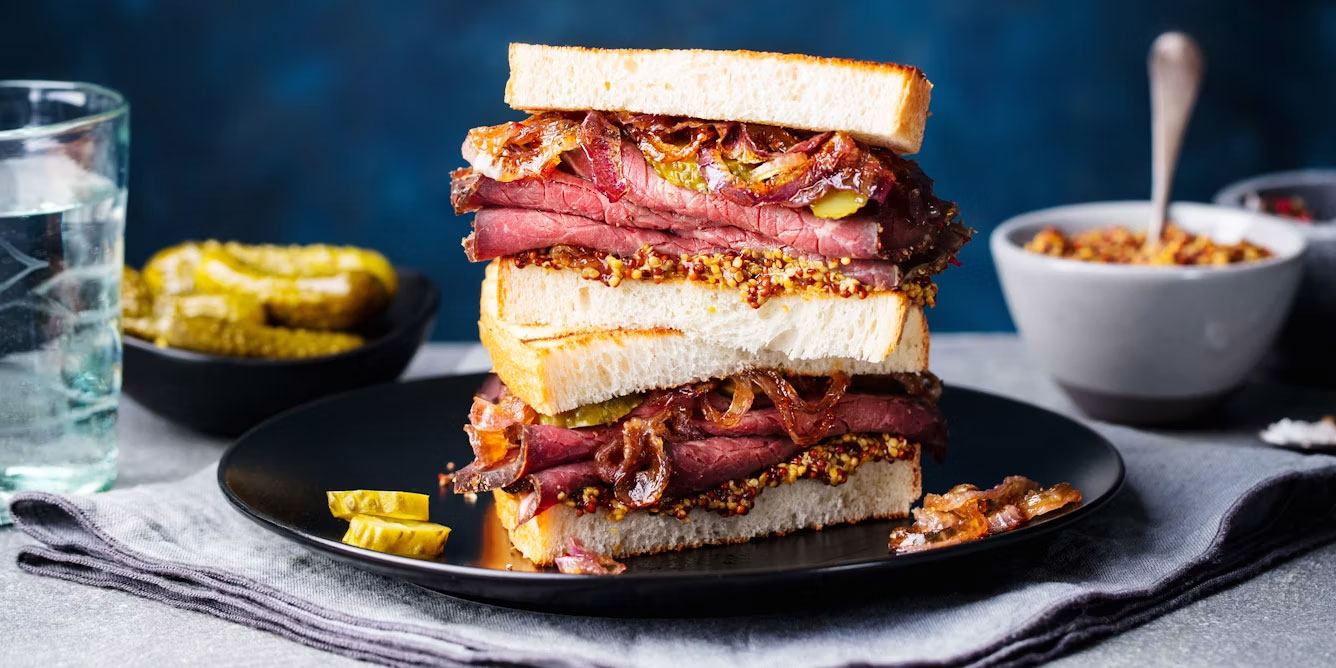





Everyone has a favorite sandwich, often prepared to an exacting degree of specification: Turkey or ham? Grilled or toasted? Mayo or mustard? White or whole wheat?

We reached out to five food historians and asked them to tell the story of a sandwich of their choosing. The responses included staples like peanut butter and jelly, as well as regional fare like New England’s chow mein sandwich.

Together, they show how the sandwiches we eat (or used to eat) do more than fill us up during our lunch breaks. In their stories are themes of immigration and globalization, of class and gender, and of resourcefulness and creativity.


A taste of home for working women

Megan Elias, Boston University

The tuna salad sandwich originated from an impulse to conserve, only to become a symbol of excess.

In the 19th century – before the era of supermarkets and cheap groceries – most Americans avoided wasting food. Scraps of chicken, ham or fish from supper would be mixed with mayonnaise and served on lettuce for lunch. Leftovers of celery, pickles and olives – served as supper “relishes” – would also be folded into the mix.

Join 1,724 readers who give monthly to fund research-based journalism

I’ll pitch in

The versions of these salads that incorporated fish tended to use salmon, white fish or trout. Most Americans didn’t cook (or even know of) tuna.

Around the end of the 19th century, middle-class women began to spend more time in public, patronizing department stores, lectures and museums. Since social conventions kept these women out of the saloons where men ate, lunch restaurants opened up to cater to this new clientele. They offered women exactly the kind of foods they had served each other at home: salads. While salads made at home often were composed of leftovers, those at lunch restaurants were made from scratch. Fish and shellfish salads were typical fare.
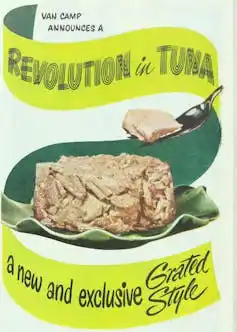
A 1949 ad in Ladies’ Home Journal announces a ‘Revolution in Tuna.'
A 1949 ad in Ladies’ Home Journal announces a ‘Revolution in Tuna.’ Internet Archive Book Images

When further social and economic changes brought women into the public as office and department store workers, they found fish salads waiting for them at the affordable lunch counters patronized by busy urban workers. Unlike the ladies’ lunch, the office lunch hour had time limits. So lunch counters came up with the idea of offering the salads between two pieces of bread, which sped up table turnover and encouraged patrons to get lunch to go.

When canned tuna was introduced in the early 20th century, lunch counters and home cooks could skip the step of cooking a fish and go straight to the salad. But there was downside: The immense popularity of canned tuna led to the growth of a global industry that has severely depleted stocks and led to the unintended slaughter of millions of dolphins. A clever way to use dinner scraps has become a global crisis of conscience and capitalism.

I like mine on toasted rye.


East meets West in Fall River, Massachusetts

Imogene Lim, Vancouver Island University

“Gonna get a big dish of beef chow mein,” Warren Zevon sings in his 1978 hit “Werewolves of London,” a nod to the popular Chinese stir-fried noodle dish.

During that same decade, Alika and the Happy Samoans, the house band for a Chinese restaurant in Fall River, Massachusetts, also paid tribute to chow mein with a song titled “Chow Mein Sandwich.”

Chow mein in a sandwich? Is that a real thing?

I was first introduced to the chow mein sandwich while completing my doctorate at Brown University. Even as the child of a Chinatown restaurateur from Vancouver, I viewed the sandwich as something of a mystery. It led to a post-doctoral fellowship and a paper about Chinese entrepreneurship in New England.

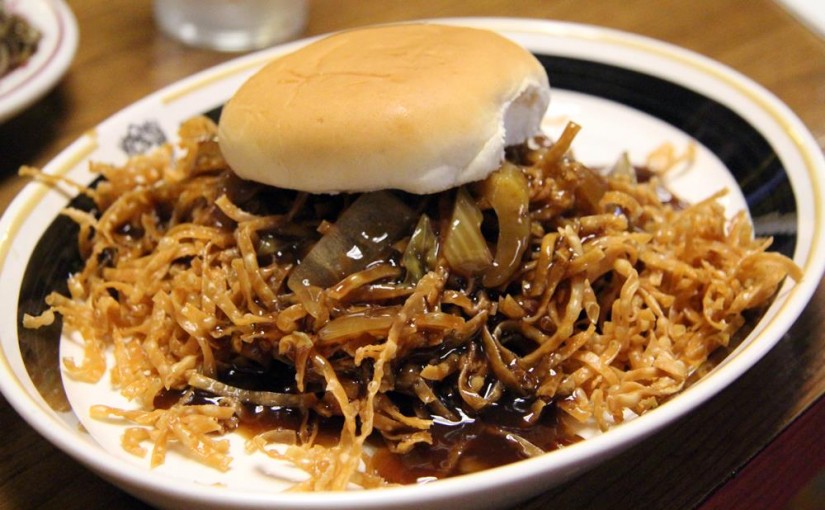
The chow mein sandwich is the quintessential “East meets West” food, and it’s largely associated with New England’s Chinese restaurants – specifically, those of Fall River, a city crowded with textile mills near the Rhode Island border.

The sandwich became popular in the 1920s because it was filling and cheap: Workers munched on them in factory canteens, while their kids ate them for lunch in the parish schools, especially on meatless Fridays. It would go on to be available at some “five and dime” lunch counters, like Kresge’s and Woolworth – and even at Nathan’s in Coney Island.
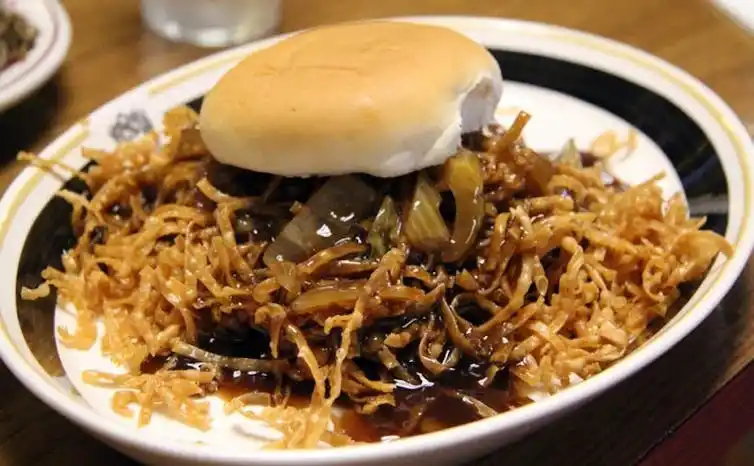
Fall River’s famous chow mein sandwich.
Fall River’s famous chow mein sandwich. Roadfood

It’s exactly what it sounds like: a sandwich filled with chow mein (deep-fried, flat noodles, topped with a ladle of brown gravy, onions, celery and bean sprouts). If you want to make your own authentic sandwich at home, I recommend using Hoo Mee Chow Mein Mix, which is still made in Fall River. It can be served in a bun (à la sloppy joe) or between sliced white bread, much like a hot turkey sandwich with gravy. The classic meal includes the sandwich, french fries and orange soda.

For those who grew up in the Fall River area, the chow mein sandwich is a reminder of home. Just ask famous chef (and Fall River native) Emeril Lagasse, who came up with his own “Fall River chow mein” recipe.

And at one time, Fall River expats living in Los Angeles would hold a “Fall River Day.”

On the menu? Chow mein sandwiches, of course.


A snack for the elites

Paul Freedman, Yale University

Unlike many American food trends of the 1890s, such as the Waldorf salad and chafing dishes, the club sandwich has endured, immune to obsolescence.

The sandwich originated in the country’s stuffy gentlemen’s clubs, which are known – to this day – for a conservatism that includes loyalty to outdated cuisine. (The Wilmington Club in Delaware continues to serve terrapin, while the Philadelphia Club’s specialties include veal and ham pie.) So the club sandwich’s spread to the rest of the population, along with its lasting popularity, is a testament to its inventiveness and appeal.

A two-layer affair, the club sandwich calls for three pieces of toasted bread spread with mayonnaise and filled with chicken or turkey, bacon, lettuce and tomato. Usually the sandwich is cut into two triangles and held together with a toothpick stuck in each half.

Some believe it should be eaten with a fork and knife, and its blend of elegance and blandness make the club sandwich a permanent feature of country and city club cuisine.
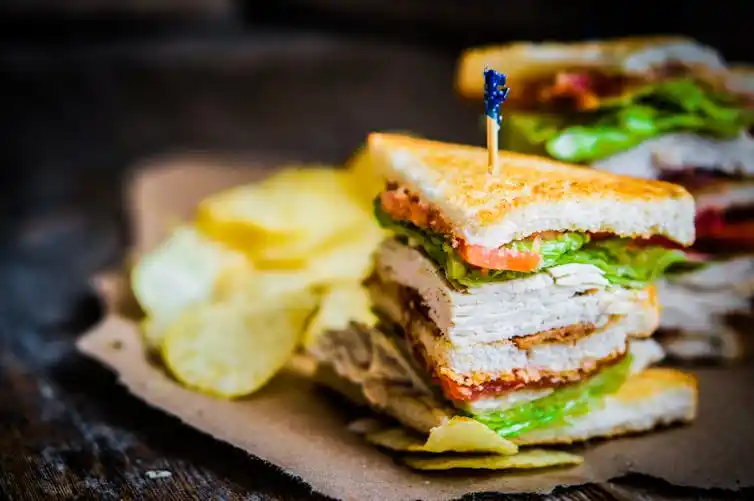
The club sandwich: A perfect blend of elegance and blandness.
The club sandwich: A perfect blend of elegance and blandness. Alena Haurylik

As far back as 1889, there are references to a Union Club sandwich of turkey or ham on toast. The Saratoga Club-House offered a club sandwich on its menu beginning in 1894.

Interestingly, until the 1920s, sandwiches were identified with ladies’ lunch places that served “dainty” food. The first club sandwich recipe comes from an 1899 book of “salads, sandwiches and chafing-dish dainties,” and its most famous proponent was Wallis Simpson, the American woman whom Edward VIII abdicated the throne of Great Britain to marry.

Nonetheless, an 1889 article from the New York Sun entitled “An Appetizing Sandwich: A Dainty Treat That Has Made a New York Chef Popular” describes the Union Club sandwich as appropriate for a post-theater supper, or something light to be eaten before a nightcap. This was one type of sandwich that men could indulge in, the article seemed to be saying – as long as it wasn’t eaten for lunch.

New York City’s Union Club served an early version of the club sandwich that was a hit.
New York City’s Union Club served an early version of the club sandwich that was a hit. GryffindorCC BY-SA

‘The combination is delicious and original’

Ken Albala, University of the Pacific

While the peanut butter and jelly sandwich eventually became a staple of elementary school cafeterias, it actually has upper-crust origins.

In the late-19th century, at elegant ladies’ luncheons, a popular snack was small, crustless tea sandwiches with butter and cucumber, cold cuts or cheese. Around this time, health food advocates like John Harvey Kellogg started promoting peanut products as a replacement for animal-based foods (butter included). So for a vegetarian option at these luncheons, peanut butter simply replaced regular butter.

One of the earliest known recipes that suggested including jelly with peanut butter appeared in a 1901 issue of the Boston Cooking School Magazine.

“For variety,” author Julia Davis Chandler wrote, “some day try making little sandwiches, or bread fingers, of three very thin layers of bread and two of filling, one of peanut paste, whatever brand you prefer, and currant or crabapple jelly for the other. The combination is delicious, and so far as I know original.”

The sandwich moved from garden parties to lunchboxes in the 1920s, when peanut butter started to be mass produced with hydrogenated vegetable oil and sugar. Marketers of the Skippy brand targeted children as a potential new audience, and thus the association with school lunches was forged.

The classic version of the sandwich is made with soft, sliced white bread, creamy or chunky peanut butter and jelly. Outside of the United States, the peanut butter and jelly sandwich is rare  – much of the world views the combination as repulsive.

These days, many try to avoid white bread and hydrogenated fats. Nonetheless, the sandwich has a nostalgic appeal for many Americans, and recipes for high-end versions – with freshly ground peanuts, artisanal bread or unusual jams – now circulate on the web.


The Daughters of the Confederacy get creative

Andrew P. Haley, University of Southern Mississippi

The Scotch woodcock is probably not Scottish. It’s arguably not even a sandwich. A favorite of Oxford students and members of Parliament until the mid-20th century, the dish is generally prepared by layering anchovy paste and eggs on toast.

Like its cheesier cousin, the Welsh rabbit (better known as rarebit), its name is fanciful. Perhaps there was something about the name, if not the ingredients, that sparked the imagination of Miss Frances Lusk of Jackson, Mississippi.
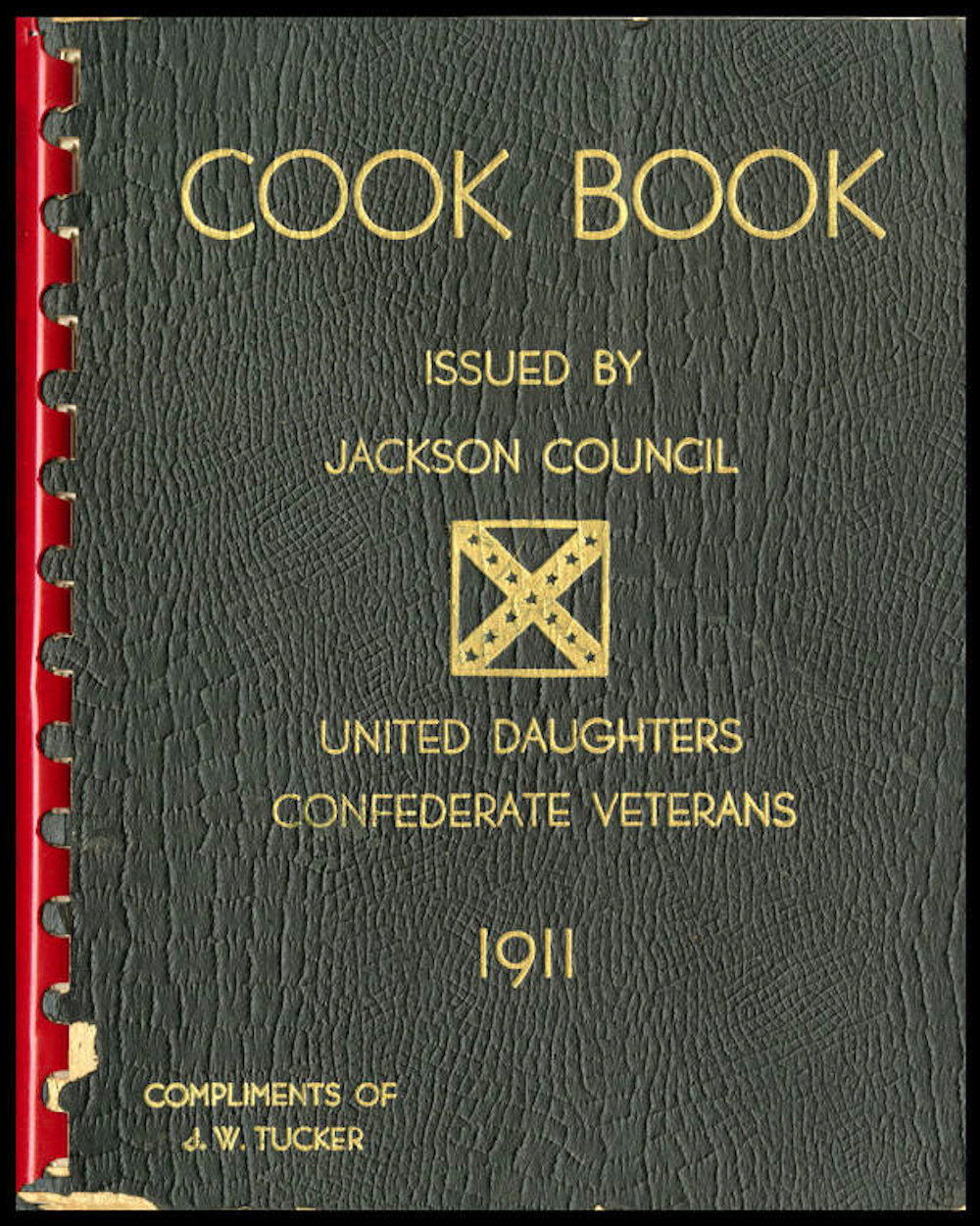
The United Daughters of the Confederacy cookbook features a take on the Scotch woodcock.
The United Daughters of the Confederacy cookbook features a take on the Scotch woodcock. McCain Library and Archives, The University of Southern MississippiCC BY-SA

Inspired to add a little British sophistication to her entertaining, she crafted her own version of the Scotch woodcock for a 1911 United Daughters of the Confederacy fundraising cookbook. Miss Lusk’s woodcock sandwich mixed strained tomatoes and melted cheese, added raw eggs, and slathered the paste between layers of bread (or biscuits).

As food historian Bee Wilson argues in her history of the sandwich, American sandwiches distinguished themselves from their British counterparts by the scale of their ambition. Imitating the rising skylines of American cities, many were towering affairs that celebrated abundance.

But those sandwiches were the sandwiches of urban lunchrooms and, later, diners. In the homes of southern clubwomen, the sandwich was a way to marry British sophistication to American creativity.

For example, the United Daughters of the Confederacy cookbook included “sweetbread sandwiches,” made by heating canned offal (animal trimmings) and slathering the mashed mixture between two pieces of toast. There’s also a “green pepper sandwich,” crafted from “very thin” slices of bread and “very thin” slices of green pepper.

Such creative combinations weren’t limited to the elites of Mississippi’s capital city. In the plantation homes of the Mississippi Delta, members of the Coahoma Woman’s Club served sandwiches of English walnuts, black walnuts and stuffed olives ground into a colorful paste. They also assembled “Friendship Sandwiches” from grated cucumbers, onions, celery and green peppers mixed with cottage cheese and mayonnaise. Meanwhile, the industrial elite of Laurel, Mississippi, served mashed bacon and eggs sandwiches and creamed sardine sandwiches.

Not all of these amalgamations were capped by a slice of bread, so purists might balk at calling them sandwiches. But these ladies did – and they proudly tied up their original creations with ribbons.

This article originally appeared on The Conversation. You can read it here.
  • European Broadcasting Union offers guide to reduce sexualizing camera angles of Olympic women athletes
    Photo credit: CanvaA new guide has been introduced on how to respectfully broadcast woman athletes.

    Being an athlete is tough, especially if you’re an Olympian. They sacrifice their time and bodies in order to achieve peak physical condition. There is also the mental pressure to compete against the best. The last thing they should worry about is being objectified and sexualized online. 

    With this in mind, the European Broadcasting Union wants to help. They offered a booklet to broadcasters titled Raising the Bar: Guidelines for respectful media coverage in women’s athletics. The 23-page guide shows how camera placement choices and editing could potentially compromise an athlete. It also offers broadcasters guidelines for how to set up camera shots and show slow-motion replays that won’t sexualize or present athletes in undignified poses. 

    athletes, infographic, olympians, guide
    Screenshot

    Focusing on the sport, reducing harassment

    These guidelines come as multiple stories about women athletes being harassed online have surfaced. Many misogynistic posts about athletes have come from slow motion footage focused on certain parts of the athlete’s body. 

    “The sexualization of women athletes through selective camera angles and editing choices continues to be a significant concern across many sports broadcasts,” wrote Glen Killane, executive director of EBU Sport in the booklet. “Lingering shots on bodies, low-angle cameras that capture revealing views, and excessive slow-motion replays that serve no technical or storytelling purpose are among the issues observed in the media coverage of women’s athletics competitions today.”

    These new broadcast guidelines and suggestions are backed by Serbian long jumper Ivana Španović, British Olympic pole vaulter Holly Bradshaw, and Croatian high jumper Blanka Vlašić. Vlašić has spoken out regarding the equal visibility of women’s sports. Bradshaw has spoken out against the discomfort and sexualization of Olympic women athletes due to their tight-fitting uniforms.

    “I first-hand have received social media abuse and witnessed inappropriate videos online of myself and colleagues when slow motion content of us competing is captured,” wrote Bradshaw in the guide. “Athletes want to enjoy themselves doing the sport they love without feeling uncomfortable or anxious about the footage being shown live. Many athletes, myself included, have been in competitive scenarios where they are more focused on the cameras instead of their own performance.”

    What the guide provides

    The guide provides visual aids for broadcasters along with insights from the athletes to explain why certain shots would be preferred. Broadcasters are requested to avoid tight shots from the back of athletes. They’re also asked to avoid low camera angles from underneath. They recommend shots above the pelvis or ones that don’t linger onto commonly sexualized areas of the body. They recommend wider shots so the audience can see the technical ability being displayed by the athlete. Overall, the point is to focus on the athletic performance rather than close-ups of the athlete.

    Currently, there is no enforcement of these guidelines or penalties if a sports broadcast doesn’t adhere to them. However, there is value in knowing which broadcasts will focus on the athletic contests rather than an athlete’s appearance. This will help the competitors focus on how they do rather than how they look when the cameras are on.

  • The summer concert state rankings: Which states pack more festivals, shows, and tours in 2026
    Photo credit: Matthew Bolt // Icon Sportswire via Getty ImagesILLENIUM performs a free concert for fans prior to the start of Game 3 of the Stanley Cup Finals between the Vegas Golden Knights and the Carolina Hurricanes on June 06, 2026 at T-Mobile Arena in Las Vegas, Nevada.

    Trevor Mahoney

    Summer 2026 is shaping up to be one of the densest live music seasons in recent years. From packed festival calendars to a resurgent touring industry, a handful of breakout U.S. states are finally getting the traffic they deserve.

    Not all states are created equal when it comes to live music density, though. ThatsThem has compiled per-capita concert data, venue infrastructure metrics, and festival schedules from leading sources including the Recording Industry Association of America, Pollstar, and the National Independent Venue Association to create a list of 15 standout locations this summer.

    15 of the most concert-dense states in Summer 2026

    1. Nevada

    Las Vegas leads the nation in concerts per capita in 2026. According to an analysis on the website of Princess Polly, a clothing brand, nearly 3,500 concerts are listed in Las Vegas alone, translating to approximately 150.67 concerts per 100,000 residents. This is undoubtedly the highest concentration in the country. The residency model means the Strip always has something major running, regardless of the season, but the Las Vegas Summer Concert series is the standout event.

    2. Tennessee

    Nashville ranks second in concert density nationally, with 6.76 venues per 100,000 residents. This is the highest venue density among top-ranked cities and equates to 1,148 concerts in 2026. Bonnaroo’s return to Manchester, Tennessee in June anchors their summer calendar on top of nonstop club and arena action across the entire state.

    3. California

    California dominates by sheer volume alone. Research from the Recording Industry Association of America counts over 80,433 music establishments in the state, with music contributing more than $51.4 billion to gross domestic product. The summer calendar alone includes Outside Lands in San Francisco, a dense SoCal arena circuit, and Coachella’s long tail of satellite events that carry into the fall.

    4. New York

    New York generated $24.9 billion in music industry value and supports 210,878 music jobs in 2020, which is the highest job count among all states. The summer festival circuit reflects this depth. The Governors Ball, featuring Lorde and A$AP Rocky as headliners per Variety, is followed by a packed arena season through Labor Day.

    5. Illinois

    Chicago’s Lollapalooza remains one of the best-attended urban music festivals across the whole country, with around 100,000 people turning up per day. The city’s venue ecosystem, from the Riviera to the United Center, also keeps the calendar full beyond just a single festival weekend.

    6. Texas

    Texas punches well above its weight on music infrastructure, with over 127,993 songwriters and $26.6 billion in annual music industry economic output. In fact, it’s second only to California nationally. ACL Fest’s October dates are the main headliner event, but Austin’s live music scene means something notable is happening every weekend.

    7. Colorado

    Denver ranks fifth nationally for concert density, with 1,766 concerts listed in 2026 and 59.41 concerts per 100,000 people. The real draw, though, is Red Rocks. The event calendar of this outdoor amphitheater boasts a summer schedule that many serious concertgoers are planning vacations around this year.

    8. Georgia

    Atlanta holds the title of “premier U.S. city for music aficionados” according to one 2026 study highlighted by Spin Genie, scoring more than 8.74 points out of 10. The city boasts 188 upcoming events and 577 musical artists per 100,000 residents.

    9. Florida

    Florida’s music economy supports 169,706 jobs and adds $9.3 billion to the U.S. GDP, fueled by Latin, pop, and Southern rock scenes. Welcome to Rockville in Daytona Beach is their signature event, while the Latin and pop circuit continues to run year-round.

    10. Washington

    Seattle ranks 10th among top U.S. concert cities with 1,304 concerts listed in 2026. The city’s venue density, anchored by Climate Pledge Arena and a dense club circuit in Capitol Hill, helps to keep national tours running even in the summer months.

    11. Louisiana

    New Orleans ranks second nationally in SCCG Management’s live music city analysis, and The Big Easy plays host to three major festivals in 2026. With 302 concerts planned and an average concert attendance of 74, the city’s extensive live music culture is on full display this year, anchored by the genuine local community engagement as opposed to tourist capture alone.

    12. Minnesota

    Minneapolis ranks third among U.S. cities for live music in 2026 per the same SCCG Management study, with two major festivals, 1,055 concerts listed, and an average attendance of 52. The Twin Cities’ independent venue scene, most famous for First Avenue, is truly unmatched.

    13. North Carolina: The first breakout state

    Asheville has emerged as one of the most-cited breakout music cities in 2026, with more than 61 upcoming concerts and festivals listed on music resource Bandsintown alone, including AVL Sounds Fest in August and MAJACE Festival in July. The city is small enough that shows still feel like unexpected discoveries..

    14. Pennsylvania

    Pennsylvania supports 114,731 music jobs and generates $6.3 billion in music GDP, ranking among the top six states nationally for music economic contribution. This is spread across Philadelphia’s festival-heavy summer season and Pittsburgh’s growing independent venue scene.

    15. Idaho: The second breakout state

    Boise is also one of the most-cited “rising” live music markets in the U.S., with 2025 setting concert attendance records and 2026 already tracking to match or exceed them. What makes the city notable isn’t its scale, but the fact that national tours are now coming through as a primary stop.

    The music map is changing nationally

    The traditional top tier states of Nevada, New York, California, and Tennessee are all holding strong at the top of the list of most-visited states for music. However, the story of summer 2026 is the states on the rise. Colorado’s Red Rocks circuit, Atlanta’s per-capita chokehold, and the emergence of Asheville and Boise as new hot spots show that the live music scene is shifting dramatically.

    This story was produced by ThatsThem and reviewed and distributed by Stacker.

  • The church fathers of early Christianity are showing their swag – on TikTok
    Photo credit: Holger Uwe Schmitt/Wikimedia Commons, CC BY-SASt. Paul is one of the many Christian figures whose paintings have made an appearance.

    It begins with the music: a late 1990s rap song. Then someone appears on screen, moving slowly into a pose that can only be called deeply, theatrically serious. Then comes the reveal: The video fades from the person into a medieval painting of a haloed man doing almost the exact same pose.

    Videos imitating “church fathers,” bishops and theologians who helped shape early Christianity have been popping up across social media since late 2025. Several versions have drawn hundreds of thousands of views.

    In part, they’re funny because of the incongruity: hoodies, bedrooms and phone cameras, suddenly paired with the solemn authority of saints. As an art historian who studies Christian images, I know that these types of paintings were carefully made to communicate holiness through visual cues like books, clothing, gestures and posture.

    But the humor also comes from how current they feel. These paintings may be centuries old, but the visual language is timeless. The raised hand, the open book, the severe gaze – they all communicate power. On TikTok or Instagram, a gesture once used to symbolize doctrine or wisdom starts to look like confidence, coolness, even swagger. The captions say as much: “They had swag fr,” one reads – for real.

    When the trend crossed my feed, I had to try it. What better way to show how these images work than by stepping into the pose?

    Church fathers

    Church fathers” were not “founders” in the simple sense, but foundational authorities: figures whose writings later Christians returned to when debating central questions about doctrine, scripture and religious life.

    Today’s social media trend uses the term more loosely. In addition to early Christian authors, many of the videos show later saints, monks, bishops and theologians, especially from Eastern Orthodox traditions. Online, “church father” becomes shorthand for religious authority itself.

    The paintings circulating online range from Eastern Orthodox icons to Western European Renaissance and Baroque paintings. In most cases, they were made long after the saints had died, so they don’t document what the men actually looked like.

    Instead, this style of art was meant to inspire awe, surrounding worshippers with a sense of religious authority. The saints’ books, rich vestments and formal poses were visible signs of holiness, symbolizing their learning, discipline and eloquence. Such images did not merely decorate sacred spaces; they taught viewers what closeness to divine truth – saintliness itself – could look like.

    Man of books and learning

    Several of the videos show Athanasius of Alexandria, a fourth-century bishop and theologian traditionally considered one of the church fathers.

    Painted by the Italian painter Domenichino in the 17th century, Athanasius stands in “contrapposto,” a pose inherited from classical art and common in Renaissance and Baroque painting. He leans back with his left shoulder, causing the right side of his body to project outward toward the viewer. The saint is dressed in a rich damask dalmatic – a long, wide-sleeved robe – over a white silk tunic.

    A bearded figure in an orange and brown robe gestures toward a large open book that he holds in one hand.
    An image of Athanasius by the 17th-century Italian artist Domenichino on the walls of the Santa Maria di Grottaferrata monastery outside Rome. The Web Gallery of Art

    Athanasius’ shifting stance and sweeping vestments create drama. They also direct attention to the open book he holds in one hand and points to with the other – a reminder of his place among the great teachers of the church. In religious art, books are not just props. They help the viewer recognize the figure as someone whose words matter.

    The Greek text on the page begins with the words “Whoever wishes to be saved”: the opening of the Athanasian Creed, a statement of Christian doctrine long associated with Athanasius. In the fourth century, he became famous for defending the idea that Christ was fully divine, a fiercely debated issue at the time.

    TikTokers recreating Athanasius’ pose today use a Bible or another thick volume, wielding the book with as much swagger as the saint himself.

    They lose the luxurious vestments, trading Athanasius’ sumptuous robes for hoodies and jeans. Yet their captions recognize the force of the look: Church fathers “knew the fit was hard,” one video says. The language is modern, but the point is old: Clothing, books and posture make authority visible.

    Charged with meaning

    Another star in the videos is Gregory Palamas, a 14th-century Byzantine theologian and Orthodox saint – and he presents another type of authority altogether.

    Palamas is best known for defending Hesychasm, a mystical tradition in the Orthodox Church that joins repeated prayer with contemplation. He represented holy power grounded not only in learning, but also in spiritual practice.

    An icon shows a brunette man with a long beard, wearing white robes and positioned against a gold backdrop.
    An icon of St. Gregory Palamas from the 15th century. Pushkin State Museum of Fine Arts via Wikimedia Commons

    Unlike Domenichino’s dramatic Athanasius, the painting of Palamas appears still and distant. He is not turning toward the viewer with theatrical movement, but formally facing outward, set against a plain gold background – a sacred figure, held outside ordinary time.

    Palamas’ image is an icon, a sacred image used in Orthodox Christian worship and devotion. The saint raises his hand in the Orthodox gesture of blessing, with his fingers forming the letters “IC XC,” a Greek abbreviation for Jesus Christ.

    In sacred art, hands are rarely idle. Christ and the Christ child often hold up their hands to bless the viewer. Mary and John the Baptist draw viewers’ attention to Christ through their gestures and sometimes their gaze. Saints lift their hands in prayer, teaching or intercession.

    To some viewers online, Palamas’ raised hand may simply look solemn or strange, charged with an unknown or mysterious meaning. But that gap in knowledge, I’d argue, is part of what makes the “church fathers” trend work. On social media, a hand gesture doesn’t need to be fully explained to feel meaningful: a slow point toward the camera, a hand over the heart, a peace sign.

    TikTokers today may be a great distance from the church fathers, but their images still resonate – even, and perhaps especially, on the internet.

    This article originally appeared on The Conversation. You can read it here.

Explore More Culture Stories

Film & TV

European Broadcasting Union offers guide to reduce sexualizing camera angles of Olympic women athletes

Culture

The summer concert state rankings: Which states pack more festivals, shows, and tours in 2026

Internet

The church fathers of early Christianity are showing their swag – on TikTok

Culture

Why Gen Z is falling in love with film photography