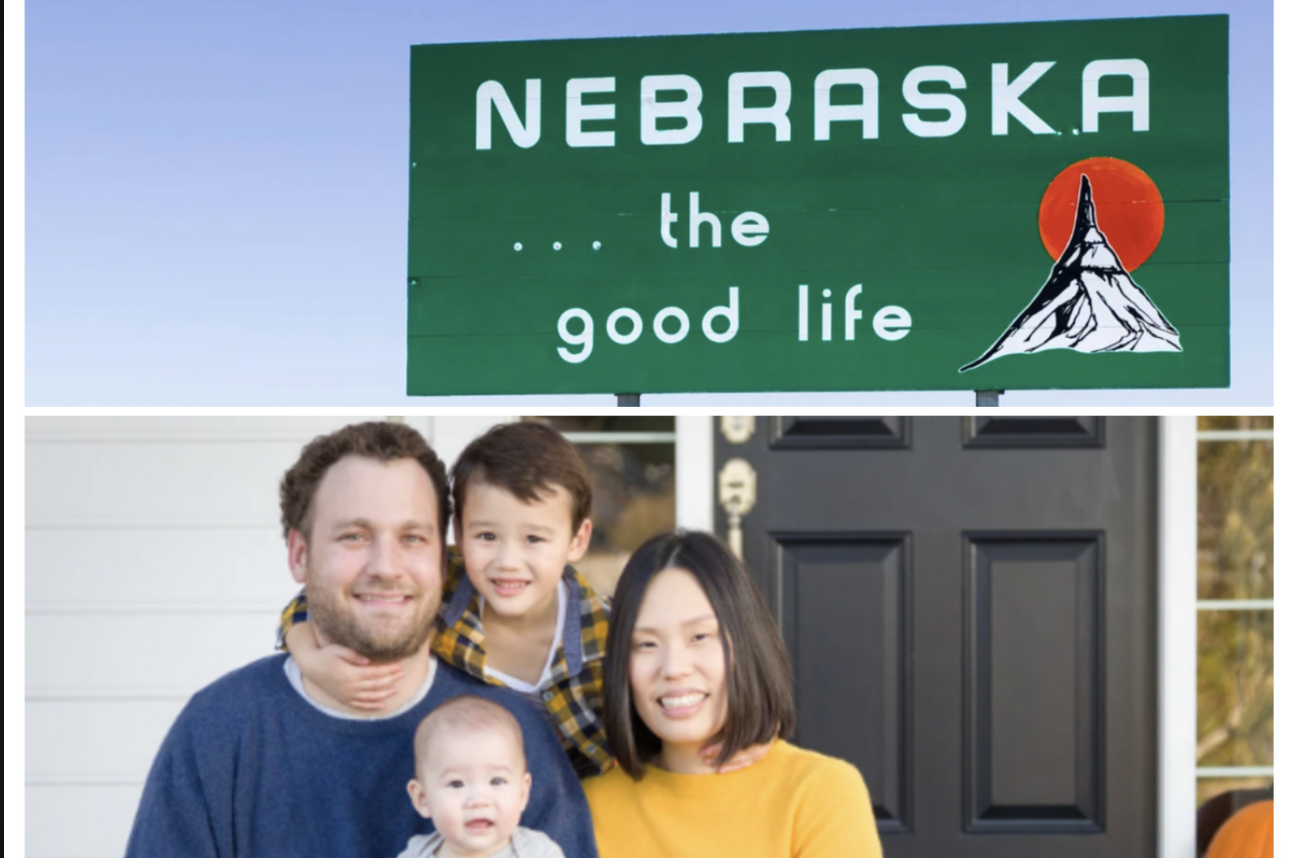
Each year, the popular personal finance website WalletHub provides an extensive list of the Happiest States in America. As many may suspect, states like Hawaii that are known for favorable weather, relaxation, and fun destinations ranked fairly high, yet there were some surprises. Notably, Nebraska leaped from ranking ninth in the 2024 happiness list all the way up to third place in 2025.

How did Nebraska make such a significant jump in happiness and contentment compared to other states? With all due respect to the citizens of Nebraska, it’s not as well known, promoted, or referenced within American culture as a hub of interest in comparison to coastal states such as New York, California, and Florida. In fact, only two of their cities, Omaha and Lincoln, were in WalletHub’s Happiest Cities in America list in 2025. So what gives?

“In addition to pursuing your passions, having a good work-life balance and maintaining an emotional support network, another key way to boost your happiness is living in the right place,” says WalletHub analyst Chip Lupo. “The happiest states are those that provide above-average quality of life in a wide variety of areas, from strong state economies and high quality physical and mental health care to adequate amounts of leisure time and good weather.”

As you may suspect, there is no one reason why Nebraska ranked so high and why the Cornhuskers that live there take pride in their home. When WalletHub puts together their list, they assess 30 different metrics of data and place them into three categories: work, community, and emotional/physical well-being. Within those three categories are self-reported examinations and vetted statistics about life expectancy, job satisfaction, and even elements like leisure time. Speaking of leisure time, Nebraska had the most leisure time of any state even though it’s the tenth hardest-working state.

WalletHub notes that Nebraska had the fourth-lowest unemployment rate and ranked second in terms of economic security. These rankings were determined by the number of residents who were financially stable, employed, and insured. The positive economic factors contribute to other elements regarding physical health and mental health in the state, which impacted Nebraska’s overall high happiness ranking.

Regarding healthiness, Nebraska had the sixth-lowest depression rate and ninth-highest reports of good or improving physical health from its residents. When it comes to mental health, WalletHub isn’t the only one praising the state; Soliant Health ranked Nebraska as the third-best state for mental health in 2025. These factors, along with the economy, contribute to overall better social conditions, which explains how Nebraska had the sixth-lowest divorce rate and tied for third with Minnesota for having the most volunteers, with 40.3% of Nebraskans donating their time to worthy causes.

Another factor to note is how Nebraska’s education system impacts the happiness of the kids, parents, and educators. ProCare Therapy’s Best States for Teachers list ranked Nebraska second, noting the high teacher retention rate and the amount of education spending: 25.3% of state and local budgets going to K–12 education.

“Teachers are the backbone of our educational system, and their well-being directly impacts student success,” said Stephanie Morris, senior vice president of ProCare Therapy. “By uncovering where educators are thriving, we hope that other states can look to leaders like Nebraska as models for investing in those who shape the future of our children.”

In addition, Nebraska ranked fourth-best in the nation for sleep, with Lincoln and Omaha coming in the top ten, according to the Sleep Foundation.

As with anything, there are pros and cons to living in Nebraska. While the state’s overall affordability is attractive, especially with the average house priced under $300,000, it’s not built for everyone. If you’re a person that likes big cities and a hustle-and-bustle lifestyle, Nebraska might not be for you as its highest populated city, Omaha, has less than 490,000 people. While the nature and greenery is nice, the winters are tough. Nebraska also has a higher tornado risk compared to other states even though there are currently less tornadoes than usual.

Cons aside, while this all looks great for Nebraska and the other top states, this doesn’t mean that happiness is guaranteed. As Lupo said, living in the right place is one of the key ways to help increase happiness.

While external factors such as where you live can definitely influence and impact your happiness, there are still personal metrics involved. Psychologists say committing to certain behaviors such as mindfulness and gratitude can make a person happier regardless of zip code.

Whether you’re looking for a fresh start or are happy where you currently live, it’s good to know what else is out there. Knowing how others are achieving happiness can help you choose the paths to take in order to improve your life, whether it’s a path to a new career, a healthier lifestyle, or a literal one to Nebraska.

  • Doctors couldn’t explain the pain in her daughter’s foot. Then a nurse looked closer and spotted something that led to a devastating diagnosis.
    A nurse checks out an x-rayPhoto credit: Canva

    Elle Rugari is a nurse. So when her 4-year-old daughter Alice started complaining about foot pain one evening in late September of last year, Elle did what most parents do first: she gave her some children’s paracetamol, a wheat bag for warmth, and put her to bed. Alice had just had a normal day at childcare. There was no obvious injury.

    But Alice woke up screaming that night, and the pain kept coming back over the following days. She started limping. She cried more often than usual. “She doesn’t like taking medicine or seeing doctors,” Elle, who is from South Australia, told Newsweek. “So I knew it was something serious” when Alice started asking for both.

    At the emergency department, doctors X-rayed Alice’s foot. It showed nothing. But as they continued their assessment, a nurse noticed something else: tiny pinprick bruises scattered along Alice’s legs. Blood tests were ordered. While they waited for results, Elle pointed out something she’d spotted too: swollen lumps along her daughter’s neck.

    @elle94x

    Battling Leukaemia with all her might! ‼️VIDEO EXPLAINING IS ON MY PAGE‼️ Instagram & GoFundMe linked in bio 💛🎗️ #cancer #medical #hospital #help #cancersucks

    ♬ original sound – certainlybee

    The blood results, in the doctor’s words, came back “a bit spicy.” When Elle asked him directly whether he was thinking leukemia, he said yes. She and her partner Cody were transferred to the women’s and children’s hospital, and the diagnosis was confirmed the following day by an oncologist.

    For parents who aren’t medical professionals, those tiny bruises might easily have been overlooked. They’re called petechiae, and they’re caused by small capillaries bleeding under the skin when platelet counts drop. According to the American Cancer Society, bruising and petechiae appear in more than half of children diagnosed with leukemia, often alongside bone or joint pain and swollen lymph nodes. The limping, the foot pain, the bruises, the lumps on the neck: in retrospect, they were telling a clear story. In the moment, without blood work, they’re easy to miss.

    Nurse, patient, medicine, hospital
    A nurse embraces a young cancer patient. Photo credit: Canva

    As Newsweek reported, Alice is now three months into a three-year treatment plan on a high-risk protocol, meaning her course of therapy is more intensive than standard. She is losing her hair. She has hard days. And she sings Taylor Swift songs every single day.

    “She lets everyone around her know that she has leukemia and that she’s going to get rid of it,” Elle said. “She’s honestly the most amazing child.”

    Under the handle @elle94x, Elle shared Alice’s story on TikTok in December 2025, and the response has been overwhelming, with the video drawing over 1.3 million views. Many of the comments came from parents who recognized the pattern from their own experience. “My daughter was changing color and having fevers and complaining of leg pain and arm pain, and hospitals all kept saying it was her making it up,” wrote one user. “I didn’t give up, and it was leukemia.” Another wrote: “I thought my son had strep throat because he is nonverbal with autism. We got admitted that night for leukemia.”

    @elle94x

    … This song is 100% about superstitions and trees 👀 Do not tell my 4 year old who’s battling leukaemia otherwise. @Taylor Swift @Taylor Nation @New Heights @Travis Kelce #taylorswift #swifties #swiftie #fyp #taylornation

    ♬ original sound – elle94x

    Medical experts recommend that parents seek urgent evaluation for any child with unexplained bruising that appears in unusual places, doesn’t heal normally, or comes alongside other symptoms like fatigue, bone pain, or swollen lymph nodes. Norton Children’s Hospital pediatric oncologist Dr. Mustafa Barbour advises that if symptoms don’t improve or don’t have a clear explanation, it’s always worth making an appointment.

    Elle said there are still days when the weight of it hits hard. But Alice’s attitude keeps pulling her forward. “There are still days where it feels so, so overwhelming,” she said. “But she’s such a little champion.”

    This article originally appeared earlier this year.

  • Licensed therapist says these 3 steps stop rude people from hijacking your mind
    Woman exhausted by man's poor behavior.Photo credit: Canva

    Licensed therapist Jeffrey Meltzer offers three steps for dealing with rude people. In his helpful TikTok post under the name therapytothepoint, he suggests helpful tactics that go far beyond setting simple boundaries.

    Rude people are almost impossible to avoid, and the instinct to snap back or make a passive-aggressive remark can be strong. Meltzer shares some practical mental health advice that can lead to a calmer resolution.

    It Begins With Emotional Regulation

    Some individuals might believe that other people are responsible for how they make us feel. Meltzer suggests that self-regulation is an important first step to dealing with disrespectful people. Despite instincts to retaliate or escalate the situation, staying calm is more effective.

    Meltzer proposes that reciprocating aggression will only embolden a rude person and even justify their poor behavior. Instead, calmness and controlling our emotions will disrupt the pattern. Meltzer explains, “You might feel angry, embarrassed, disrespected, but calmness is about your behavior, despite the internal chaos you may be having. At the end of the day, emotional regulation is your strength, and reactivity gives your power away.”

    A 2024 study in the National Library of Medicine found that people’s ability to reappraise a stressful event in a more balanced way was strongly linked to greater resilience and better recovery from stress. The strategy helps people stay calmer by changing how the brain interprets the event.

    life hacks, behavior, Jeffrey Meltzer, sarcasm, emotional regulation
    A woman is rudely interrupted on the phone.
    Photo credit Canva

    Passive Aggression Is NOT a Solution

    An easy response might be the simple eye roll, sarcasm, or a retaliatory personal dig. Meltzer points out that these are only ego attempts to win an unwinnable situation. “Instead, be straightforward. I’m open to talking about this, but not like that. It’s hard for me to connect when you speak to me that way.” Meltzer explains that these tactics bring clarity and remove the defensive guard of said rude individuals.

    A 2026 study in Psychology Today reported that passive-aggressive behaviors worsen relationship dynamics and fail to resolve disagreements. Criticism, ostracism (ignoring others), and sabotage all undermine cooperation and relational success.

    frustrating, passive aggressive, solutions, mental health
    A man blows a dandelion in a woman’s face.
    Photo credit Canva

    Role play works

    Practice makes perfect has value in dealing with rude people. “You don’t magically become composed under pressure; you train for it.” Meltzer continues, “Practice with a friend. Practice with your therapist. Have them be rude. Respond calmly. Respond assertively. Respond clearly. Because in real life, you don’t rise to the moment, you fall to your level of preparation.”

    A 2024 study in the National Library of Medicine revealed that an individual’s level of assertiveness can be trained. The strategy of preparation reduced feelings of stress, anxiety, and depression.

    meditation, annoying people, strategies, peace of mind
    Interrupting a meditation.
    Photo credit Canva

    Stay Calm, Be Assertive, and Practice

    The solutions offered by Meltzer seem to resonate. Several people reveal their own struggles when facing similar predicaments. These are some of their comments:

    “Practice with a therapist? Why didn’t I think of that”

    “You don’t rise to the moment you fall to the level of your preparation. I’m gonna memorize that.”

    “I’m waiting for you to write a book about all your amazing insights”

    “I can handle them but i internalize later n let it ruin my day”

    “The real skill is knowing when to ignore and when to address it. Not everything deserves your energy.”

    “Rudeness is a weak man’s imitation of strength. Just say that to them and if they continue, walk away with a smile.”

    Meltzer advises that the best way to handle rudeness begins with how we respond. Diffusing a situation helps maintain peace of mind. Remaining composed helps control our own reactions. In the end, rehearsing for success allows us to stay confident when difficult situations arise.

  • Love educator shares how awkward flirting can be turned into a romantic superpower
    A couple flirts on the dance floor.Photo credit: Canva

    In a recent TED Talk, love coach Francesca Hogi shared how even your awkward flirting can be a superpower. Sometimes mistaken as off-putting, flirting actually offers a powerful gateway to real human connection.

    By reframing flirting as an act of curiosity, she explains how anyone can kickstart attraction and open the door to lasting love. In an impassioned presentation, Hogi demystifies flirting and explains why building attraction matters.

    Flirting can be a superpower

    Hogi explains that for 12 years she’s been helping people fall in love as both a matchmaker and a coach. “As a love professional, I can assure you that many dating problems can be solved with flirting,” Hogi says. “If you’re single, it helps you to connect and fall in love. If you’re partnered, it helps you to reignite or maintain the spark of chemistry that brought you together in the first place.”

    Many might have concerns about their ability to flirt. Will they be received well, or are they even doing it right? Hogi explains, “I’ve got good news for the introverts out there. You don’t have to be extroverted to be a magnet for connection. In fact, I believe that introverts have a secret advantage when it comes to flirting because your efforts at being more open feel more genuinely inspired by another person and therefore special.”

    She shares that flirting can give you confidence and courage. She also acknowledges that feeling awkward is normal. “Confidence with flirting comes from knowing yourself, your intentions, reading the room, discerning other people’s reactions, and adapting accordingly,” she says. “Sometimes it’s going to be awkward, sometimes it’s going to be embarrassing, and that’s okay.”

    flirtation, connection, mental health, good vibes, sexuality
    A couple enjoys flirting.
    Photo credit: Canva

    Healthy flirting

    “Flirting gives you more agency over human connection,” says Hogi.

    She then describes the two foundational principles of healthy flirting. The first is presence: being in the moment and avoiding distractions like a phone or the surrounding environment. The second is enthusiasm. Getting the right vibe while being enthusiastic goes a long way toward mastering the art of flirting. These principles have a strong effect on other people.

    Hogi explains that expressing positive intentions has a large impact on outcomes:

    “You have the ability to leave other people feeling good for having interacted with you…Even your unspoken appreciation for a shared moment of connection, no matter how brief, can often be felt. Lean into being the version of you who leaves other people with a smile on their face and notice how much more magnetic you become.”

    community, expression, humor, self-confidence, self-esteem
    A flirtatious interaction.
    Photo credit: Canva

    Hogi inspires the crowd

    People seem quite taken with Hogi’s energy and charisma. Some of the comments expressed admiration for her vibe and flirtatious delivery on stage. Hogi was sharing her own version of flirting as a superpower:

    “Even this presentation feels like shes flirting…especially her laughs”

    “She is such a good public speaker, ten minutes of speech with no filler words whatsoever”

    “Flirting is a way making one feel seen and acknowledged.”

    “Where were you, Francesca, when I needed these words? Like, 40 years ago? Never too late, right?”

    “Had me clapping in the end! She’z good”

    “I feel better about my flirting abilities after watching this now.”

    “She’s good , reading her body language generally teaches me more about flirting than learning it itself”

    gender, attraction, laws of attraction, social skills, personality traits
    A vintage photo of a couple flirting.
    Photo credit: Canva

    The power behind a flirtatious connection

    Flirting can have a powerful effect on both the initiator and the person on the receiving end. It isn’t necessarily about romance or sex. It helps build and strengthen relationships in everyday life.

    A 2025 study on ResearchGate analyzed where and how people flirt. The results suggested that people who flirt can improve with practice. The best flirting involved humor, confidence, and social skills. A 2026 study on ScienceDirect found that flirting can be an effective way for people to express their personality and individual differences. While personality traits and sex were linked to how often and how skillfully people flirted, these influences had only modest effects on overall outcomes.

    Hogi suggests flirting requires nuance and a little bit of courage. Practice prepares you for any occasion. “Attentiveness, compliments, playfulness—there’s nothing complicated about these actions, yet they have the potential to spark and sustain connection over time,” she says. “That’s a true superpower we can all tap into.”

    Hogi and the research suggest flirting isn’t just a trivial social game. It’s a meaningful way to express personality, build connections, and boost self-confidence. Flirting isn’t shallow. It doesn’t need to involve manipulation or outcome-obsessed action. These small everyday acts of courage embolden human connection and reveal individual superpowers in all of us.

Explore More Health Stories

Well-being

Licensed therapist says these 3 steps stop rude people from hijacking your mind

Well-being

Love educator shares how awkward flirting can be turned into a romantic superpower

Well-being

Retired U.S. Navy chief explains how to end discipline anxiety with wholesome ‘butler’ trick

Health

Experts say you can ‘talk’ to someone using your eyebrows regardless of language or culture