
A recent study shows that people who daydream while they’re awake tend to have better recall of their sleeping dreams. In the article, Why Some People Remember Their Dreams (and Others Don’t)” on Studyfinds.org, the author shares that research conducted at the IMT School for Advanced Studies Lucca reveals the three main factors that predict how strong dream recall will be: “A person’s general attitude toward dreaming, their tendency to let their mind wander during waking hours, and their typical sleep patterns.”

Dreaming has always been an intriguing subject. Nearly every night, when most of us go to sleep, our minds just make us little movies and then push play. There are seemingly no editors. Why do we dream? How do we dream? Obviously, biochemically, we’re cycling through REM/deep sleep, and neurons are firing. But how often do we think about the fact that our surroundings affect our dreams?

Certified sleep coach Sarah Anderson shares in the blog, The Most Common Dream in Every Country, “Morning Life was curious about which dreams were most common in different countries around the world. So, we analyzed Google search data to see which dream symbols every country is searching for. And then we looked at what the most common dreams might mean.”
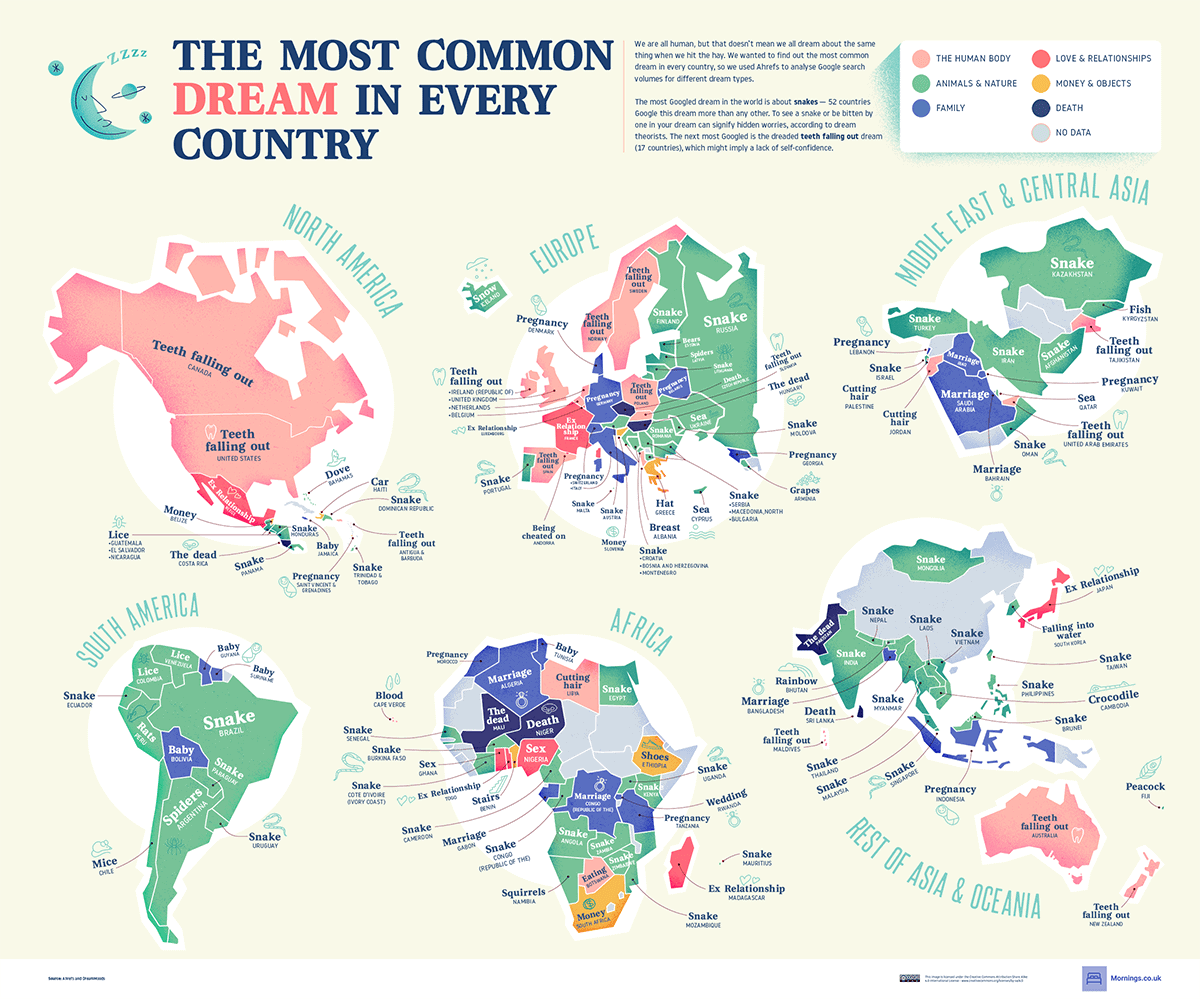
map of the world divided by the most common dreams in each location
Zomasleep.com zomasleep.com

Here are a few:

Teeth Falling Out

closeup of a child's smile missing teeth
Have you dreamt of your teeth falling out? pxhere.com


In the US and UK (and many other countries), crumbling teeth were the most common dream people Googled. Anderson added, “Both countries share snake dreams at number two. However, among terrifying snakes and spiders, the US dreams of ex-partners at number three—while Brits dream of hair.”

It should also be noted that if we’re doing top ten lists, the charts showed that “while Americans dream of vacations, bears, and being chased, Brits have pregnancy, birth, and fire on their (subconscious) mind.”
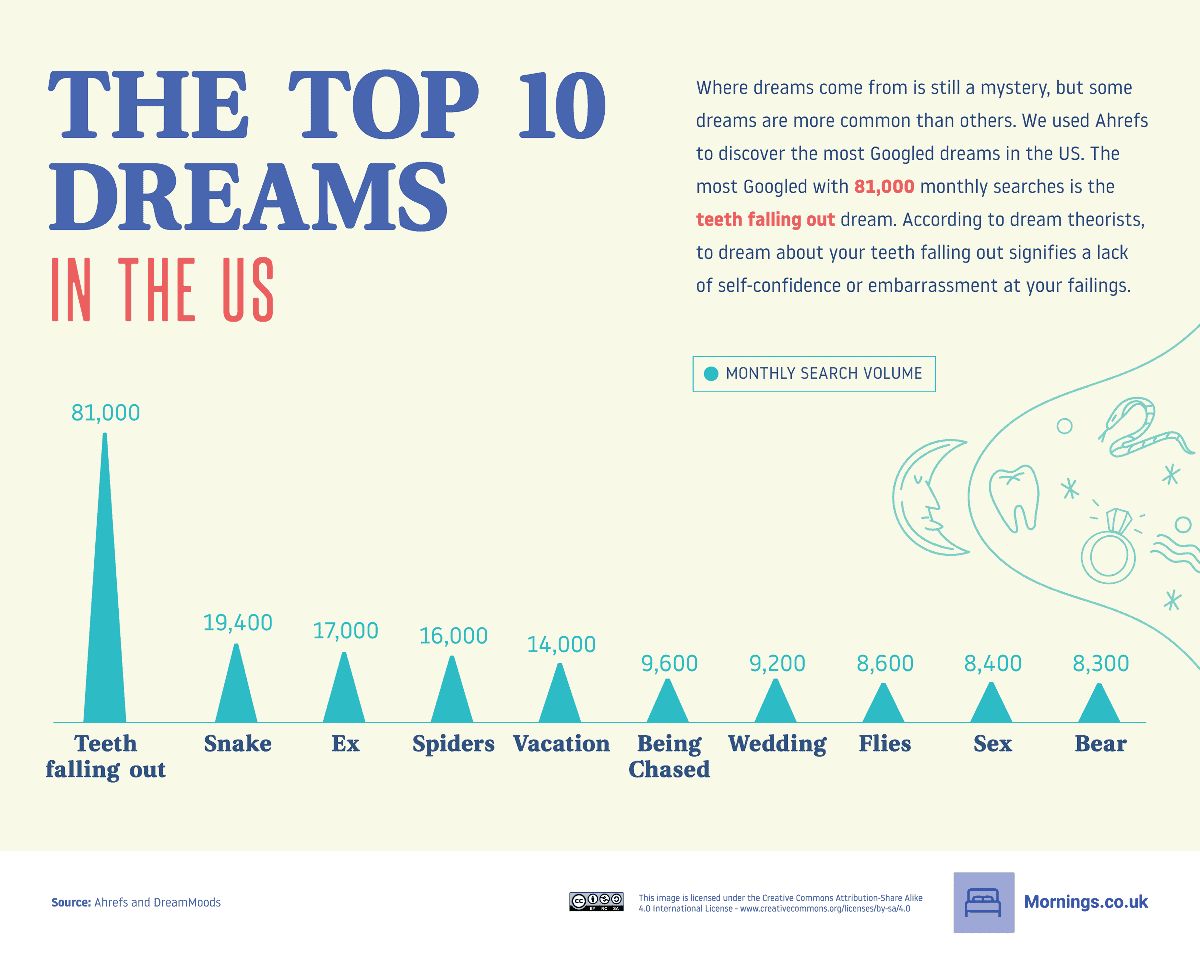
chart of the top 10 dreams in the US
Zomasleep.com zomasleep.com

Rainbows and Sex

a double rainbow with a person in red standing in the middle raising their arms
Not sunshine and lollipops, but close! en.m.wikipedia.org


Not everyone has recurring nightmares. A few lucky residents of the world list much more positive common dreams in their number one spot. Bhutan, for example, has rainbows at the top of the list, while many in Ghana and Nigeria often report dreaming of sex.

The Ones Who Got Away


silhouette image of a woman sitting on a bench and a man walking away from her
Breakups are another common dream (or nightmare)u00a0for many. www.publicdomainpictures.net


In some places, like France and Japan, people might have more complicated dreams about their exes. (Who knows, this could also involve rainbows and sex.)

Hats and Birds

metalwork birds painted bright blue, green, red, and yellow wearing glasses and hats on a metal wire
Birds of a feather dream together? pxhere.com


Some countries have inexplicable reports of dreams in first place. In Greece, people commonly dream about hats. In Fiji, it’s peacocks!

But the Winner is…
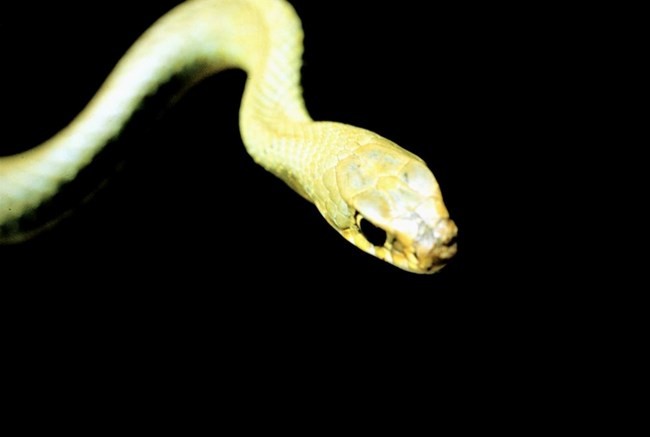
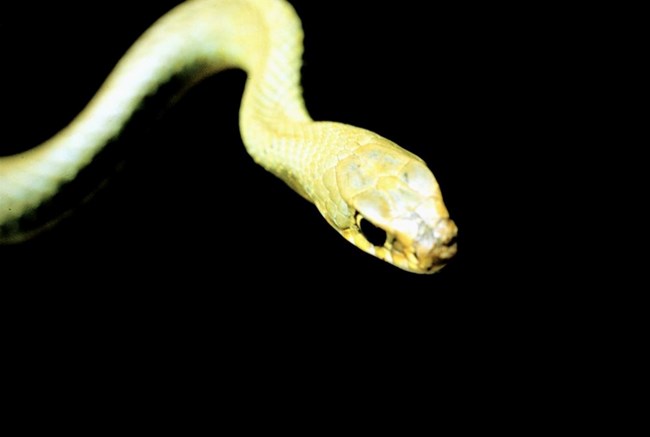
a yellow snake against a black background
Eastern Yellow-bellied Racer www.nps.gov


And the most common recurring dream according to the study is: snakes! Out of all the countries surveyed, 52 out of 147 had snakes at the top of their dream/nightmare lists. Anderson continued, “Snake dreams are particularly ‘popular’ across Eastern Europe and parts of Asia and Africa. The snake lends itself to symbolic interpretation, but in the case of some snake-inhabited localities, sometimes a snake is just a snake.”

Personally, my most common recurring dream is this: I’m back in high school, and it’s the day of the “big exam.” I’m circling the hallways but can’t remember where my class is. I CAN, however, remember that I completely forgot to study. I have this dream about once a month, and in it, I never do find that class.


  • British engineer uses 500 disposable vape batteries to power up electric car
    Combined vape pen batteries can deliver real horsepower.Photo credit: Chris Doel/YouTube

    A British engineer-turned-YouTuber turned heads with a recent invention he created from trash. After building power banks and powering e-bikes with discarded disposable vape pens, Chris Doel transformed 500 vapes into a power source capable of driving a car up to 40 miles per hour.

    On his YouTube channel, Doel documented the experiment. He recovered 500 discarded vape pens and used 3D printing to combine their batteries into a single 50-volt, 2.5-kilowatt battery pack. He then modified it to power a Reva G-Wiz, an early-2000s low-powered electric car. The vape battery pack didn’t just start the G-Wiz; it powered the car enough to travel 18 miles and reach speeds of up to 40 mph.

     “I can’t believe this car has just accepted this crazy Frankenstein battery that I’ve just slapped in it,” Doel said in the video.

    The engineer points out a problem with single-use electronic products

    Doel’s feat wasn’t just a display of ingenuity; it also highlighted a growing problem—specifically, the mounting burden of landfill waste. According to a 2024 report by Wired, 137 billion pounds of e-waste, including vape pens, are generated each year. Only one quarter of that waste is recycled.

    As Doel pointed out, much of this waste isn’t just metal and materials going to waste, but also a loss of reusable energy.

    “Unfortunately we seem to live in some crazy dystopia where buying these single use devices and then chucking them away is totally normalized, despite them having fully rechargeable lithium ion cells inside them,” Doel said.

    @sustainabilitymattersva

    E-waste will continue to become a bigger issue in the future. Be sure to do you part to mitigate the problem by properly disposing of your old electronics📱 #ewaste #landfills #landfill #waste #trash #recycle #wastedisposal #electronics

    ♬ original sound – Sustainability Matters

    Cumulative e-waste isn’t just environmentally harmful; it also poses risks to human health. The World Health Organization warns that much of this waste releases toxic chemicals and materials into soil and water. Prolonged exposure can negatively affect the health of children, pregnant women, and others.

    To reduce the amount of e-waste filling landfills, it’s important to dispose of these products properly. After deleting all personal information, consider donating your electronics to a friend or an organization. Items with lithium-ion batteries, such as vape pens, shouldn’t be thrown in the regular trash.

    You can search online to find a proper e-waste facility in your area. More information on how to properly dispose of or recycle e-waste is available on the United States Environmental Protection Agency website.

  • Scottish children are helping penguins find mating partners with these tiny, painted stones
    Scottish kids are helping penguins get a date.Photo credit: Edinburgh Zoo on Instagram
    ,

    Scottish children are helping penguins find mating partners with these tiny, painted stones

    “I would cry if a penguin picked MY pebble 😭 It’s a life goal”

    During mating season, male gentoo penguins are tasked to find pretty and smooth rocks to present to prospective mates. This is meant as a gesture to woo them and to be used to build a nest with them, too. Well, this season, the penguins at the Edinburgh Zoo in Scotland got some help.

    Kids being supported by the Edinburgh Children’s Hospital Charity gathered together to paint pebbles with vibrant colors for the penguins. The hospitalized children do this every year with the first stone traditionally placed in the penguin enclosure. The children often watch a livestream of the gentoo penguin enclosure to see the penguin pick their favorite rocks that they’ve painted.

    Commenters sound off on the penguins’ pebbling

    The Edinburgh Zoo posted this year’s pebbling pickings on Instagram, delighting the commenters:

    “I would cry if a penguin picked MY pebble 😭 It’s a life goal lol.”

    “This is just brilliant! How wonderful to see a creative health initiative that actively connects the children with a purpose like this!”

    “This is heartwarming ❤️❤️❤️”

    “This is brilliant for the penguins and the children! Can’t wait to see the beautiful nests.”

    “My grandson painted a pebble he’s hoping it gets picked.🤞🤞🤞”

    “Penguin pebble pilfering season is upon us! So pleased it makes so many people (and penguins) happy.”

     “Oh no, now I’m questioning if penguins have favourite colours.”

    “Any that aren’t picked would make an awesome rock garden that kids visiting the zoo could pick from!!”

    “This is the cutest thing I have seen probably ever.”

    Pebbling practices for human relationships

    As mentioned, this mating ritual called “pebbling” is a gesture made by male penguins to their mate to not just build a nest. It’s their version of saying, “I saw this and I thought of you.” In fact, psychologists and couples therapists recommend adopting a version of pebbling for human relationships.

    Now to “pebble” in dating or married relationships doesn’t literally mean giving your partner rocks (unless they’re a geologist that would love that sort of thing). For humans, pebbling your partner means to share or give a small gift like a flower, toy, or object that has some meaning to one or both of you. It doesn’t always have to be a gift either, but it could be a photo, social media post, or a meme you can text them. It’s essentially anything that conveys “I saw this and thought of you” in order to showcase affection to them and initiate closer conversations.

    Pebbling isn’t just for romantic couples either. Many autistic people find it more difficult to navigate socially due to high anxiety, sensory sensitivities, or having trouble interpreting social cues. By texting a GIF to a friend, giving a small flower to their parent during a walk, or other such pebbling, it allows some autistic people the ability to communicate their affection and connection without the pressure of using words.

    Whether it’s a colorful rock or something else, pebbling can be a valid form of communication between friends, partners, or potential mates. It all depends on who you choose to build a nest with.

  • Scientists have created a leather clothing alternative made entirely from mushrooms that looks and feels like the real thing
    Left: Mushrooms. Right: A model dressed in a leather jacket.Photo credit: Canva

    Austria’s scientists have created a leather made from mycelium. Growing mushrooms in low-oxygen chambers allows researchers to craft an alternative material that feels and looks like traditional leather. The finished textile is strong, flexible, and even fire-resistant.

    Manufacturers grow the material instead of harvesting it from animals. After it reaches the desired thickness, they apply non-toxic enzymes to keep it fully biodegradable. The vegetative part of the fungus grows into a dense mat over a matter of days. Above all, it avoids the environmental impact of traditional leather production.

    Alternative leather made from mushrooms

    This is not science fiction; fungal fabric has grown from a curiosity into reality. A 2025 report listed the benefits of mushroom leather as having a lower carbon footprint. It begins with a substantial reduction in water use. Growing mushrooms, compared to raising cattle, requires a fraction of the water.

    Secondly, the product breaks down naturally without microplastic contamination. Using enzymes that cross-link the fibers results in a material free of blended toxic materials.

    Moreover, by creating the right environment—a low-oxygen chamber with a nutrient-rich substrate—the mushroom mat can be grown in a matter of days.

    Lastly, mushroom leather is naturally fire-resistant. There’s no need for harmful chemicals to treat the textile. In addition, clean up requires mild soap and lukewarm water.

    A 2026 study in ScienceDirect confirmed the fungal mycelium as an eco-friendly alternative to traditional and synthetic leathers. It demonstrates structural integrity and favorable thermal stability.

    fungus, clothing materials,  environment, biodegradable, non-flammable, dense mat
    Mushroom leather.
    Photo credit: ThamaraGroenleer/ Wikimedia Commons

    Is the public ready for vegan leather?

    People have conflicting thoughts, as seen in the comments on the Instagram post. Some individuals are excited and encouraged by the possibilities. Others, however, are less impressed:

    “I’m ready for it. How do we buy it?”

    “Make it affordable and common!”

    “As long as the final product keeps being painted and coated with chemicals, the purpose of the product is merely green washing.”

    “bio degradable? sorry your shoes were eaten by mold after the rain.”

    “Where we can buy this leather?”

    “Unless we’re talking about aprons/gloves for welders or blacksmiths (which is a fairly niche market), flammability isn’t something most people that wear leather are concerned about.”

    fashion, sustainable materials, clothing, vegan leather, eco-friendly
    Materials and scissors.
    Photo credit: Canva

    Fashion looks for sustainable, yet affordable materials

    Fashion leaders are looking to incorporate more sustainable fabrics into their creations. A 2025 post on Open Forem explored material choices for leading industry fashion designers in 2025. For example, more familiar textiles like polyester, organic cotton, and wool made their traditional rounds. But there was an effort to use plant-based leathers, too.

    Mushroom mycelium leather was a hot choice for its low environmental impact, its short creation time, and its customizable texture and thickness.

    Other exotic materials included banana fibers, seaweed-based fabrics, and Piñatex, a natural, low-impact textile made from pineapple leaf fibre. Designers fashion the plant-based material into vegan handbags, shoes, and wallets.

    A 2026 article in Vogue revealed that Gucci seeks more sustainable ways to produce leather products. The luxury brand began a campaign for vegan alternative leather back in 2021.

    Despite commercial adoption remaining somewhat limited, mushroom leather continues to attract attention for its eco-friendly production and versatility. Grown on agricultural waste while remaining fully biodegradable are cornerstones of this remarkable material.

    You can watch this TED Talk on fashion made from mushrooms:

Explore More Science Stories

Science

Scottish children are helping penguins find mating partners with these tiny, painted stones

Science

Scientists have created a leather clothing alternative made entirely from mushrooms that looks and feels like the real thing

Environment

Scientists create environmentally friendly plastic replacement from shrimp shells

Science

Scientists invent ‘smart’ underwear that tracks gut bacteria health through your farts