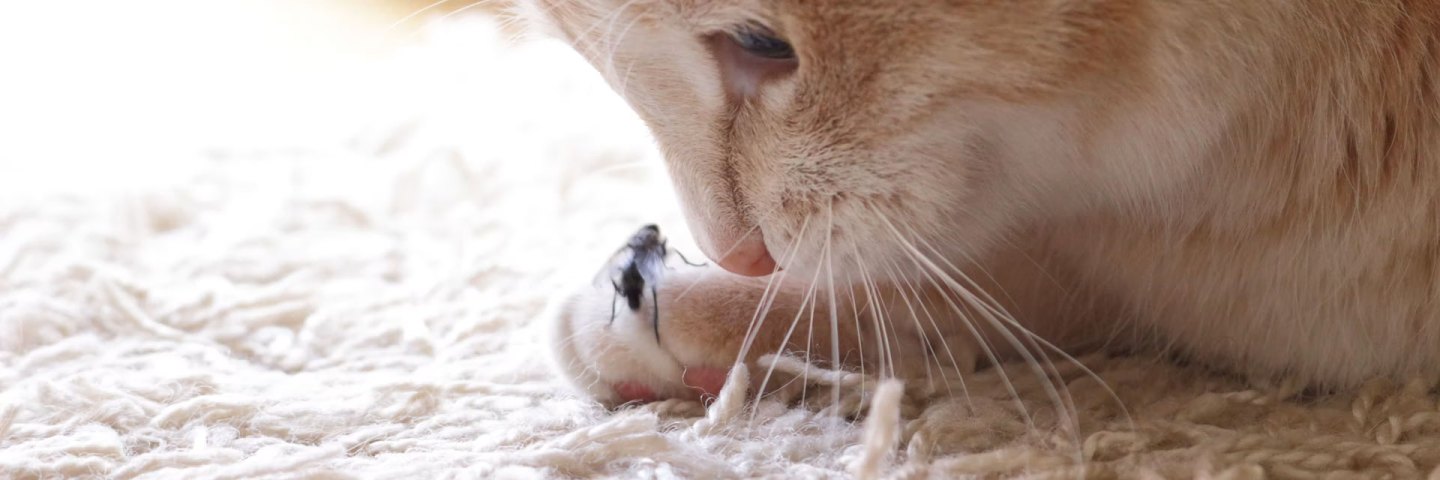



It’s pretty commonly known, and not very startling, that free-ranging cats eat birds and small rodents. But the degree to which they eat insects might surprise you.

We are biologists who for many years have been trying to figure out what feral or outdoor-roaming pet cats eat outside.

When domesticated cats – Felis catus – live freely in the wild or are allowed to hunt outside the homes where their owners live, they are an invasive species, which live in every ecosystem of the world except the continent of Antarctica. We wanted to know all of the species they eat – and to what degree free-ranging cats are eating endangered or threatened species.

Examining reams of research

Over the past two decades, we have evaluated hundreds of scientific findings, including searching through Google Scholar and Web of Science using the keywords “cat predation,” “feral cat,” “cat diet” and “Felis catus.” For each item we found, whether peer-reviewed or not, we evaluated whether it contained conclusive evidence of cat diet or predation. We also reviewed each one’s reference section for additional unique articles or databases pertaining to cat diet and predation, and included those in our search.

Overall, we identified 533 unique publications – books, journal articles, theses and agency reports – that reported specific animal species consumed by cats. Cats’ plant-eating habits are occasionally, but haphazardly, noted in studies, so we did not include them in our analysis.

Our initial work focused on an overall assessment of what free-ranging cats eat around the world. Published in 2023, this paper analyzed the 533 studies on cat diet or predation events published over more than a century and found that cats ate nearly 2,100 different species of animals, including invertebrates.

Of those 2,100, the International Union for Conservation of Nature’s Red List of Threatened Species listed 347 as “near threatened,” “vulnerable,” “endangered,” “critically endangered” or “extinct” in 2023. Some of the species went extinct during the many decades covered by the data.
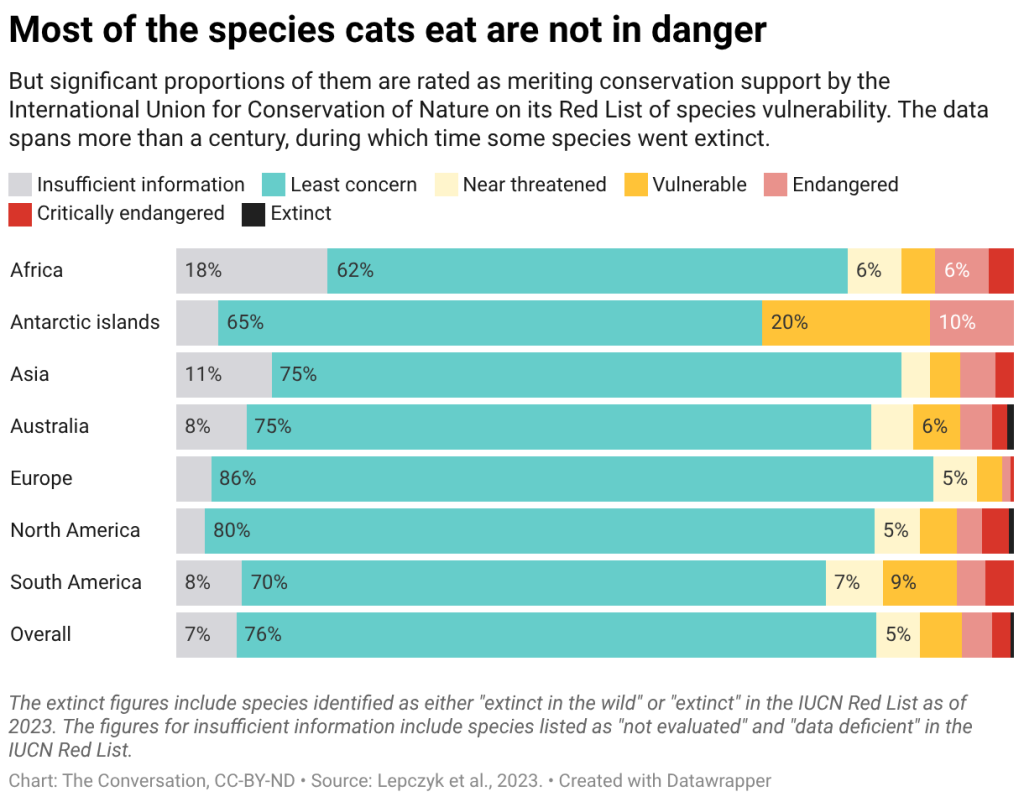
Most of the species cats eat are not in danger

Insects and the like

Most of the species cats ate were vertebrates – mostly birds, followed by mammals and reptiles. But the data also indicated that at least 7% of the species cats eat are insects and other invertebrates, particularly beetles, and less frequently crustaceans, arachnids, centipedes, snails and slugs, and millipedes.

Many of the cat studies we reviewed did not report on how many individuals of a given species cats ate, so it was unclear what the total amount of insects was or how many calories cats are deriving from insects.

Invertebrates make up more than 70% of all terrestrial animal species and are important pollinators, predators and herbivores in virtually every nonmarine ecosystem. Many invertebrates are in decline globally due to urbanization, habitat destruction, increases in both light and pesticide pollution, and climate change. So we dug deeper into the data to understand what invertebrates cats are eating.

While a little more than one-third of all the studies we analyzed included invertebrates as part of cats’ diet, most of those failed to identify specific species of invertebrates. But we were able to find identifications of 148 invertebrate species.

Of those, two are considered endangered by the International Union for Conservation of Nature: the Aldabran grasshopper (Pternoscirtus aldabrae) in Seychelles and the Tasmanian giant freshwater crayfish (Astacopsis gouldi), which can grow up to 13 pounds (6 kilograms). Two others are considered vulnerable: wētāpunga (Deinacrida heteracantha), an insect native to New Zealand that can be about the size of a mouse, and the common yabby (Cherax destructor), a freshwater crayfish native to southeastern Australia. One other, the Canary Islands horned beetle (Arhopalus pinetorum), is listed as “near threatened.”

A cat licks its lips while crouching over a dead mouse.
Not surprising: Cat eats mouse. Julian Stratenschulte/picture alliance via Getty Images

Effects on populations

We have not found formal research evaluating how cats’ eating habits affect invertebrate populations. And for many species, they are likely not as significant a factor as wide-scale pesticide use.

But it’s possible that cats could be significant contributors to the deaths of rare species or in specific locations.

Cats require a large amount of protein, as much as one-third of their daily diet, and invertebrates are good sources of protein.

In many places, invertebrates provide an easy source of food. Whether in an urban backyard or on a remote island, cats are unlikely to turn a blind eye to available prey. And some cats may find it entertaining to chase, catch and eat insects even if they don’t need their nutrition.

A challenge of researching this question is that many invertebrates are relatively small, which makes direct observation in the field harder and can require more analytical approaches in the lab. And they have soft bodies, without distinguishing characteristics that could be easily recognized in scat or stomach contents.

However, molecular technologies can identify species using trace amounts of DNA left in the environment by animals. Promising new studies are beginning to identify what cats eat by analyzing the DNA found in their stomachs and scat. That research may help explore in even more detail what cats are eating in the outdoors, and how it’s affecting various species and the environment as a whole.

This article originally appeared on The Conversation. You can read it here.

  • The University of Cambridge found a way to reduce plastic waste and create clean hydrogen energy at the same time
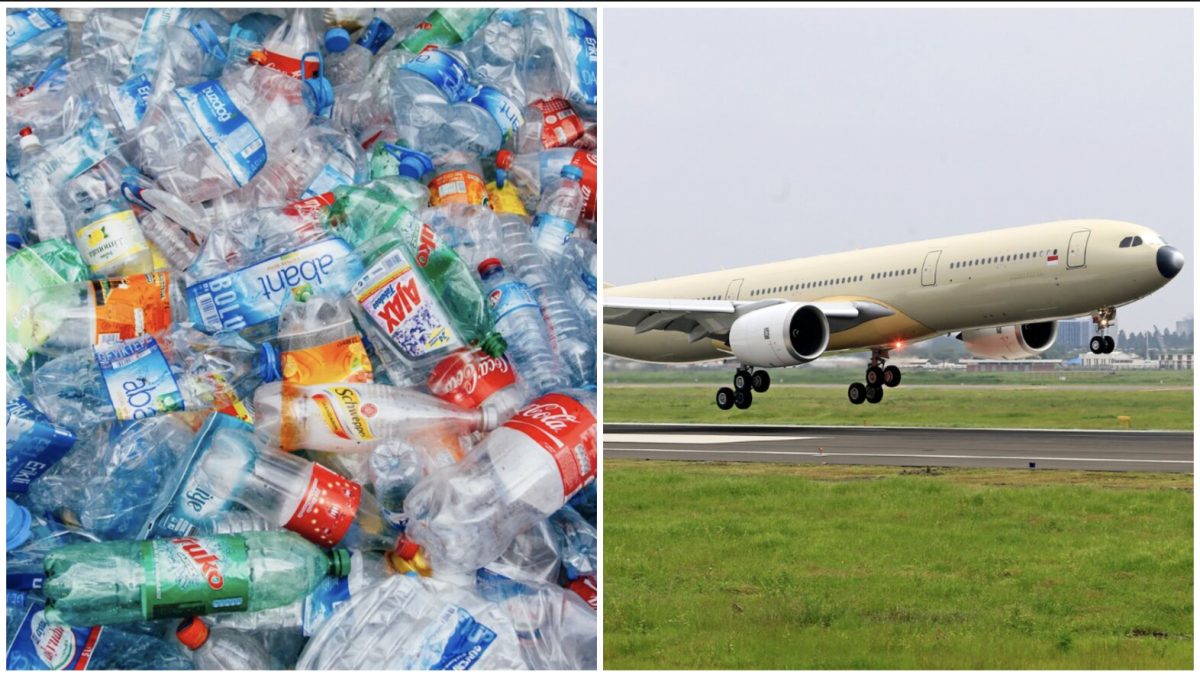
    Photo credit: CanvaPlastic bottles, left, and an airplane.

    The world’s top environmental concerns come down to two basics: reducing waste and creating clean energy. Thanks to researchers at the University of Cambridge, we may be able to tackle both with a single solution.

    Inspired by a previous solar-powered reactor the team created that turned carbon dioxide and plastic waste into fuel and useful chemicals, the researchers developed a new device that uses sunlight to break down plastic into hydrogen.

    “Converting waste streams into valuable products using clean energy sources is…an attractive strategy to address both energy and environmental concerns,” the team wrote in Nature Chemical Engineering.

    How does this device work?

    The reactor is relatively simple compared to others of its kind. The researchers sprayed a light-absorbing material onto a glass panel. They then added a second layer of molecules containing zirconium and cobalt to act as the catalyst for the reaction. All told, the device measures about one square meter and was tested under natural sunlight.

    Under sunlight, the device was able to extract hydrogen from sliced-up plastic bottles. It also extracted hydrogen from glucose and cellulose. This means the device can produce hydrogen from both plastic and plant waste.

    Hit two problems with one device

    This could help reduce a rapidly growing problem. The world produces more than 359 million tons of plastic each year, much of which ends up in landfills. Most modern plastics take 100 to 1,000 years to decompose. Much of the plastic polluting our land and oceans comes from food packaging, including water bottles. This device can turn those plastics into a cleaner fuel source. It could also help address the growing problem of microplastics contaminating drinking water and soil.

    Hydrogen is a powerful fuel for trucks, ships, and airplanes, and demand for it is growing. Because it typically produces only water as a byproduct, it is a highly sought-after source of clean energy. While there are green methods for producing hydrogen using solar and wind power, a significant amount of the world’s hydrogen still comes from natural gas. In other words, while hydrogen itself is a clean source of energy, the way much of it is produced is not.

    Could this device work realistically on a global scale?

    The use of spray coating and relatively simple materials makes this new reactor easier to manufacture.

    “What surprised me was, after all the optimization, just how simple it is,” researcher Ariffin Bin Mohamad Annuar said in a press release. “We just have this huge panel, we spray our catalyst on it, put it into our solution, put it under the sun, and it produces hydrogen and other valuable chemicals just from plastic waste. It’s just simple and scalable.”

    The team says that before they can make the device commercially available, they hope to make it more durable and efficient. Time will tell whether it becomes a solution to both problems as it becomes more widely available.

  • Kenyan teens create award-winning, affordable car exhaust filters made with corn cobs and algae
    Photo credit: @theearthprize on Instagram/CanvaTwo 17-year-olds made a device that is helping reduce air pollution in Kenya.

    When Fredrick Njoroge Kariuki of Kenya turned 12 in 2021, he experienced incredible difficulty breathing. Doctors diagnosed him with bronchitis, explaining that his coughing and breathing issues were connected to the thick layers of exhaust fumes emitted by vehicles in the area. Five years later, the teenager teamed up with his classmate Miron Onsarigo to create an award-winning, inexpensive filter made with agricultural waste.

    While air pollution is a global concern, it is particularly an issue in Kenya. A 2024 study found that Nairobi, Kenya’s capital, had 3.7 times higher levels of particulate air pollution than the World Health Organization’s guidelines. This doesn’t just contribute to illness like Kariuki’s bronchitis. Experts estimate that the country’s air pollution is responsible for 400 to 1,400 premature deaths in Nairobi each year.

    The global environment issue was personal

    Both teens were hardened in their resolve to tackle this air pollution problem largely caused by the matatus (shared minibuses) and boda bodas (motorcycle taxis) common in urban areas.

    “The problem of air pollution was very personal to us, and that is why we started thinking about coming up with a solution,” Kariuki told Mongabay. “It was a passion before it became a project.”

    “I did not choose this problem. It chose me,” Kariuki said to Daily Nation. “Growing up in Naivasha, my bronchitis got so bad that I stopped thinking of air pollution as an environmental issue and saw it as something being committed against us.”

    “Seeing people get sick as a result of fumes from vehicles has become normal back home in Kisumu County. The ‘normal’ did not feel right to me. I wanted to do something about it,” added Onsarigo.

    Using waste products to clean the air

    With time, intelligence, and hard work, Kariuki and Onsarigo created the HewaSafi vehicle exhaust filter. The HewaSafi, which means “clean air” in Swahili, was made using locally sourced agricultural waste. The entire mechanism is made from steel mesh, copper, corn cobs, coconut shells, recycled batteries, and algae. All of these components help further filter out particles in the air straight from the exhaust pipe.

    The results of the HewaSafi were impressive. The device reduced particulate matter in the air by 93.3%. The HewaSafi also reduced carbon monoxide by 42% and absorbed 21.4% of CO2 that would otherwise be released into the atmosphere.

    Since the device was made using waste products, the HewaSafi manufacturing cost is around $126. By comparison, conventional filters of this sort typically cost around $390. So, not only is this filter effective, it’s cheap enough for more people to use.

    @urbanbetternairobi

    You breathe it every day. But how often do you think about it? Air pollution affects where we live, how we move, and who gets left behind. This Air Quality Awareness Week, swipe to see how Nairobi communities are taking action!#AirQualityAwarenessWeek #Cityzens #Cityzens4CleanAir #CleanAirNairobi #nairobi

    ♬ LET ME BE – The Second Voice

    A prize that leads to further opportunity

    The ingenuity of these two 17-year-olds won them the 2026 Earth Prize for Africa. They received $12,500 for their regional win and global attention to the HewaSafi.

    The teens hope to use the prize money and attention to further develop the HewaSafi. Using connections made through the Earth Prize, they aim to start a full line of emission control products. While they want to work with people with different budgets, their main target is to specifically cater HewaSafi filters toward public transportation vehicles.

  • The drawer problem: Why so many of us can’t let go of our old electronics, and what we can do about it
    Photo credit: Peter Dazeley/Photodisc via Getty ImagesThis look familiar?

    Think about the last smartphone, tablet or smartwatch you stopped using. Odds are it is not in a recycling bin or a new owner’s hands; it is sitting in a drawer.

    From our survey of 4,000 American consumers, we found the single most common thing people did with a device they were finished with was nothing at all: 39% simply stored it. Recycling and reselling, outcomes better for the environment, each accounted for only about 1 in 10 devices. Throwing devices in the trash claimed another 9%.

    What people do with old electronics

    Funded by the National Science Foundation, our multidisciplinary team blended our expertise in causal inferencesustainability and cybersecurity, to work on the tangled question of what people do with their consumer electronics when they’re done using them. We used statistical models to connect what people say – that is, their stated knowledge and attitudes – to what they actually did.

    Why the drawer wins

    Two main forces keep devices in the drawer. The first is anxiety about data. People who worried that recycling or reselling a device would compromise their data were 14% and 9% more likely to store it instead.

    The second force is simply not knowing how to. People who did not know where to recycle were 10% more likely to hold onto a device, and many also kept old gadgets as a perceived data backup.

    Recycling and reselling electronics are a lot easier than a lot of people think. In the U.S., the national chain Best Buy accepts devices for recycling; reselling online is convenient with vendors such as Back Market and Gazelle.

    Just be sure to wipe data before parting with a phone or computer. Also, remove the device from your account, for instance with Apple or Android. Unless you do, the device stays locked to you, and no one else can use it.

    We also compared what people intended to do with what they had actually done. This led to a telling detail: Data security worries led to people storing devices at a greater rate than they said they intended to.

    In other words, the fear of leaking personal data kicks in only when someone is facing the real decision of whether to hand off their device to a recycler or secondhand buyer.

    Getting at why people don’t recycle

    Researchers have long studied why people do or don’t recycle electronics: Convenience, awareness and incentives showed up as affecting the decision. But prior work examined recycling as the only option.

    Instead of considering the issue as a yes-or-no vote on recycling, we treat it as a comparison between different options: Storing, reselling, donating, trading in, recycling and throwing away the device in the trash. When modeling this way, trade-offs became visible.

    Knowing where to recycle, for instance, made recycling 47% more likely, but it also pulled people away from reselling, which is often the more environmentally friendly choice. You can explore the survey results in our interactive dashboards.

    Getting people to let go

    Storage is the worst of both worlds: A device sitting unused for years loses its resale value, and erasing its data only gets harder over time. The good news is that the main barriers – data concerns and not knowing where to turn – can be addressed with better information.

    We are experimenting with information interventions that walk people through their options, including how to securely wipe their data. We are testing nudges with randomized, controlled trials to test what leads people to give their old electronics a second life.

    It might be a good time to remember what old devices you’re holding onto and revisit your reasons for not letting go of them.

    This article originally appeared on The Conversation. You can read it here.

Explore More Environment Stories

Environment

Kenyan teens create award-winning, affordable car exhaust filters made with corn cobs and algae

Science

The drawer problem: Why so many of us can’t let go of our old electronics, and what we can do about it

Environment

Solar-powered boat feasts on trash and could solve the ocean’s plastic waste problem

Environment

As climate change causes flooding in London, experts found an effective, low-cost solution: beavers