


Caring about future generations means believing that people who will live decades or centuries from now deserve ethical consideration. In practice, that means taking their interests into account when making all kinds of decisions across a range of issues – from aggressively cutting carbon emissions to investing in pandemic preparedness initiatives and regulating powerful emerging technologies, such as artificial intelligence.

While it may sound like a niche moral view to care about future generations in this way, our new research, published in the academic journal Futures, suggests otherwise. In fact, Americans appear to care substantially about future generations. Nevertheless, they also systematically underestimate how much other Americans care.

To study this, we conducted two online surveys of U.S. adults, totaling 1,000 respondents. The samples were built to roughly match the U.S. population in age, gender, race or ethnicity, and political affiliation. In one survey, people told us their own views about future generations. In the other, a different group told us what they thought the average American believes.

We examined this in three ways. First, we asked how many future generations people think society should keep in mind when making collective decisions. For example, when setting climate targets or designing pandemic response systems, how many future generations should count as stakeholders in that decision? Second, we asked how many future generations elected officials should keep in mind when making decisions about laws and public policy. Third, we asked how far into the future people still deserve “moral concern.”

For the third question, participants were shown a list of the present generation and the next 50 generations, with each generation defined as a 25-year period. They then indicated how many of those generations still belonged inside their “moral circle.” In plain terms: If someone will live 100, 200, or even 1,000 years from now, does their suffering matter – and do we have some responsibility to help make their lives go better?
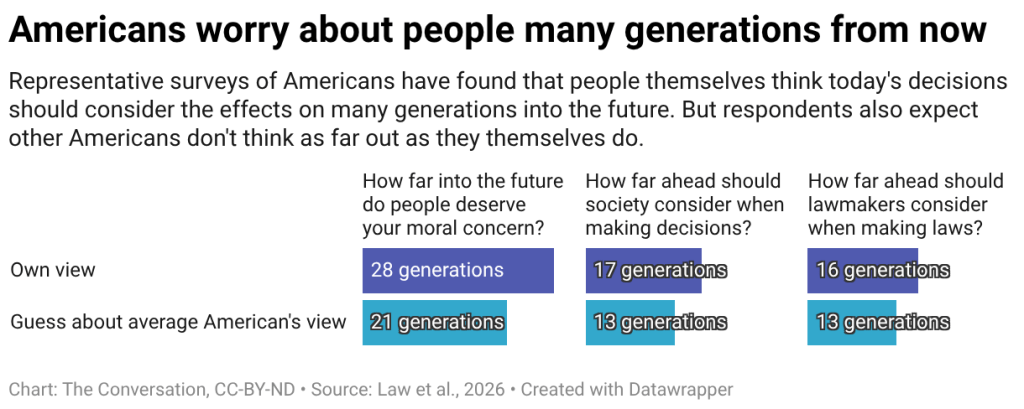
Americans worry about people many generations from now

We found that Americans, on average, extended at least some moral concern about 28 generations into the future, or roughly 700 years. But there was a mismatch about when other people’s concern faded – respondents guessed that it happened around 21 generations out, about 175 years sooner.

A similar pattern appeared on the policy questions. Americans said society and government should take into account people living roughly 16 to 17 generations ahead, respectively – around 400 to 425 years into the future. But they assumed other Americans would endorse a shorter horizon of only about 13 generations, or roughly 325 years. In other words, Americans are more future-oriented than they think their fellow citizens are.
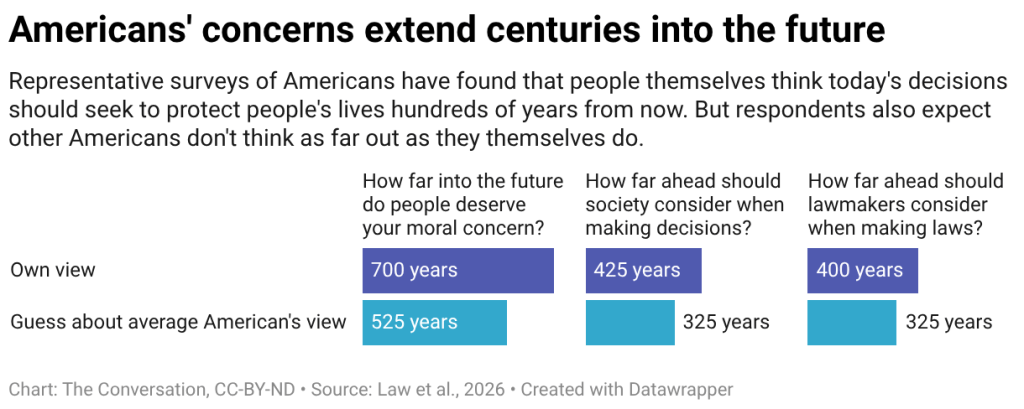
Americans' concerns extend centuries into the future

Why it matters

Public support for long-term policies depends partly on what people think other people value. Research on climate policy, for example, shows that Americans often underestimate how much support already exists for major mitigation measures. When people wrongly think their view is unusual, they can become less likely to speak up, join with others or pressure leaders to act.

Our findings suggest a similar dynamic may shape support for future-oriented policies more broadly. For issues such as pandemic preparedness, nuclear risk and emerging technologies, decisions made now can affect people far into the future.

It’s possible that a person might support stronger emissions cuts, better disease-prevention systems or safeguards on high-risk technologies, but stay quiet if they assume most other Americans do not care about those kinds of long-term consequences.

What’s next

Several hands holding up a globe which appears to be made from blue and green fabric.
Research shows Americans underestimate support for major climate change mitigation measures. Alistair Berg/DigitalVision via Getty Images

For climate change, misperceptions are partly driven by partisan polarization, visible disagreement among leaders and vocal opposition from skeptics. Together, they can make public support appear weaker than it is.

Concern for future generations, by contrast, is much less overtly politicized – meaning it does not divide along party lines the way climate policy does. Most Americans, regardless of political affiliation, say they care about people living centuries from now. Yet this concern is rarely voiced in everyday conversation, in media coverage or in political debate.

Future research needs to examine why concern for future generations isn’t more visible in public life, such as in the media or voiced in everyday conversations. As a result, people might assume that others do not care as much as they actually do.

The Research Brief is a short take on interesting academic work.

This article originally appeared on The Conversation. You can read it here.

  • The evidence points to a crisis in teaching, yet Gen Z is still choosing to show up in the classroom
    Photo credit: CanvaSmiling Gen Z teachers.

    Anyone interested in becoming a teacher in today’s environment does so under a warning label. With lower pay, political pressure, community standards, lack of necessary funding, and general safety concerns, this profession is in crisis. Seasoned educators are completely burned out.

    As more teachers share on social media that they’re tired of the system and ready to leave education, something unexpected is also happening. Despite every statistic adding up to a profession better avoided, Gen Z graduates are choosing to teach anyway.

    teaching shortage, young teachers, underfunding, work conditions
    Young educator in the classroom.
    Photo credit Canva

    A generation shaped by isolation, Gen Z chooses connection

    Teach for America (TFA), one of the larger teacher pipelines in the country, brings in thousands of new educators every year. In 2025, over 2,300 college graduates from 600 colleges and universities have joined up.

    In January 2026, The Guardian wrote that despite a nationwide decline in teachers, a significant number of Gen Z graduates are entering the classroom. A generation that faced the social isolation created during COVID lockdown looks to make connections and give back. “Teaching is a job where they can find that,” said Whitney Petersmetyer, TFA’s chief growth and program officer. She believes the generation is “craving human connection and experiences that feel real.”

    Petersmetyer adds that Gen Z is, “responding to the opportunity for purpose and responsibility at a time where many entry jobs feel uncertain or disconnected from impact.”

    purpose, meaning, mental health, Gen Z teachers
    What’s your purpose?
    Photo credit Canva

    Gen Z craves purpose and meaning

    In a global 2024 survey by Deloitte, a massive sample of 23,000 respondents from 44 countries was surveyed on financial insecurity, rapidly evolving technology, and career choices. Results showed 9 out of 10 Gen Zers believed purpose was the key to job satisfaction. Almost 50% of job opportunities were rejected because they failed to meet their personal values.

    Gen Z actively wants work that has a positive social impact, acknowledges environmental values, and follows ethical concerns. In 2023, Forbes reported that Gen Z is fueled by purpose perhaps more than any previous generation. They prioritize values over salary.

    Many Gen Zers have been rethinking what work should really provide. They want income, yet personal fulfillment and a life balance remain crucial. Business Insider reports this generation is less willing to accept work that feels transactional or leaves them feeling empty.

    impactful career, priorities, education impact, classroom innovation
    The many roles of a teacher.
    Photo credit Canva

    The challenges haven’t gone away

    Teaching is still one of the most challenging jobs in the country. The work is complex, emotional, and highly demanding. A 2024 report in EdWeek found that teachers earn lower pay and experience more stress than workers in other professions. A 2024 report by the U.S. Bureau of Labor Statistics showed the teaching profession in decline due to low wages and reduced freedom in the classroom.

    In2024, the RAND Corporation also conducted a survey that found 53% of teachers report being burned out. Over half of the educators faced frequent job-related stress and declining well-being.

    teaching methods, student engagement, teaching statistics, impact
    A Gen Z teacher.
    Photo credit Canva

    Choosing a profession that others are leaving

    Gen Z knows the challenges. They’ve seen the uncomfortable headlines. Despite everything, they’re still coming to teach.

    “My philosophy is focused much more on being a good human at this age,” said 23-year-old educator Van De Vijver. The third-grade math teacher in Fairfax, Virginia, added, “If they leave my classroom as someone who is willing to help others, who keeps an open mind and is caring, as long as they also don’t get zeros on everything, then I feel like I have done a good job teaching.”

    Whether these incoming, motivated, young teachers decide to stay will likely depend on their personal motivations and the experiences they encounter as educators. Despite burnout in a strained profession, they’re choosing a job that offers them connection and meaning. Even if the path ahead is uncertain, Gen Z brings new energy and ideas into the classroom.

Explore More Society Stories

Society

10 conversation starters that actually work, according to communication experts

Public Good

The evidence points to a crisis in teaching, yet Gen Z is still choosing to show up in the classroom

Society

Worrying about being a perfect mother makes it harder to be a good parent

Society

Are women board members risk averse or agents of innovation? It’s complicated, new research shows