“Did you know Big Boi loves Kate Bush?” I croaked on the phone to my boyfriend Chris in between bouts of hacking up a lung.

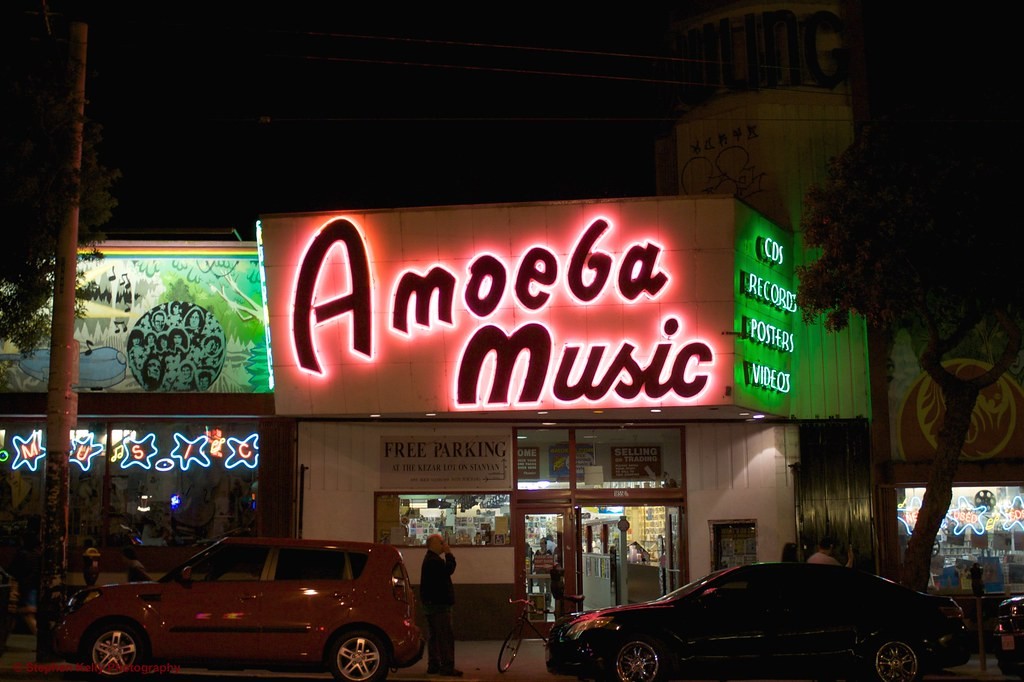
By then I had been in bed for three days fighting some heinous respiratory/headache/fever combo sent up from the worst parts of hell or the airport at Thanksgiving, depending on which you think is worse. Of the things that got me through, besides lemon-mint cough drops and hot cereal, my favorite was my repeated trip to Amoeba Music’s YouTube Channel for their What’s in My Bag? series.

For the uninitiated, California’s legendary independent record store Amoeba Music—with locations in Berkeley, Hollywood, and San Francisco—has been producing what’s now a Webby Award-winning YouTube series called What’s in My Bag? for 18 seasons, starting some 16 years ago. In each video, which is usually less than 15 minutes, artists from across the cultural spectrum—musicians, actors, comedians, and directors among them—choose items from Amoeba to put into one of the store’s famed tote bags, then discuss their collections for the camera, thereby answering the series’ eponymous question. Amoeba then plays sound and video clips of everything so you can hear and see what’s going on, too.

Chris and I first stumbled upon What’s in My Bag? many years too late, (a few weeks ago to be exact), and I was instantly taken with it, making notes on my phone about all these different artists I liked anew, or for the first time. I remember a while ago Spotify sent some notification that people tend to stop listening to new music around age 33. While my first thought was, “Ugh, rude,” because that was probably an age I was approaching at the time, I took it to heart. Whenever I notice I’m stuck in my own modes I try to expand, at least a little. As Chris played different videos, I let Marc Maron recommend me Free and their guitarist Paul Kossoff; let Matt Berry recommend me Tennis; let Pom Pom Squad recommend me Sonic Youth’s Daydream Nation. I was hooked. When I ended up in a swirling sinus-and-body-ache tornado this week, I sat enraptured again, video after video. At my core I am still a curious little knowledge beast (read: journalist), even when I am coughing my chest into the next millennium. Because I could sit there and not only listen to great music but learn for pleasure, I was able to find some joy amidst all the throat lozenges.

In the same way that Architectural Digest’s home tours give us insight into who a person is, so too does What’s in My Bag? And in an age where all of us, whether we know it or not, are struggling for human connection, What’s in My Bag? offers this in a way that’s wholly accessible. While not all of us will be able to custom-design the mansion-on-the-lake of our dreams, for example, it may be significantly easier for us to visit Amoeba and go shopping, to even pick up one of the albums or books or movies or t-shirts we see in the series. It is a slightly more down-to-earth version of “aspirational.” It also humanizes these seemingly larger than life stars, asking both them and us to remember that for a few minutes everyone involved here is just a person with tastes formed by the lives we’ve lived.

A longtime music nerd, my education began in record stores not unlike Amoeba–RIP Fort Lauderdale’s All Books and Records and Radio-Active Records—and I’ve always held fast to the idea, as many have, that we can learn so much about people not just by looking at their taste in music, but listening to how they talk about it. One of the many things Amoeba’s series does so well is it lets these artists share kernels of themselves when they tell stories about how they came to a particular musician, book, or film–where they were when they heard it the first time, why they love it, who showed it to them, what they’ve shared with their families, and more.

Among my favorite moments in the videos I watched was Big Boi, of OutKast fame, waxing poetic about his love of British songstress Kate Bush. Praising her for her poetry and innovation, he also shared that he was introduced to her by his uncle. “Music supposed to evoke emotion and make people feel a certain way, whether it’s happy or sad or [it makes] you think, so I love Kate Bush,” he says, as the singer’s operatic voice plays behind him. Another was the lovely Flea in a video with writer and producer Amy-Jo Albany (daughter of jazz pianist Joe Albany) talking about a box set of music by the gifted, eccentric pianist Glenn Gould playing Bach orchestrations. After taking two years off of the Red Hot Chili Peppers to study music, Flea had discovered a love of Bach, he said, and found in Gould his favorite Bach pianist. I loved listening to Alice Bag talk about rad Xicano musicians and rock and roll gals she admired and got a great reminder from Orville Peck to listen to more Bobbie Gentry. And saints preserve us, what an education from Nick Waterhouse on jazz, R&B, and bebop from the 1950s and 1960s (plus, he talked about Jackie Shane, who I had just written about for this very site; the video was five years old, but still…exciting!).

I’m sure I’m not the only person who’s prone to feeling isolated when they’re sick. Watching What’s in My Bag? made me feel like I had company, maybe in the same parasocial way that podcasts make us feel like its hosts are our friends. I had headaches and backaches and coughing fits, but for a few minutes at a time they didn’t have to be the center of my universe. I was able to take a break from 101.8 degree-fever reality and instead imagine what I would look for at Amoeba, what treasures its vast spaces held in store for me. Maybe Chris and I could make What’s in My Bag? videos of our own there (do they have non-famouses like us doing that all the time now?) and cross our fingers they wouldn’t kick us out before we finished. One day I’ll have the tote bag in my sights. I’ve already started my list.
  • A woman complained to her upstairs neighbor about  a strange noise in the middle of the night. His wholesome response was perfect.
    A woman reads a note from her neighborPhoto credit: Canva

    She had never actually met the man who lived above her. She knew him only as the source of the noise coming through her ceiling at 12:30 in the morning, the night after Super Bowl LIX. She pulled herself out of bed, went upstairs, and asked him through his Ring camera to please turn it down. He was polite. She went back to sleep.

    The next morning, there was a bottle of wine outside her door.

    The woman, who goes by u/operarose on Reddit, posted the photo to r/MadeMeSmile , and it pulled in 84,000 upvotes, as Newsweek reported. The caption was simple: “Had to get out of bed and go ask the upstairs neighbor (whom I’ve never actually met) to turn it down at about 12:30 am this morning. Found this outside my door when I woke up.”

    Attached to the bottle was a handwritten note. “I got too carried away watching recaps from the Superbowl and I didn’t realize how loud my TV was,” it read. “I’m so sorry for not being considerate with the volume. In positive news, the cookies you made for Christmas were amazing. Please allow me to return the favor.”

    That last part is what made the story. He already knew who she was. She’d baked Christmas cookies and apparently given some to neighbors she’d never formally met. He’d received them, remembered, and now here he was, months later, referencing them in an apology note attached to a bottle of wine.

    neighbors, kindness, apology, community, apartment living
    Plate of holiday cookies. Image source: Canva

    She reported back in the comments that the wine was good. “Never had this brand before, but I definitely recommend it,” she wrote.

    Etiquette expert Jo Hayes told Newsweek the neighbor had essentially done everything right. “A clear, sincere apology is necessary, and he did exactly this. Plus a kind word about the Christmas cookies. Plus a gift, as a token gesture of said apology, is the icing on the cake. This would have flooded the downstairs neighbor with warm fuzzies.”

    The comments filled with people who seemed almost relieved. “It’s insane just how hard it is to find people who can just be considerate and move on,” one user wrote. “Congratulations to both of you for spontaneously demonstrating how to be an adult,” said another. “This is how you neighbor,” someone summed up simply.

    The whole exchange took about two minutes of awkwardness and produced something neither of them had before the night started: a neighbor they actually know.

    This article originally appeared earlier this year.

  • He threw a message in a bottle into the ocean as a teen. It washed up 49 years later with a response.
    A bottle with a message inside resting on a beachPhoto credit: Canva
    ,

    He threw a message in a bottle into the ocean as a teen. It washed up 49 years later with a response.

    Two beachcombing brothers nearly skipped the trip. On a remote Bahamian island, one of them found a sand-covered glass Pepsi bottle with a note inside from 1976.

    In May 1976, a ninth-grader named Peter R. Thompson sealed a short note inside a glass Pepsi bottle, handed it to the Coast Guard, and watched it get dropped into the Atlantic Ocean. The note asked whoever found it to write back with the date, location, and how they’d come across it. He was 14. He was doing it for an oceanography class at Pentucket Regional Junior High School in West Newbury, Massachusetts. He then, by his own admission, mostly forgot about it.

    The bottle drifted for 49 years.

    Earlier this year, brothers Clint and Evan Buffington had nearly canceled a trip to a remote out-island in the Bahamas after both came down with an illness. They went anyway. As Clint told WCVB, they were walking the beach on a beautiful sunny morning when his walkie-talkie crackled to life. His brother’s voice came through: “You’re not going to believe what I just found.”

    It was the bottle. Inside, the note was sand-covered and browned with age but still fully legible, more than 1,000 miles from where it had started.

    As reported by Boston.com, Clint Buffington is no casual beachcomber. He found his first message in a bottle in 2007 and has since found over 120 of them, documenting each one on his Message in a Bottle Hunter blog. He knew immediately this one was special. In a Facebook post that began circulating widely, he wrote about what the note meant not just as an artifact, but as a window into the mind of a kid from the 1970s with a science assignment and a big imagination: “Just think what it meant to the 14-year-old kid who sent it in the 70s! The dreams of where it would travel, where it might wind up, who might find it.”

    @clint_buffington

    Here’s the 1976 message in a bottle my brother found a few weeks ago! Y’all wanted to know what it says, so here you go 🙂 Now, to some, this may sound like a pretty “straightforward” message… No romance, no pirate treasure map. But just think what it meant to the 14 year old kid from West Newbury Massachusetts who sent it in the 70s! The dreams of where it would travel, where it might wind up, who might find it… Well, after who knows how many trips around the North Atlantic, drifting past whales and cargo ships, shimmering under the northern lights…it wound up on a very sparsely inhabited out-island of the Bahamas and rested in the sun as world leaders and wars came and went, music and clothing styles rose and fell. Somewhere in there, my brother (who found it) and I were born, grew up, went to school, got married, had kids…. And all that time, this message was waiting to be found. There’s way more going on with this message than you could ever imagine just by reading it! So, here’s hoping we connect with Peter R. Thompson of West Newbury, MA — And that wherever he is today, he still has that 14-year-old dreamer inside him, full of curiosity! #messageinabottle #westnewbury #massachusetts #beachcombing #beachcomber #beachcombingtreasure #treasurehunting #fun #happy #goodvibes #newengland #lostandfound #exciting

    ♬ original sound – Message in a Bottle Hunter

    He went on to describe the bottle’s imagined journey across the North Atlantic, drifting past whales and cargo ships, sitting on a Bahamian shoreline while decades of history rolled by, while he and his brother were born, grew up, got married, had kids. “And all that time,” he wrote, “this message was waiting to be found.”

    Clint posted a TikTok asking for help tracking down Thompson. It crossed one million views. Boston journalist Emily Maher, a reporter at WCVB, got there first. She found Thompson, now living in Leominster, Massachusetts, and put him on the phone with the brothers. “I have found someone that you’ve been looking for,” she told Clint. “I’m going to hand the phone over to Mr. Peter Thompson.”

    Thompson’s reaction, as he told WCVB, was simple and genuine: “It’s amazing. It’s almost 50 years later. It’s a big surprise.” He said he doesn’t remember writing the exact note, but he does remember the oceanography class. The Buffington brothers are planning to return the note to him in person.

    @clint_buffington

    Wow, you guys! Guess what? WE FOUND PETE THOMPSON!! The author of this 1976 message in a bottle!! My sweet brother, Evan, and I are still reeling from the outpouring of support and help we got through TikTok and @WCVB Channel 5 Boston News as we searched for Pete, who was about 14 when he sent the bottled note 49 years ago. Well, thanks to YOU all, we DID find him!!! I mean, really, we are just two goofy brothers, now dads in our 40s (where did the time go!) who have a weird hobby (finding messages in bottles) and we’ve never gone viral on TikTok, so we are a little overwhelmed and a lot grateful! Evan was FLOORED when we very luckily happened to be together this past week, and in the midst of this wild search for Pete, all of a sudden we received a phone call from WCVB’s Emily Maher who had Pete ON THE PHONE WITH US!!! We had a great little chat, all of us totally in shock, and we all STILL are! Pete still lives in the area and was deeply surprised to hear about his message in a bottle—at last check he was still combing through memories of his science / Oceanography class for recollections of making this message in a bottle. It’s amazing what one little scrap of paper in a bottle can do—the memories it can rekindle, the friendships it can spark. It’s so strange to think that this bottle was sent 6 years before Evan was born, and 8 years before I was. Every day of our lives, every little triumph or loss—graduations, meeting and losing friends, getting our drivers licenses, family vacations when we were tiny…every single breath we’ve ever breathed, and this message in a bottle was out there the whole time, just waiting… Sharing this with Pete is a great joy, and sharing it with all of you—who really seem to understand why we love this crazy hobby so much—has also been a total thrill. We have so many more unopened messages in bottles to investigate, and we will need your help! Each one is a portal into someone else’s life, into their world, and who knows where the next one will take us?! We really hope you stick around for the ride. So, from Evan, from me: Thank you, thank you, thank you. We could not have done this without you! As Evan says in this video, “It takes a village”!! Here’s hoping we can return Pete’s message to him! #messageinabottle #westnewbury #massachusetts #boston #newengland #bahamas #fun #happy #goodvibes #goodnews #beachcombing #beachcombingfinds #oceanography #grateful #gratitude

    ♬ original sound – Message in a Bottle Hunter

    Clint’s framing of what makes these discoveries meaningful applies as much here as anywhere: “I always think the most important thing about these messages is not how old they are or how far they’ve traveled. It’s the people on the other side.”

    Peter Thompson spent 49 years not thinking much about a bottle he threw into the ocean as a kid. Then two brothers nearly sick enough to stay home decided to go to the beach anyway, and suddenly the question he asked in 1976 finally had an answer.

    @clint_buffington

    Ahoy, New England!! My goonball brother EVAN found this 1976 message in a Pepsi bottle on a sparsely inhabited Bahamas island last month, 49 years after it was sent by a Peter R. Thompson who lived in West Newbury, MA at the time! He was a 9th grader at Pentucket Regional Junior High School. Yes, there are many Peter Thompsons on social media but we can’t seem to find the right one! Does anyone out there know the right Peter? And @pepsi – if you are looking to rack up some good karma, here’s a chance: Get out your megaphone! Let’s find Peter R. Thompson and COMPLETELY BLOW HIS MIND!! #messageinabottle #pepsi #westnewbury #massachussets #newengland #lostandfound #beachcombing #beachcomber #beachcombingaddict #beachcombingfinds #beachtreasure #trashtotreasure #found #exciting #fun #mystery #happy #goodvibes #goodnews #solvethis #whoareyou #bahamas #treasurehunter

    ♬ original sound – Message in a Bottle Hunter

    This article originally appeared last year.

  • Restaurant owner turns a fake 1-star tamale review into a social media frenzy
    (Left) Tamales in the corn husk. (Right) A woman works on a laptop. Photo credit: Canva

    A restaurant owner shared a strategic, fake one-star review that became a social media frenzy. Posing as Rebecca O., the first review described the tamale-eating experience as “absolutely awful tamale.” A second review followed, joking that Rebecca didn’t know to remove the husk before eating it.

    Restaurant owner Pauline Alvarado dreamed up the creative marketing tactic. She came up with the idea after a woman had expressed a similar experience just days before.

    One-star tamale review goes viral

    Located in Phoenix, Arizona, The Tamale Store is a family-owned Mexican restaurant. After Alvarado craftily posted the first one-star review, the second earned a full four stars. It read, “OK, I was just told I’m not supposed to eat the cornhusk. That just changed the whole experience. Seriously the best thing I’ve ever tried omg. Sorry I don’t know how to delete my other review, my bad.”

    The review has gone viral on multiple platforms, including Instagram and Facebook. The Internet delivered thousands of comments and a flood of exposure for the restaurant—an excellent outcome for any successful marketing strategy.

    In a 2026 article in Newsweek, Alvarado shared the story behind her winning idea:

    “The idea came from a woman who purchased a hot tamale the day before and came back to complain. When I went to see which one she had been eating, I realized she had eaten part of the corn husk. We both laughed, and I gave her another tamale on the house so she could try again. That moment inspired the Rebecca character. In our 18 years in business, I cannot count how many Rebecca O’s we have had. I wanted to showcase that in a lighthearted and funny way!”

    tamale, restaurants, Mexican food, husk, food preparation, funny story
    Unwrapping a tamale from the corn husk.
    Photo credit: Canva

    People share their thoughts with Rebecca

    One of the reasons behind the success of the fake one-star review was its relatability. Here are some of the comments shared on one of the Instagram posts:

    “Welcome to the wonderful world of tamales, Rebecca.”

    “Had a friend from Ohio also eat the husk and was trying to be polite and still said it was good. Such a good laugh lol.”

    “Like when my dad said he didn’t like mango and come to find out it’s because he ate it like an apple”

    “They really should tell people or give instructions not to eat the skin I had my first one a couple years ago and I didn’t know either.”

    “I didn’t eat a tamale until I was almost 30 and I was so confused about this too”

    crowd, community, relatability, social interactions, social media, events, viral
    A crowd doing the wave. Photo credit: Canva

    Why relatability sells

    Alvarado isn’t the first business owner to craft a successful sales and marketing tactic through social media. Credibility and engagement are often tied to relatability.

    A 2025 study published on Springer Nature Link revealed that “authentic” influencers drive stronger engagement and significantly affect consumer response and purchases. Similarly, a 2025 engagement study found that increased user interaction on platforms like Instagram suggested relatable content influenced sales.

    When studies reveal that relatable, story-driven content drives engagement, it’s easy to see why Alvarado’s fake one-star tamale review was so successful. Turning confusion into comedy and connection created real buzz. The idea, based on real-life experience, was simple, human, and funny.

Explore More Culture Stories

Culture

He threw a message in a bottle into the ocean as a teen. It washed up 49 years later with a response.

Culture

Restaurant owner turns a fake 1-star tamale review into a social media frenzy

Well-being

These seven simple phrases could be the secret to deepening trust and romance in your relationship

Culture

Local governments provide proof that polarization is not inevitable