As soon as 20 years from now, 45 percent of American jobs may be performed by computers, as many as 10 million self-driving cars will be on the roads, and robots—computerized machines—will infiltrate almost every arena of our daily lives, from healthcare to energy production. The desire to make systems easier, faster, and more efficient is a human imperative that drives technological advancement, sometimes for the better, but have we crossed over the line into dangerous dependence?


Human society owes a great deal of its advancement to technologies that automate our lives. Since the computer revolution of the 1960s, machines have efficiently taken on tasks saving human sweat and time. In the ’70s, workers at distant terminals, such as reservation clerks, became “increasingly connected to computers, and data entry clerks benefited from video display terminals, gradually replacing punch card data entry,” according to “Technology Shocks and Urban Evolutions,” a paper by Thor Berger and Carl Benedikt Frey, professors at the Oxford Martin School. By the time the Internet came along in the ’90s, it displaced “middle-skill” routine jobs and increased the demand for workers who could perform “cognitive” tasks.

While it’s good to know that dentists, physicians, and fine artists are not so easily replaced, within the next 20 years, Frey and a second co-author, Michael Osborne, determined there is a 97.6 percent chance of bookkeepers seeing themselves replaced, 88.8 percent of technical writers, and even housekeepers stand a 68 percent chance of losing their jobs to machines that can outperform. NPR compiled a handy, interactive graph to determine if your job will be farmed out to robots.

As robotic service providers become the norm and our reliance on handheld devices for more of our lifestyle habits increases, we must consider if we’re pushing a dangerous boundary with our dependence. Especially now that cataclysmic climate change is breaking weather records and taxing power infrastructure. Imagine the frustration you feel when your Internet goes down, or loads too slowly. A study that looked into the adverse consequences of computer technology on healthcare professionals—called “Overdependence on Technology” by Emily M. Campbell, M.S. et al—points out that system unavailability, no matter the cause, can “create chaos and frustrate busy end-users,” which may interrupt workflow, such as lab results, appointments, and worse, causing serious chaos and patient harm.

Of course, many new technologies bring positive results. Google’s newest project, the self-driving car, tempts the human desire for freedom, while offering tremendous possibilities for transport of those too frail, ailing, or young to transport themselves. Such cars also promise greater safety. But are we ready to give over control of our safety to an automated driver that may be unable to respond to human cues of alarm?

Inventions like Tesla’s new solar-powered Power Wall could change our dependence on oil, and allow individuals to produce clean energy. But, warns Edward Sturm, a robotics guest lecturer at Columbia University, “We are advancing way faster than we can give ourselves time to prepare [for].” His research on a forthcoming book about the risks of technology reliance gives him cause for concern. “The technological connectedness we have is incredible. But if one link in the chain were to fail, it could mess up the entire thing.”

Steve Tobak, a long-time consultant in the high-tech industry and author of Real Leaders Don’t Follow, takes a more positive view of automating technology in our lives. “Taking things out of human hands is the best thing that technology has ever done.” He feels the future of automation lies in “The Internet of Things,”—a kind of “mirror world of intelligence that maps out everything that matters and helps to make it more efficient” by automating systems in much the same way as the Internet links people by email and website. He points to Smart Highways, where digital displays show you which highway routes are the best to take to avoid traffic; personal GPS systems in our cars; and smart meters installed by utility companies like Pacific Gas & Electric (PG &E). “It’s great that PG & E tells us how to make our usage more efficient, but wouldn’t you rather that all the things in your home that use energy were smarter and looped into each other, so they could determine when it was best to shut off?”

Tobak is encouraged by digital automation, and does not take an apocalyptic view. “It’s a lot faster for a system to alert itself than for a failure to be noticed by a human being,” he says. “The failure you should be worried about is having too many humans in the loop. If you design the system to be smart, humans have to do a lot less. It’s not like there is some computer overlord plotting evil.”

Somewhere between fear of dependence and a belief that we should become more automated is computer scientist Kentaro Toyama, author of Geek Heresy. He is not so convinced of the transformative effects of technology on society. “The only way that technology is transformative is when it amplifies underlying human forces. It’s like an engine in your car, and society is the driver. Whether you get to the right place or are headed in the right direction is something that technology doesn’t address directly. It’s more important that we get the human element correct.”

Toyama believes the best use of technology is applying it where “human forces are already positive” such as government programs that have a positive impact.

Since it’s most likely inevitable that technological innovation, leaning on the side of greater automation, will only continue, Toyama strives for a future in which “we focus just as much, if not more, on nurturing people.”

Illustration by Brian Hurst. Thumbnail image by Flickr user Peyri Herrera (cc).
  • Overpackers love this simple ‘5-4-3-2-1’ packing rule that makes travel way easier
    An obvious overpack for travel.Photo credit: Canva
    ,

    Overpackers love this simple ‘5-4-3-2-1’ packing rule that makes travel way easier

    When it comes to travel, packing efficiently is a skill acquired through experience. Lifestyle and content creator Alison Lumbatis shares a helpful 5-4-3-2-1 method designed to take the stress out of packing for both seasoned travelers and first-timers. Trying to pack light while still remembering everything you need can feel a little daunting. A simple…

    When it comes to travel, packing efficiently is a skill acquired through experience. Lifestyle and content creator Alison Lumbatis shares a helpful 5-4-3-2-1 method designed to take the stress out of packing for both seasoned travelers and first-timers.

    Trying to pack light while still remembering everything you need can feel a little daunting. A simple trick is knowing exactly what’s necessary, making your bag lighter and more practical.

    @alisonlumbatis

    Calling all overpackers—this one’s for you! ✈️🧳 The 5-4-3-2-1 packing method is one of my favorites because it’s totally customizable. Prefer dresses? Swap a top and bottom for a dress. Love skirts? Sub them in for pants! These pieces should last you 1-2 weeks, depending on your access to laundry. 🔗’s to everything in bio! #outfitformulas #packinglight #styleconfidence #wardrobemadeeasy #travelcapsule #dailyoutfits #closetconfidence #vacationstyle #fashionover40 #smartstyle

    ♬ original sound – Alison Lumbatis

    Putting The ‘5-4-3-2-1 Packing Method’ Into Action

    In her trending TikTok post, Lumbatis shares a packing system she claims to be “as easy as it sounds.” Here are the basics of the 5-4-3-2-1 packing method:

    • 5 TOPS
    • 4 BOTTOMS
    • 3 SHOES
    • 2 LAYERS
    • 1 MISCELLANEOUS

    Lumbatis explains, “So all you got to do is pick out 5 tops, 4 coordinating bottoms, 3 pairs of shoes, 2 layering pieces, and 1 of anything else. Like a dress, pajamas, a hat, a belt, or any other accessories that you might need. And then of course pack as many undergarments and toiletries as you need.”

    The strategy isn’t just about simplifying and maximizing the number of items you bring on a trip. It’s also about function. “The key is to pick versatile pieces that can mix and match so you can pair them up for whatever activities you have planned for your trip.”

    minimalism, versatile pieces, functionality, packing
    Packing the necessary items
    Photo credit Canva

    Taking Pictures Can Help Plan Ahead

    Another helpful step is taking photos of your outfits to remember how everything fits together. Lumbatis offers, “You can even take pictures of the outfits with you wearing them or flat lays of the pieces and keep them on your phone or in your Notes App — So you can refer back to it on your trip.”

    Is the 5-4-3-2-1 packing method effective? These were some of the thoughts in the comments from readers hopeful to put the plan into action:

    “Great tip for me. Hate packing and never wear all the clothes I bring.”

    “Heading to Japan and I was just going to my closet to put it together. I overpack so this is sooo helpful.”

    “I’m dreading how to not over pack for such a variety of occasions, heat, and limited washing facilities. Ugh.”

    “I struggle with under packing so this is super helpful!”

    travel, adventure, alleviate stress, preparation
    Soaking up the adventure.
    Photo credit Canva

    The Science Behind Good Preparation

    Traveling is a great way to alleviate the stress and burdens of our daily lives. A 2025 study in Springer Nature Link showed travel helped people improve their long-term resilience by creating positive emotions while ecouraging self reflection. National Geographic found the benefits of travel begin even before the trip begins.

    However, preparation can have a powerful effect on the simple stresses a person might acquire during traveling. A 2025 study revealed that planning reduced anxiety and helped people prepare for delays or unexpected changes. Research in 2025 reported by AP News found that even making a simple checklist reduced anxiety and helped make for smoother trips.

    Lumbatis claims, “If you struggle with overpacking and want to create a great capsule wardrobe packing list, you’ve got to try this method.”

    People hope that traveling will relieve stress more than generate it. The 5-4-3-2-1 packing method offers a clear and simple way to pack just what you need. Careful preparation helps prevent last-minute chaos and produces a more enjoyable trip. Hopefully, this method can help you spend less time worrying and more time soaking in the adventure.

    Watch this YouTube video on incredible vacation destinations to inspire your next trip:

  • People are cheering woman’s refusal to accept the latest trend in hotel bathrooms
    Sadie has declared war on non-private hotel bathrooms.Photo credit: @bring_back_doors

    People are cheering woman’s refusal to accept the latest trend in hotel bathrooms

    “I HATE how hotels started thinking going to the bathroom is a shared experience.”

    It can be frustrating seeing change for change’s sake in the world. To be more specific, changes that are said to be done in the name of innovation and design, but are in truth ways for companies to save a buck.

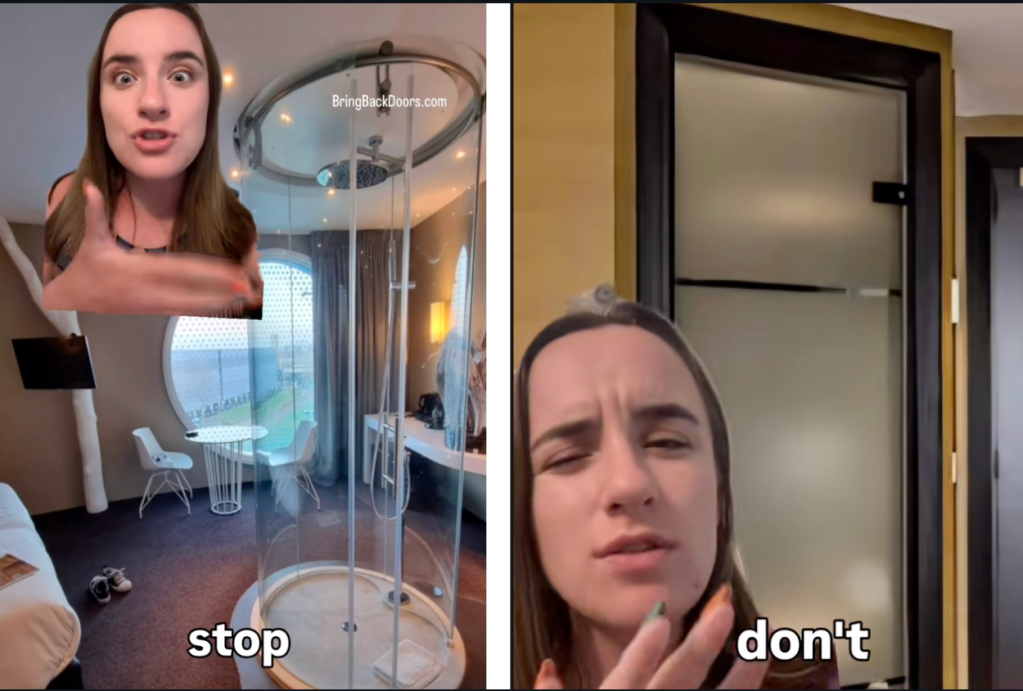
    One example that is getting attention is the bathroom doors in hotels… or the lack thereof, actually. One TikToker has had enough and has taken it upon herself to save regular bathroom doors in hotels and to point out why open-space bathrooms and glass doors just don’t cut it.

    On her @bring_back_doors TikTok account, Sadie has a collection of videos highlighting the flaws in hotel bathroom designs, with the most prominent being the lack of a regular door to the bathroom. In one viral TikTok, Sadie discussed a hotel that reached out to her, explaining that they have “foggy” glass doors to their bathroom to provide privacy. She was quick to point out that it still doesn’t provide adequate privacy. “Yes you can see through these,” Sadie said, adding that “glass doors do not close properly.”


    @bring_back_doors

    Hotel name: Alexander Hotel, Noordwijk aan Zee, Netherlands I need to be clear. Glass doors are not private. And making them foggy does not make them private. I am once again sitting here saying screw you to all bathroom doors that are not solid and close fully. And I am providing alternative hotels with guaranteed doors at bringbackdoors.com Check your hotels door situation before you book or risk your privacy. Door submitted by @mmargaridahb, DM me to submit your own bad doors. #bathroomdoors #hotel #travel #fyp Bathroom doors | bathroom design | hotel design | bad hotel design | travel fail | travel memories | travel inspo | door design | hotels with privacy

    ♬ original sound – Bring Back Bathroom Doors

    The comments rallied behind Sadie’s bathroom-door crusade

    The commenters joined in with Sadie, demanding the return of solid, closing, and lockable doors to bathrooms in hotels:

    “I HATE how hotels started thinking going to the bathroom is a shared experience.”

    “I hate how you can’t turn the bathroom light on without disturbing the other person in the room.”

    “The foggy ones are almost worse, you just get a hazy fleshy silhouette hunched over on the crapper like some kind of sack of ham.”

    “I just don’t get it, NOBODY wants this, even couples. I won’t be more likely to book two separate rooms for me and my friend/sibling/parent, I’ll just book another hotel.”

    “Love this campaign, I do not want a romantic weekend listening to the other person poo.”


    @bring_back_doors

    Hotel Names⬇️⬇️ Citizen M South Hotel (first pics) and Fletcher Hotel (third pic) both in Amsterdam. As part of this project, I’ve been emailing hotels around the world to put together an easy to reference list for people to find hotels with guaranteed doors at BringBackDoors.com And I did notice that in Amsterdam a lot of hotels were saying they don’t have doors. It wasn’t the worst city (that honor goes to Barcelona, so far I’ve only found TWO that have said yes to all doors), but it was still bad. Then I went into the comments. And kept getting people mentioning these hotels in Amsterdam. And I realized that clearly the city has a designer or architect on the loose who has a thing for test tubes. It’s horrible. Luckily, I was able to find 6 hotels in Amsterdam that all have bathroom doors in every room and have them all listed on BringBackDoors.com These hotels were submitted by so many people I couldn’t name them all. But to submit your own bad hotel bathroom send me a DM with hotel photo, name, and location! #hotel #bathroom #hoteldesignfail Bathroom doors | hotel bathrooms | hotel privacy | no privacy | travel problems | hotel issues | travel | hotel design | hotel design fail | hotel designers | design fail | hotel concept | bathrooms | Citizen M | Hotel Fletcher | Hotels in Amsterdam | Visit Amsterdam | Amsterdam

    ♬ original sound – Bring Back Bathroom Doors

    A great way to save a buck—er, I mean, ‘create a modern look’

    As many commenters asked, why do hotels have glass doors — or, worse, no doors at all—in their bathrooms? Well, this has been a growing trend in modern hotels over the past decade as a means to create a sleek aesthetic and to allow glass partitions to bring more daylight into otherwise darker sections of the room.

    At least that’s what’s being promoted to the customer. In reality, skimping on solid doors for glass ones or none at all gives the illusion that the room is bigger than it is while requiring fewer building materials. It does bring in more daylight, but mostly with the hope that you’ll cut down on electricity use for lights in an otherwise enclosed space. These reasons are also why some hotels don’t have solid walls around their bathroom areas at all.

    TikTok · Bring Back Doors

    TikTok u00b7 Bring Back Doors www.tiktok.com


    Tired of the lack of privacy? Check out the database

    To combat this trend, Sadie has developed a database at bringbackdoors.com for her and her followers to report which hotels have true, solid, private bathrooms in their accommodations and which ones do not, so people can properly plan where to stay and have true privacy during their most vulnerable moments.

    “I get it, you can save on material costs and make the room feel bigger, but what about my dignity?,” Sadie wrote on her website. “I can’t save that, when you don’t include a bathroom door.”

    Over time, the hope is that sanity and dignity can be restored as hotels realize that their glass “features” don’t have any real benefit when they don’t allow basic privacy.

  • MIT’s super-fast camera can capture light as it travels
    ArrayPhoto credit: assets.rebelmouse.io

    MIT’s super-fast camera can capture light as it travels

    It has a resolution rate of one frame per trillionth of a second.

    A camera developed at MIT can photograph a trillion frames per second. Compare that with a traditional movie camera which takes a mere 24. This new advancement in photographic technology has given scientists the ability to photograph the movement of the fastest thing in the Universe, light. In the video below, you’ll see experimental footage of light photons traveling 600-million-miles-per-hour through water.

    The actual event occurred in a nano second, but the camera has the ability to slow it down to twenty seconds. For some perspective, according to New York Times writer, John Markoff, “If a bullet were tracked in the same fashion moving through the same fluid, the resulting movie would last three years.”


    It’s impossible to directly record light so the camera takes millions of scans to recreate each image. The process has been called femto-photography and according to Andrea Velten, a researcher involved with the project, “There’s nothing in the universe that looks fast to this camera.”


    This article originally appeared seven years ago.

Explore More Design Stories

Culture

Overpackers love this simple ‘5-4-3-2-1’ packing rule that makes travel way easier

Design

People are cheering woman’s refusal to accept the latest trend in hotel bathrooms

Design

MIT’s super-fast camera can capture light as it travels

Articles

Kelsey Wells’ Side-By-Side Photos Prove That Weight Doesn’t Equal Health