
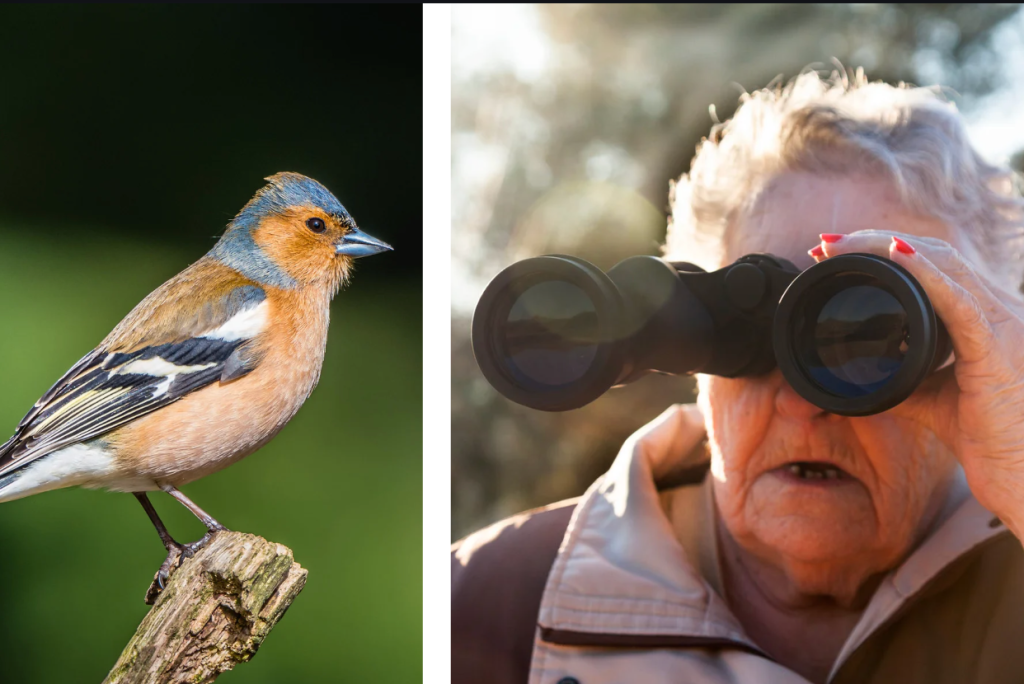
Birdwatching, or “birding,” is a calm hobby that many people, especially older adults, tend to gravitate toward. It allows people to increase their knowledge and appreciation of our feathered friends flying above us. It can also, according to a published study, help maintain brain health as we age.
A Canadian study of adult birdwatchers with varying levels of experience found something interesting: the brains of more seasoned birdwatchers had denser areas related to perception and attention than those of novices. This density was also present in older participants.
Compared to their less experienced counterparts, expert birdwatchers also showed increased activity in three brain regions when identifying non-local birds: the bilateral prefrontal cortex, bilateral intraparietal sulcus, and right occipitotemporal cortex. These regions are involved in attention, memory, object identification, and visual processing.
This suggests that taking up birdwatching could help maintain brain function and encourage neuroplasticity as we age. That makes sense, given how mentally engaging birdwatching can be.
“[Birding] combines fine-grain identification, visual search and attention to the immediate environment and sensitivity to motion, pattern detection, building these elaborate conceptual networks of different related species,” said Erik Wing, a research associate at York University in Toronto and lead author of the study, according to NBC News.
Should birdwatching be a part of senior living?
Caregivers for seniors can vouch for birdwatching as a brain-stimulating activity for older adults.
Debra Maddox, director of community relations at Springs Ranch, a memory care senior living center in Colorado Springs, Colorado, tells GOOD that birdwatching has become a regular part of their clients’ activities and care.
“Because many of our residents who are living with dementia enjoy birdwatching, last summer, we installed a wild bird sanctuary outside our dining room windows,” said Maddox. “Since then, watching the various bird types has become a popular activity enjoyed by residents, families, and team members.”
“The activity offers sensory stimulation, promotes relaxation, and provides opportunities to reminisce, all of which are especially meaningful for those living with memory loss,” added Maddox. “Additionally, when our residents and their families birdwatch together, they connect on a unique level and discuss what they see outside.”
A geriatrician weighs in on birdwatching
Dr. Manisha Santosh Parulekar, a geriatrician at Hackensack Meridian Health, confirmed the potential brain benefits of birdwatching to GOOD.
“[Birdwatching] is a mentally stimulating activity that can be as simple or as challenging as you choose to make it, from identifying common backyard birds to learning complex bird songs and migration patterns,” said Parulekar. “Research has shown that learning new, cognitively demanding skills can enhance memory function in older adults.”
Parulekar added that birdwatching can help an older person’s brain for reasons outside of the actual activity.
“Furthermore, hobbies like birdwatching can become a meaningful part of one’s daily routine, providing a sense of purpose and accomplishment,” she said. “It can also be a social activity, connecting you with a community of fellow enthusiasts and warding off the loneliness and depression that can contribute to memory loss. Consistently engaging in such purposeful activities is a powerful, evidence-based strategy for lowering the risk of dementia and extending your ‘healthspan,’ the years you live without chronic disease or disability.”
While evidence can’t prove that birdwatching prevents cognitive decline, it’s helpful to know that staying active and participating in hobbies like this can help our brains “stay in shape” as we grow older and wiser.