Have you ever wondered how you just seem to know how far you have to go to your destination? Or maybe you were on a road trip and thought to yourself, “only about 275 miles to go,” only to pass a sign that lists your destination as 272 miles away. Well, it turns out there’s a reason for these occurrences and also for why you inherently remember how to get somewhere.
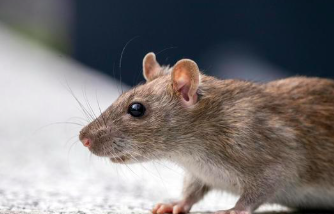
Scientists at Scotland’s University of St. Andrews located the “mileage clock” inside a brain after recording the brain activity of rats running in a square around the perimeter of their cage. This allowed them to find the part of the brain responsible for this very important task. When the scientists changed up the rats path, that sense failed them and they wandered around lost and confused.
Rats, and most likely people, have an internal odometer that tracks our movement and makes it so we can estimate how far things are. Canva
The brains of the rats behaved like an odometer, ticking off the steps and miles. When the researchers put people in a similar situation, they behaved exactly like the rats, suggesting humans have this same feature in their brains, the study, published byCurrent Biology, revealed.
“Imagine walking between your kitchen and living room,” Professor James Ainge, who led the study, told BBC News. “[These cells] are in the part of the brain that provides that inner map – the ability to put yourself in the environment in your mind.”
“The fact that humans and rats show the same type of errors in distance estimation in different environments gives us confidence that the brain mechanisms are the same in both species,” Ainge said.
This is the first study to reveal the ticking of Canva
Alzheimer’s connection
This is the first study to reveal the ticking of “grid cells” in the brain that are responsible for correctly assessing the distance we’ve traveled. These cells are one of the first areas that Alzheimer’s disease affects, making this a potentially useful early detection tool.
“People have already created [diagnostic] games that you can play on your phone, for example, to test navigation,” Ainge said. “We’d be really interested in trying something similar, but specifically looking at distance estimation.”
When this process backfires, such as in darkness or fog, it becomes difficult to gauge how far we’ve gone. In the study, when the scientists changed the shape the rats had to run in, their behavior became erratic and the rats grew agitated while attempting to figure out the maze.
“It’s fascinating,” Ainge added. “They seem to show this sort of chronic underestimation. There’s something about the fact that the signal isn’t regular that means they stop too soon.”
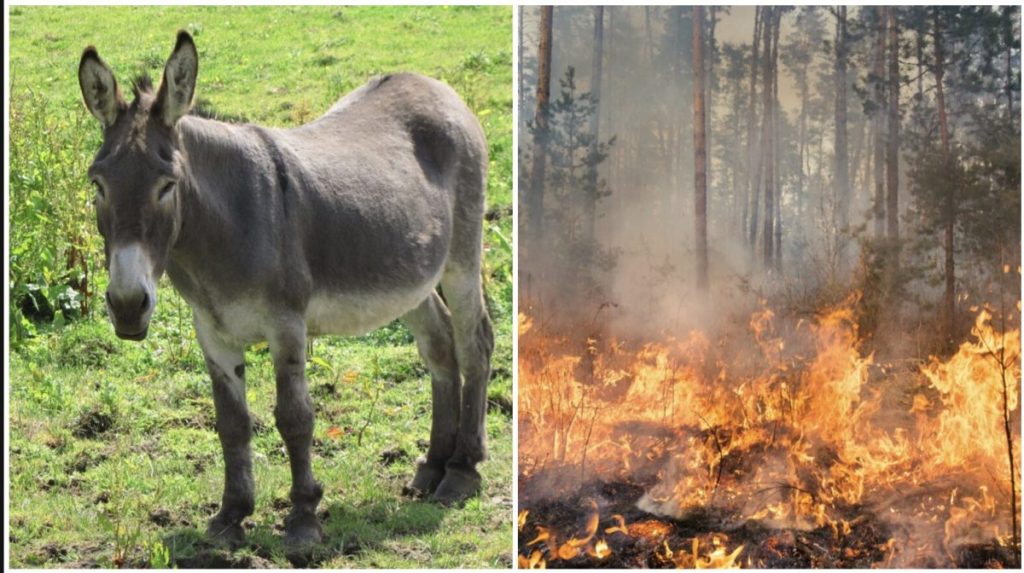
According to NASA, wildfires have doubled worldwide due to climate change. Throughout the globe, governments and environmentalists have been trying to find ways to curb the fires. One particular national park in Spain has found a solution that has been keeping them fire-free for over a decade: donkeys.
Since 2014, the Firefighting Donkey Battalion unit consisting of 18 donkeys has been preventing wildfires in Doñana National Park in Doñana, Spain. The mission these donkeys do is simple: eat the dry brush that usually sparks and fuels wildfires. The donkeys spend up to seven hours a day using their voracious appetites to graze and clear a 130 by 50 feet area of dried grass, scrub, and other vegetation.
Why donkeys?
While humans can do this type of clearing out of dry brush, using donkeys for this work is arguably more effective. While it is a slower process, it is consistent and thorough. Donkeys are able to quietly patrol in areas that are inaccessible to vehicles. In exchange for the feasting, the donkeys get about eight gallons of water and rest. No money or fuel needed.
The donkeys’ bodies are also pretty much built for this kind of environmental work, too. Their stomachs are built to eat the same rough and dry grass repeatedly without issues. These daily grazings slowly but surely remove potential origin sources for fires. As a bonus, the donkeys are naturally disposing of the dried vegetation whereas humans would have to find a different way to dispose of it.
Having donkeys or other livestock graze in such areas was once more common in agriculture prior to modern farming. Some argue that the machinization of farming and urbanization have reduced the number of grazing animals. This in turn allows more vegetation growth that become dry spots for more wildfires to occur.
The method expands
This method has been so successful that other areas of Spain have adopted it. In 2020, Tivissa launched the Burros Bomberos project with three donkeys to so much success they’ve expanded. They now have 40 donkeys grazing and clearing nearly 400 hectares of land.
The Andrea Association in Allariz uses a team of donkeys to clear and maintain nearly 1,000 hectares of a biosphere reserve. Using GPS to monitor the donkeys’ activity, the group of grazers travel 19 kilometers per day to feed. Similar initiatives have since started in Basque Country, Catalonia, and Galicia, too.
In the United States, California has been using goats in a similar function. The group Fire Grazers Inc. has been contacted throughout California to bring hundreds of goats to eat dried vegetation. Much like donkeys, goats are built to eat rough and dry brush. This includes certain plants such as star thistle that are painful for human hands to grab.
It’s important to note that donkeys or other animals that eat dry scrub are the primary solution to wildfires. The same folks behind these initiatives also advocate proper forest planning and land management. This includes reducing the amount of easily flammable species of plants and trees such as pine. It takes thought, care, work, and maybe a bunch of donkeys to make a difference.
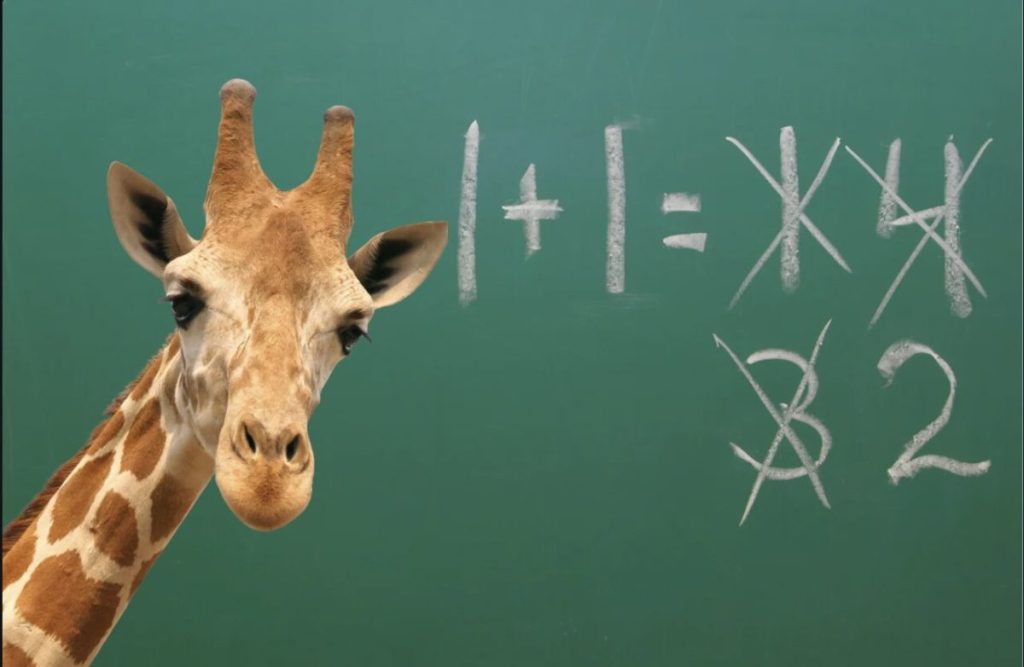
A group of researchers from the University of Leipzig, the Max Planck Institute for Evolutionary Anthropology, and the University of Barcelona published their study observing four giraffes at the Barcelona Zoo. The experiment involved the giraffes observing containers that had different amounts of carrot pieces inside.
The researchers showed each giraffe the two yellow containers and the amount of carrots within each one. After a few seconds, they closed the containers, keeping the carrots out of sight. They then showed each giraffe a green container which had extra carrots inside. Researchers took the carrot pieces from the green container and placed them into one of the closed yellow containers. They then let each giraffe independently choose which of the two closed yellow containers they preferred, without them seeing the total number of carrot pieces within each box.
The results found the giraffes would choose the container that had the most carrot pieces around 68% of the time. This suggests to the scientists that the giraffes were mentally adding the carrots up in each container before making their choice. After all, there have been past studies suggesting that other hoofed mammals, such as horses, had similar capability of basic quantity tracking.
The researchers did the experiment again. Only this time they subtracted the amount of carrots in each container. The giraffes were mostly unsuccessful at finding the container with the most pieces. So while giraffes showed signs of knowing addition, they don’t quite process all forms of arithmetic.
Math = Survival
Scientists believe that this understanding of addition helped giraffes survive in the wild. They cite that acacia trees, a dietary staple for wild giraffes, can be spread far apart in Africa. Being able to figure out which area has the most trees and the most leaves can help them decide where to graze next.
Giraffes also live in flexible groups that often change in size. One grouping can mix in with another group and then branch off or away. This means that the giraffes often have to keep track of those currently within their group and surroundings to survive.
Can other animals do math?
Giraffes are just the latest animal species known to have some form of mathematical skill. Chimpanzees displayed similar abilities to count as giraffes in a similar experiment that involved them picking the bowl with the most chocolate pieces rather than carrots. Chickens and black bears also showed aptitude in quantity tracking, too.
Scientists theorize that most of the animals that can do this basic math through evolutionary survival. After all, the animal that can deduce where more food is tends to live longer.
One species that displays remarkable mathematical ability are Tunisian desert ants. An observation of their navigational skills of finding their way to food and back to their nest suggests they use the sun as a compass in combination with mentally keeping track of the number of steps they take in a three-dimensional space. In short, these desert ants possess basic geometric and trigonometry skills.
While you wouldn’t want wild animals to calculate your taxes, it’s interesting to see how rudimentary math is a language that goes beyond species.
Wearebiologists who for many years have been trying to figure out what feral or outdoor-roaming pet cats eat outside.
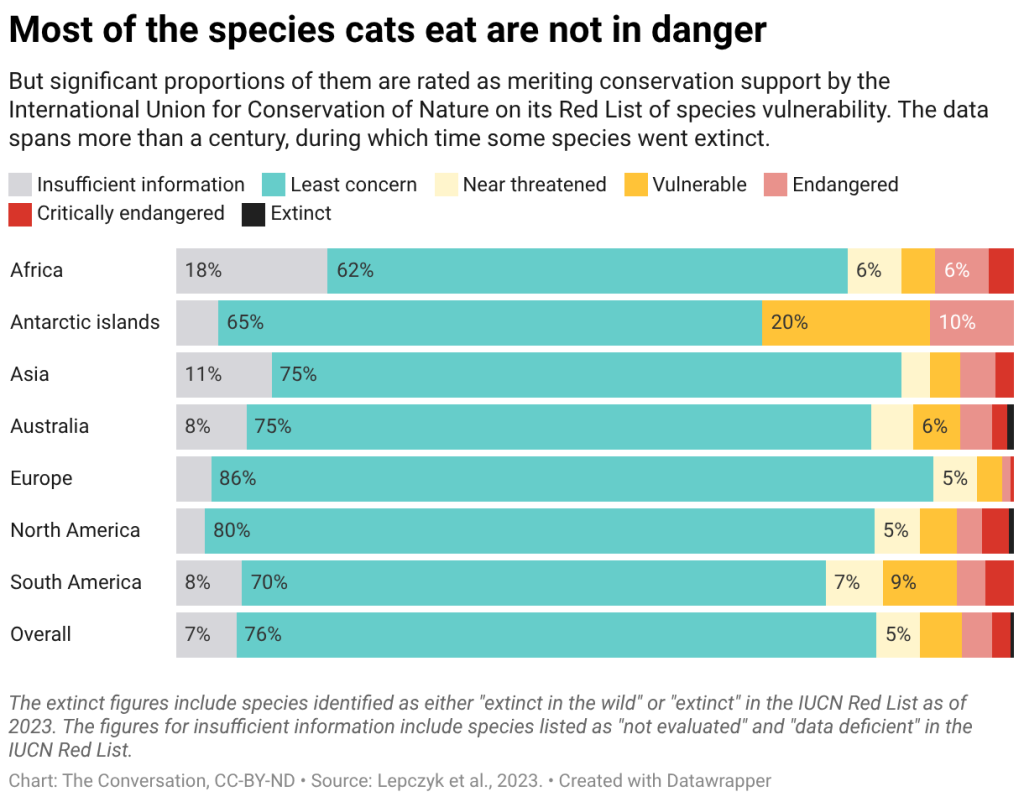
When domesticated cats – Felis catus – live freely in the wild or are allowed to hunt outside the homes where their owners live, they are an invasive species, which live in every ecosystem of the world except the continent of Antarctica. We wanted to know all of the species they eat – and to what degree free-ranging cats are eating endangered or threatened species.
Examining reams of research
Over the past two decades, we have evaluated hundreds of scientific findings, including searching through Google Scholar and Web of Science using the keywords “cat predation,” “feral cat,” “cat diet” and “Felis catus.” For each item we found, whether peer-reviewed or not, we evaluated whether it contained conclusive evidence of cat diet or predation. We also reviewed each one’s reference section for additional unique articles or databases pertaining to cat diet and predation, and included those in our search.
Overall, we identified 533 unique publications – books, journal articles, theses and agency reports – that reported specific animal species consumed by cats. Cats’ plant-eating habits are occasionally, but haphazardly, noted in studies, so we did not include them in our analysis.
Our initial work focused on an overall assessment of what free-ranging cats eat around the world. Published in 2023, this paper analyzed the 533 studies on cat diet or predation events published over more than a century and found that cats ate nearly 2,100 different species of animals, including invertebrates.
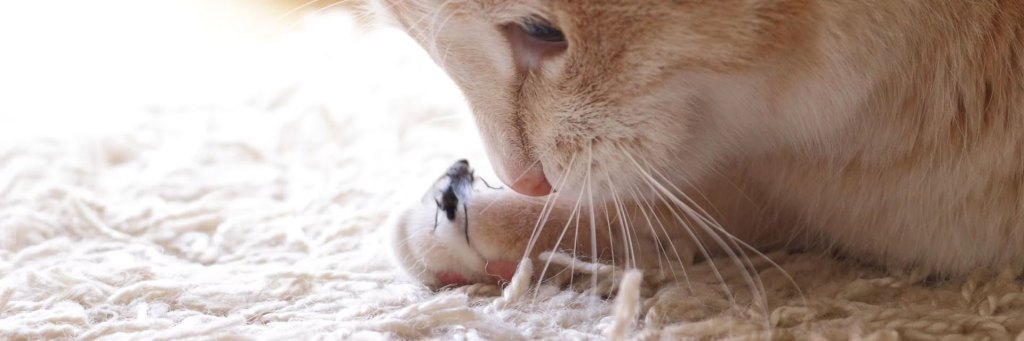
Most of the species cats ate were vertebrates – mostly birds, followed by mammals and reptiles. But the data also indicated that at least 7% of the species cats eat are insects and other invertebrates, particularly beetles, and less frequently crustaceans, arachnids, centipedes, snails and slugs, and millipedes.
Many of the cat studies we reviewed did not report on how many individuals of a given species cats ate, so it was unclear what the total amount of insects was or how many calories cats are deriving from insects.
Invertebrates make up more than 70% of all terrestrial animal species and are important pollinators, predators and herbivores in virtually every nonmarine ecosystem. Many invertebrates are in decline globally due to urbanization, habitat destruction, increases in both light and pesticide pollution, and climate change. So we dug deeper into the data to understand what invertebrates cats are eating.
While a little more than one-third of all the studies we analyzed included invertebrates as part of cats’ diet, most of those failed to identify specific species of invertebrates. But we were able to find identifications of 148 invertebrate species.
Of those, two are considered endangered by the International Union for Conservation of Nature: the Aldabran grasshopper (Pternoscirtus aldabrae) in Seychelles and the Tasmanian giant freshwater crayfish (Astacopsis gouldi), which can grow up to 13 pounds (6 kilograms). Two others are considered vulnerable: wētāpunga (Deinacrida heteracantha), an insect native to New Zealand that can be about the size of a mouse, and the common yabby (Cherax destructor), a freshwater crayfish native to southeastern Australia. One other, the Canary Islands horned beetle (Arhopalus pinetorum), is listed as “near threatened.”
We have not found formal research evaluating how cats’ eating habits affect invertebrate populations. And for many species, they are likely not as significant a factor as wide-scale pesticide use.
But it’s possible that cats could be significant contributors to the deaths of rare species or in specific locations.
In many places, invertebrates provide an easy source of food. Whether in an urban backyard or on a remote island, cats are unlikely to turn a blind eye to available prey. And some cats may find it entertaining to chase, catch and eat insects even if they don’t need their nutrition.
A challenge of researching this question is that many invertebrates are relatively small, which makes direct observation in the field harder and can require more analytical approaches in the lab. And they have soft bodies, without distinguishing characteristics that could be easily recognized in scat or stomach contents.
However, molecular technologies can identify species using trace amounts of DNA left in the environment by animals. Promising new studies are beginning to identify what cats eat by analyzing the DNA found in their stomachs and scat. That research may help explore in even more detail what cats are eating in the outdoors, and how it’s affecting various species and the environment as a whole.