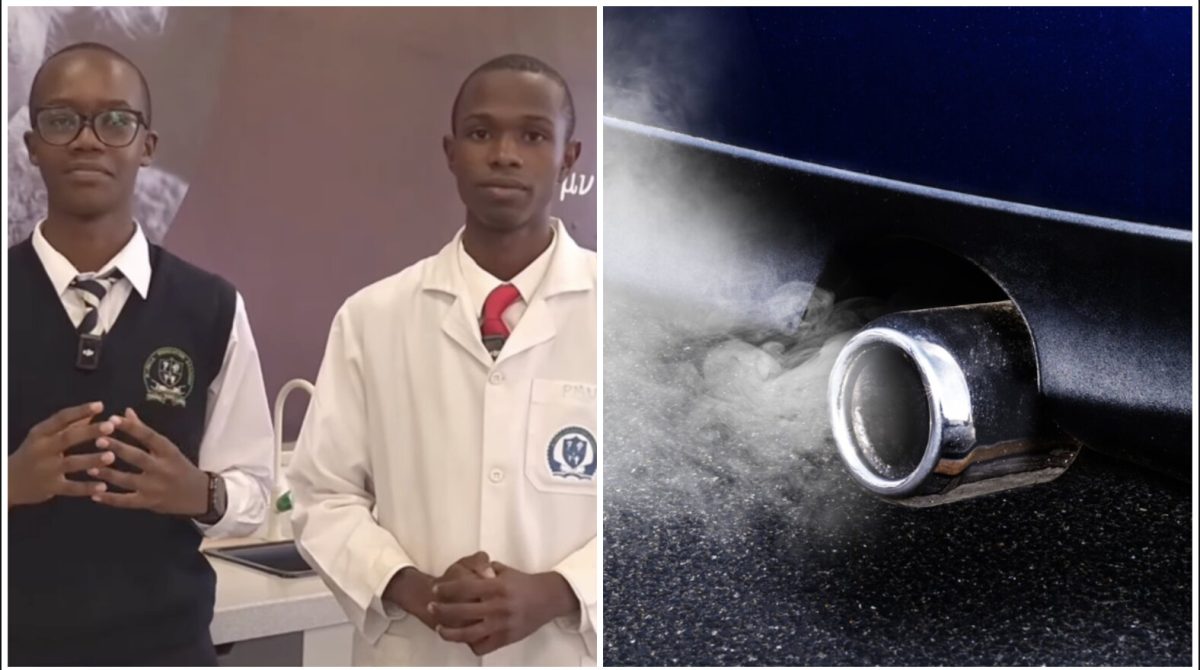
When Fredrick Njoroge Kariuki of Kenya turned 12 in 2021, he experienced incredible difficulty breathing. Doctors diagnosed him with bronchitis, explaining that his coughing and breathing issues were connected to the thick layers of exhaust fumes emitted by vehicles in the area. Five years later, the teenager teamed up with his classmate Miron Onsarigo to create an award-winning, inexpensive filter made with agricultural waste.
While air pollution is a global concern, it is particularly an issue in Kenya. A 2024 study found that Nairobi, Kenya’s capital, had 3.7 times higher levels of particulate air pollution than the World Health Organization’s guidelines. This doesn’t just contribute to illness like Kariuki’s bronchitis. Experts estimate that the country’s air pollution is responsible for 400 to 1,400 premature deaths in Nairobi each year.
The global environment issue was personal
Both teens were hardened in their resolve to tackle this air pollution problem largely caused by the matatus (shared minibuses) and boda bodas (motorcycle taxis) common in urban areas.
“The problem of air pollution was very personal to us, and that is why we started thinking about coming up with a solution,” Kariuki told Mongabay. “It was a passion before it became a project.”
“I did not choose this problem. It chose me,” Kariuki said to Daily Nation. “Growing up in Naivasha, my bronchitis got so bad that I stopped thinking of air pollution as an environmental issue and saw it as something being committed against us.”
“Seeing people get sick as a result of fumes from vehicles has become normal back home in Kisumu County. The ‘normal’ did not feel right to me. I wanted to do something about it,” added Onsarigo.
Using waste products to clean the air
With time, intelligence, and hard work, Kariuki and Onsarigo created the HewaSafi vehicle exhaust filter. The HewaSafi, which means “clean air” in Swahili, was made using locally sourced agricultural waste. The entire mechanism is made from steel mesh, copper, corn cobs, coconut shells, recycled batteries, and algae. All of these components help further filter out particles in the air straight from the exhaust pipe.
The results of the HewaSafi were impressive. The device reduced particulate matter in the air by 93.3%. The HewaSafi also reduced carbon monoxide by 42% and absorbed 21.4% of CO2 that would otherwise be released into the atmosphere.
Since the device was made using waste products, the HewaSafi manufacturing cost is around $126. By comparison, conventional filters of this sort typically cost around $390. So, not only is this filter effective, it’s cheap enough for more people to use.
A prize that leads to further opportunity
The ingenuity of these two 17-year-olds won them the 2026 Earth Prize for Africa. They received $12,500 for their regional win and global attention to the HewaSafi.
The teens hope to use the prize money and attention to further develop the HewaSafi. Using connections made through the Earth Prize, they aim to start a full line of emission control products. While they want to work with people with different budgets, their main target is to specifically cater HewaSafi filters toward public transportation vehicles.