
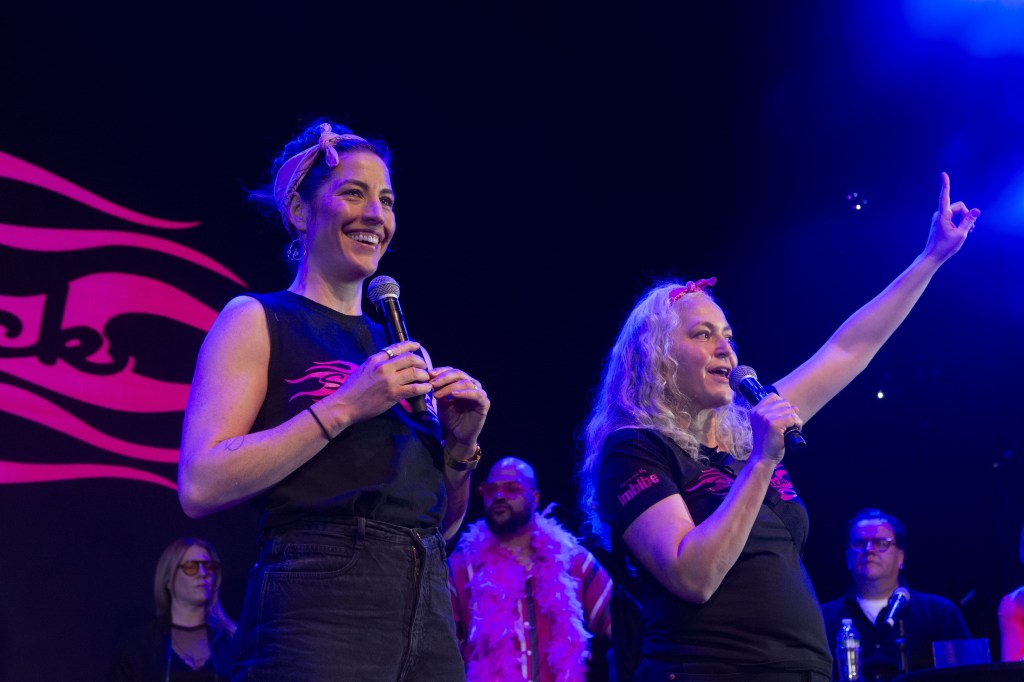
“We have no women bartenders, where are all the women?” Lynnette Marrero remembered.

The decorated bartender and mixologist worked a cocktail festival many years ago where some 30 women put it together behind the scenes. But when it came time for a film crew to record female bartenders, they were at a loss. She didn’t want it to happen again and neither did fellow renowned bartender Ivy Mix. “It was an a-ha moment, of what can we do to showcase these women?”

Their answer became Speed Rack, the world’s first and only all-female and femme speed bartending competition–a speed rack is also part of a bar to place liquor for quick handling. Now in its thirteenth year, Speed Rack, featuring “Women shaking up the cocktail world,” is part of a larger movement ensuring nobody else wonders where the female bartenders are: they’re right there behind the bar. Marrero and Mix had witnessed too many women and femme identified individuals not getting the credit they deserved or not being able to break through into craft cocktails. Speed Rack became a way to help change that. “It was just about creating a platform and a pedestal for these women to be seen doing what they do every day,” Marrero says. Plus, all proceeds from every Speed Rack event support charities dedicated to breast cancer research like The Pink Agenda. Since it began, Speed Rack has raised over two million dollars for these organizations.
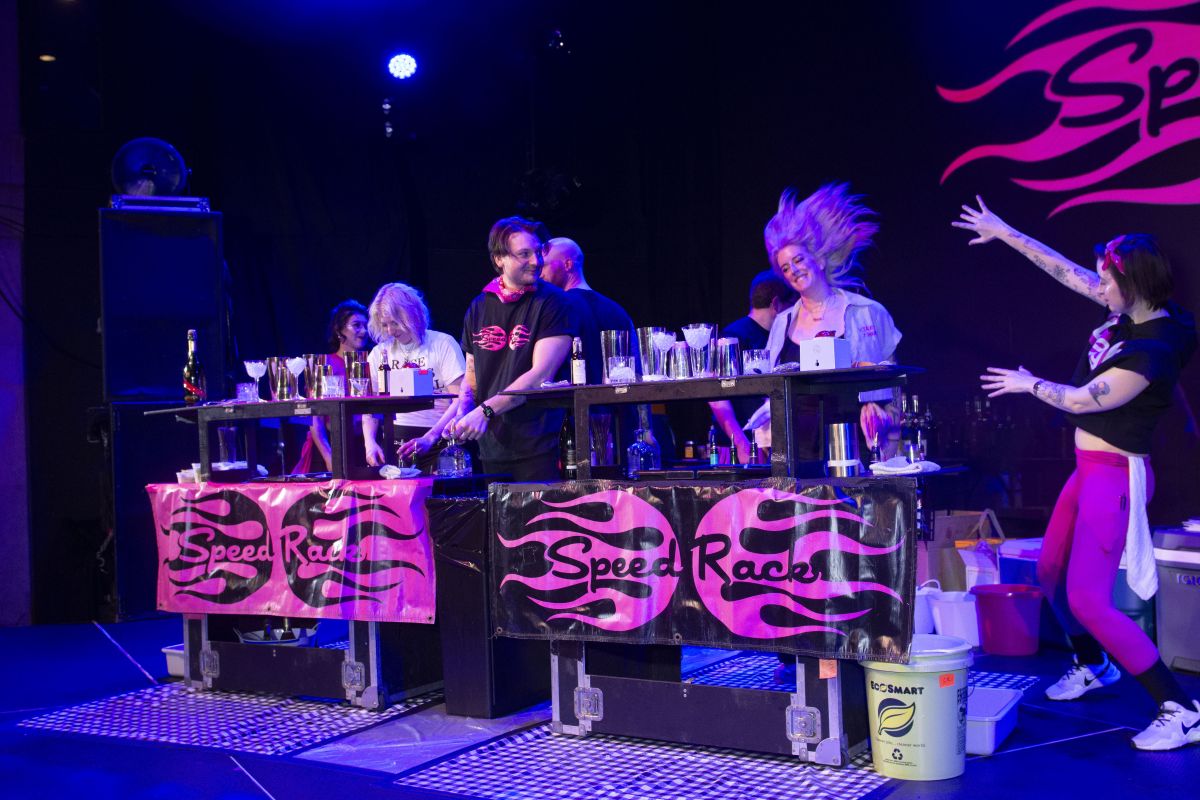
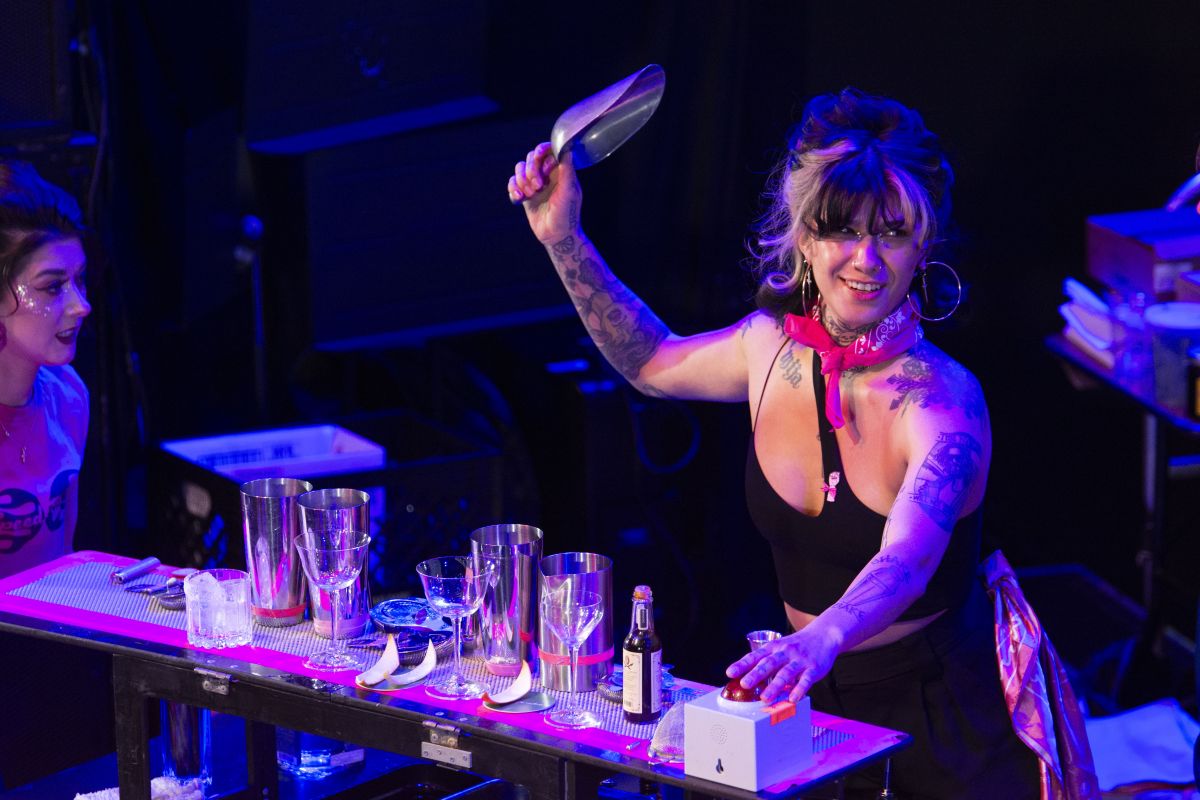
Competitors Sam Smagala, of the bar Joyface, and Miranda Midler, Head Bartender of Dear Irving's Broadway location,u00a0shake it off before Round 1 begins. Elyssa Goodman

On February 17 2025, the eight top bartenders in New York’s regional Speed Rack competition arrived at Melrose Ballroom in Queens for the city’s regional finals. By that point, the field had already been narrowed from some 85 online applications with video submissions to a preliminary competition of 20-25 to tonight’s eight participants. They came from across the city’s cocktail bars–Mister Paradise, The Crane Club, The Portrait Bar, and others–and had to be working at least four shifts a week to qualify.

In a round-robin, bracket-style competition, participants will have to make four perfect cocktails in a matter of minutes–it’s a competition that’s ultimately about speed and accuracy. The drinks will then be delivered to the judges, who will deliberate and give feedback–errors will add time to a competitor’s score. The winner of each round proceeds until there are only two left and a winner is chosen.

The winner will proceed to the National Finals in July at the annual Tales of the Cocktail conference, this year in New Orleans. There, winners from events in Chicago, Denver, Portland, OR, Washington, D.C., and Puerto Rico will join her, as will winners from Fast Track competitions in Nashville, San Francisco, Houston, Louisville, and Orlando. By the time finalists get to Nationals, they’ll have been training for at least two months, selected for teams sponsored by some of the biggest alcohol brands in the world.
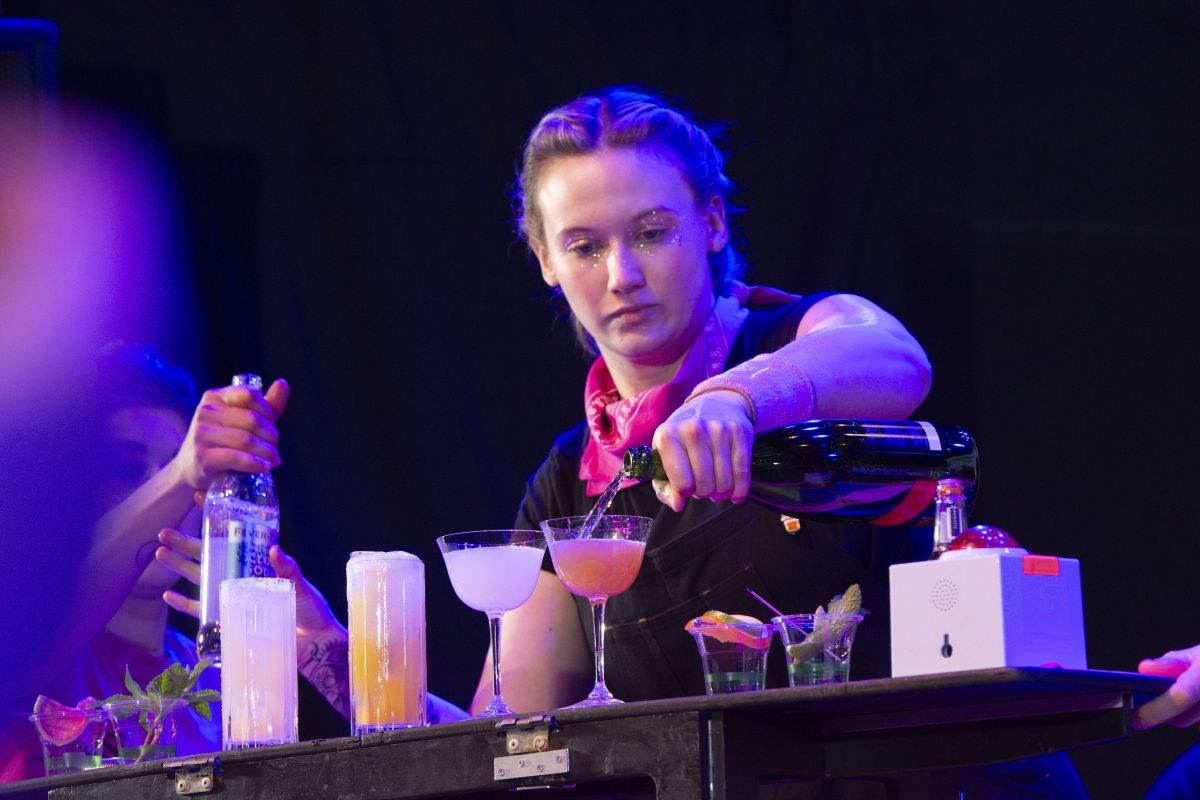
Competitor Hope Rice of The Crane Clubu00a0finishes up the final cocktail of her round, an Old Cuban, with a pour of G.H.Mumm Champagne. The Old Cuban is a drink created by legendaryu00a0bartender Audrey Saunders. Elyssa Goodman

At Nationals, between 16-18 people will compete for a scholarship to the Beverage Alcohol Resource’s 5-Day Program, featuring an opportunity for certification with the “Curriculum for the World’s Most Comprehensive Distilled Spirits & Mixology” held at once a year at the Culinary Institute of America in Hyde Park, New York, not to mention countless brand and networking opportunities. Marrero says that Mix usually speaks to contestants beforehand and reminds them that “everyone knows you competed.This is a job interview, so go out there and network, do your best, because whether you’re the winner or not, there’s opportunities that come from this.” Later this year, Speed Rack will also return to Canada and Australia.

Speed Rack becomes not just a way to bring awareness to the gender gap in bartending and the beverage industry, it’s how the gap starts to close. Build a community, reward people for doing a good job, and give them the resources to continue pursuing their education in the field. So it’s fitting that even before the audience starts to arrive at Melrose Ballroom, there’s something electric happening. What’s at stake is not just about cocktails.The venue’s two floors will eventually fill up entirely, and over $14,000 will go to charity. The hot pink fireballs of Speed Rack’s logo and matching pink lights cast a glow across the venue, where sponsors of the event, including brands like Cointreau and Patron, among many others, have set up booths and started mixing cocktails of their own for guests. It’ll be a night full of industry folks, though anyone is welcome to attend.
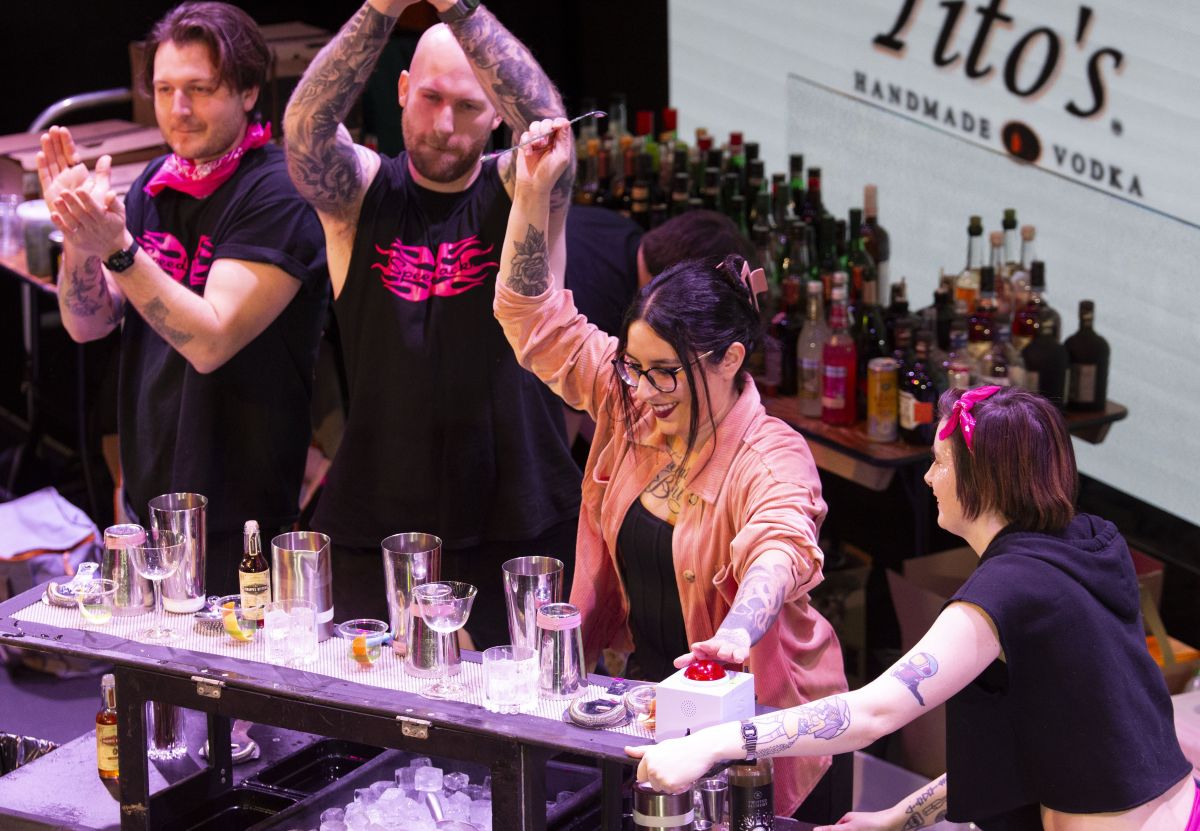
Competitor Ileana Hernandez just before her round begins. Ileana works at Greenwich Village restaurant Llama San. Elyssa Goodman

Contestants start to mill about the space–they’ve dotted their faces with pink glitter, tied hot pink Speed Rack bandanas around their necks, spotted clothing with pink rhinestones, painted on thick cat eye liner, donned olive cocktail rings, and more. Hugs are thrown with abandon.

“We have so many fresh new faces, I just wanna let y’all know drinking culture in New York is in great hands,” Marrero says, to uproarious applause as she and Mix begin the event. With volunteer barbacks, the first contestants prepare their stations. Ice fills glassware, and sponsors’ bottles are lined up behind the bars for easy access. The host tonight is Vance Henderson, lauded National Brand Ambassador for Hendricks Gin, decked out in hot pink sunglasses and a matching feather boa. He introduces the judges, who are also deeply respected in the beverage industry: Ignacio “Nacho” Jimenez, Operating Partner of cocktail bar Superbueno; Iain Griffiths, co-founder of Bar Snack; Charlotte Voisey, Tales of the Cocktail’s Executive Director; and Amy Racine, Beverage Director and Partner of JF Restaurants.

Full of friends and industry professionals, the audienceu00a0cheers for the annualu00a0New York Regional Speed Rack competition. Elyssa Goodman

I feel jitters just hearing their credentials, but it’s part of the bartenders’ presentation tonight to remain calm and poised. The event, Marrero says later, “showcases what happens on a Friday night, Saturday night, when you’re in a craft cocktail bar and you’re working service, and then four cocktail luminaries walk in and ask for a round, and you have to make that round perfectly, beautifully and fast, really fast.” The drinks must be “balanced, look beautiful and be made with grace behind the bars,” Speed Rack says in its competition notes. The event is intense–the opportunities it gives participants could really change their lives if they want it to–but the mood remains high: Henderson introduces each contestant not unlike fighters in a boxing match, and volunteer barbacks, also industry people, are personal hype folks throughout the night, waving fans and cheering on participants.

With each round, contestants will be given four classic cocktails to produce, one selected by each judge, and the round will be over in a matter of minutes–never longer than five, and even four would be pushing it. The bartenders become a choreography of shaking and stirring and pouring and tasting (and, at least once, egg separating) and when they’ve finished all four beverages, they slap a buzzer to stop their clock. Bensonhurst, Suffering Bastard, Whiskey Sour, Cosmopolitan, Nippon and other cocktails course over the bar through the evening, and soon the judges weigh in. Was it perfect? Too much tequila? Too herbaceous? Was the garnish placed appropriately? Did the drink need to be more diluted? While they wait for final scores, bartenders high five friends like they’re autographing headshots at a movie premiere, they pour shots into mouths, they can’t believe they did it again. With final scores, the winners advance.

As the night goes on, more and more people push toward the front. People cheer on their friends, bang on the stage, a flamboyant chorus of “WOOOOOOO” and “GIRLS! GIRLS! GIRLS!” and the girl next to me who looks a contestant dead in the eyes and says “Rachel, you’re a bad bitch. BAD. BITCHES. ONLY,” with a half-empty cocktail in her hand.
Competitor Rachel Prucha, of Mister Paradise and Hawksmoor,u00a0ready to take on her round. Elyssa Goodman

The music gets louder. In the last round, the finalists are indeed the aforementioned Rachel, Prucha of Mister Paradise and Hawksmoor, and Lana Epstein of The Portrait Bar. Taking their places behind the bar, all they have to do now is make four perfect cocktails while a few hundred of their closest friends and industry professionals scream and chant and applaud. It’s another dance, of whiskey and raspberries and straws and tonic and ice and god knows what else, into jiggers, into shakers, into mixing glasses, until that buzzer is banged for the last time and the cocktails are out, in front of the judges. The deliberation feels endless. It’s some four hours from when we started and nerves are askew. More shots! More cheering! Lana, Lana! Rachel, Rachel!

Lana wins, and then something amazing happens–a swirl of friends and bartenders who competed rush the stage to cheer her on, her name chanting from their lips as they embrace her in a giant hug and pink petals fall from the ceiling. People put her on their shoulders, they take pictures, they pour bubbly into her mouth like it’s the Super Bowl. The joy is genuine, and to me it’s the most moving part of the evening because it’s ultimately what Speed Rack is actually about: women supporting women.

Bartender Lana Epstein, of The Portrait Bar,u00a0wins Speed Rack's New York Regional competition. Friends and fellow competitors raise her up and offer bubbly to celebrate. Elyssa Goodman

“The community vibe of, ‘it’s not just one of us, it’s all of us,’ is really important,” Marrero says. She believes Speed Rack can keep regenerating itself because it really is an event for the community. There’s an understanding that the platform represents inclusivity, she continues, giving basic training to everyone and sharing foundational knowledge, and this helps people move up in the industry and continue sharing.

Marrero doesn’t remember a lot of men helping her with this when she started–it was women. She hopes in the future there will be even more women and femme identified individuals in ownership, partnership, and leadership positions throughout the beverage industry. While she says many people come to the industry for a flexible work life as they pursue an artistic endeavor, she already sees Speed Rack’s impact making space for the next generation. “The future is in, the more people that we continue to recruit to stay in the industry,” she says. “The rest of us can then go on to get funding, open places, and give those folks a spot to grow and and really, light the world on fire one cocktail at a time.”

Stay up to date with Speed Rack on Instagram, and buy the Speed Rack cocktail book A Quick Drink: The Speed Rack Guide to Winning Cocktails for Any Mood, published in 2024. A portion of Marrero and Mix’s royalties also go to breast cancer charities.

And if you’re interested in competing, learn more here.

  • Students go for a world record with group drumming rendition of “Beggin”
    Photo credit: CanvaA music teacher plays drums with a student.

    Drum instructor Patrick Abdo doesn’t simply direct a children’s recital—he launches into a full-body celebration of music. In an Instagram post gaining widespread attention, he leads 10 children, ages 5 to 10, in a drumming rendition of the Måneskin song “Beggin’.”

    As the kids bang the drums in rhythmic unison and parents watch, beaming with pride, the room pulses with energy. But what makes the performance all the more magnetic isn’t simply the precision of the young drummers—it’s Abdo’s infectious excitement.

    Abdo guides kids to an impressive musical moment

    In the video, captioned “A record like no other!,” the 10 kids each have their own drum kit arranged in a circle around a large room. As the music starts, Abdo takes the lead, instructing the young musicians and wildly raising his arms to the rhythm. He keeps perfect time with his air drumming, and the kids follow.

    These young drummers do a fantastic job, fully committed and bringing the focus and skill needed to pull off such a high-octane song. Yet it’s nearly impossible not to have your attention drawn to the teacher. Abdo radiates an infectious belief in every child in the room.

    This type of wholehearted encouragement feels increasingly rare, and it’s wonderful to watch. As proud parents smile from the sidelines, he moves through the room, connecting with each student. With each burst of encouragement, the recital transforms into something special.

    There is little publicly available information about Abdo’s background. His breakout visibility appears tied to short-form drum lesson videos posted on his Instagram page. His profile lists Dubai as his location, and his bio reads, “My dream is to recreate School Of Rock MENA [Middle East North Africa] version.”

    The good-vibes energy inspires people

    The video quickly became impossible to scroll past. Views steadily increased, and so did the comments. The appreciation for both the synchronized performance and Abdo’s teaching style offers a moving example of mentoring at its best. As much as viewers loved the kids’ musical showcase, many seemed even more inspired by Abdo’s uplifting and engaging style:

    “They shut it down for real !!!The instructor deserves an applause”

    “I love the teacher !! So enthusiastic, motivating and you can tell he loves these kids!!!”

    “well done to that teacher and all the children — luv this”

    “This teacher has incredible enthusiasm which inspires all the kids to work so hard to get it!”

    “Wow, the instructor’s patience and passion for his work are truly admirable!”

    “This is called perfection.”

    “The teacher’s passion! The talented, focused kids!”

    Great teachers and mentorship matter

    There is simply no denying the value of great teachers and mentors. Everyone benefits from guidance and encouragement, especially young people. Research in 2025 found that mentored youth were 20% more likely to attend college, earn higher incomes, and exhibit better behavior. A 2023 trial conducted by Big Brothers Big Sisters of America found measurable improvements in social and emotional well-being.

    A 2022 study found that mentorship increased retention and promoted success. The benefits extend to mentors as well, offering opportunities to build enduring relationships that evolve and provide value over time.

    The music recital had the Internet buzzing over its great energy and the joy of watching kids go for it. Inspiring mentorship may be the real power behind Abdo’s musical instruction. Whether viewers remember a beloved teacher or recognize the one they wish they’d had, the right mentor can stay with a child long after the music stops.

  • A BBC crew broke ‘cardinal rule’ of nature documentaries to save trapped penguins
    Photo credit: CanvaPenguins jumping off a glacier into the water.
    ,

    A BBC crew broke ‘cardinal rule’ of nature documentaries to save trapped penguins

    Even the show’s narrator, David Attenborough, supported the controversial decision to step in.

    Nature documentaries operate on a single, golden rule: observe, record, but never interfere. The goal is to capture the raw, unscripted reality of the natural world, even when that reality is brutal. But during the filming of the BBC Earth series Dynasties, a situation arose that was so dire, the crew felt compelled to break that cardinal rule.

    The incident, which took place in November 2018, involved a colony of Emperor penguins in Antarctica. A massive storm had hit, dropping temperatures to minus 50 degrees Celsius (minus 76 degrees Fahrenheit) and trapping a large group of mothers and chicks in a steep, icy ravine.

    Separated from the safety of their rookery, the birds were helpless. The mothers, cradling their chicks, were unable to climb the slick, vertical slopes.

    Emperor penguins, BBC Earth, David Attenborough, Antarctica, nature documentary
    Penguins march across the ice. Photo credit: Canva

    The situation was desperate. Some chicks had already been abandoned and frozen to death in the gully, while predators circled the survivors. The emotional toll on the crew was immense. As one cameraman told Country Living, “I know it’s natural, but it’s bloody hard to watch.”

    Faced with the potential extinction of the entire group, the team made a controversial choice.

    “It was not a straightforward decision by any stretch of the imagination,” director Will Lawson explained in an interview with Lorraine. “You just have to look at the facts that are in front of you before you make a decision like that.”

    Once the storm broke, the crew decided to intervene, but they did so “passively.” They didn’t lift the birds; instead, they used their tools to dig a shallow ramp into the ice, creating a path the penguins could potentially use to escape on their own.

    “Once we’d dug that little ramp, which took very little time, we left it to the birds. We were elated when they decided to use it,” Lawson told Country Living, noting that there is simply no “rule book” for such extreme scenarios.

    The footage of the penguins waddling up the man-made ramp to safety became a defining moment for the series. Even Sir David Attenborough, a staunch defender of non-intervention, backed the move.

    “It’s very rare for the film crew to intervene. But they realize that they might be able to save at least some of these birds, simply by digging a few steps in the ice,” Attenborough said.

    Producer Mike Gunton agreed, framing it as a moral imperative rather than a documentary breach. “We have a rule that interfering is a very dangerous thing to do. But these penguins were going to die through a freak act of nature if nothing happened,” he said. “How would this conversation be going if you said you saw them there and did nothing? I think you have to do it.”

    The intervention was passive, but the result was profound. The colony survived, and the crew walked away with clear consciences. As Attenborough concluded, “To have done anything else would only make matters worse and distort the truth.” 

    This article originally appeared two years ago. It has been updated.

  • Therapist shares why Justin Bieber’s duet with 13-year-old self was so incredibly moving
    Photo credit: Wikimedia Commons & FlickrJustin Bieber performs onstage (left) and at a Nintendo store in 2009 (right).

    Taking the stage at Coachella, singer Justin Bieber gave fans something unique: singing along to a YouTube video of himself at just 13, he harmonized on songs like “Baby,” “Never Say Never,” “With You,” and others.

    Blake Roberts, a licensed therapist and self-proclaimed “dude,” shared his perspective on Bieber’s performance. While reactions to the appearance may be mixed, Roberts found it courageous.

    Therapist finds Bieber’s performance incredibly moving

    “From the perspective of a therapist and dude, I have to talk about this Justin Bieber-Coachella thing,” Roberts said in an Instagram Reel. “If you’ve ever done any amount of inner child work, you can appreciate what that moment was.”

    “That little boy was artistic and creative. Just doing his thing. Probably got made fun of a bunch, and then he gets thrown into this industry. And he loses parts of himself, and people probably take advantage of him,” he added.

    Roberts turned the performance into a learning experience, discussing a form of therapy known as inner child work:

    “Like we watched this man’s trauma, and yet he still shared a moment with us. Like a peek inside what it looks like to do inner child work. What looks like to look back at the younger versions of ourselves who have been rejected, who have been abused, who we ourselves have left behind. And to look at them with compassion and see them from the purity that they were.”

    Mixed reactions to Coachella performance

    Bieber’s performance relied heavily on nostalgia and early-career callbacks. A review in Entertainment Weekly described the set as “lacking some swag.” For much of the performance, Bieber sat at a desk onstage, scrolling through viral videos of himself.

    Despite negative feedback on his set, some fans appeared to be very appreciative of Bieber. One fan commented on Roberts’ Instagram post, saying, “I loved it so so much, aaaand now I’m crying again.”

    Regardless of whether people admire what the artist did, Roberts saw an opportunity to highlight recovery and the value of therapy. Bieber’s duet with his younger self could be seen as a meaningful act of openness and vulnerability. Roberts reflected, saying, “I thought it was pretty crazy. I could feel it.”

    Bieber’s challenges scrutinized by the public

    For those unfamiliar with Bieber’s personal life, he has faced some rough patches, as rumors have circulated about a struggling marriage and financial difficulties.

    The obstacles began to appear in 2017, when Bieber pulled out of a world tour due to mental exhaustion. In 2022, he posted on Instagram about the challenges of dealing with Ramsay Hunt syndrome. The illness occurs when the chickenpox virus reactivates later in life, causing facial weakness. Bieber said he was experiencing facial paralysis on his right side, which led him to cancel his tour again.

    There have also been allegations, including claims of drug use and questions about Bieber’s friendship with Sean “Diddy” Combs dating back to his youth. Clips have resurfaced showing Bieber as a teenager spending time with the music mogul. However, Bieber has not made any clear, on-the-record statements about that time.

Explore More Culture Stories

Music

Therapist shares why Justin Bieber’s duet with 13-year-old self was so incredibly moving

Culture

25 hilarious signs proving some messages just can’t be taken seriously

Design

Indie coffee shops are meant to counter corporate behemoths like Starbucks – so why do they all look the same?

Culture

It’s never too late to learn a language – adults and kids bring different strengths to the task