An inner-city schoolteacher on the challenges of getting his kids to come to school.

I start each class with a hearty call-and-response of either “Good morning” or “Good afternoon.” When I have class first period, however, there is no need to bellow—I oftentimes have so few students that I can easily greet each one individually.

Attendance is an enormous problem at my school and at many others throughout the city. Absenteeism is one issue, lateness is another, but poor attendance overall is a significant factor in students’ chronic low achievement.

Starting a class with a smattering of students or teaching an incomplete class creates a litany of problems. On Monday, for instance, I had four students at the start of first period. A colleague of mine routinely has only half of his high school freshmen present. Most importantly, students are missing out on opportunities to learn and are thus creating gaps in their knowledge. Less significant but still relevant is teachers’ morale, which really takes a hit when, day after day, only a handful of students are there for the lesson they dutifully prepared with 20-something students in mind.

Students at my school miss class for a variety of reasons. First, there are students with family obstacles, like Jalene, a student and mother who has been absent 30 days and late 67 others. Myriad other family issues, like babysitting younger relatives, bringing a parent to the hospital, visiting relatives from out-of-town and so on, account for more than their fair share of absences and lateness. Some of my students are responsible for taking their siblings to school before they walk through our doors (which, in New York City, can mean a cross-borough or cross-city trek). Other students wake up before their parents, who may work a night shift or not work at all, responsible for readying themselves for school each morning.

Second, there are students generally uninterested in school. This occurrence is universal, of course, and includes all types of students. At my school, however, there is a disturbing trend of the more academically advanced students in my grade expressing apathy toward school (which I believes stems from how rarely us teachers actually challenge them). The most intelligent student in my grade has been absent 29 times and late 54 times.

Third, there is the aforementioned issue of toughness. Part of the reason I had four students in class Monday was because it was raining, and some of my students refused to make the trip in poor weather. Students have missed school because of being sore from an after-school pilates class and from staying up too late playing video games, among other reasons.

Fourth, there are logistical constraints. I teach urban students, many of whom rely on mass transit to get to school. A delay in their commute can throw the morning into chaos. While most students pay for their fares with a MetroCard provided by the Department of Education, if the card gets lost, they are frequently on their own until the next distribution period. As a result, I had a student last year come late to the end-of-year high-stakes test because she had lost her MetroCard and couldn’t find the $2.25 needed to cover her fare. (I told her she should have just jumped the turnstile.) Many of my students also seek medical care from emergency rooms or clinics that do not take appointments. Students have lost entire days of instruction while simply waiting to see a doctor.

What can be done? Parental involvement is a good place to start. The overwhelming majority of parents I have reached out to on attendance-related issues have been helpful in improving their child’s attendance. I have called parents asking them to find an actual babysitter or to reschedule a (non-emergency) doctor’s appointment. Generally, parents are happy to comply when they see their student’s teacher looking for ways to get their son or daughter to class.

More meaningful, engaging teaching would also help. If there weren’t such variance in teacher quality, students wouldn’t pick and choose when to come to school.

Other possible remedies, like New York City’s truancy court, reflect the education establishment’s admission that there are few easy levers they can pull to increase attendance.

On Wednesday, however, I managed to pull off a real trick—every one of my students who had come to class in the last month was in school. Long-term absentees notwithstanding, we had perfect attendance.

Their motivation was a mock Regents exam, a three-hour, practice version of the high-stakes test my students will take in a month’s time. Simply finishing the entire mock exam earned the students 100 points. I had told them more than a week in advance about the exam, and the office staff and I called home that morning to track down late arrivals.

On Thursday, though, we were already back to normal—during second period I had five students who showed up on time, 10 who walked in late, and another five that never came to school at all.

Brendan Lowe is a Teach for America corps member who is in his second year of teaching high school in the South Bronx. His dispatch for GOOD appears on Fridays.


  • New world map makes Africa look bigger: what’s the fuss about? Cartographers explain
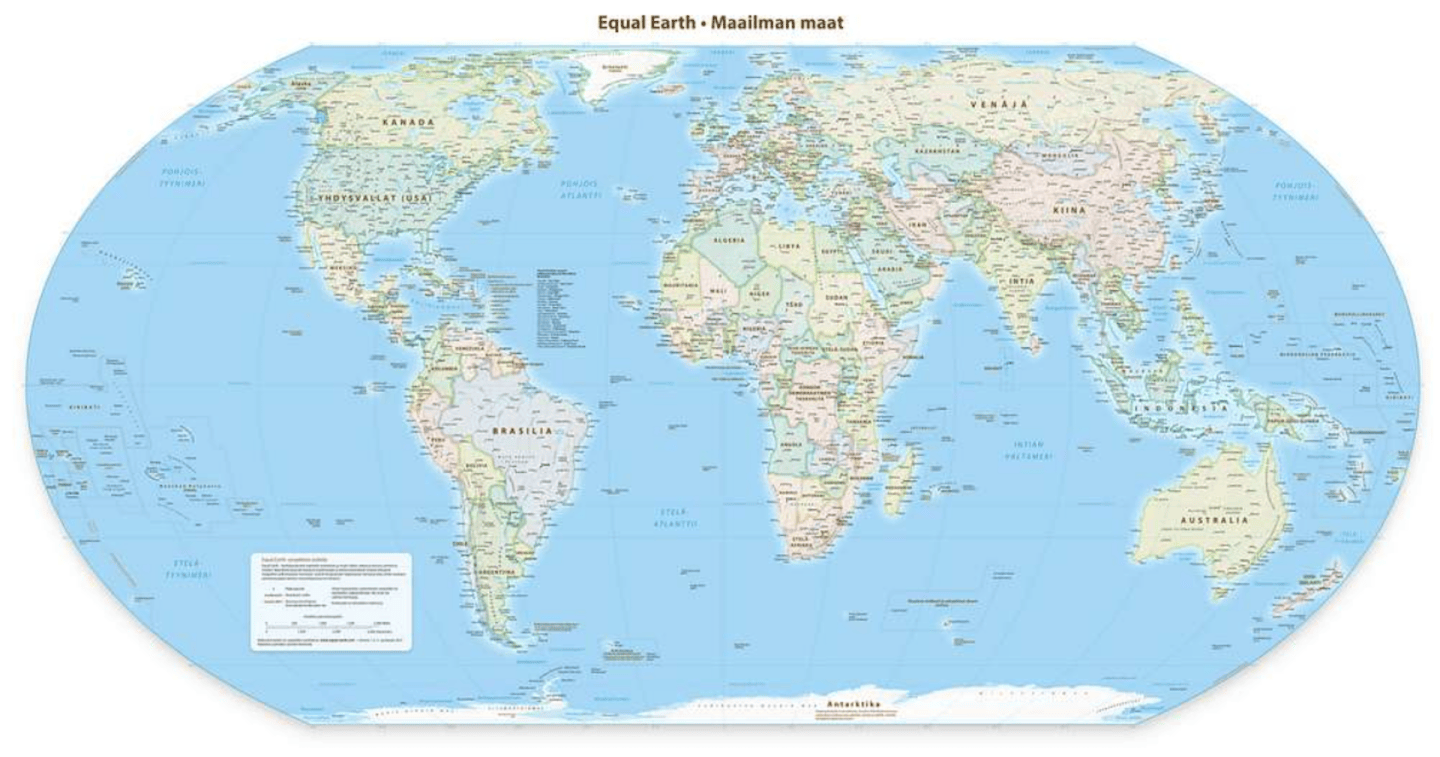
    A political wall map using the Equal Earth projection centred at the prime meridian. Wikimedia Commons

    The UN has passed a non-binding resolution to endorse the Equal Earth Projection, a map which more fairly represents the true size of the Earth’s landmasses. The current commonly used projection, called the Mercator Projection, greatly exaggerates land towards the north and south poles, which makes Africa look much smaller. In the Mercator projection, countries near the north and south pole can be anywhere from two to 14 times their true size. In the Equal Earth projection these distortions are minimised, making Africa look larger in comparison.

    We asked Jack Swab and Derek Alderman, cartographers and geographers who study the social and communicative power of maps, to explain what’s going on.


    What is a map projection?

    A map projection is a technique that cartographers (map-makers) use to transform the round, three-dimensional Earth into a flat, two-dimensional map that we see on the wall or on our computer screen. As cartographers flatten the globe, the map becomes distorted, changing shapes and areas. There is no map projection that does not distort the Earth, but some projections are better suited for some uses than others.

    A cartographer’s job is to choose from the hundreds of different map projections, and consider where the map is focused and how it is going to be used. No single projection is best for every use. This new Equal Earth projection is better suited than Mercator for producing global scale world maps for educational, public communication and policy purposes.

    The Equal Earth supports a more accurate geographic understanding of the relative sizes of countries and continents. It provides a fairer perspective for the public to compare regions in terms of population, environment, development, politics and other global patterns.

    Is the Mercator projection still useful?

    While the Mercator projection isn’t good for showing the size of the Earth’s landmasses, we won’t see it totally disappear. For example, it’s very useful for navigational purposes as it maintains the accuracy of a compass bearing between two points without having to recalculate it.

    This is why most online mapping platforms like Google Maps or Apple Maps rely on a variation of the Mercator projection to provide directions. Using the Equal Earth projection for navigation would not be as effective as the Mercator projection.

    How will the Equal Earth projection be used?

    Map-making is decentralised and there is no single authority regulating which map projection is used. What the UN did was endorse the broader message that Equal Earth is a fairer projection that more equitably displays the true size of the Earth’s land. And although this action is happening at a global level, there are movements underway in cartographic communities to make the Equal Earth projection the default world map projection.

    The UN resolution by itself will not make Equal Earth a globally adopted projection. That requires intentional revision of maps used in textbooks, databases, media productions and diplomatic discussions, which requires labour and financial investment.

    The Equal Earth projection was developed by cartographers and is a popular choice among map-makers since it was unveiled in 2018. It’s now possible to buy wall maps with the Equal Earth projection on them, and the projection has already been used in a wide variety of media. That said, individuals will need to opt in to using the Equal Earth projection over other types.

    Why has the Equal Earth projection sparked resistance?

    Resistance to the Equal Earth projection has been quite limited. There were several abstentions from the United Nations General Assembly vote, but most of this was for other reasons. Ukraine, for example, raised concerns over the depiction of the contested Crimean Peninsula on the map, which the Equal Earth Projection website depicts as contested territory.

    This spurred a Russian response, along with points from other nations about contested territory. Given the UN resolution was a vote on how the world is portrayed and not about any specific political boundaries (a point that both Russia and Ukraine agreed on), these discussions amounted to geopolitical posturing about non-map issues.

    The lone outlier, and only “no” vote against the Equal Earth projection, came from the United States. It claimed that the proposal was part of a “radical and ideological project” that was not appropriate for the United Nations to be debating. American delegates took issue with language linking Mercator’s distortions to colonial legacies and the marginalisation of Africa. This is not surprising since the current administration denies the existence of structural systems of inequality.

    It is hard to miss the hypocrisy at play. The US wants other countries not to discuss the political implications of cartography even as President Trump engages in his own nationalist branding of the map. He has unilaterally renamed the Gulf of Mexico to the Gulf of America and Lake Ontario to Lake America for clear ideological reasons and without international consultation.

    How does the new map matter when it comes to changing global views of the world?

    The argument that African nations put forward was that the Equal Earth projection is a form of “cognitive justice”. Cognitive justice recognises that people often equate power and value of places with their apparent size on maps. Traditional views of Africa as a smaller continent compared to Europe or North America typically reflect the perceived importance of these parts of the world.

    Equal Earth may make it easier to teach, broadcast and discuss a different view of Africa and its prominence in the world. Today, African countries are among the world’s fastest growing economies and fastest growing populations. Map projections alone cannot change people’s attitudes. Yet, as African nations seek to have more influence in international affairs, correcting the mental map of global leaders is an important step in amplifying the continent’s relevance and rights.

    Jack Swab, Assistant Professor Department of Geography & Sustainability, University of Tennessee and Derek H. Alderman, Chancellor’s Professor of Geography, University of Tennessee

    This article originally appeared on The Conversation. You can read it here.
  • Gen Z communicates differently in the workplace, but older colleagues can still decode them
    Young workers often share values with older colleagues, but the environment where they learned about workplace behavior is different. Sebastian Herrmann on Unsplash, CC BY
    ,

    Gen Z communicates differently in the workplace, but older colleagues can still decode them

    The same text can mean consideration to one coworker and disrespect to another.

    Learning Facilitator for Online Master of Business Administration, Boston University

    For all the talk about generational differences at work, some of the biggest differences show up in surprisingly ordinary moments.

    Take being late for work. A Gen Z employee in her 20s I spoke with works at a small, locally owned café and restaurant run by an older Gen X owner. When she realized she was going to be late one day, she texted him. He was frustrated. To him, being late was serious enough to warrant a phone call, and a text felt too casual and impersonal.

    She saw the exact same interaction very differently.

    “He’s super busy, so I felt a call was going to take up too much time,” she told me. “So I texted. I thought it was more considerate.”

    Both thought they understood what respectful workplace communication looked like. They just had completely different definitions of it.

    I study workplace culture and communication, and I see this type of misunderstanding as increasingly common in multigenerational workplaces. And this is becoming more pronounced as Gen Z moves further into the workforce. The oldest members of Gen Z are now approaching 30, while the youngest are in college and high school.

    What’s distinctive about the older members of Gen Z is that many went through college, internships or their first jobs during the COVID-19 pandemic, when much of our communication moved online and masks often covered half our faces. And there’s a new twist now, as artificial intelligence changes how we communicate all over again.

    The result isn’t necessarily that Gen Z employees communicate better or worse with their bosses and colleagues than previous generations did. I argue that they have simply learned to do so in a very different environment.

    When a text means something more

    The café example is an easy one to dismiss as younger workers preferring texting and feeling that phone calls are for important occasions only.

    But that misses what I think is the more interesting point: The employee wasn’t trying to avoid her boss. She thought she was respecting his time.

    For her boss, by contrast, the phone call itself carried meaning. It communicated that she understood the seriousness of being late.

    Neither one had explained that expectation to the other.

    Managers shouldn’t assume employees attach the same meaning they do to a particular form of communication. If being late requires a phone call, they need to say so. A two-minute conversation about expectations can prevent both people from walking away from an interaction believing the other was disrespectful.

    Another common stumble concerns openness, which might feel like oversharing.

    One Gen Z worker I spoke with had recently started a job at a large New England company in a blue-collar industry. He was struggling with severe anxiety and decided to tell his baby boomer manager. The manager was sympathetic, but also uneasy.

    “It made me feel uncomfortable, if I’m being honest,” the manager told me. “I didn’t want to downplay his anxiety, but I’m not sure I needed to know.”

    That distinction matters. His reaction wasn’t that anxiety wasn’t real or that his employee should simply get over it. But he questioned how much of it belonged in their professional relationship.

    Many older workers learned that professionalism is about setting clear boundaries between personal and professional life. Members of Gen Z are coming of age during a period when conversations about mental health and personal well-being are considerably more public. What feels like honesty to one person can feel like oversharing to their boss.

    This doesn’t mean that managers have to become therapists, and employees don’t have to disclose everything happening in their lives. But both may need to recognize that their comfort level around disclosure isn’t universal.

    One young worker in a white and blue sweater grins while his colleague, a woman with long hair, puts her head in her left hand.
    What younger workers may see as honesty could be seen as oversharing by older colleagues, who tend to keep more boundaries over personal information. Aleksandra Sapozhnikova on Unsplash, CC BY

    Learning to read a room when the room disappeared

    Some workplace communication is never spoken at all. Think about how people traditionally learned to read a room. They watched faces around a conference table. They noticed a change in a manager’s tone. Someone caught them after a meeting and quietly explained what had just happened.

    Now think about someone who was 18 or 19 in 2020.

    At exactly the age when many young people would have been developing these skills in college, internships and early jobs, the room disappeared. Classes went online. Internships became remote. When people returned in person, masks sometimes made facial communication more difficult.

    That doesn’t mean members of Gen Z can’t read facial expressions, but we should be careful about assuming everyone had the same opportunities to learn the unwritten signals of professional life. If feedback matters, I believe managers should say it. A disappointed expression on a Zoom call is a poor substitute for a conversation.

    I thought that was understood

    Imagine a manager telling a young employee: “I need this by Friday.” The employee sends it back at 4:30 p.m. that Friday afternoon. The manager is annoyed because they intended to review it that morning, make changes and send it along to someone else.

    The employee is equally confused. The deadline was Friday, and they met it.

    This deadline mismatch gets at something I have repeatedly encountered in my research with Gen Z workers. In a survey I conducted of 250 Gen Z professionals across industries, clear structural expectations emerged alongside fairness and empathetic engagement as recurring themes.

    If an employee wants clarity, it shouldn’t automatically be confused with hand-holding. An employee can want autonomy and still want to know exactly what success looks like. “Friday” and “Friday by 10 a.m. because I need three hours to review this” communicate very different expectations.

    Artificial intelligence may make this issue even more important. We can now produce polished emails, summarize meetings and generate information faster than ever. But more communication does not guarantee more understanding.

    I believe that may be the larger lesson for every generation working together. We tend to mistake the workplace norms we learned for common sense. They aren’t. They were taught to us by the workplaces, technologies and moments in history in which we began our careers.

    Gen Z is learning theirs in a very different world.

    This article originally appeared on The Conversation. You can read it here.
  • Generous paternal leave policies improve maternal and newborn health, family finances and workplace equality
    Paid leave gives fathers time to bond with their children and improves their mental health. Piksel/iStock via Getty Images Plus

    Instructor of Family Science and Social Work, Miami University

    When our second child was born, my spouse had several weeks of paternity leave under his parental leave policy at work.

    I’m a certified family life educator, and parental leave comes up regularly in my teaching and community work. So I was aware of the benefits his leave could have for our family – in theory.

    Still, I could not have imagined how significantly his leave would end up affecting our family and our connections with community.

    During his leave time, my spouse took our oldest child to playdates and birthday parties. He quickly became connected with our small-town network of families with kids close in age. I witnessed my spouse becoming more comfortable being the “main” parent in public, going to kid-centered community events and connecting with other parents.

    Our family is still seeing the benefits of those few weeks 10 years later.

    Leave for supporting parents after the birth of a child isn’t standardized or required by law in most places in the U.S. Even countries with generous paid time off for the birthing parent don’t always offer similarly generous time for the non-birthing parent.

    This diversity in leave policies can make it hard to assess the impact of leave for the non-birthing parent. But existing research suggests that extended leave for birthing parents and moderate leave for non-birthing partners positively impact infant well-being and reduce postpartum mental health challenges.

    Maternal and newborn health

    Leave for both parents with the birth of a child can significantly benefit parental mental health overall and maternal mental health specifically. Paternity leave assists in the mother’s recovery and contributes to less of an increase in stress and depression than for mothers whose partners didn’t take leave.

    One Swedish study showed that flexibility within paternal leave policies, such as allowing new dads to take intermittent time off after the birth of a child, helped reduce the incidence of maternal postpartum health complications.

    Children also benefit from paternity leave. When a father takes significant leave – meaning at least two weeks – children report experiencing more father-child closeness and better communication in the relationship up to nine years later. And overall child health tends to improve when fathers take paternity leave.

    When paid leave policies are available for both mothers and fathers, breastfeeding is more likely to last longer. Longer breastfeeding is strongly linked to overall infant health and decreased infant mortality.

    two dads walking their babies in strollers
    Paternity leave is an opportunity for fathers to become comfortable in their parenting role and connect with other parents. SolStock/E+ via Getty Images

    Family balance

    Allowing both parents to have sufficient time off to bond and adjust to their new roles can also have longer-term benefits within the family unit and contribute toward more equity in child rearing. Even in 2026, mothers are often considered the “default” parent, with fathers taking a more secondary role.

    While fathers are more involved now than in previous generations, mothers are still more likely to be the first call from school. And even with an involved father, mothers continue to carry the invisible mental load of the family, an unseen burden of data, obligations and preemptive planning tasks. This overreliance on mothers comes with a price: Mothers report being more stressed and tired than fathers do.

    As I experienced in my own family, when fathers have ample time off, it sets up the dynamic to be more balanced between parents. This helps reduce the strain on recovering mothers and redistributes some of the care work that goes into raising children.

    Home economics

    What’s more, paid leave policies have been shown to help families’ financial health. Pay rates during leave can vary widely depending on your company, organization or country. Without full or close to full pay, many families cannot afford to take leave.

    In the U.S., for example, the Family and Medical Leave Act allows time off, but not in all circumstances, nor is that time required to be paid. Many families cannot afford to take the full allowable time off, using up sick or vacation time if available. Many parents in the U.S. end up going back to work sooner than seems healthy.

    New parents in the U.S. often find themselves in an economic bind – they can’t afford to take leave, nor can they afford to rely on a single income to have a parent stay home. But many also can’t afford the childcare rates for newborns, which tend to be particularly high. National averages for infant care at childcare centers are nearly US$200 more per month than toddler care. While rates vary significantly depending on where you live and what type of care you choose, infant care remains the most expensive.

    Despite the lack of a paid U.S. federal leave policy for parents, both domestic and multinational companies have noticed that their workers care about parental leave policies. Some have begun to offer leave for supporting parents in order to recruit and retain workers.

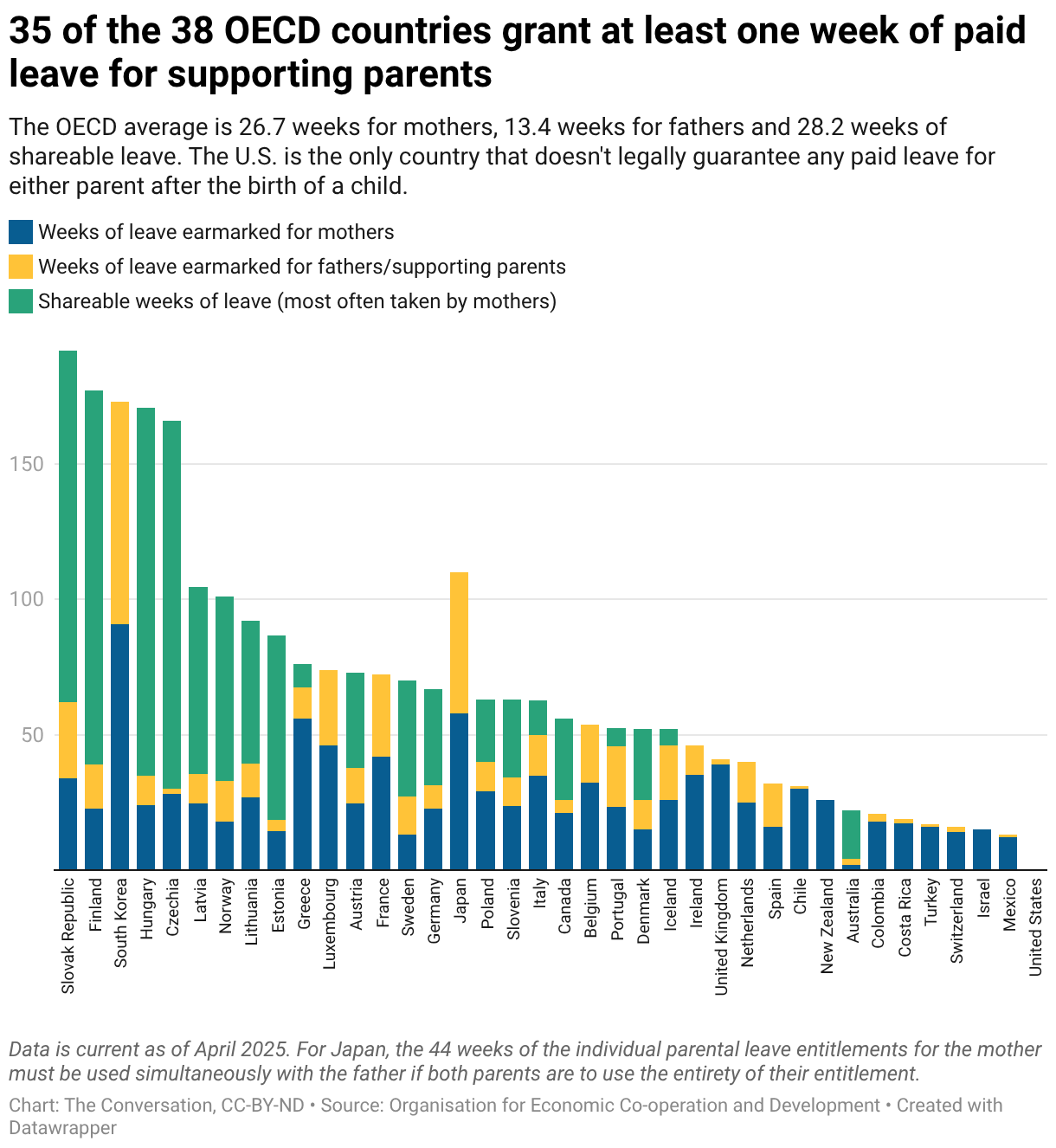
    Bar chart showing leave earmarked for mothers, fathers and shareable leave for each of the 38 OECD countries.
    Chart: The Conversation, CC-BY-ND. Source: Organisation for Economic Co-operation and Development. Data current as of April 2025.

    Outside the US

    U.S. leave policies consistently rank at or near the bottom when compared with other similarly developed countries, like the 38 members of the Organization for Economic Cooperation and Development, or OECD.

    Some countries follow a “use-it-or-lose-it” model of parental leave, where fathers in particular are encouraged to take a more substantial role in childcare. Sweden and Norway, for example, earmark 90 days of leave for each parent, and it cannot be transferred to or split with the other parent. This encourages both parents to take time off.

    There are many options across countries with parental leave policies. Flexibility and defined expectations seem to be key contributors to getting the most out of the parental leave that is offered.

    Cultural adoption

    When non-birthing parents are men, another barrier to taking leave is the perceived social acceptability within their communities. Even when paid paternity leave is available, many men struggle to take it because of how traditional gender roles and expectations of masculinity frame childcare as women’s work.

    To offset these kinds of social pressures, countries like Japan and Austria offer incentives such as bonus leave time for families when fathers actually take their available leave. Germany offers a similar bonus, and it has found improved couple relationship satisfaction when fathers take more of their leave time.

    Beyond improvements in maternal and infant health, both parents taking leave can create a more equitable workplace environment. Disparities and discrimination that come when only women take leave after birth can lessen when fathers and other supporting parents also take leave. Childbearing women are then less likely to be penalized, formally or informally, for taking parental leave.

    Paid parental leave policies that provide leave for all parents, regardless of gender, also can help reduce structural inequality in the workplace across race and class. In the U.S., Hispanic and Black workers often have less access to paid leave policies and may experience increased pressure to return to work earlier than their white counterparts.

    As more states, countries and corporations adopt more flexible and inclusive leave policies, researchers will continue to learn how parental leave benefits both parents and children. What they’ve found so far leads me to believe that, just like we’ve seen with prenatal care and early education programs, parental leave will prove to be an early investment in healthy children and families that pays dividends in the long term.

    This article originally appeared on The Conversation. You can read it here.

Explore More Stories

Technology

Only 17% of people can pass this 3-question IQ test on the first try. Can you?

Local

‘But you already helped me’: Elderly woman floored as landscaper reveals $625K GoFundMe in her name

Exploration

Earth’s missing continent rediscovered 375 years after sailors first set foot there

Science

Compared to driving, flying is extraordinarily safe – but why doesn’t it feel that way?