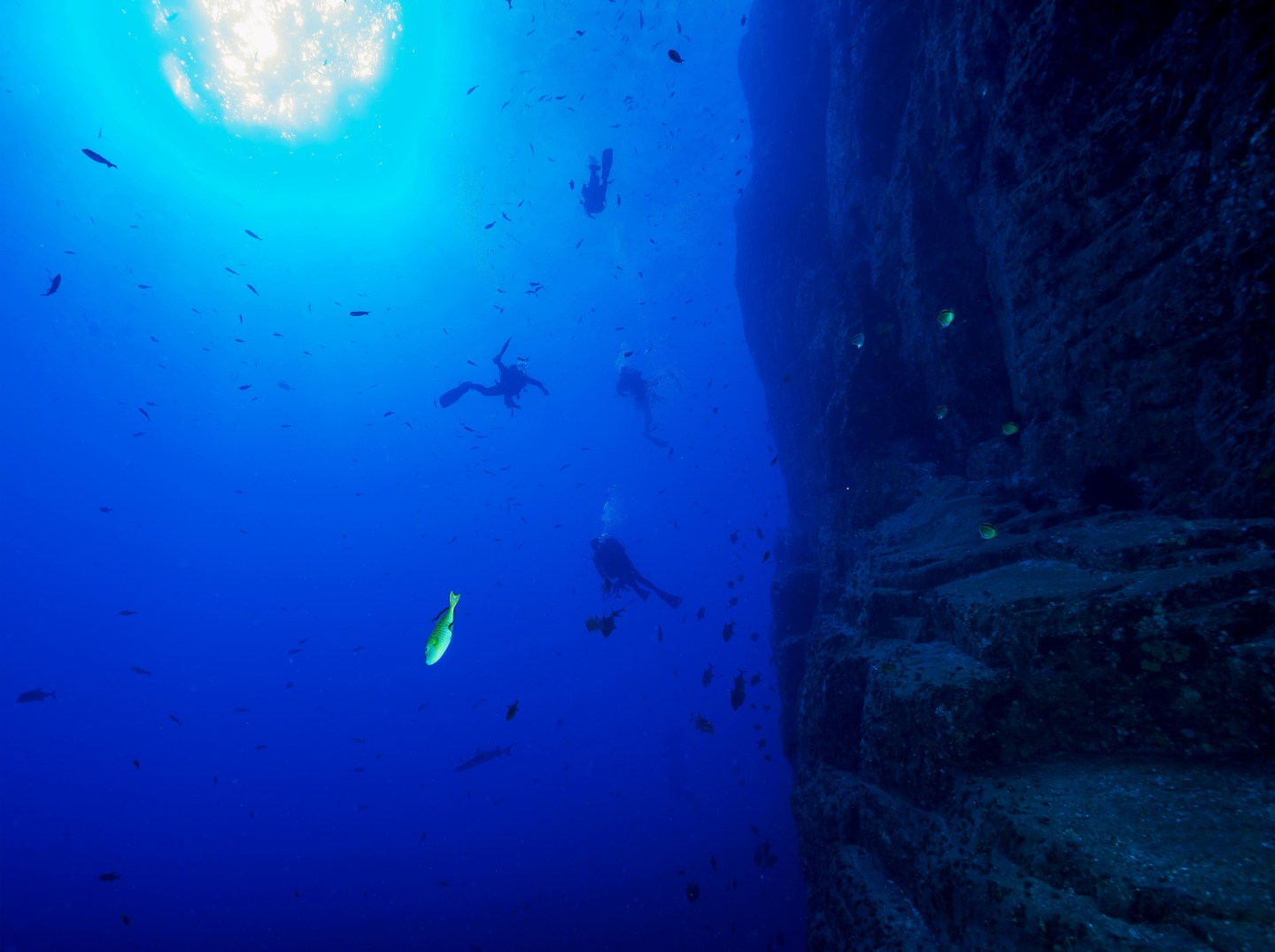
With nearly 70% of Earth’s surface covered by water, our oceans hold some of the planet’s most intriguing geological and historical secrets. In 2022, marine biologists discovered a unique formation in an unexplored part of the Pacific Ocean—a structure they playfully nicknamed the “yellow brick road to Atlantis.” The Ocean Exploration Trust’s E/V Nautilus captured the breathtaking find on video and shared it on their YouTube channel.

This “yellow brick road” formation was located atop an undersea mountain near Hawaii, leaving the research team in awe. In the footage, one researcher expresses curiosity about sampling the manganese crust after spotting a strange, almost paved-looking pattern across its surface.

Using a machine’s claws, they extracted a chunk of the shiny, charcoal-grey ferromanganese crust. “That’s not sediment, that’s like baked crust. You can peel it off,” one of them says. “It’s like bricks and cobblestone,” says another. Suddenly one of the researchers exclaims, “It’s the road to Atlantis!” Another adds, “That’s a really unique feature.”

“This is the yellow brick road,” someone else from the team exclaims. Another one says, “Are you kidding me? This is crazy.” One researcher says she feels like they’re on Mount Vesuvius, excavating. One of the team members shouts, “This is bizarre!”

As per HISTORY, Atlantis is a mythical island nation mentioned in Greek philosopher Plato’s dialogues “Timaeus” and “Critias.” Plato describes Atlantis as an island larger than Libya and Asia Minor put together, located in the Atlantic just beyond the Pillars of Hercules, generally assumed to mean the Strait of Gibraltar. After a series of earthquakes and floods, this island sank into a muddy sea. The oceanographers believe that they have stumbled upon this lost city.

However, what they called the “yellow brick road to Atlantis” was an example of ancient active volcanic geology, they wrote in the video description. They first discovered this structure when they dived on the Liliʻuokalani Ridge within Papahānaumokuākea Marine National Monument (PMNM). Swirls of seamounts rose from the seabed.

At the summit of Nootka Seamount, the team spotted a “dried lake bed” formation, which was later identified as a fractured flow of hyaloclastite rock, a volcanic rock formed in high-energy eruptions where many rock fragments settle to the seabed. “The unique 90-degree fractures are likely related to heating and cooling stress from multiple eruptions at this baked margin,” they wrote.

As shown in the footage, the team sampled basalts coated with ferromanganese crusts throughout the seamount chain at different depths and oxygen levels. They said one of these rocks “almost resembled a sponge.”

According to Vice, this team of oceanographers, first stepped aboard the E/V Nautilus research vessel as part of the Ocean Exploration Trust to explore this region. The project is part of an expedition called Luʻuaeaahikiikekumu (Luʻu-a-ea-a-hiki-i-ke-kumu), which represents the journey into the foundation and origin of the oceans or islands. In this particular project, the aim was to explore the PMNM, a U.S. marine conservation area in the North Pacific Ocean outside of Hawaii. As per NautilusLive, this expedition was funded by NOAA Ocean Exploration via the Ocean Exploration Cooperative Institute with additional support from the NOAA Office of National Marine Sanctuaries.

Around 25% of the ocean floor has been mapped. Researchers plan to use mapping equipment to create more detailed maps and uncover more secrets about this underwater area.

This article originally appeared last year.

  • Researchers capture sperm whales headbutting on camera, validating what sailors have said for centuries
    Sperm whales headbutting.Photo credit: University of St Andrews/YouTube
    ,

    Researchers capture sperm whales headbutting on camera, validating what sailors have said for centuries

    “It’s exciting to think about what as-yet unseen behaviours we may soon uncover”

    For centuries, sailors have told wild tales of whales ramming ships. Reports of a sperm whale smashing and sinking the Essex in 1820 inspired Herman Melville to write Moby-Dick. Scientists had never witnessed it themselves—until now.

    Researchers have captured the first-ever drone footage of sperm whales headbutting each other. During fieldwork off the coast of the Balearic Islands, they recorded three separate incidents between 2020 and 2022.

    Drone footage captures sperm whales headbutting

    The new study was published in the journal Marine Mammal Science. Using drones, researchers from the University of St Andrews, the University of the Azores, and Asociación Tursiops captured video evidence of sperm whales headbutting. They found that most of the whales were young, immature males. In one incident, a young male circling near a female suddenly charged and slammed into her, knocking her off course. After the impact, she broke away from the group and did not return.

    The researchers estimated impact speeds ranging from 1.8 to 8 miles per hour, with collisions generating forces of up to 20 tons of pressure. The impacts captured on video were not necessarily considered aggressive. In fact, researchers believe the behavior reflects rough play or forms of mock combat. Similar behaviors can be seen in other mammals, like dolphins and lions.

    sperm whales, Moby Dick, literature, history, whaling
    A depiction of Moby-Dick.
    Photo credit: Canva

    Observations of sperm whale behavior

    Using their large heads, sperm whales have been reported by whalers to strike and move objects since the 19th century. “It was really exciting to observe this behaviour, which we knew had been hypothesised for such a long time, but not yet documented and described systematically,” said Dr. Alec Burslem, lead author of the study.

    “It’s exciting to think about what as-yet unseen behaviours we may soon uncover, as well how more headbutting observations may help us to shed light on the functions the behaviour may serve,” Burslem added.

    Documented, unprovoked attacks on humans by sperm whales are exceedingly rare, with most occurring during historical whaling incidents. Research indicates that sperm whales do not naturally exhibit aggression toward humans. While they can be curious, they often avoid vessels and observers. Historical accounts of whales ramming ships are likely defensive reactions rather than predatory attacks.

    ocean mammals, sperm whales, non-aggressive behavior, language, social structures
    A sperm whale.
    Photo credit: Canva

    Language and cultural identities

    Whales use clicks like letters, combining them into sequences that function like words in a complex form of communication. A 2024 study found that sperm whales use a highly sophisticated communication system with structures resembling a phonetic alphabet. These audio cues are used for coordination, caregiving, and social interaction.

    A 2022 study found that specific click patterns serve as symbolic markers that help establish cultural identities within sperm whale pods. Researchers identified seven distinct clans, each with its own unique dialect. This provided quantitative evidence of whale social structures known as identity codas.

    Studying this new drone footage offers fresh insights into whale social groups and behavior. While the headbutting may look aggressive, researchers interpret it as rough play. With technologies like drones giving scientists unprecedented access to these interactions, it’s exciting to think of what discoveries are yet to be made.

  • Study reveals startling truth: Intelligence lowers our empathy toward other people
    (L) A man gives a thumbs up; (R) An eviction noticePhoto credit: Canva

    A recent study conducted on adults in the UK found that people with higher cognitive ability scored lower on moral foundations. The study, published this summer in the journalIntelligence, sought to gage people’s response to the Moral Foundations Theory based on their overall intelligence. After two different studies, no difference was found between genders, but a person’s intelligence revealed a different story.

    The research suggests that analytical thinkers tend to override their baseline moral intuitiveness. But what does that actually mean? First, cognitive ability refers to problem solving, abstract thinking, memory, logic, language comprehension, and basic critical thinking. This isn’t only IQ, but a person’s ability to process and apply their knowledge. Think of it as a living scholastic aptitude test (SAT.)

    intelligence, moral psychology, cognitive science, empathy, human behavior
    Man embraces a sunset. Photo Credit: Canva

    After testing to rate cognitive ability, subjects were then tested against The Moral Foundations Theory. The idea behind the theory is that, despite different cultures and populations, people tend to follow a similar set of themes and intuitive ethics. The theory follows six core ideas: care, equality, proportionality, loyalty, authority, and purity.

    Surprisingly, the results of the tests found that people with higher intelligence found the moral foundations to be less important.

    Care

    Care has to do with the virtues of kindness, gentleness, and nurturing. This is the foundation of empathy. By feeling connected and emotionally attached to the community, people gain purpose and a strong feeling of belonging.

    Equality

    intelligence, moral psychology, cognitive science, empathy, human behavior
    Symbols for equal diversity. Photo credit: Canva

    Always a hot topic on the political playing field, equality looks to create fair circumstances. The idea is all people have equal opportunity and treatment. Communities offering equality have reduced resentment and foster a cooperative environment where people feel respected and included.

    Proportionality

    This concept is based on fairness and merit. People should get what they deserve and be treated by what they do, not just who they are. What you put in, you get out. This is a driving principle underlying a core belief of this country: that anyone can achieve most anything if they are willing to put in the work. Many would argue for its merit while others would call it wishful thinking.

    Loyalty

    intelligence, moral psychology, cognitive science, empathy, human behavior
    Hands come together. Photo credit: Canva

    This is another popular topic of political leaders and followers. We are tribal by nature and greatly benefit from a feeling of belonging. Sacrificing the individual wants for the needs of the group, this is one of the foundational cornerstones of building communities.

    Authority

    leaders, leadership, hierarchy, traditions, genetics, authority, groups, UK adults, social groups
    Leader in front of group. Photo credit: Canva

    Authority encompasses the concepts of hierarchy and respect for traditions. Research shows we are genetically programmed to seek a social hierarchy. As much as many fight to climb to the top, feeling a part of the system is often enough to supply someone with a great amount of emotional security.

    Purity

    Perhaps you’ve heard the phrase, “Your body is a temple.” The ideal is expressed through self-discipline, self-improvement, and spirituality. Striving to be noble and less carnal, people try to be the best version of themselves. The moral advancement and the elevation of the social consciousness of the community is believed to have incredible value.

    These core values are believed to be inherent in all people, but are they? At least according to this most recent study, the more intelligent you are, the less you might care about them. However, author and literary genius Leo Tolstoy once famously claimed that kindness is one sure sign of a highly intelligent person and other studies back up his views. Maybe when it comes down to it, it depends on the person.

    This article originally appeared last year. It has been updated.
  • Body language experts reveal the secret truth about people who walk with their hands behind their backs​
    A man and a woman walking with their hands behind their backsPhoto credit: Canva
    , ,

    Body language experts reveal the secret truth about people who walk with their hands behind their backs​

    It isn’t just an old-fashioned habit; experts say this specific posture signals confidence, deep thought, and openness.

    The way a person walks is a silent broadcast of their current state of mind. A fast pace with swinging arms suggests determination; a slow shuffle with eyes downcast suggests detachment or aimlessness.

    But what about the person strolling with their hands clasped firmly behind their back?

    Well, body language experts believe that walking with your hands behind your back reveals a great deal about your mindset and your personality. They believe that, by keeping your hands behind your back while walking, a person is removing a distraction from their field of vision. This can allow a person to better process complex ideas, difficult emotions, or mentally work through problems as they walk. In short, walking with your hands behind your back indicates deep overall thoughtfulness.

    @the.mcfarlands

    not an ounce of stress in that walk ? follow us on IG: itsthemcfarlands ? #dad #dan #dadsoftiktok

    ♬ original sound – notrigby


    It’s not just deep thinking either. Other experts believe that walking with your hands clasped behind your back shows off confidence but without intimidation. By walking with your hands away from your torso, you’re fully exposing your chest and belly rather than being in a traditionally defensive position. While you may be walking deep in thought, it also allows people around you to know that you can be approached and will respond without malice. This is in contrast to body language in which the arms are in front of the body, indicating that you’re closed off or not in the mood for interaction.

    @yajairarh40

    Old people know what they are doing with this walk. #walks #saturdaymorning #carync #fy

    ♬ original sound – ar1esluver

    However, while walking with your arms behind your back can be seen as an invitation, it can come off as authoritative, too. By walking tall with your chest fully exposed, it mentally communicates that you’re calm and in control of the situation, not worrying about any incoming threat. This is partially why you see world leaders, military folks, teachers, and other persons in such roles walk this way in order to appear authoritative yet approachable. By having your arms behind you, your defense appears down but your authority appears up simultaneously.

    Alongside the psychological body language aspects of this type of walk, it also has some physical benefits. While walking with your hands behind your back shows a more confident posture, it improves your posture overall, too. Putting your arms behind your back naturally pulls your shoulders back and opens your chest, allowing your spine to straighten up and align. While it won’t improve your posture instantly, habitually walking with your hands behind your back can turn proper posture into an instinctual habit as well.


    So, if you’re heading to and from places and your mind’s racing with stress, you may want to try putting your hands behind your back. The posture helps reset your mind and keeps it calm while searching for solutions to your every day problems. Will it work? Maybe. Maybe not. Some things cannot be willed into existence. However, you’ll at least appear like you have your act together (and great posture, too!).

    This article originally appeared earlier this year.

Explore More Exploration Stories

Science

Researchers capture sperm whales headbutting on camera, validating what sailors have said for centuries

Exploration

Study reveals startling truth: Intelligence lowers our empathy toward other people

Exploration

Body language experts reveal the secret truth about people who walk with their hands behind their backs​

Exploration

Psychologists reveal 10 signs that someone is secretly super intelligent and may not even know it