In early 2011, my doctor informed me that a vaccine to protect against the human papillomavirus—HPV—was now available for men. I was relieved, then frustrated—my doctor didn’t actually offer the principal vaccine, Gardasil, to her male patients. After a couple days of hunting around town, I finally found the vaccine at the Mazzoni Center, a LGBT health clinic in downtown Philly. I received all three shots, and joined the less than 1 percent of American men who are vaccinated against the most dangerous strains of the virus.

While I was exceedingly grateful to the Mazzoni Center inoculating me, I knew of only one other male friend who’d received his shots. So since I got my shots, I’ve made a point of discussing my experience with any friend, acquaintance, or bemused bystander who will listen. And I’ve learned two things about young, straight men and HPV: We all know it exists, and not much else.


When I posted about my vaccinations on Facebook and Twitter, the response was largely positive—but the dozen or so likes and comments mainly came from my female friends. When I brought up the issue with a few straight guys, they seemed confused about my decision to air the information in public. Embarrassed, I let the conversation drop. But a couple weeks later, I received a Facebook message from an acquaintance in another city, freaking out about his own HPV scare, and asking me whether he could be vaccinated, and where. My status update provided a rare safe zone around a toxic topic.

Like local zoning policy, a death in the family, or what actually lurks within Taco Bell tacos, few people feel comfortable talking publicly about STDs. There’s no better environment for breeding misinformation than the dense cocoon of embarrassment we’ve woven around sex. The result is that most men I’ve spoken with are familiar with just one statistic that pervades the conversation around HPV: An estimated 50 to 80 percent of American adults will contract it. The universality of the threat engenders a laissez-faire attitude: Fuck it. I probably already have HPV, as do all my peers. Why worry?

The stats above are as accurate as we have. But the real story of HPV is more complicated. There are more than 130 strains of HPV, and the vast majority of them do no harm: No cancer, no warts, nothing. Most immune systems take care of the few nastiest strains just as they would any other virus. Then again, some don’t.

“[Nearly] everyone is going to be HPV positive in their lifetime, but we are only worried about the people who have an immune system who cannot clear the infection,” says Brian Hill, president of the Oral Cancer Foundation and a survivor of HPV-related oral cancer, which was located at the base of his tongue in 1997, before the virus was recognized as a cause. “Of the 99 percent of people that engage in a sexual activity that transfers the virus, orally or genitally, only 1 percent will have it cascade into a cellular event. It’s the luck of the draw in having a gene pool that does not recognize HPV 16”—the dominant cancer-causing strain—“as a threat.”

There’s no way to tell if you, or your partner, lost the genetic lottery. HPV is transmittable through skin-to-skin contact, so condoms aren’t as effective as they are at, say, preventing HIV/AIDS. There aren’t even worthwhile tests to determine if you have a dangerous HPV infection or, unnervingly, a way to test for the penile cancer HPV can cause. Anal and oral cancer screenings exist, but dental insurance often does not cover the latter, as I found to my dismay when I booked one while researching this article. (I decided that the $65 out-of-pocket fee was worth protecting against tumors on my tonsils.)

The truth is that most young men don’t know about the risks of HPV—and their options for preventing it—because our culture’s sexual awkwardness distorts corporate, government, and even scientific decision-making. In the mid-2000s, before the vaccination was marketed to the public, the CDC conducted extensive focus group research to ascertain the American public knowledge of, and attitude toward, HPV. “Current focus-group findings revealed that STD-associated stigma served as a barrier to HPV-vaccine acceptability,” the researchers found. “[E]xperts…cautioned strongly against focusing primarily on the sexually transmitted nature of HPV…which can be stigmatizing and detract from the more important public health concern of cervical cancer.”

Merck took note. The results can be seen in the company’s initial “One Less” advertising campaign, which used images of jump-roping school girls to advocate the vaccination use for girls ages 9 to 26. Any mention of sexual transmission, genital warts, male victims, and non-cervical HPV-linked cancers are noticeably absent.

I don’t remember seeing those ads, which were rolled out in late 2006, in the midst of my higher education. But my college girlfriend knew about HPV and Gardasil, and I’m sure her awareness was directly affected by Merck’s framing. I remember her frustration at learning of another negative consequence of sex—and that women, as usual, were expected to bear its financial and health costs. Neither of us knew that men could be anything more than passive carriers, or that the vaccine might eventually be available to both genders.

“When we talk to guys, often young men especially will say, oh, but that’s the girl vaccine,” says Dr. Robert Winn, Medical Director of the Mazzoni Center. The culture of silence around men and HPV means that the burden is on women to protect themselves and their partners—and that the virus can be doubly dangerous for men. Of the HPV-associated cancers, cervical cancer (11,967 cases annually) is only slightly more prevalent than oral cancer (11,726). The death rates are three times higher for the latter, and men are far more likely to contract it. In a population of 100,00, 6.2 men and 1.4 women are diagnosed with HPV-related oral cancer. Of the 2,500 cases of HPV-related anal cancer reported annually, 900 are in men and 1,600 in women. According to the CDC, men who have sex with men are 17 times more likely to contract anal cancer. Prevalence rates are also higher among those with HIV/AIDS.

Some of the statistics on male HPV rates are still emerging, but the idea that HPV affects men, too, has long been obvious. “When vaccines were being developed, HPV had the clearest causal link to cervical cancer,” says Adina Nack, Associate Professor of Sociology at California Lutheran University and author of Damaged Goods: Women Living With Incurable Sexually Transmitted Diseases. “[But] they knew boys contract it. Boys transmit it. There was already a growing body of clinical research that some cancers men suffer from are caused by the same strains of HPV.”

Three years after the 2006 release for women, the vaccines were quietly approved for men. Neither Merck nor the U.S. government widely advertises its universal availability. I consider myself relatively plugged-in when it comes to sexual health, and I didn’t learn I could use the vaccine until 2011—two years of exposure while protection was there, unknown and unasked for. But in men, the HPV vaccine is still only approved as a defense against genital warts and anal cancer. Oral cancer is not officially one of the cancers Gardasil protects against, although the CDC notes that it’s “likely that this vaccine also protects men from other HPV-related cancers,” like cancers of the penis and the back of the throat. The Oral Cancer Foundation has been pushing for studies on the issue, but Merck announced in 2010 that it had no “plans to study the potential of Gardasil to prevent HPV-related [oral] cancers.”

These false assumptions can be easily reversed. But men and women are still paying for Merck’s crappy reasoning. It would be great if the CDC conducted a sweeping public health campaign to alert Americans to the full facts about HPV and its vaccines. Merck should advertise its services to both men and women. But with the institutional players showing little inclination to try another big push for HPV vaccination, word of mouth remains our principal sources of information about HPV protection. So start calling your local clinics—LGBT and otherwise—to see if they offer free shots. And when you get your vaccine, tell everyone who will listen.

  • Why Michelangelo’s ‘Last Judgment’ endures
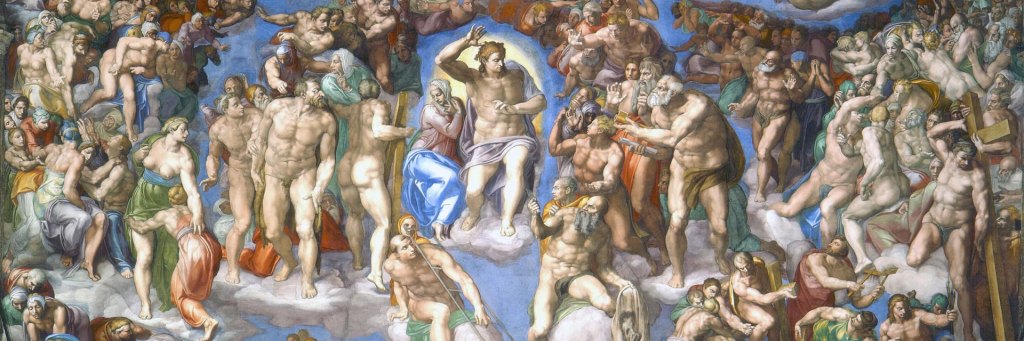
    Photo credit: Sistine Chapel collection via Wikimedia CommonsMichelangelo’s 16th-century fresco ‘The Last Judgment.’
    ,

    Why Michelangelo’s ‘Last Judgment’ endures

    A restored masterpiece still provokes awe and debate.

    Michelangelo’s fresco of “The Last Judgment,” covering the wall behind the altar of the Sistine Chapel in Vatican City, is being restored. The work, which started on Feb. 1, 2026, is expected to continue for three months.

    The Sistine Chapel is one of the great masterpieces of Renaissance art. As the setting where the College of Cardinals of the Catholic Church meets to elect a new pope, it was decorated by the most prestigious painters of the day. In 1480, Pope Sixtus IV commissioned Domenico Ghirlandaio, Sandro Botticelli, Pietro Perugino and Cosimo Rosselli to paint the walls. On the south are six scenes of the “Life of Moses,” and across on the north are six scenes of the “Life of Christ.”

    In 1508, Pope Julius II commissioned Michelangelo to paint the ceiling. The theme is the Book of Genesis, the first book of the Bible. The images show God creating the world through the story of Noah, who was directed by God to shelter humans and animals on an ark during the great flood. The ceiling’s most famous scene may be “God Creating Adam,” where Adam reaches out his arm to the outstretched arm of God the Father, but their fingers fail to meet.

    At the sides, the artist juxtaposed the male Hebrew prophets and the female Greek and Roman sybils who were inspired by the gods to foretell the future. It was completed in 1512; then in 1536, Michelangelo was asked to create a painting for the wall behind the altar. For this immense work of 590 square feet (about square meters), filled with 391 figures, he labored until 1541. He was then nearly 67 years old.

    As an art historian, I have been aware how, from the beginning, Michelangelo’s “The Last Judgment” sparked controversy for its bold and heroic portrayal of the male nude.

    Many layers of meaning

    Michelangelo liked to consider himself primarily a sculptor, expressing himself in variations of the nude male body. Most famous may be the Old Testament figure of David about to slay Goliath, originally made for the Cathedral of Florence.

    The artist’s ceiling for the Sistine Chapel had included 20 nude males as supporting figures above the prophets and sibyls. Originally, Michelangelo’s Christ of “The Last Judgment” was entirely nude. A later painter was hired to provide drapery over the loins of Christ and other figures.

    “The Last Judgment” scene also contains multiple references to pagan gods and mythology. The image of Christ is inspired by early Christian images showing Christ beardless and youthful, similar to the pagan god of light, Apollo.

    A section of a fresco shows a naked man bound by a coiling snake, and donkey's ears, surrounded by beastlike figures.
    Group of the damned with Minos, judge of the underworld. Sistine Chapel Collection, Michelangelo via Wikimedia Commons

    At the bottom of the composition is the figure of Charon, a personage from Greek mythology who rowed souls over the river Styx to enter the pagan underworld. Minos, the judge of the underworld, is on the extreme right.

    Giorgio Vasari, a fellow artist and historian who knew Michelangelo personally, later recounted the criticism by a senior Vatican official, Biagio da Cesena. The official stated that it was disgraceful that nude figures were exposed so shamefully and that the painting seemed more fit for public baths and taverns.

    Michelangelo’s response was to place the face of Biagio on Minos, the judge of the underworld, and give him donkey’s ears, symbolizing stupidity.

    A painted scene shows a bearded man holding a knife in one hand and a flayed skin with a human face in the other, while another figure sits just behind him.
    A detail of a scene connected to the Apostle Bartholomew in ‘The Last Judgment.’ Sistine Chapel Collection via Wikimedia

    Michelangelo included a reference to his own life in a detail connected to the Apostle Bartholomew, who is located to the lower right of Christ. The apostle was believed to have met his martyrdom by being flayed alive. In his right hand, he holds a knife and, in his left, his flayed skin whose face is a distorted portrait of the artist.

    Michelangelo thus placed himself among the blessed in heaven, but also made it into a joke.

    Thought-provoking imagery

    The Last Judgment is a common theme in Christian art. Michelangelo, however, pushes beyond simple illustration to include pagan myths as well as to challenge traditional depiction of a calm, bearded judge. He uses dramatic imagery to provoke deeper thought: After all, how does anyone on Earth know what the saints do in heaven?

    In these decisions, Michelangelo displayed his sense of self-confidence to introduce new ideas and his goal to engage the viewer in new ways.

    A digital reproduction of the painting will be displayed on a screen for visitors to the Sistine Chapel during this period of restoration. Behind the screen, technicians from the Vatican Museums’ Restoration Laboratory will work to restore the masterpiece.

    This article originally appeared on The Conversation. You can read it here.

  • Seeing women govern encourages support for women in politics – with no apparent backlash among men
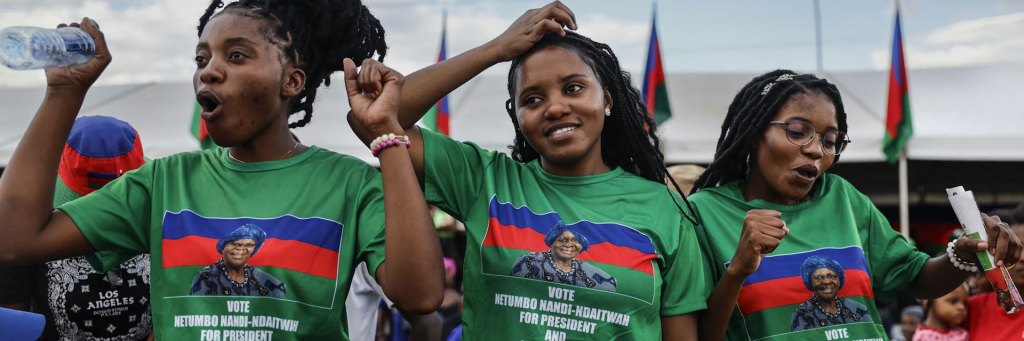
    Photo credit: Simon Maina/AFP via Getty ImagesSupporters of the South West Africa People’s Organization gather at a campaign rally in Windhoek, Namibia, on Nov. 24, 2024.

    Quotas designed to bring gender parity to parliaments have an overall positive impact on support for female political leadership – especially after women members of parliament take office. Furthermore, there is no evidence of a backlash among men.

    That’s what I found in a study published in October 2025 looking at the impact of gender-parity quotas in Namibia, in sub-Saharan Africa.

    In 2013, Namibia’s dominant political party, the South West Africa People’s Organization, or SWAPO, quietly rewrote its internal rules. From that point forward, every spot on its parliamentary candidate list would alternate between a man and a woman.

    Most prior research on measures to encourage gender parity in politics focuses on national or legislative policies rather than voluntary party quotas. Namibia offers an unusually “clean” case in that SWAPO is electorally dominant and did not face grassroots pressure to adopt its quota policy. That makes it possible to isolate the effects of the quota itself, rather than any preexisting trend in public attitudes.

    And the impact on the subsequent 2014 election was clear. Women’s representation in the National Assembly nearly doubled overnight, rising from 21% to 41%.

    But the more surprising story unfolded outside Parliament. Using several waves of nationally representative surveys from 2006 to 2017, I traced how ordinary Namibians reacted when women suddenly became far more visible in national politics.

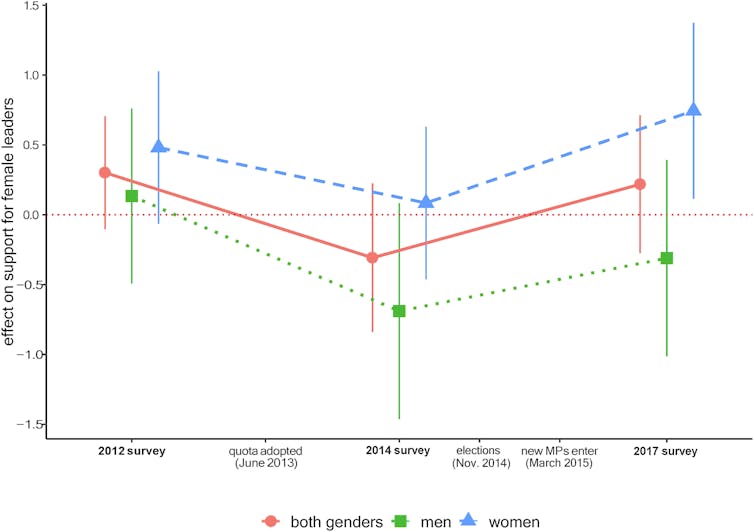
    Support for female leaders increased after SWAPO quotas were brought in. But the biggest increase was after more women became MPs in early 2015.
    Support for female leaders increased after SWAPO quotas were brought in. But the biggest increase was after more women became MPs in early 2015. Vladimir ChloubaCC BY-SA

    The findings are striking. Women who lived in SWAPO strongholds, the communities where the surge in female MPs was most evident, became more supportive of women’s right to hold political office. Their attitudes tilted upward by about four-tenths of a standard deviation on a four-point scale of support for female leadership. Put simply, women were more likely to endorse the statement “women should have an equal chance to be elected to political office” over “men make better leaders” when asked to pick one of the two claims.

    Just as striking is what did not happen. Men did not move in either direction. They did not become more supportive of women in politics, but they did not become less supportive, either.

    The absence of backlash is as important as the positive change among women. It suggests that the fear that quotas will inflame male resentment – a common concern in culturally conservative settings – did not materialize in this case.

    Perhaps the most striking point is the timing. Public opinion did not shift when the quota was announced. It shifted only after women actually took office and became plainly visible as political leaders.

    Why it matters

    Around the world, women hold fewer than 3 in 10 parliamentary seats. In sub-Saharan Africa, the average share of women in parliaments is 27%. However, this masks wide variation. A handful of trailblazers, such as Rwanda, pull the figure up, while women remain severely underrepresented in many countries across the continent.

    In many countries, deeply entrenched cultural norms cast politics as a male domain and lead citizens to doubt women’s capacity to lead. Yet exposure to women who defy stereotypes can begin to challenge these assumptions, reshaping what people believe is possible.

    The case of SWAPO in Namibia shows that quotas, introduced voluntarily by a political party rather than imposed by law, can challenge people’s gender bias without triggering the backlash many observers predict.

    What still isn’t known

    This study shows that voluntary quotas shift attitudes, but several questions remain. First, we do not yet know how durable these changes are. Do they last only as long as female leaders remain highly visible in Parliament, or do they persist across election cycles?

    Second, visibility is almost certainly not the only mechanism encouraging change. The next step is to examine how media coverage, local campaigning and community-level engagement shape perceptions of women leaders.

    It is also important to think about how these effects might vary country to country. Namibia is in some ways a special case. SWAPO has dominated Namibian politics for over three decades. Whether my findings travel to more competitive environments or to regions beyond Africa is a question worth pursuing.

    What this study does make clear is that quotas adopted voluntarily, without legal coercion, can change how ordinary citizens think about leadership.

    Sometimes the most convincing argument for women in politics may simply be watching women govern. The symbolic impact is too often overlooked, and in places where formal reforms are politically difficult, it may be the most promising starting point.

    This article originally appeared on The Conversation. You can read it here.

  • ‘Bouncing back’ is a myth – resilience means integrating hard experiences into your life story, not ignoring them
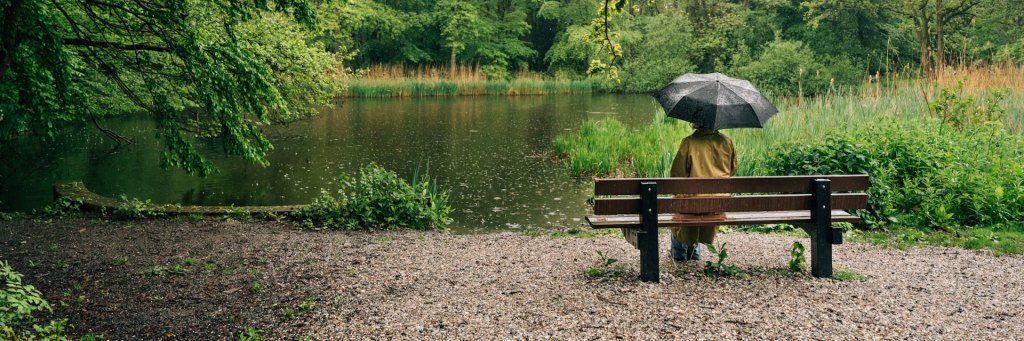
    Photo credit: Anastasiia Voloshko/Moment via Getty ImagesInto each life some rain must fall.

    When Maria looked at herself in the mirror for the first time after her mastectomy, she stood very still.

    One hand rested on the bathroom counter. The other hovered near the flat space where her breast had been. The scar was raw and angry. The loss was quiet but enormous. Her body felt foreign.

    In moments like these, people are often urged to be resilient – which can feel like being told to show no weakness, to push through no matter what. Or they imagine resilience as bouncing back: returning somehow unscathed to be the person you were before.

    But standing in that bathroom, Maria knew there was no going back. And toughness wouldn’t change what had happened. The real question was how she could move forward, carrying this experience into her new reality.

    Maria’s story, one I came to know personally, is far from unique. Loss, trauma and illness often bring the same wrenching questions of identity and the painful uncertainty of what comes next.

    I’ve spent more than two decades studying resilience, particularly among individuals and families navigating these kinds of life-changing events. I am also a four-time cancer survivor and author of a new book, “Falling Forward: The New Science of Resilience and Personal Transformation.” If there is one myth I wish society would retire, it’s the idea that resilience means “toughness” or “bouncing back.”

    woman wearing hat seated in wheelchair looks outside
    Resilience doesn’t rely on relentless positivity in the face of traumatic challenges. pocketlight/iStock via Getty Images Plus

    Rethinking resilience based on research

    Moments like Maria’s reveal something important: The way people tend to talk about resilience often doesn’t match how people actually live through adversity.

    In popular culture, resilience is often equated with grit, toughness or relentless positivity. People celebrate the warrior, the fighter, the triumphant survivor.

    But across research, clinical practice and lived experience, resilience is something far more nuanced, raw and human.

    It’s not a personality trait that some people simply have and others lack. Decades of research show resilience is a dynamic process. It’s shaped by the small, everyday decisions and adjustments individuals make as they adapt to significant adversity while maintaining, or gradually regaining, their psychological and physical footing over time.

    And importantly, resilience does not mean the absence of distress.

    Research on people facing serious life disruptions shows that distress and resilience often coexist. For example, in my study of adolescent and young adult cancer survivors, participants reported being upset about finances, body image and disrupted life plans, while simultaneously highlighting positive changes, such as strengthened relationships and a greater sense of purpose.

    Resilience, in other words, is not about erasing pain and suffering. It is about learning how to integrate difficult experiences into a life that continues forward.

    How resilience really works

    At one point, Maria told me she had started avoiding mirrors, intimacy, even conversations that made others uncomfortable.

    “Well, you’re strong,” people would tell her. “Just stay positive. This too shall pass.”

    But strength, she said, felt like a performance.

    What ultimately shifted for Maria was not an increase in toughness. It was permission to grieve.

    She began speaking openly about the loss of her breast; not just as a medical procedure but as a symbolic loss tied to identity, sexuality and womanhood. She joined a support group. She allowed herself to feel anger alongside gratitude for survival.

    This kind of emotional processing turns out to be central to resilience.

    My colleagues and I have found that people who actively process loss, rather than suppress it, demonstrate better long-term adjustment. Tamping down negative feelings may provide short-term relief, but over time it is associated with greater stress on your body and more difficulty adapting.

    In other words, resilience is not about sealing the wound and pretending it no longer aches. It is about learning how to carry the wound without letting it consume your entire story.

    Neuroscience supports this integration model. When people engage in meaning-making – reflecting on their experiences and incorporating them into a coherent life narrative – brain networks associated with emotional regulation and cognitive flexibility become more active. The brain, quite literally, reorganizes as you adapt to new realities.

    Maria described the change simply.

    “I don’t like what happened,” she told me. “But I’m not at war with my body anymore.”

    That is resilience.

    Arms in sweater with hand writing in a journal
    Acknowledging what’s been lost can be part of the process of resilience. Grace Cary/Moment via Getty Images

    Practices that help build resilience

    If resilience is about integration rather than toughness and bouncing back, how can you cultivate it? Research across psychology, neuroscience and chronic illness points to several evidence-based strategies:

    • Allow emotional complexity: Resilient people are not relentlessly positive. They allow space for the full range of emotions, such as gratitude and grief, hope and fear. Paying attention to your feelings through strategies such as reflective writing or psychotherapy have been linked to improved psychological adaptation.
    • Build a coherent narrative: Human beings are storytellers. Trauma can shatter one’s sense of self, but constructing a narrative that acknowledges loss while identifying continuity and growth supports adaptation. The goal is not to spin suffering into silver linings, but to situate it within a broader life story. For example, someone might say, “Cancer derailed my plans and changed my body, but it also clarified what matters to me and how I want to move forward.”
    • Lean into connection: Isolation magnifies suffering. Social support is one of the strongest predictors of how well people are able to cope and move forward after illness or trauma. For Maria, connection with other women who had had mastectomies normalized her experience and reduced shame.
    • Practice deliberate pauses: Intentionally give yourself some time to breathe. Mindfulness and contemplative solitude can strengthen your ability to regulate emotions and recover from stress. Pausing allows experience to be processed rather than avoided.
    • Expand identity: Illness, loss and trauma reshape how you think of yourself. Rather than clinging to who you were, resilience often involves expanding who you are becoming. Research on post-traumatic growth shows that people often report deeper relationships, clarified priorities and renewed purpose – not because trauma was good, but because it forced reevaluation. Maria no longer describes herself simply as a breast cancer patient. She is a survivor, yes, but also an advocate, a mentor, a woman whose sense of femininity is self-defined rather than dictated by her anatomy.

    Moving forward

    We are living in a time of widespread burnout and rising mental health challenges, where cultural pressure to appear strong often leaves people silently struggling. An insistence on grit and relentless optimism can backfire, making people feel inadequate when they inevitably feel pain.

    Resilience is not about returning to who you were before illness, loss or trauma. It is about becoming someone new: someone who carries the scar, remembers the loss and still chooses to engage with life.

    Maria still pauses when she sees her reflection. But she no longer turns away.

    “This is my body,” she told me recently. “This is my story.”

    Resilience is not forged in the denial of vulnerability, but in its acceptance. Not in bouncing back, but in integrating what has happened into who you are becoming.

    And that, I believe, is where real strength lives.

    This article originally appeared on The Conversation. You can read it here.

Explore More Stories

Everyday Economics

Driver breaks down how much he makes from Uber, enraging both drivers and passengers

Media

A BBC crew broke ‘cardinal rule’ of nature documentaries to save trapped penguins

Music

Therapist shares why Justin Bieber’s duet with 13-year-old self was so incredibly moving

Science

City animals act in the same brazen ways around the world