To raise awareness for their brand, an art supply company created this viral campaign featuring real people using technology to create beautiful abstract art. Sixteen disabled individuals in China (home to the world’s largest disabled population) were invited to participate in the project, which involved using advanced brainwave scanning technology in conjunction with detonator-equipped, paint-filled balloons. The video seems to show that by concentrating really hard, the participants were able to trigger the colorful explosions, resulting in some very unique pieces.
Check out the commercial here (some stills are below):
There is nothing wrong with politeness and a particular point of view, unless, of course, your interpretation of kindness is different from everyone else’s. Case in point? Boomers and every other generation.
What is it about Boomer energy that can just rub people the wrong way sometimes? It’s quite common for different age groups to have different needs and habits, and perhaps the Boomers you know may find 20% tips an absolute must, yet the concept of a service fee infuriating. Maybe they feel there is only one perfect way to load a dishwasher. Maybe job loyalty does have value. Whatever the topic, Boomers are likely to have a certain opinion about it that they feel is the best.
Finding ways to communicate and connect are important dynamics to building community and bridging the generation gap, and sometimes understanding what Boomer actions bother the other generations can help start a dialogue. VegOut Magazine described seven habits that may seem thoughtful to Boomers, but are actually emotionally taxing to younger generations.
Calling whenever they want
Boomers largely grew up in an age of landline phones that often ran unexpectedly. Instead of the horror that Millennials experience from an unsolicited phone call, Boomers find them normal and inviting. A reach out to say “Hello!” means they care and are interested in your life.
Younger generations feel it’s an uninvited threat. Where’s the heads up text? Nothing triggers anxiety like an unexpected ring.
Solution: How about everyone just chill? Older people can learn to text first. Younger people can acknowledge they don’t have to answer the phone, and often don’t anyway.
The unexpected visit
Boomers grew up in an age of the unannounced visit. There was a time when neighbors just rang a doorbell and offered up some extra muffins, freshly baked. Today, people guard their homes with intensity. A doorbell ring is terrifying, especially if pizza hasn’t been ordered.
Solution: Boomers, just send a text first. It’s not that complicated. Younger generations, you can always hide in the closet and pretend you’re not home.
Comments on personal appearance
Into today’s world, unsolicited comments on someone’s appearance seem a bit risky. And yet, Boomers never seem afraid to comment on someone’s weight loss or ask questions like, “Why aren’t you smiling?” These questions and comments were once considered tools of connection. It showed interest and concern for the mental and physical health of friends and people in general.
Younger people guard all aspects of “self” and “body image.” It’s dangerous territory leading toward hurt feelings and possible backlash.
Solution: If you don’t have anything to say nice, don’t say it. Even if you do, probably don’t say it.
With age comes wisdom, yet sometimes nobody wants to hear it. Knowledge acquired over time and experience is valuable and should be passed on, but in certain contexts. Younger people often find unsolicited advice to be a rude personal attack, so be careful about offering a note no one asked for.
Solution: I had a friend who used to always ask, “Do you want to hear my opinion?” before they shared it. It was a pretty amazing quality that gave me time to prepare for what might be coming. In the end, it’s best to get permission. Simple.
Chain messages
Breaking chains. Image via Canva – Photo by Merydolla
There’s nothing quite like the inspirational chain meme your grandma found. Especially when it was making the rounds eight months ago. Like everyone else, older people benefit from feeling connected. They’re just attempting to get in the digital meta. It’s easy to point out who’s out of the loop when you’re in it.
Solution: Can we all cut one another some slack? Instead of attacks, reconnect and appreciate the meme or image you already saw months ago. Replying with, “Ha, that’s a good one” isn’t that much of a stretch, and it isn’t that much to ask when given an opportunity to share love instead of disdain. I have an aunt who gets concerned when those chain mails say, “Pass this on to 10 people…” I told her to send them my way, because I’m not afraid to dump them in the digital garbage.
Lengthy conversations for business
Boomers have worked networking and building relationships into their business model. A chat about what’s trending is a great way to ease into an important conversation. It’s a way to be polite and build-up camaraderie before the deal is done.
Younger generations don’t want to waste time. A “thumbs up” emoji can be enough to get things going.
Solution: Acumen took a look at getting generations to learn how to connect with one another. They found that “common ground” was crucial for networking. Younger people can work on patience and respecting the time offered by older generations, and Boomers can learn to fire a quick text instead of dragging every conversation into a “life lesson.”
Checking and rechecking replies
Boomers may not be totally confident in how the whole digital world works. It’s not uncommon to receive texts and emails asking, “Did you get that email…” or “Curious on your thoughts of the text I sent.” These follow-ups were designed to show interest and thoroughness. Younger people can just find them bothersome.
Solution: Boomers can learn to not treat texting and emails like a personal journal. It’s okay to be brief and to the point. A short message doesn’t mean someone is being short with you.Speak with People suggested that younger generations can give Boomers the “benefit of the doubt.”
The wrap up
Everyone is trying to fit in the best they can. It can be difficult to adapt and move with the times. Some day, younger people will be a little out of touch with the next generation.
Philosopher and theologian Martin Buber wrote, “All real living is meeting.” The more we can learn to help each other connect, the better. Learning to be curious about other people and their generation instead of dictating will build deeper and more mutual connections.
This article originally appeared 1 year ago. It has been updated.
The test was introduced in a 2005 paper in the Journal of Economic Perspectives by Yale professor Shane Frederick. It’s designed to test your ability to override a quick, intuitive gut reaction and engage in deeper, more analytical thought.
Want to try it yourself?
Woman sits in front of her computer thinking Canva
Here are the three questions:
A bat and a ball together cost $1.10. The bat costs $1.00 more than the ball. How much does the ball cost?
If it takes five machines five minutes to make five widgets, how long would it take 100 machines to make 100 widgets?
In a lake, there is a patch of lily pads. Every day, the patch doubles in size. If it takes 48 days for the patch to cover the entire lake, how long would it take for the patch to cover half of the lake?
The Answers and Why They’re So Tricky
If you answered 10 cents, 100 minutes, and 24 days, you’re in the majority—and you’ve fallen for the trap. Those are the common intuitive answers. The correct answers are 5 cents, 5 minutes, and 47 days.
Woman proudly shows testy results Canva
Here’s the breakdown:
The Bat and Ball: If the ball cost 10 cents, the bat (at $1.00 more) would cost $1.10, for a total of $1.20. The correct math shows the ball is 5 cents and the bat is $1.05.
The Widgets: The rate of production is one widget per machine every five minutes. Therefore, 100 machines can produce 100 widgets in the same five-minute timeframe.
The Lily Pads: Since the patch doubles in size every day, it must have been half its final size just one day before it covered the whole lake—on day 47.
The Science of Your Brain
An artistic representation of the brain Canva
This test brilliantly illustrates the two modes of thinking identified by Nobel Prize-winning psychologist Daniel Kahneman.System 1 is our fast, automatic, intuitive thinking, which gives us the quick (but wrong) answers.System 2 is our slower, more deliberate, and analytical thinking, which is required to solve the puzzles correctly.
As Frederick explains, the test measures how we make decisions based on instinct versus analysis. “System 1 thinkers respond spontaneously, often making mistakes, while System 2 thinkers engage in effortful thought processes,” he wrote.
Frederick’s research found that those with stronger cognitive reflection skills (System 2 thinkers) tend to be more patient and willing to take calculated risks. His work aims to understand the real-world impact of our cognitive styles, noting, “Despite the diversity of phenomena related to IQ, few have attempted to understand—or even describe—its influences on judgment and decision making.”
So, whether you passed the test or not, it offers a fascinating glimpse into the constant tug-of-war between gut reaction and careful thought that happens inside our brains every day.
This article originally appeared earlier this year.
This article originally appeared [time-difference] ago. It has been updated.
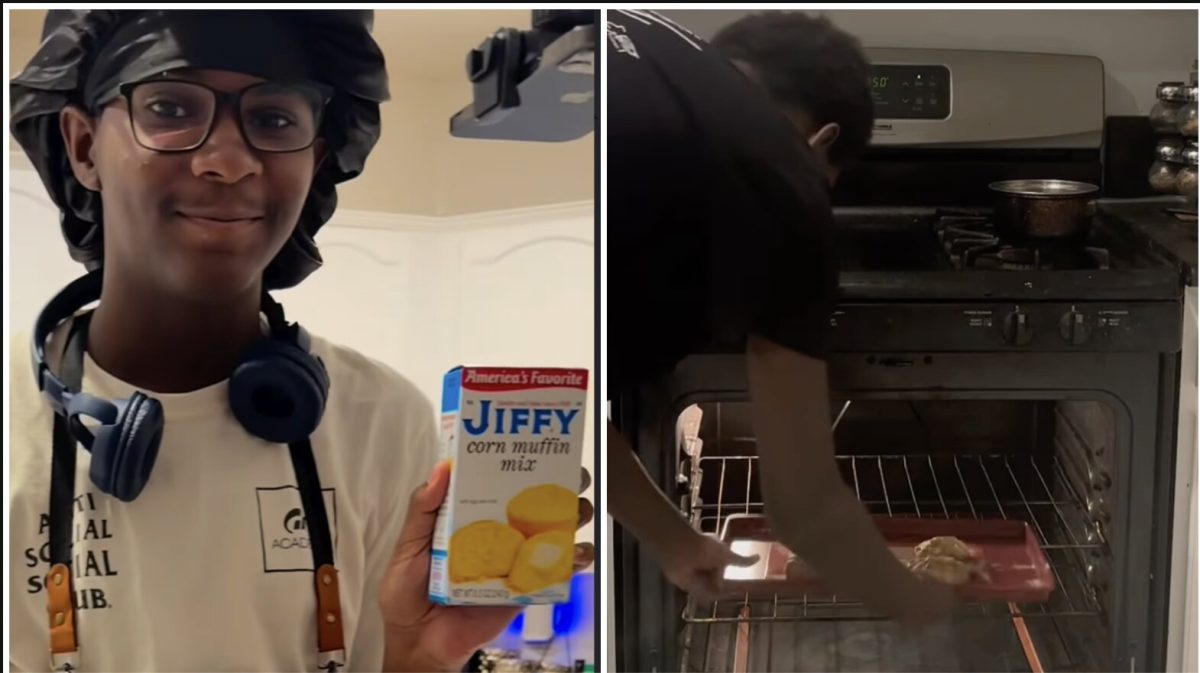
One night in Apple Valley, California, Morgan Graham rose in the middle of the night. A smell had woken her up. It was pleasant, but at 11:28 p.m. she wasn’t expecting to smell delicious cooking. She went down into the kitchen to see her 15-year-old nephew, Amir Jackson, baking cookies.
This was the first of several viral videos of Graham’s nephew cooking up a storm late at night. Jackson, who has been staying with his aunt during the summer, is taking advantage of her kitchen to whip up some sumptuous snacks.
Nearly every night, Graham wakes up around midnight to the smell of cookies, cornbread, tacos, or whatever her nephew wants to prepare.
“I don’t care,” said Graham in the initial video. “He’s very responsible. He’s not gonna burn the house down, so therefore, cook whatever you want.”
Graham further explained in the video that Jackson looks at recipes daily. He also rummages through her pantry during the day to search for ingredients for his nightly cooking fest.
“In his world, he’s having the time of his life. In my world, I just want to stop waking up close to midnight to the smell of food,” Graham joked.
Graham’s videos featuring her nephew have racked up millions of views on TikTok and Instagram. The commenters soon bestowed the nickname “Midnight Chef” upon Jackson, to general delight. In another video, Jackson explained he liked the peace and quiet of the night while preparing his dishes.
“I was like, ‘Man, I could go for some cookies right now.’ I saw they had cookie dough, so I started just making them, just randomly,” Jackson told TODAY. “I was trying to make sure nobody was up. My thought process was just like, ‘Man, why not?’”
Graham is encouraging her nephew to keep cooking even though it wakes her. In fact, Graham set up Jackson’s own Midnight Chef Instagram page for him to post his latest recipes.
“I just want to experiment while I still got the chance to experiment. I’ll maybe like branch into different fields,” said Jackson. “Explore what I can do while I still got time to.”
Jackson’s popularity has brought up a commonly asked question: Why do we crave food randomly in the middle of the night?
Well, there’s actually a bit of science behind it. Turns out that late night snacking is a result of our circadian rhythm system. As part of our now-defunct survival mechanism, our ancestors would eat large meals at night to store energy in times of famine. This is also why most midnight snackers crave foods higher in fat, salt, and sugar compared to what they’d usually eat during the day. While there’s nothing inherently wrong with late night snacking, it could curb certain health goals if a person is trying to trim down.
If you find yourself getting up in the middle of the night with a hankering for a snack, it may be worth taking a peek at Jackson’s videos. Who knows what kind of late night cooking it can inspire? Perhaps you’ll become a Midnight Chef yourself.