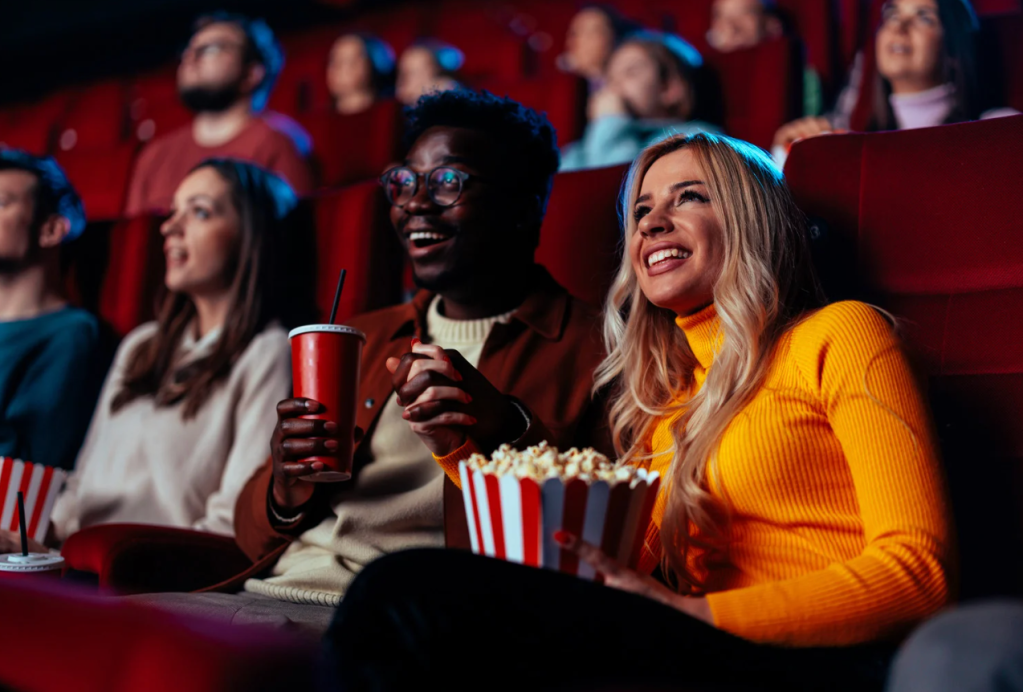
For people who love to go to the movies, things are not looking good. As the film theater industry struggles financially and home theaters become less expensive, it’s hard to justify the cost of going to the movies during the age of streaming. It doesn’t help that parents report spending over $100 for a family of four on tickets and snacks, only to watch nearly a half hour of trailers and ads before the film starts. Yet, according to one 2024 study, 30% of Americans stream two movies or more per week while 34% still prefer to watch films in the theater. Since the issue isn’t a love of movies as an entertainment art form, one can believe there are ways to improve the movie-going experience.

In response to this, the mega movie theater chain AMC introduced a warning regarding the length of trailers and a 50% ticket discount on Tuesdays and Wednesdays. However, their response has been criticized by many as tone deaf since those discount days are school nights, and it’s fairly common knowledge among film goers that trailers will take nearly 30 minutes at the start of showtime. Though those efforts missed the mark, there are still some things that could help the movie theater industry stay in business and allow the communal experience of going to theaters live to see the future.

Put trailers at the end (and hold off on debuting them immediately online)

The first change is in response to the AMC warning about trailer length. While trailers have been a part of the film-going experience since 1919, it’s time for a change. As more people end up watching a trailer online, it might be time to move in reverse, not forward. Film trailers got the “trailer” moniker because they used to air after the film trailing behind rather than at the start. It might make showtimes easier if theater goers knew the start time of the film was the actual start time, and could stick around to watch trailers after the credits should they wish. It may also help if studios leaned toward making trailer premieres at the theater first for a week or so before debuting them online so there is more anticipation for them.

@daveordavid3

Bucket of popcorn coming from off screen.. #fyp #fypシ゚viral ♬ original sound – Dave

Market more special themes or events

The Rocky Horror Picture Show was a flop when it first debuted on screens, and yet it is now celebrating 50 years of showings at movie theaters across the country. This was due to having special rowdy screenings at midnight to cater to the fan base. Doing more special screenings like that could help get more people into the theater experience rather than choosing to wait at home to watch on streaming. This has already proven successful with sing-a-long screenings of Wicked that let the audience sing in their seats and chaotic “Chicken Jockey” screenings of Minecraft. On the opposite end, having screenings specifically for the film experience that seriously reinforce “no talking, no cell phone” rules, like at the steadily growing Alamo Drafthouse theater chain, can appeal to folks who want to ensure a film experience without distraction like they would get at home. Reinforcing a communal experience by leaning into specialty concert-like showings of current films could help increase ticket sales.

@ashleybejarano_

This is your sign to rent out a theatre for your toddler’s first movie theatre experience! ??️ grab your closest friends & family and let the kiddos run wild and enjoy a movie ? #movie #movietheater #movietheatre #toddlersfirstmovie #toddlersfirstmovietheaterexperience #kidsmovies #summersctivities #summeractivitiesforkids #toddlermom #toddleractivities #movietheaterhacks #momhack #movienight #toddlermovienight ♬ Summer – Croquet Club

Increase the appeal of theater rentals

While the home theater experience is getting cheaper, it’s still not feasible for many people due to space and expenses. However, renting out a movie theater for a private showing among your friends and family can be a nice way to enjoy a current film without fearing distractions from strangers. This move was popular during the COVID-19 pandemic when folks wanted to be in their “bubbles” of family and friends. If further advertised at a good price point, this option could allow people to host their own private screenings of the latest blockbuster at smaller venues or show a digital projection of a beloved classic of their choosing.

@erin_rach

Neither of us have been to a movie since early 2020 and had no idea what movie tickets cost ?? $50 just for 2 tickets is robbery ? ♬ original sound – erin ?

Lower prices

While these suggestions can help movie theaters have more appeal to current audiences, the stark reality is that high ticket prices are the main problem. This is because, per a 2024 CNN poll, four out of ten Americans worry that they can’t pay their expenses. By adjusting prices along with the other proposed changes, going to the movies would be seen as less of a financial burden and an opportunity to do something new. Remember, the movies were originally a hit because they were cheaper entertainment than going to a live play or concert, but now film tickets are rivaling those prices. While the film industry struggles, it might be time for them to take a financial risk to survive rather than depending on the general public to do so.
  • 25 hilarious signs proving some messages just can’t be taken seriously
    Photo credit: Reddit | u/beachvbguyA funny bathroom sign.
    ,

    25 hilarious signs proving some messages just can’t be taken seriously

    From sharp edges to dog-friendly policies, these funny signs show how humor and confusion collide in public places.

    Signs are meant to inform, warn, or direct, but sometimes, they unintentionally entertain. Whether due to poor wording, clever humor, or just plain absurdity, some signs end up being comedic gold.

    Thanks to the internet, we no longer have to stumble upon them by accident—there’s even a whole subreddit, r/funnysigns, dedicated to collecting the most ridiculous ones.

    Here are 25 of the funniest signs that prove not all signage is created equal.

    1. Some people might need this reminder

    “Not knowing who Taylor Swift is doesn’t make you interesting.”

    funny signs, viral humor, Reddit funnysigns, funny warning signs, humorous signage
    Funny sign Reddit | u/Key_Shoe5850

    2. A dog-friendly policy we can all support

    “Dogs welcome. People tolerated.”

    funny signs, viral humor, Reddit funnysigns, funny warning signs, humorous signage
    Funny sign. Photo credit: Reddit | u/phoenix-fatale

    3. Coffee fixes everything

    “Given enough coffee, I could rule the world.”

    funny signs, viral humor, Reddit funnysigns, funny warning signs, humorous signage
    Funny sign. Photo credit: Reddit | u/AprilBoon

    4. Watch your step—sort of

    “Caution: This sign has sharp edges. Also, the bridge is out ahead.”

    funny signs, viral humor, Reddit funnysigns, funny warning signs, humorous signage
    Funny sign. Photo credit: Reddit | u/Winnin_Dylan

    5. Priorities: Keep the cat inside!

    “Please close the door behind you. DO NOT LET THE CAT OUT! No matter what it tells you!”

    funny signs, viral humor, Reddit funnysigns, funny warning signs, humorous signage
    Funny sign. Photo credit: Reddit | u/GigaPrime14900

    6. Cats really are the masterminds

    “If a cat asks for a cheeseburger, give it one. You don’t want to know what happens if you don’t.”

    funny signs, viral humor, Reddit funnysigns, funny warning signs, humorous signage
    Funny sign. Photo credit: Reddit | u/Zion_Annabella

    7. Nice try

    “Always read the fine print.”

    funny signs, viral humor, Reddit funnysigns, funny warning signs, humorous signage
    Funny sign. Photo credit: Reddit | u/Winnin_Dylan_

    8. Football confidence at its peak

    “World champions… of a sport only we play.”

    funny signs, viral humor, Reddit funnysigns, funny warning signs, humorous signage
    Funny sign. Photo credit: Reddit | u/Khaleeasi24

    9. The toughest decision you’ll make all day

    “Hmmm.”

    funny signs, viral humor, Reddit funnysigns, funny warning signs, humorous signage
    Funny sign. Photo credit: Reddit | u/Material-Practice-58

    10. Not the CPR instructions we were expecting

    “If someone collapses, administer CPR. If CPR doesn’t work, try turning it off and back on again.”

    funny signs, viral humor, Reddit funnysigns, funny warning signs, humorous signage
    Funny sign. Photo credit: Reddit | u/Lovecutiepie77

    11. Honesty is the best policy

    “Lying is bad. Except when you tell someone they look good in those pants.”

    funny signs, viral humor, Reddit funnysigns, funny warning signs, humorous signage
    Funny sign. Photo credit: Reddit | u/BaronVonBroccoli

    12. Job requirements have changed

    “Now hiring: Must be able to lift 50 lbs, work weekends, and fight off at least two raccoons a day.”

    funny signs, viral humor, Reddit funnysigns, funny warning signs, humorous signage
    Funny sign. Photo credit: Reddit | u/PurpleRuby_

    13. Someone really needed spellcheck

    “Public Notice: The libary is close today.”

    funny signs, viral humor, Reddit funnysigns, funny warning signs, humorous signage
    Funny sign. Photo credit: Reddit | u/Internetboy5434

    14. Looking for the Teenage Mutant Ninja Turtles

    “Caution: Sewer entrance. Heroes in a half-shell may be present.”

    funny signs, viral humor, Reddit funnysigns, funny warning signs, humorous signage
    Funny sign. Photo credit: Reddit | u/Poke-girl56

    15. In case of emergency… or not

    “In case of fire, please use stairs. (Sign is next to an escalator).”

    funny signs, viral humor, Reddit funnysigns, funny warning signs, humorous signage
    Funny sign. Photo credit: Reddit | u/Swimming-Pool143

    16. Why do we need to know this?

    “Fun fact: The average person will walk past a murderer 36 times in their lifetime.”

    funny signs, viral humor, Reddit funnysigns, funny warning signs, humorous signage
    Funny sign. Photo credit: Reddit | u/PrettySuccubus

    17. Stating the obvious

    “Warning: Water is wet.”

    funny signs, viral humor, Reddit funnysigns, funny warning signs, humorous signage
    Funny sign. Photo credit: Reddit | u/celestial-chic

    18. This store was ahead of its time

    “Employees must wash hands before returning to work. We’ve been saying this since 1992!”

    funny signs, viral humor, Reddit funnysigns, funny warning signs, humorous signage
    Funny sign. Photo credit: Reddit | u/beachvbguy

    19. The Force is strong with this one

    “Please use the Force to open the door.”

    funny signs, viral humor, Reddit funnysigns, funny warning signs, humorous signage
    Funny sign. Photo credit: Reddit | u/beachvbguy

    20. Elevator or trampoline?

    “To activate the elevator, please jump three times.”

    funny signs, viral humor, Reddit funnysigns, funny warning signs, humorous signage
    Funny sign. Photo credit: Reddit | u/PurpleRuby

    21. Beware of the nighttime hunters

    “Warning: This area is protected by highly trained owls.”

    funny signs, viral humor, Reddit funnysigns, funny warning signs, humorous signage
    Funny sign. Photo credit: Reddit | u/ScarlettPrincess

    22. Karen’s personal space

    “DO NOT TOUCH. This wall belongs to Karen.”

    funny signs, viral humor, Reddit funnysigns, funny warning signs, humorous signage
    Funny sign. Photo credit: Reddit | u/Limp_Duck_9082

    23. Not exactly good life advice

    “Or get away from that road as soon as possible.”

    funny signs, viral humor, Reddit funnysigns, funny warning signs, humorous signage
    Funny sign. Photo credit: Reddit | u/celestial-chic

    24. A new spin on fast food slogans

    “Make fast food great again.”

    funny signs, viral humor, Reddit funnysigns, funny warning signs, humorous signage
    Funny sign. Photo credit: Reddit | u/AprilBoon

    25. A truly ineffective calming method

    “Would be great if it did work, though.”

    funny signs, viral humor, Reddit funnysigns, funny warning signs, humorous signage
    Funny sign. Photo credit: Reddit

    Want more? Check out these YouTube videos for additional funny signs:

    This article originally appeared six ago. It has been updated.

  • Indie coffee shops are meant to counter corporate behemoths like Starbucks – so why do they all look the same?
    Photo credit: stomy/iStock via Getty ImagesMany coffee shops today seem to be aesthetically divorced from time and place.

    Like many young, urban professionals, we run on coffee. We especially enjoy frequenting independently owned cafes that pride themselves on ethically sourced beverages, strong local ties and a hip aesthetic.

    They’re the kinds of places that sneer at the homogenization and predictability of Tim Hortons, Second Cup, Dunkin and Starbucks.

    But as public space and consumer culture researchers, we began noticing a pattern: While the invention of new, nondairy milks to mix into lattes continues to amaze us, many U.S. coffee shops seemed to share a similar aesthetic.

    What was up with all the exposed brick? Why did so many of the baristas look cooler than us, but also so similar to one another? And why did most menus appear on a chalkboard, as if we were still in kindergarten?

    Weren’t we supposed to be in one-of-a-kind, authentic settings that make us feel unique and, let’s admit it, slightly elevated?

    As it turns out, the visual patterns we noticed had never been backed up by research. So after a quick cortado, we set out to test our hunch that local coffee shops had adopted a uniform aesthetic.

    Measuring homogeneity

    We asked over 100 American and Canadian young professionals living in cities to share an interior image of their favorite independent coffee shop, describe why they liked the shop’s appearance, and document aspects of its interior design.

    They could select these interior design features from a list of 23 common elements that we had identified in a pilot study – brick walls, marble counters, indoor plants, local art, vintage furniture and even the look of the baristas. Respondents could also write down other details they noticed.

    The elements that they selected and wrote down showed a fascinating overlap.

    Baristas led the pack: Two-thirds of the participants’ favorite local coffee shops had staff with tattoos or piercings. Over half had baristas with beards. Well over half of the respondents noted that their favorite shop had chalkboards, reclaimed wood features, local art, milk foam designs on beverages, local event posters and exposed brick. A large share of the shops had vintage furniture, community message boards and free books available to patrons to read. One-third of the images had indoor plants, trees or greenery.

    Barista with a beard and tattooed hands pours boiling water over coffee grounds.
    Chances are your favorite local coffee shop has a barista with a beard and tattoos. Wera Rodsawang/Moment via Getty Images

    Next up, we challenged the participants to identify the city where these coffee shops were located.

    Using the images provided by the respondents from the initial survey, we asked 158 new and prior participants if they could match the location of the shops depicted in six photographs to Cincinnati, St. Louis or Toronto – cities chosen for their different architectural and aesthetic qualities.

    Not a single participant was able to correctly identify the correct city for all the photos.

    We gave respondents another chance by showing two pictures of coffee shops, one at a time. This time, the two shops were located in Chicago and San Francisco – again, places that pride themselves on their unique and recognizable design culture. They were now given the choice of these key cities to select from, as well as three wrong cities. Only 6% successfully located both coffee shops, and nearly 20% immediately gave up.

    As one participant conceded: “Honestly, these aesthetics are very transferable now … they were random guesses and they could have been in any of the cities mentioned.”

    In other words, independent coffee shops in North America have become so similar aesthetically that their location cannot be picked from a lineup. The purportedly unique and local feel of coffee shops has instead been homogenized into a singular, palatable, North American aesthetic.

    Ironically, these shops have narrowed their aesthetics like a de facto brand franchise – exactly like the chain stores that their patrons ostensibly reject.

    A young woman with dreadlocks pays for her coffee as a smiling young female barista with short hair holds out a card reader.
    Exposed brick, check. Plants, check. Chalkboard, check. Tara Moore/Digital Vision via Getty Images

    Computers and capital

    So why is this happening?

    New Yorker cultural critic Kyle Chayka has attributed aesthetic homogenization to popular social media platforms like Instagram. He calls it the “tyranny of the algorithm”: Social media algorithms promote the visuals that users are most likely to engage with. This, in turn, causes the same types of visuals to be liked and shared, since users encounter them more often. Because the algorithm sees they’re popular, it continues to promote them, in a self-reinforcing cycle. In turn, coffee shop owners also see these online images and try to replicate them in their own establishments.

    Artificial intelligence will likely accelerate the digital homogenization of visual culture, since AI models are trained on massive datasets that feature widely circulated images. Whether it’s popular fashion, architecture or interior design, idiosyncrasies are collapsing into a generic, hegemonic aesthetic – what scholars Roland Meyer and Jacob Birken call “platform realism.”

    Finance plays a role as well. With the average cost of starting a new coffee shop between US$80,000 and $300,000, and with only a small share of coffee shops expected to stay open beyond five years, banks are keen to reduce their risk. Many of them will therefore ask aspiring coffee shop owners to opt for cheaper interior design choices that appeal to the broadest customer base.

    The consumer also plays a role

    But patrons of hip coffee shops may also be to blame.

    Decades before the rise of social media, AI and financial risk management, scholars such as Sharon Zukin revealed how young urban professionals paradoxically embrace the homogenization of their environment in their quest for authenticity.

    Those exposed brick walls? Zukin already described how Manhattan real estate brokers had marketed them to gentrifying SoHo yuppies in the early 1980s.

    Like their predecessors, today’s hipsters, creative professionals and knowledge workers are essentially cultural and aesthetic consumers. Many of them crave visuals – from fashion to architecture – that are different enough to feel cool and authentic, yet safe enough to match their lifestyle and their social status. They want a tasty latte as much as a palatable interior to drink it in.

    Businesses and developers are eager to appeal to these upwardly mobile consumers. At the same time, they want to reach the biggest number of customers. So they tend to create repeatable, homogenized environments in what Zukin describes as a “symbolic economy.”

    In coffee shops, patrons want more than a good espresso. They want to immerse themselves in a “scene” that matches their lifestyle and aspirations. And the exposed brick and the vintage furniture do just that – even if they’ve been copy-and-pasted in cities, small and large, across the nation.

    As we chase authenticity, we may just be finding comfort in carefully curated conformity.

    This article originally appeared on The Conversation. You can read it here.

  • It’s never too late to learn a language – adults and kids bring different strengths to the task
    Photo credit: Bulat Silvia/iStock/Getty Images PlusAdult language learners have an understanding of grammar that can help them learn a new language. But they are also likely to feel more self-conscious as they do so.

    There’s a common assumption that if someone starts learning a language when they are very young, they will quickly become fluent.

    Many people also assume that it will become much harder to learn a language if they start later in life.

    Research into language learning shows that how old someone is when they learn a language does matter, but there is no point at which the ability to learn a language switches off.

    While a young language learner can more easily acquire a native accent, adults retain the ability to learn new languages well into later life. Anyone can continue to learn and refine their vocabulary and grammar. Other factors, like motivation, can also play a role for learners of all ages.

    I am a linguist and the author of a forthcoming book, “Beyond Words: How We Learn, Use, and Lose Language,” which looks at how language is learned, used and lost across a lifespan — and why age alone does not set hard limits on our linguistic abilities.

    Instead, the strategies learners use, the outcomes they achieve most easily, and how others judge their progress can all change over time.

    How age shapes language learning

    Someone’s age can influence their language learning ability in a variety of ways.

    Scientists sometimes talk about sensitive periods, or an early development window in which the brain is especially receptive to certain kinds of input.

    When it comes to language, babies and children are particularly sensitive to the sound patterns of speech. They can also pick up on subtle phonetic distinctions that adults struggle to perceive or reproduce.

    This helps explain why children who grow up bilingual often sound native in both languages. Accents, more than vocabulary or grammar, are where age-related differences are most pronounced.

    Sensitive periods are found in other animals, too, especially birds, which have an early sensitive period for learning their species-specific song from an adult tutor.

    After this window closes, learning a new language is still very much possible. But it usually takes more conscious effort and practice.

    Studies also show that children exposed to a second language early, roughly before puberty, are more likely to develop nativelike pronunciation and intonation.

    Brain imaging research shows that people who learn two languages early in life tend to process both languages in the same parts of the brain. Those who learn a second language later often use slightly different brain areas for each language.

    In practical terms, early bilinguals are more likely to switch between languages effortlessly. Later learners may have to more consciously work through their second language, especially at first.

    Two boys sit next to each other at a desk in a classroom filled with other children at desks.
    Second grade students do classwork during a Spanish-only, dual immersion class in University Hill Elementary School in Boulder, Colo., in 2022. Glenn Asakawa/The Denver Post via Getty Images

    Benefits to learning a language as an adult

    Pronunciation is only one part of language proficiency. Adults bring their own strengths to the task.

    Unlike young children, adult learners already have a fully developed first language. They also have skills in reasoning and pattern recognition, as well as an awareness of how language works.

    This allows adults to learn in a more deliberate way, as they study grammar rules and consciously compare languages. Adults are also more likely to rely on deliberate strategies, such as memorization, to learn a language.

    In classroom settings, adults often outperform children in early stages of learning, particularly in reading and writing.

    Language learning never truly stops. Even in adulthood, people continue to develop and refine their first language, shaped by their education, work and social environment, and how they use it day to day.

    While it may be harder for adults to acquire a nativelike accent later in life, the good news is that grammar, vocabulary and fluency remain well within reach for most adult learners.

    Benefits of learning a language as a kid

    Children, meanwhile, tend to learn languages implicitly, through immersion and interaction, often without conscious attention to rules.

    Social and emotional factors also play a major role in successfully learning a language.

    Children are generally less self-conscious than adults and more willing to take risks when speaking.

    Adults, by contrast, are often acutely aware of mistakes and may hesitate to speak for fear of sounding foolish or being judged.

    Research consistently shows that being willing to communicate is a strong predictor of success in learning a new language. Anxiety, inhibition and negative feedback from others can significantly slow progress, regardless of age.

    Accent, bias and social pressure

    Other factors, like social pressure and discrimination, matter as someone tries to learn a new language.

    Research into language and identity shows that listeners frequently associate accented speech with lower intelligence or competence, despite there being no connection between accent and cognitive ability.

    Non-native speakers often experience stigmatization, discrimination and prejudice from native speakers.

    This bias can discourage adult learners and reinforce the false belief that successful language learning means sounding native.

    Motivation and aptitude matter, too

    Motivation is another key factor that affects learners of all ages.

    People learn new languages for many reasons: a new country, work, school, relationships or interest in another culture.

    Research distinguishes between the different reasons people learn a language. Some are practical, like advancing a career or passing a test. Others are personal, such as wanting to connect with a community, culture or family.

    Learners who feel a strong personal or emotional connection to the language are more likely to keep going even when it gets difficult, and they often reach higher levels of fluency than those without this connection.

    Other people have a natural aptitude for learning a language and can pick it up easily. Perhaps they quickly notice sound patterns, or they can remember new vocabulary after hearing it once or twice.

    Language aptitude is different from intelligence and varies from person to person. Aptitude makes success in learning a language more likely, but it doesn’t guarantee it.

    Learners with average aptitude can still become very proficient in new languages as adults if they have consistent exposure, practice and motivation.

    Different ages, different strengths

    So is it better to learn a second language as a child or as an adult? Research suggests the more useful question is which aspects of language learning, such as pronunciation, fluency or long-term mastery, matter most.

    Learning a new language early makes it easier to sound like a native speaker and to use the language smoothly, without having to think about the rules.

    Learning that language later in life draws on adult strengths, such as planning, problem-solving and focused practice.

    Ultimately, some people pick up languages quickly while others struggle, regardless of how old they are.

    Beliefs about language learning shape education policy, parenting choices and how multilingual speakers are treated in everyday life.

    When adults are told they’ve missed their chance to learn a language, many never bother to try. When foreign accents are treated as flaws, capable speakers can be unfairly discriminated against.

    In fact, research shows that learning a language is possible at any age – it’s a lifelong, achievable journey, rather than a race against the clock.

    This article originally appeared on The Conversation. You can read it here.

Explore More Culture Stories

Internet

Today’s obsession with authenticity isn’t new – being true to yourself has troubled philosophers for centuries

Culture

Teacher shares 5 specific examples of how chaotic an average middle school day really is

Culture

During one of Peter Gabriel’s final Genesis shows, a roadie got naked for one amazing prank

Music

41 years ago Bono’s Live Aid stage antics ended up saving a female fan from being crushed