Fusion cuisine has long been a hot commodity in the restaurant industry—with flavors and ingredients from disparate countries and cultures being mashed together in an effort to reinvent meals and create new combinations. For instance, the restaurant Nobu is famed for its twist on Japanese dining with Wagyu Tacos and Seabass Jalapeno Miso. And Oregon restaurant chain Koi Fusion blends Korean specialties with sandwich mainstays like the Reuben, cheesesteak, and slider.
Fusion is actually just a buzzword to describe the very old custom of mixing cultural foodstuffs, and has been around for as long as countries have traded. Colonization has always been a huge factor in this. For instance, the Bánh mi—a popular Vietnamese sandwich served on a French-style baguette—developed during the French colonial period. Fillings include ingredients native to the Southeast Asian region, such as cilantro, cucumber, and the root vegetable daikon, topped off with those of European origin like pâté and cheese.
While Vietnamese food has wide and growing recognition, Indonesian food—let alone Indo-Dutch food—doesn’t have much of a foothold in the world outside of the Netherlands, despite the fact that Indonesia is the fourth most populous nation on earth and that there are over 8 million Indonesians living outside of Indonesia.
Los Angeles-based chef and food blogger Jeff Keasberry, who moved to Southern California from Amsterdam in 2005 in pursuit of year-round sunshine, is looking to change that with his new cookbook, Indo Dutch Kitchen Secrets, will be released in December 2016.
The Dutch arrived in the Indonesian archipelago in 1595 in pursuit of spices. The profit margins made on return to Europe fueled their return and rapid colonization of the region. By 1920, the Netherlands had almost completely colonized the Indonesian and Malaysian archipelagos, then known as the Dutch West Indies. The Dutch successfully retained control of the nation until World War II, which brought about a Japanese invasion and occupation. Following the surrender of the Japanese in 1945, the Dutch attempted to assert ruling power again, leading to a nearly five-year-long war for control and independence.
The centuries-long occupation gave birth to a mixed-race Eurasian population known as the Indo, the result of relationships between European male colonizers and native women. Until World War II, a quarter of the European unions in Indonesia were with native spouses. During that same time period, 250,000 people living in Indonesia maintained Dutch citizenship (of that number, nearly 200,000 were of Indo descent). Currently, 1 million Indo now live in Indonesia, while over 500,000 live abroad in the Netherlands, the United States, or are part of a sizeable population anchored in Australia.
During colonization, cultural exchange created a fusion, and Indo-Dutch food was born. Through the operation of trade routes and the movement of people, Indo-Dutch food became global. Starting in the 19th century, Dutch colonizers began shipping off indentured servants from Java to the far reaches of Suriname—a small South American country that borders Brazil—to work on sugarcane plantations. The transit continued for over two decades and is the reason that food of Indo-Dutch origin incorporated ingredients with a South American twist.
The influence of Dutch trade routes from present day Sri Lanka to South Africa (along the West African coastline and back up to Holland) is evident in local communities—from fabric to food— along the way. Keasberry offers a steamed meatloaf dish as an example. In Indonesia, where it originates, it’s known as Botok. The South African version is made with similar ingredients and carries a familiar name Bobotie.
“Culture is always moving and changing,” Keasberry says of the cuisine’s continued mutations.
Keasberry was initially inspired to write the book after he noticed a disturbing trend in his new home of California: The older generation was dying and the Indo-Dutch recipes from the mothers and grandmothers of the matriarchal Indonesian society were getting lost over time. Southern California is home to the largest group of Indo-Dutch immigrants and descendants in America (as many as 28,000 Indo-Dutch were living in the area by the 1970s, though the numbers have since become fuzzy as the community loses its identity). This fuzziness distressed Keasberry. As he spent more time in the Golden State, he began to realize the Indo-Dutch heritage was at risk of being lost through assimilation. Creole languages like Petjo and Javindo, which combine elements of Dutch and indigenous Indonesian languages, are on the path to extinction—and so are the recipes that help define the Indo culture.
Keasberry has his grandmother to thank for the roots of his career in food. She was the proprietor of an Indo-Dutch restaurant in Amsterdam and authored her own cookbook that remained in print for 20 years. His book, Indo Dutch Kitchen Secrets, which he refers to as a sequel, is his spin on family recipes. And while this is his first American release, he’s previously authored two cookbooks that have been published in the Netherlands.
Through his food blog, Indo Foodie, and Indo Dutch Kitchen Secrets, Keasberry aims to make Indo-Dutch fusion food more accessible to American eaters. Part of the hurdle is the cultural complexity of the country itself: Indonesia is made up of more than 13,000 islands, with each carrying its own traditions and twists. Which is to say, Indonesian food on its own is hard to nail down due to the myriad of cultures, traditions, and populations present across the islands, as well as and the different dishes and styles that have sprung forth from that. If it must be defined, Indo-Dutch cuisine relies on the Indonesian hallmarks of rice and noodles as staples, along with vegetables, soups, and complex spice flavoring paired with traditional Dutch fare.
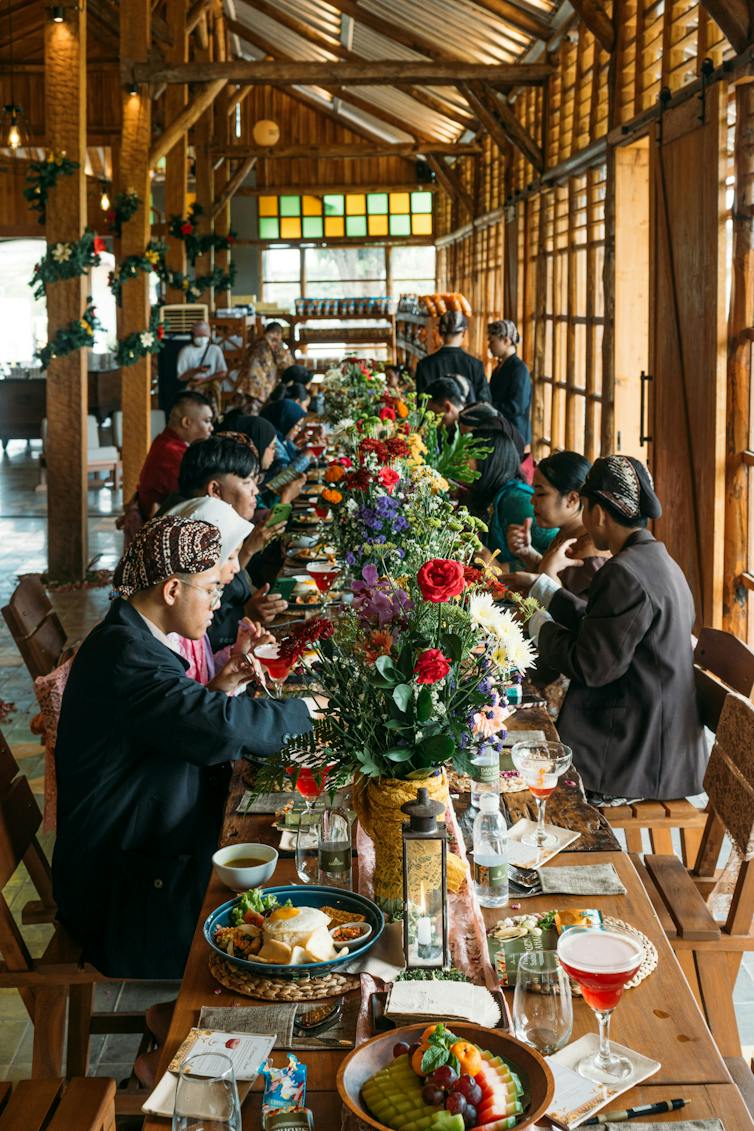
Keasberry cites rijsttafel, which literally translates to “rice table,” as a true example of the cultural fusion. Rijsttafel is an elaborate spread of dishes that was created in the former Dutch Indies by the colonialists, who accumulated a collection of indigenous dishes such as rendang, a meat dish seeped in spices from the Minangkabau people of Sumatra; Gado Gado, a combination plate of boiled eggs and vegetables along with tofu and tempeh that originated in Jakarta, but was popular nationwide; and rice wrapped within a banana leaf and bathed in peanut sauce. Dishes with European influences or heritage also have their place, such as macaroni schotel (noodle casserole); ajam kodok (chicken stuffed with egg); or pastei tutup (baked Shepherd’s pie). These are all served together smorgasbord style and snacked upon leisurely over several hours.
At the tail end of last year, rijsttafel was officially adopted as part of the National Inventory of Intangible Cultural Heritage within the Netherlands, becoming part of the intangible culinary or cultural heritage of the Netherlands, but also situating it as a Dutch invention. Dutch schooling leaves out much of the nation’s colonial history, instead focusing on its golden age of renowned art and architecture. Many textbooks omit reference to the colonial trade, and if referenced at all, the curriculum instead focuses on the Netherlands’ prosperity during the period. This anointment seems like a baby step toward acknowledgement, which is where Keasberry’s book comes in.
“My motivation is to talk about the dying ethnic group of Indo-Dutch, the second largest group of people who basically fled Indonesia after its independence,” he says. “They were repatriated to the Netherlands, but then they immigrated through to the United States and their offspring has questions.”
Indo Dutch Kitchen Secrets attempts to answer them, by including historical content and context alongside the recipes, as well as lessons on etiquette and tips for both ingredient sourcing and substitutions. “Through my book, you follow the journey of the Indo-Dutch diaspora that started in the former Dutch East Indies, and then you follow it to Holland, where the cuisine was influenced by other European cuisine as well, and then on to the U.S.” Though Keasberry considers himself an Amsterdammer first and foremost, he was raised on Indo-Dutch culture. He fondly recalls “memories of the good old times in the tropics, with the stories of how good it was before World War II, and (how) they lived in abundance where outside there was plenty of food and great feasts,” as told to him by his grandparents.
However, there is still an ongoing struggle over how to handle and discuss the colonial past of the cuisine, which Keasberry calls a “black page” in the history books.
“There was a time when they wanted to get rid of symbols of imperialism, of which the rijsttafel was one, because it was an invention of the Dutch colonialists,” he says when speaking of the current visibility of colonialism in Indonesian society following the Indonesian independence movement. “But lately you see some kind of a re-awakening and a little bit of pride, in that it is also part of that heritage.
“Some people wonder, ‘Can you talk about colonialism?’ Yes we can, especially when we talk about food. Because the subject is still sensitive, but food unites, and I think we should be proud about our shared culinary heritage.”
For Keasberry, food is about more than just eating—it’s about connecting history, culture, and the way societies have developed over time. A bite has the ability to represent generations, cultures, history, and evolution.
“Fusion may be regarded as modern, hip, and fresh, but in the case of the Indo-Dutch, it’s been going on for hundreds of years. The cuisine has been in the making for over 250 years. It’s our lifestyle, and it’s also a representation of our diverse hybrid community.”