The Simpsons, as of this writing, has existed for 37 seasons across 36 years—adding up to nearly 800 episodes, making it the longest-running animated sitcom.

It’s brought us some of the most influential scripted comedy ever, particularly during its early days, when the writers, animators, and voice actors seemed to defy some TV norm in every other episode. They were on fire back then. And they established one particularly unique tradition during Season Two: the Halloween-timed “Treehouse of Horror” episode, which adds a macabre twist to their regular style.

These have never been mere throwaway filler installments. In some ways, the format allows the writers to be even more ambitious, exploring their love of beloved horror/sci-fi anthology series like The Twilight Zone. They also exist in their own (mostly) self-contained universes—therefore not beholden to the canon of the actual show—bending reality while often spoofing classic film and TV staples. It’s become a fan-favorite concept, churning up some legitimately creepy moments.

Just ahead of Halloween, here are six unsettling Simpsons segments that diehards say have stuck with them:

6. “Life’s a Glitch, Then You Die” (1999)

(written by Ron Hauge, directed by Pete Michels)

Ah, the Y2K scare. It’s easy now to look back on this time of tech paranoia with an eye roll, but it was a somewhat disconcerting experience to live through. Everybody tried to brush aside the dire predictions of computer catastrophe, but many of us probably still grimaced when the New Year came, assuming there was indeed a small chance our digital systems would collapse.

This bleakly comic segment expertly plays on that very fear, with Homer Simpson—the “Y2K compliance officer” at the nuclear power plant—forgetting to “debug” the computers. “You did fix them, right, dad?” Lisa asks her bumbling father. “Because even a single faulty unit could corrupt every other computer in the world!”

Homer’s screw-up leads to a hilarious global disaster—though those laughs are laced with disturbing tension. “[T]hat was one of the first episodes I watched,” one Redditor wrote. “Nelson getting stuck in the copy machine creeped me out.” Another added, “[W]atching as a kid, I remember feeling the ending to the Y2K one was funny but also dark and [eerie] just because of the palpable Y2K anxiety among people back then, worrying what was gonna happen to computers everywhere on January 1, 2000.”

5. “Bart Sells His Soul” (1995)

(written by Greg Daniels, directed by Wes Archer)

OK, we’re slightly cheating here—this Season Seven classic is a regular standalone episode, not connected to the “Treehouse” series. But it had to make the cut. When one thread posed the question, “What are genuinely creepy Simpsons episodes?” this was the clear top pick, earning praise for its darkly psychological story.

Bart, enduring a punishment at his church, agrees to sell his soul to pal Milhouse—a decision he later comes to regret. For those of us who search for bad omens and/or torment ourselves over past screw-ups, this scenario may hit close to home.

“That episode is very odd,” one person commented on Reddit, while someone else compared it to The Twilight Zone. It definitely sticks with you.

4. “The Thing and I” (1996)

(written by Ken Keeler, directed by Mike B. Anderson)

Bart and Lisa, bothered by some strange sounds in their house, discover a monster living in the attic. But it’s a special kind of creature—Bart’s evil twin, Hugo, whom their parents have chained away in an effort to keep him away from the public.

Despite the dark storyline, so much of the characters’ behavior is mundane, and that contrast, according to one Redditor, is what makes the segment “extra unsettling.” “The family [acts] SO much like they do in the normal show,” they wrote. “Homer driving around in the rain instead of going to the car wash, Homer’s unsold autobiography, Lisa putting baby booties on the cat, the kids pestering Homer about what happens to nosy kids—just tons of completely typical Simpsons jokes happening around this story about Homer and Marge keeping a secret fourth child chained up in the attic.”

No argument there.

3. “Terror at 5 1/2 Feet” (1993)

(written by Bill Oakley and Josh Weinstein, directed by David Silverman)

An overt homage to the classic Twilight Zone episode “Nightmare at 20,000 Feet,” this early segment finds Bart disturbed by a gremlin that seems intent on killing him and his fellow classmates on their school bus. The problem is that, just like with William Shatner’s Twilight Zone character on board a plane, no one else can see this supernatural creature. The tone here is just perfect, balancing the humor of its parody and the genuinely creepy nature of what’s happening on screen.

“For me, it’s the part where the gremlin first sees Bart in the window and smiles,” one Redditor wrote. “Just thinking about it makes me shiver to this day…It’s more about the fact that that’s where you can tell that it isn’t just an animal mindlessly destroying things. It’s intelligent, and it’s enjoying tormenting people and causing fear and pain.”

Another Redditor zeroed in on the scene where the gremlin (spoiler alert) holds onto Ned’s severed head. “I was at least used to some kind of funny closure on the Treehouse of Horror segments,” they wrote. “But that one still stands out for its scariness.”

2. “Nightmare on Evergreen Terrace” (1995)

(written by Steve Tompkins, directed by Bob Anderson)

This Season 7 piece reads like pure nightmare fuel on paper. Logical, given that it’s a parody of A Nightmare on Elm Street, with the reliably hostile Groundskeeper Willie serving as proxy for the diabolical “Freddy” Krueger terrorizing the children of Springfield in their dreams (and, eventually, beyond).

“For me it is the Nightmare on Elm Street parody,” one Redditor wrote, adding that a scene with a “burning Willie” genuinely haunts them. “When Willie catches on fire,” another user confessed. “The black burning skeleton is pretty frightening.”

1. “Nightmare Cafeteria” (1994)

(written by David X. Cohen, directed by Jim Reardon)

So many “Treehouse of Horror” segments could appear on this list, but one seems to earn praise most consistently.

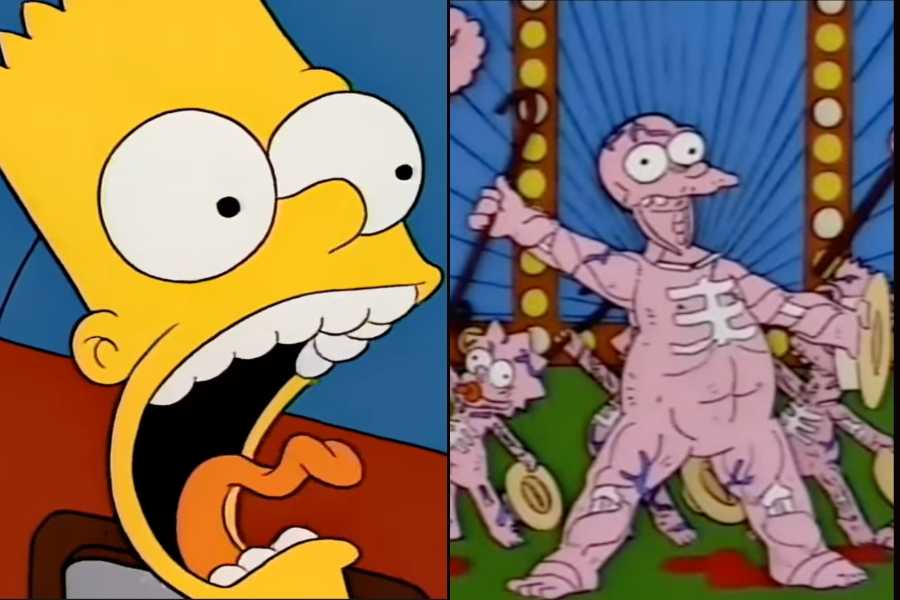
“Nightmare Cafeteria,” a standout from Season Six, has a wildly creepy premise: In an effort to solve two distinct problems—poor-quality cafeteria food and too many troublemakers—Principal Skinner decided that any kid sent to detention shall be…cooked and eaten. The climactic scene, featuring a gruesome musical number, left some fans especially weirded out.

“I found this very disturbing the first time I saw it as a kid,” someone wrote on Reddit. “I don’t necessarily consider it creepy, but it is by far the grossest thing I’ve seen in the show,” another argued. “It still gets me, especially how the blood and viscera fly off as they’re dancing.” Someone else went even deeper: “[I] feels so much like a nightmare a kid would actually have—something horrible is happening slowly at school, it’s coming for them, and their parents just… won’t get involved? And everyone is really doomed? Great stuff.”

  • Voice actor explains why Americans instantly trust people with British accents, even if they’re lying
    Photo credit: CanvaA traditional town crier, left, and a happy, applauding audience, right.

    Americans have this strange love of British accents—so much so that even when someone is speaking absolute gibberish, we find ourselves transfixed and absurdly trusting them.

    Tawny Platis, a professional voice actor and content creator, expertly captured the phenomenon in her YouTube video, “Why Americans Love This Accent.” In the video, she analyzes why Americans find Billy Butcher’s voice so compelling despite the character’s violent and morally chaotic behavior on the TV show The Boys.

    Americans trust and love rough, working-class British masculinity

    “So Karl Urban is a New Zealander doing a Cockney, working-class, East End London accent,” Platis explained. Regardless of how well the actor nails the accent for his character, Butcher, Americans buy right into it anyway. “That’s because working-class English masculinity is coded in American media as authenticity,” she added.

    She goes on to give examples to help substantiate her point: “Every Guy Ritchie movie, British gangster film, and working-class antihero from Michael Caine to Tom Hardy has trained American audiences to hear that voice as unfiltered and honest.”

    A 2024 study published in SAGE Journals found that listeners unconsciously form social biases based on accents. People rapidly make assumptions about personality and identity.

    decision making, accents, familiarity, credibility
    A young businessman speaks into a microphone.
    Photo credit: Canva

    Make ordinary information sound important

    The accent becomes a shortcut the brain uses to make immediate decisions about intelligence, honesty, confidence, warmth, and even competence. When it comes to characters like Butcher, the key detail isn’t so much the “Britishness” itself—it’s the association.

    “Butcher is using the working-class Brit voice to showcase honesty,” Platis said. “Butcher is a liar who manipulates Hughie, hides things from his team, and is willing to take out children. But the audience keeps forgiving him because his voice sounds like a man who’s earned the right to do all that, when he very much hasn’t.”

    Psychologists believe part of this effect comes from something called “processing fluency.” A 2023 study published in Scientific Reports found that increased exposure to certain accents reduced listeners’ cognitive effort. As a result, people made more positive social judgments about the speaker.

    Accents that feel familiar after years of movies, television, and media unconsciously influence people. Audiences automatically attach credibility and trustworthiness to them. Simply put, people mistake familiarity for truth.

    A 2024 study found that Americans rate the standard British accent most positively, strongly associating it with traits like intelligence, status, and competence. The Northern English accent is viewed slightly less favorably. Scottish accents are considered strong and friendly. Meanwhile, the Welsh accent falls somewhere in the middle, depending on how well the listener recognizes it.

    factual, educated, casual interactions, performance
    Blocks spell out the words “fact” and “fake.”
    Photo credit: Canva

    Accent bias sways people’s opinions

    The same instinct that makes one accent sound “trustworthy” can also make another sound “unreliable.” In real-world interactions, working-class accents can be perceived as less intelligent or less educated. This can affect hiring decisions and even workplace promotions.

    A 2024 study focusing on “Americanness” found that accented speakers were perceived as “less American.” In simulated hiring scenarios, they were less likely to be hired, demonstrating that an accent can override other judgments.

    When a person speaks, people instantly begin building a story about who they are. Many decide whether a voice sounds trustworthy long before consciously realizing it. Platis points out that a lifetime of exposure to social media, movies, and television has shaped that perspective.

    “Butcher’s accent is the most effective because it’s the only one many viewers don’t even recognize as a performance,” Platis said. Which basically means somewhere out there right now, a confident British accent is talking nonsense that feels totally believable.

  • Italian man claims to be ‘human cheetah’ with lightning-fast reflexes
    Photo credit: CanvaA man with fast reflexes.

    At first glance, this probably looks like a camera trick. Ken Lee, an Italian content creator, has built a massive online following by doing something that doesn’t quite feel real. Viewers refer to him as the “human cheetah” because it appears he has near-instant reflexes.

    Grabbing objects out of the air with uncanny precision, flicking clothespins and lighters, and throwing a blur of punches and kicks at impossible speeds, it is easy to call him unbelievable. Half the audience thinks his viral speed videos are fake. The other half is just as convinced they are watching something incredibly rare.

    Hands so fast they blur time

    In the video above, a timer runs to confirm its authenticity. In what looks like half a second, he reaches out and snags the lighter from the table. To prove it is real, he does it twice.

    Having amassed millions of followers on his TikTok page, the identity behind the mysterious influencer remains largely unknown. Active since around 2022, with almost 100 million accumulated likes, Lee has cultivated a fandom around his self-proclaimed “Superhero per Hobby!”

    Do you believe it is real? Is this person the fastest human alive? Many followers cannot wait for the next video to be posted. Plenty of his fervent fans are Italian, so sifting through the remarks takes a bit of hunting. Here are some comments that sum up how much people enjoy the fun and the spectacle:

    “Ken lee the fastest and the best”

    “Most dangerous human”

    “Is this what the lighter sees before my homie steals it”

    “It was sped up during he grabbed the lighter, if u count up with the timer u would be off by like 0,5 seconds whenever he grabs the lighter.”

    “If the flash were human”

    “How is it possible to get such powers ?”

    “I blinked and I missed it”

    People love good entertainment

    The awe of peak performance attracts people to watch elite athletes, musicians, or even dancers. There is something that deeply satisfies all of us when a human appears to push a skill to its limit. Whether it is real or fake seems to matter less than the opportunity to chime in on some good entertainment.

    How far could any of us go by practicing and repeating a particular motion over and over until it is mastered? Beneath the flashy nickname and his viral speed videos, Lee’s content has a way of drawing people in. This is not a superpower. Just repetition. Focus. Obsession. And maybe some digital wizardry.

    Testing the science of speed

    If you wish to question the validity of Lee’s performances, maybe some basic science can help. Human reaction time is not just a reflex. A 2024 study found that the nervous system can fine-tune responses in real time. Practice can make movements appear almost automatic.

    It has been well established in research that the gap between seeing something and responding has a limit. A 2025 study concluded that the most elite extremes allow for reaction times of 100 milliseconds. At that speed, the human brain can barely process that something has happened.

    Science explains Lee is not necessarily moving as fast as we might perceive him to be. And therein lies all the fun of it. We cannot prove it is real, nor can we actually prove that it is fake.

    Maybe Lee is the “fastest man alive” or the so-called “human cheetah.” Or maybe he is just a remarkable entertainer. Either way, he has clearly tapped into something strange and fascinating: a blend of human ability and fantasy that people do not want to miss.

    To give context to Lee’s videos, watch this performance on Tú Sí Que Vales:

  • Despite all the likes, literallys and dropped g’s, English isn’t decaying before our eyes
    Photo credit: LisaStrachan/iStock via Getty Images Fear not: There isn’t anything that needs saving.

    As a linguistics professor, I’m often asked why English is decaying before our eyes, whether it’s “like” being used promiscuouslyt’s being dropped deleteriously or “literally” being deployed nonliterally.

    While these common gripes point to eccentric speech patterns, they don’t point to grammatical annihilation. English has weathered far worse.

    Let’s start with something we can all agree on: Old English, spoken from approximately A.D. 450 to 1100, is pretty unintelligible to us today. Anyone who’s had the pleasure of reading “Beowulf” in high school knows how different English back then used to sound. Word endings did a lot more grammatical work, and verbs followed more complicated patterns. Remnants of those rules fuel lingering debates today, such as when to use “whom” over “who,” and whether the past tense of “sneak” is “snuck” or “sneaked.”

    The language went on to experience centuries of tumult: Viking invasions, which introduced Old Norse influence; Anglo-Norman French rule, which shifted the language of the elite to French; and 18th-Century grammarians, who dictated norms with their elocution and grammar guides.

    In that time, English has lost almost all of the more complex linguistic trappings it was born with to become the language we know and – at least, sometimes – love today. And as I explain in my new book, “Why We Talk Funny: The Real Story Behind Our Accents,” it was all thanks to the way that language naturally evolves to meet the social needs of its speakers.

    From dropping the ‘l’ to dropping the ‘g’

    The things we tend to label as “bad” or sloppy English – for instance, the “g” that gets lost from our -ing endings or the deletion of a “t” when we say a word like “innernet” – actually reflect speech habits that are centuries old.

    Take, for example, “often.” Originally spoken with the “t,” that pronunciation gradually became less favored around the 15th century, alongside that “l” in “talk” and the “k” in know. Meanwhile, the “s” now stuck on the back of verbs like “does” and “makes” began as a dialectal variant that only became popular in 16th-century London. It gradually replaced “th” whenever third persons were involved, as in “The lady doth protest too much.”

    While dropping the “l” in talk may have been initially frowned upon, today it would be strange if you pronounced the letter. And the shift makes sense: It smoothed out some linguistic awkwardness for the sake of efficiency.

    If people learned to look at language more like linguists, they might come around to seeing that there is more than one perspective on what good speech consists of.

    And yes, that absolutely is a sentence ending with a preposition – something many modern grammar guides discourage, even though the idea only took hold after 18th-century grammarian Robert Lowth intimated it was a less elegant choice based on the model of Latin.

    Though Lowth voiced no hard and fast rule against it, many a grammar maven later misconstrued his advice as an admonition. Just like that, a mere suggestion became grammatical law.

    The rise of the grammar sticklers

    Many of today’s ideas about what constitutes correct English are based on a singular – often mistaken – 19th-century view of the forces that govern our language.

    In the late 18th century, the English-speaking world began experiencing class restructuring and higher literacy rates. As greater class mobility became possible, accent differences became class markers that separated new money from old money.

    Emulation of upper-crust speech norms became popular among the nouveau riche. With literacy also on the rise, grammarians and elocutionists raced to dictate the terms of “proper” English on and off the page, which led to the rise of usage guides and dictionaries that were eager to sell a certain brand of speech.

    Another example of grammarian angst reconfiguring the view of an otherwise perfectly fine form is the droppin’ of the “g.” It became so tied to slovenly speech that it was branded with an apostrophe in the 19th century to make sure no one missed its lackadaisical and nonstandard nature.

    Up until the 19th century, however, no one seemed to care whether one pronounced it as “-in” or “-ing.”

    Evidence suggests that -ing wasn’t even heard as the correct form. Many elocution guides from the 18th century provide rhyming word pairs like “herring/heron,” “coughing/coffin” and “jerking/jerkin,” which suggest that “-in” may have been the preferred pronunciation of words ending with “-ing.” Even writer and satirist Jonathan Swift – a frequent lobbyist for “proper” English – rhymes “brewing” with “ruin” in his 1731 poem “Verses on the Death of Dr. Swift, D.S.P.D..”

    Embrace the change

    Language has always shifted and evolved. People often bristle at changes from what they’ve known to what is new. And maybe that’s because this process often begins with speakers that society usually looks less favorably on: the young, the female, the poor, the nonwhite.

    But it’s important to remember that being disliked and bad are not the same thing – that today’s speech pariahs are driven by the same linguistic and social needs as the Londoners who started going with “does” instead of “doth” or dropped the “t” in often.

    So if you think the speech that comes from your lips is the “correct” version, think again. Thou, like every other English speaker, art literally the product of centuries of linguistic reinvention.

    This article originally appeared on The Conversation. You can read it here.

Explore More Culture Stories

Internet

Italian man claims to be ‘human cheetah’ with lightning-fast reflexes

Culture

Despite all the likes, literallys and dropped g’s, English isn’t decaying before our eyes

Culture

10 boys and 10 girls were left alone in separate houses and the different results are just wild

Media

9-year-old girl asks Steph Curry why his shoes aren’t in girls’ sizes. The response was perfect.