

Caring about future generations means believing that people who will live decades or centuries from now deserve ethical consideration. In practice, that means taking their interests into account when making all kinds of decisions across a range of issues – from aggressively cutting carbon emissions to investing in pandemic preparedness initiatives and regulating powerful emerging technologies, such as artificial intelligence.

While it may sound like a niche moral view to care about future generations in this way, our new research, published in the academic journal Futures, suggests otherwise. In fact, Americans appear to care substantially about future generations. Nevertheless, they also systematically underestimate how much other Americans care.

To study this, we conducted two online surveys of U.S. adults, totaling 1,000 respondents. The samples were built to roughly match the U.S. population in age, gender, race or ethnicity, and political affiliation. In one survey, people told us their own views about future generations. In the other, a different group told us what they thought the average American believes.

We examined this in three ways. First, we asked how many future generations people think society should keep in mind when making collective decisions. For example, when setting climate targets or designing pandemic response systems, how many future generations should count as stakeholders in that decision? Second, we asked how many future generations elected officials should keep in mind when making decisions about laws and public policy. Third, we asked how far into the future people still deserve “moral concern.”

For the third question, participants were shown a list of the present generation and the next 50 generations, with each generation defined as a 25-year period. They then indicated how many of those generations still belonged inside their “moral circle.” In plain terms: If someone will live 100, 200, or even 1,000 years from now, does their suffering matter – and do we have some responsibility to help make their lives go better?
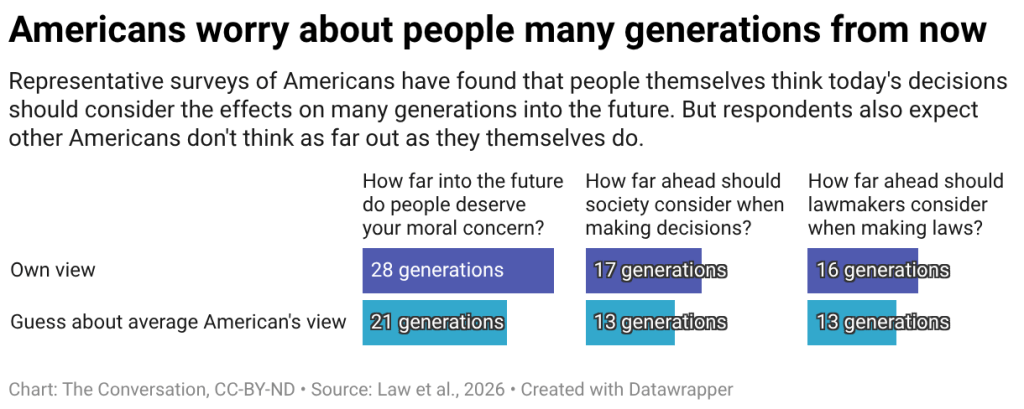
Americans worry about people many generations from now

We found that Americans, on average, extended at least some moral concern about 28 generations into the future, or roughly 700 years. But there was a mismatch about when other people’s concern faded – respondents guessed that it happened around 21 generations out, about 175 years sooner.

A similar pattern appeared on the policy questions. Americans said society and government should take into account people living roughly 16 to 17 generations ahead, respectively – around 400 to 425 years into the future. But they assumed other Americans would endorse a shorter horizon of only about 13 generations, or roughly 325 years. In other words, Americans are more future-oriented than they think their fellow citizens are.
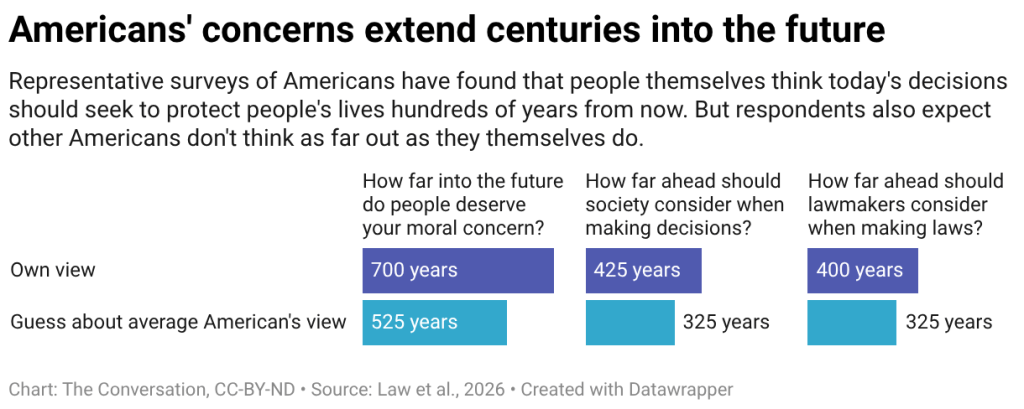
Americans' concerns extend centuries into the future

Why it matters

Public support for long-term policies depends partly on what people think other people value. Research on climate policy, for example, shows that Americans often underestimate how much support already exists for major mitigation measures. When people wrongly think their view is unusual, they can become less likely to speak up, join with others or pressure leaders to act.

Our findings suggest a similar dynamic may shape support for future-oriented policies more broadly. For issues such as pandemic preparedness, nuclear risk and emerging technologies, decisions made now can affect people far into the future.

It’s possible that a person might support stronger emissions cuts, better disease-prevention systems or safeguards on high-risk technologies, but stay quiet if they assume most other Americans do not care about those kinds of long-term consequences.

What’s next

Several hands holding up a globe which appears to be made from blue and green fabric.
Research shows Americans underestimate support for major climate change mitigation measures. Alistair Berg/DigitalVision via Getty Images

For climate change, misperceptions are partly driven by partisan polarization, visible disagreement among leaders and vocal opposition from skeptics. Together, they can make public support appear weaker than it is.

Concern for future generations, by contrast, is much less overtly politicized – meaning it does not divide along party lines the way climate policy does. Most Americans, regardless of political affiliation, say they care about people living centuries from now. Yet this concern is rarely voiced in everyday conversation, in media coverage or in political debate.

Future research needs to examine why concern for future generations isn’t more visible in public life, such as in the media or voiced in everyday conversations. As a result, people might assume that others do not care as much as they actually do.

The Research Brief is a short take on interesting academic work.

This article originally appeared on The Conversation. You can read it here.

  • I research play – and here’s why recess is much more important than just a fun break
    The amount of time children spend at recess varies considerably. Dan Kenyon/Stock Photos via Getty Images

    Professor of Education, Harvard University

    School recess has long been considered a standard part of children’s education in the United States. But it’s more than just a fun break from sitting at a desk.

    Daily recess is necessary for supporting young children and adolescents’ learning, as well as their physical and mental health.

    It’s so important that the American Academy of Pediatrics notes that reducing the amount of time set aside for playing, running and exploring in order to fit in more academic work could actually be counterproductive.

    But in recent decades many schools have cut back on recess, which many states do not require.

    As a scholar who researches childhood play, I have studied and witnessed the benefits of play in children’s lives, including the significant social, emotional and cognitive impacts it has on students’ overall well-being.

    A group of children play and hang from monkey bars in a yard.
    Most states do not require that schools have recess every day. John P Kelly/Stone via Getty Images

    The many benefits of recess

    The U.S. Centers for Disease Control and Prevention recommends that children and adolescents get at least 60 minutes of physical activity per day.

    The CDC also defines recess as a “regularly scheduled period in the school day for physical activity and play that is monitored by trained staff or volunteers.”

    Recess can look different across various schools – while some kids play outside on play structures or in grassy fields, others might play indoors during inclement weather.

    Research also shows, for example, that children living in lower-income communities have fewer opportunities than their peers in higher-income communities to play outside.

    Unlike physical education classes or participating in organized sports, recess gives students the time to engage in physical activity and interact with their peers however they like.

    This time for unstructured play can offer much-needed relief from the mental focus that students need to maintain throughout the school day. It can also support their cognitive development and overall emotional and physical well-being.

    Research also consistently shows that giving children breaks each day for recess has immense benefits for their mental health and the executive functioning skills that support academic achievement.

    This includes benefits for students’ focus and creativity, as well as their memory and executive function.

    Some states, but not all, require recess

    Most states do not mandate that schools have recess every day or spell out a minimum amount of time students must spend moving their bodies.

    A 2025 report from the Johns Hopkins Bloomberg School of Public Health found that 11 states have laws addressing school recess. This ranges from Arizona’s requirement for 40 minutes of daily recess to Georgia, Indiana and Kentucky all requiring recess, but with no minimum duration.

    Massachusetts is one of the nearly 40 states without any laws regarding recess time. A recent article in The Boston Globe reported schools in Cambridge having 25 minutes of recess, while other schools across the state had only 15 minutes per day.

    Overall, there has been an uptick in state legislation aimed at preserving mandated daily school recess time, thanks partly to a new parent-led advocacy group called Say Yes to Recess. This group is pushing for schools across the country to provide a minimum of 60 minutes of protected school recess time each day.

    Started by three Tennessee moms, Say Yes to Recess has also helped advocate for Tennessee legislation that increased the state’s mandated daily school recess time from 15 to 40 minutes in July 2025.

    A moving target

    During the 2001-02 school year, elementary school students from 349 school districts spent on average 36.8 minutes per day at recess.

    By 2025, the CDC found that students were spending 27 minutes on average in recess each day.

    It’s also hard to track how much physical activity students get at school because public school districts and private schools often do not record and report this information.

    While the benefits of recess are not just isolated to young children, a 2026 international study showed that the amount of daily recess time across U.S. schools declines from a mean of 39.3 minutes per day for 6- to 7-year-olds to 24.5 minutes per day for 12- to 18-year-olds.

    Making way for play

    I conducted research at the Project Zero research center for creativity, ethics and the arts at Harvard University and highlighted the significance of play and the arts within urban public schools.

    This 2024 study showed how play with materials supports both children’s and teachers’ creative learning. As someone who designs and studies children’s play spaces, I worry about what could happen if schools continue to reduce school recess because of staffing issues, budget cuts or prioritization of students’ preparation for high-stakes tests focused solely on literacy and numeracy.

    Research shows that this trend of not prioritizing recess could have significant effects on children’s and adolescents’ mental health, cognitive development and overall enjoyment of school.

    A group of teenagers are seen sitting together on benches outside of a red brick building.
    Older children and teenagers also benefit from getting regular breaks from the academics of a school day. Maskot/Digital Vision via Getty Images

    School are well intended but under strain

    The decline in time for recess comes at a moment when many schools and districts are under increasing pressure as a result of declining student enrollment, pressure to meet state learning standards and budget cuts.

    For some schools, reduced staffing and the costs of maintaining outdoor play equipment to meet safety requirements have made it difficult to offer school recess.

    For other schools, an assumption that more time for instruction equals a higher-quality education may be driving decisions to minimize or eliminate time for unstructured play.

    Another factor that influences recess is when schools deny students recess time as a form of punishment – a policy that some scholars and educators are trying to block through legislation.

    As childhood health, social and cognitive research demonstrates, the amount of time school recess is given matters in children’s development as whole human beings. I believe it is up to schools, districts and parents to advocate for and ensure children’s right to protected school recess time every day.

    This article originally appeared on The Conversation. You can read it here.

  • Oakland officials open ‘play-lending library’ to offset the cost of equipment for youth sports
    Photo credit: Canva – Oakland is providing free sports equipment so kids can just play.

    Playing sports has been a common childhood experience that has led to lifelong hobbies, exercise, and forming lasting friendships. However, it’s gotten less common in recent years. Sign-up fees, uniforms, and many other expenses have led to most low-income families unable to afford to have their kids play. With that in mind, the city of Oakland, California believes they found a solution: a library. No, not the book kind.

    Officials are letting children check out soccer balls, footballs, yoga mats, tennis equipment, and other sports supplies at their newly opened Park Play Lending Library. Kids can also check out board games and card games like UNO as well. Using this library located at the Larry E. Reid Sports Center is absolutely free to anyone.

    “Every child deserves the opportunity to play, learn, and thrive,” said Maribel Lopez, City of Oakland Recreation Supervisor said in a press release. “The Park Play Lending Library is an investment in our community and a step toward ensuring that all Oakland residents have access to the recreational resources they enjoy, regardless of their financial situation.”

    Encouraging kids to socialize, play, and grow

    Oakland residents and officials welcome this sports equipment library for a myriad of reasons. It’s not just to allow access to certain activities, but to help address the lack of third places and areas for children to play overall. Whether it’s through sports or games, face-to-face playing helps children’s social skills, combats loneliness, and expands the immediate world around them.

    “We’re aware that sports can lead to social mobility,” Lopez told SFGate. “When kids are familiar with golf, tennis, soccer, and other, you know, games or sports that are more socially mobile, then they have access to different communities, different friend groups, different neighborhoods, and we want to be a vehicle for that. We want kids to be able to speak each other’s language and connect through sports.”

    Expenses in youth sports has become a federal government issue

    Children being priced out of local sports programs due to expense has been a rising issue across the country. It’s to the point where the federal government is looking to intervene.

    Representatives of both Congress and the Senate have introduced the Let Kids Play Act bill to their peers. The purpose of the bill, according to Congressman Pat Ryan and Senator Chris Murphy among other authors, is to limit or outright remove private equity firms’ involvement in youth sports. The representatives state that the cost to participate in youth sports rose by 46% over the last five years. They also claim that many families are paying more than $5,000 per kid so they can play. By removing private equity involvement, the hope is to cut down on junk fees, stay-to-play schemes, data mining, and other issues that are making it harder for families to allow their kids to participate in local organized youth sports.

    While the federal government debates on this issue, a local library or park allowing children access to sports equipment to have pick-up games may be a great first step to renew what was a common American childhood experience.

  • After a field trip for 100 low-income kids was canceled, police officer rents a whole movie theater for them
    Photo credit: Canva – Officer Reavie opened his wallet and his heart to help kids enjoy a movie in the theater.

    Arizona middle schoolers that were a part of Greenway Middle School’s “After the Bell” summer program were really looking forward to their field trip. However, funding for their end-of-summer field trip fell through. That’s when School Resource Officer Sean Reavie stepped in.

    Using money from his own pocket, Reavie rented out all 144 seats at a local movie theater so the kids could enjoy a screening of Toy Story 5. The movie, the snacks, the sodas, all on him. For many of the kids, it would be their first time ever watching a movie in a theater.

    An act of generosity, an act of community

    After being contacted by the program director, Katie Jenkins, Reavie didn’t hesitate to spend his own money on the theater rental and treats. The cost added up to nearly $2,000.

    “If they needed more, I would have given them more,” Reavie said to 12 News. “You can’t break a promise to a child. They come here knowing that there’s a reward at the end.”

    Reavie understood that this trip to the movies was more than it seemed. Greenway Middle School is a Title one school, meaning that the majority of the students came from low-income households. Several of the students qualified for free breakfast and lunch daily from the school. Going to a movie theater was a luxury that most of the kids’ families cannot afford.

    “Some of them live in a different life than most of us would comprehend, and they just haven’t seen a lot of good things with their own eyes,” said Reavie. “Their family doesn’t have a car. Parents, if they have two, work multiple jobs. Half of them have never been to a water park before. They’ve never been across the other side of the highway before.”

    Prior to the movie, after Officer Reavie explained that he would take care of all expenses, he made just one request to the kids.

    “As you get older in life, help other people, as a payback to me,” he told them. “Would you do that? That’s all I ask of you.”

    Reavie is a superhero (well, dresses like one sometimes)

    This isn’t the first time Reavie helped fund a great experience for local school kids. In 2025, he spent more than $3,000 to take students to Hurricane Harbor water park.

    Reavie spent the early years of his police career as a child crimes detective for six years before taking on his current role. Along with that, Reavie started a superhero-inspired charity that supports teen youth programs and child advocacy.

    “It dawned on me that little kids who were scared responded to superheroes,” he said. “So I started a superhero-based foundation called Put On The Cape: A Foundation For Hope.”

    The Put On The Cape organization has officers and “causeplayers” dress up as superheroes to host events to raise money for children’s causes. Their homepage reads,”Our mission fills the toy closet, food pantry, and clothing wardrobe to the children and their families. This takes the burden off the center so they can focus on healing the child from the trauma they’ve endured.”

    With or without a cape, Officer Reavie is setting a great example of giving in order to plant hope in a generation that could grow up to give back tenfold.

Explore More Society Stories

Society

I research play – and here’s why recess is much more important than just a fun break

Society

Remote work made these colleagues more open with each other, not less

Society

Dog parks are an antidote to the isolation and divisions that social media can fuel

Society

Gen Z communicates differently in the workplace, but older colleagues can still decode them