
Zachary del Rosario

Zachary del Rosario

Probability underpins AI, cryptography and statistics. However, as the philosopher Bertrand Russell said, “Probability is the most important concept in modern science, especially as nobody has the slightest notion what it means.”

I teach statistics to engineers, so I know that while probability is important, it is counterintuitive.

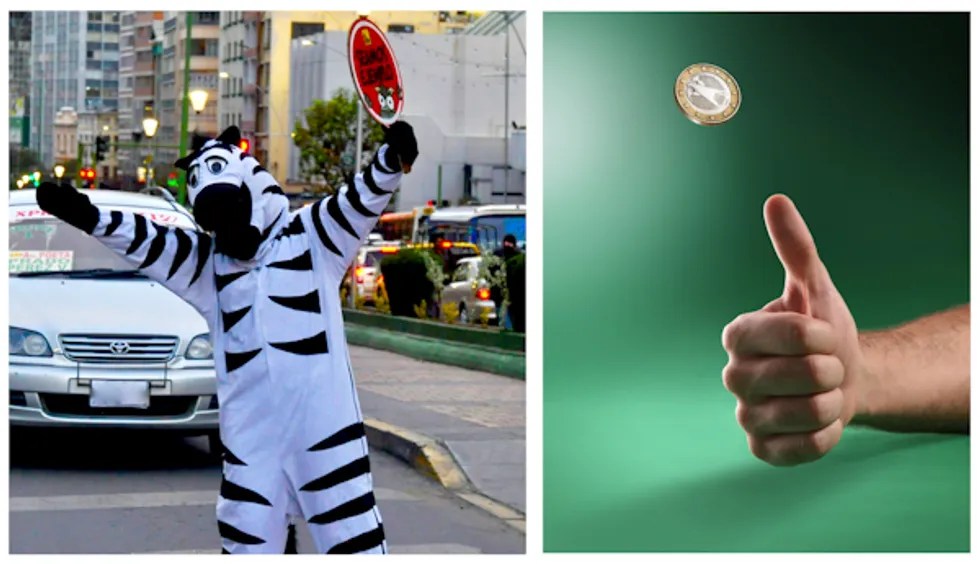
Probability is a branch of mathematics that describes randomness. When scientists describe randomness, they’re describing chance events – like a coin flip – not strange occurrences, like a person dressed as a zebra. While scientists do not have a way to predict strange occurrences, probability does predict long-run behavior – that is, the trends that emerge from many repeated events.
Mathematics, Education, Explainer, Statistics, Probability, Frequency, Doing science
Photo credit: Zebras in La Paz, Bolivia by EEJCC, Own Work CC A-SA 4.0; CC BY-SAWe may say ‘random’ to describe strange occurrences (person dressed as zebra), but probability describes chance events (a coin flip).

Modeling with probability

Since probability is about events, a scientist must choose which events to study. This choice defines the sample space. When flipping a coin, for example, you might define your event as the way it lands.

Coins almost always land on heads or tails. However, it’s possible – if very unlikely – for a coin to land on its side. So to create a sample space, you’d have two choices: heads and tails, or heads, tails and side. For now, ignore the side landings and use heads and tails as our sample space.

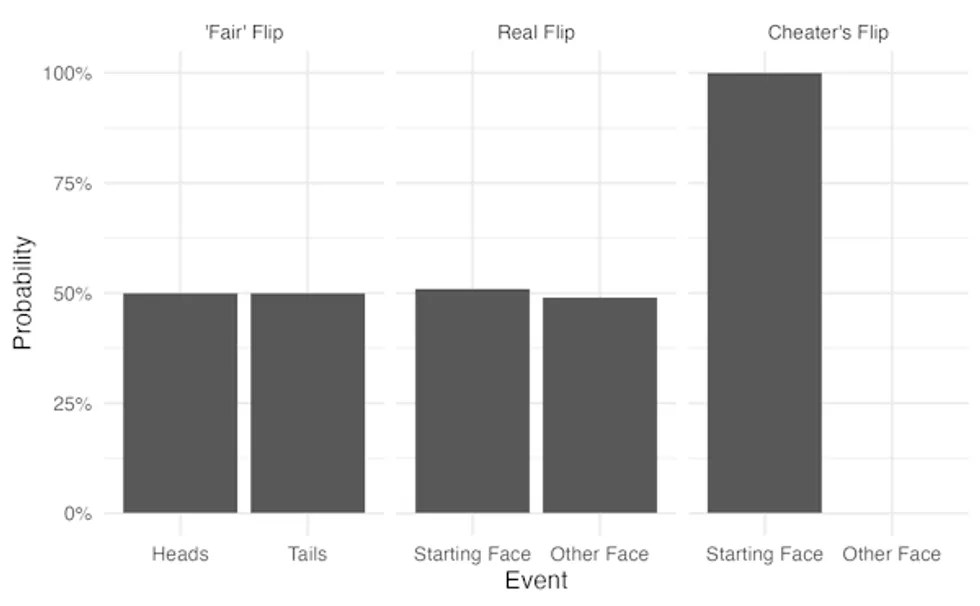
Next, you would assign probabilities to the events. Probability describes the rate of occurrence of an event and takes values between 0% and 100%. For example, a fair flip will tend to land 50% heads up and 50% tails up.

To assign probabilities, however, you need to think carefully about the scenario. What if the person flipping the coin is a cheater? There’s a sneaky technique to “wobble” the coin without flipping, controlling the outcome. Even if you can prevent cheating, real coin flips are slightly more probable to land on their starting face – so if you start the flip with the coin heads up, it’s very slightly more likely to land heads up.

In both the cheating and real flip cases, you need an appropriate sample space: starting face and other face. To have a fair flip in the real world, you’d need an additional step where you randomly – with equal probability – choose the starting face, then flip the coin.
Mathematics, Education, Explainer, Statistics, Probability, Frequency, Doing science
Photo credit: Zachary del Rosario, CC BY-SAThe probabilities for different coin-flipping scenarios.

These assumptions add up quickly. To have a fair flip, you had to ignore side landings, assume no one is cheating, and assume the starting face is evenly random. Together, these assumptions constitute a model for the coin flip with random outcomes. Probability tells us about the long-run behavior of a random model. In the case of the coin model, probability describes how many coins land on heads out of many flips.

But instead of using a random model, why not just solve the coin toss using physics? Actually, scientists have done just that, and the physics shows that slight changes in the speed of the flip determine whether it comes up heads or tails. This sensitivity makes a coin flip unpredictable, so a random model is a good one.

Frequency vs. probability

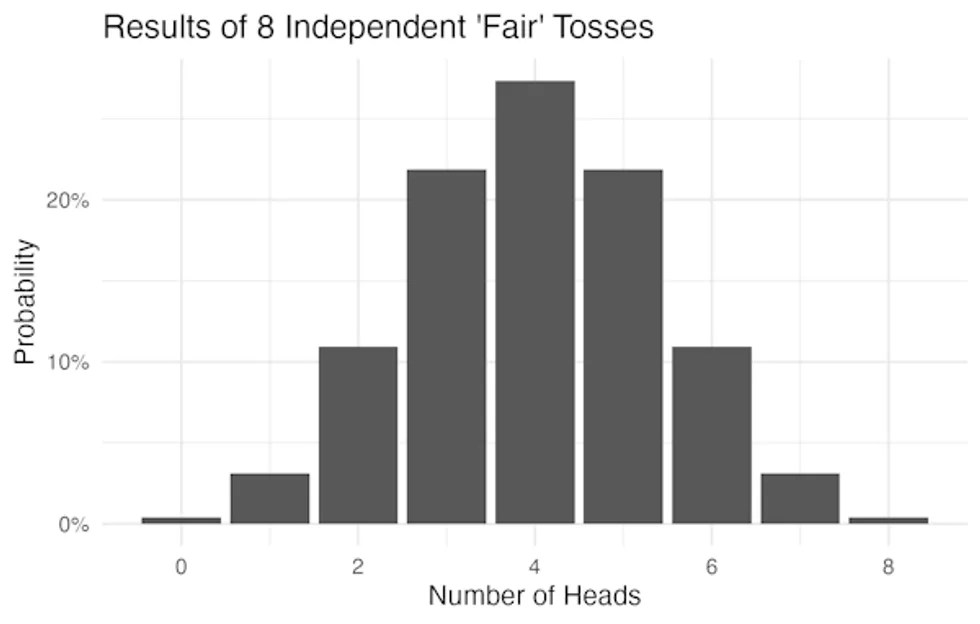
Probability differs from frequency, which is the rate of events in a sequence. For example, if you flip a coin eight times and get two heads, that’s a frequency of 25%. Even if the probability of flipping a coin and seeing heads is 50% over the long run, each short sequence of flips will come out different. Four heads and four tails is the most probable outcome from eight flips, but other events can – and will – happen.

Frequency and probability are the same in one special setting: when the number of data points goes to infinity. In this sense, probability tells us about long-run behavior.
Mathematics, Education, Explainer, Statistics, Probability, Frequency, Doing science
Photo credit: Zachary del Rosario, CC BY-SAProbabilities for all possible outcomes of eight ‘fair’ coin flips.

Applications to AI, cryptography and statistics

Probability isn’t just useful for predicting coin flips. It underlies many modern technological systems.

For example, AI systems such as large language models, or LLMs, are based on next-word prediction. Essentially, they compute a probability for the words that follow your prompt. For example, with the prompt “New York” you might get “City” or “State” as the predicted next word, because in the training data those are the words that most frequently follow.

But since probability describes randomness, the outputs of a LLM are random. Just like a sequence of coin flips is not guaranteed to come out the same way every time, if you ask an LLM the same question again, you will tend to get a different response. Effectively, each next word is treated like a new coin flip.

Randomness is also key to cryptography: the science of securing information. Cryptographic communication uses a shared secret, such as a password, to secure information. However, surprising randomness isn’t good enough for security, which is why picking a surprising word is a bad choice of password. A shared secret is only secure if it’s hard to guess. Even if a word is surprising, real words are easier to guess than flipping a “coin” for each letter.

You can make a much stronger password by using probability to choose characters at random on your keyboard – or better yet, use a password manager.

Finally, randomness is key in statistics. Statisticians are responsible for designing and analyzing studies to make use of limited data. This practice is especially important when studying medical treatments, because every data point represents a person’s life.

The gold standard is a randomized controlled trial. Participants are assigned to receive the new treatment or the current standard of care based on a fair coin flip. It may seem strange to do this assignment randomly – using coin flips to make decisions about lives. However, the unpredictability serves an important role, as it ensures that nothing about the person affects their chance to get the treatment: not age, gender, race, income or any other factor. The unpredictability helps scientists ensure that only the treatment causes the observed result and not any other factor.

So what does probability mean? Like any kind of math, it’s only a model, meaning it can’t perfectly describe the world. In the examples discussed, probability is useful for describing long-term behaviors and using unpredictability to solve practical problems.

This article originally appeared on The Conversation. You can read it here.
  • 20 enormously funny photos of animals in the wild
    Photo credit: Comedy Wildlife PhotographyA young cat lunges towards a sensitive place on older animal
    ,

    20 enormously funny photos of animals in the wild

    A laugh-out-loud look at the funniest animal photos from the Comedy Wildlife Photography Awards, where nature meets pure comedy.

    Since 2015, the Comedy Wildlife Photography Awards, created by photographers and conservationists Paul Joynson-Hicks and Tom Sullam, have been delivering laugh-out-loud moments through the lens of nature. With a mission to entertain while raising awareness about wildlife conservation, the competition celebrates the charming and comical side of the animal kingdom.

    Let’s take a joyful stroll down memory lane with some of the most funniest entries from the 2019 contest (and if you’re feeling inspired, you’ll also learn how to submit your own wild and witty shots for future competitions).

    OVERALL WINNER, CREATURES OF THE LAND WINNER: “Grab Life By the…”

    funny animal photos, comedy wildlife photography awards, 2019 wildlife photos, hilarious animal pictures, wildlife humor, funny nature moments, animal photo contest, otters, squirrels, wildlife conservation
    A young cat gropes at sensitive part of an older animal. Photo credit: Comedy Wildlife Photography

    You don’t think about how hard it would be to be the parent of a small, curious creature with massive, sharp claws. Let’s all take a moment to be grateful that even though it’s very hard to have a human baby, they don’t have super sharp claws. That would make things ten times worse.

    CREATURES IN THE AIR WINNER: “Family Disagreement”

    funny animal photos, comedy wildlife photography awards, 2019 wildlife photos, hilarious animal pictures, wildlife humor, funny nature moments, animal photo contest, otters, squirrels, wildlife conservation
    A bird appears to be yelling for its companions’ attention. Photo credit: Comedy Wildlife Photography

    “I did not pluck a feather out your head! I did not pluck a feather out of his head. Mom! Mom! He’s lying! I didn’t do it!”

    “Honestly, Stuart, you’re just making a fool of yourself. Get it together, man.”

    PEOPLE’S CHOICE WINNER, CREATURES UNDER THE WATER WINNER: “Oh My”

    funny animal photos, comedy wildlife photography awards, 2019 wildlife photos, hilarious animal pictures, wildlife humor, funny nature moments, animal photo contest, otters, squirrels, wildlife conservation
    An otter holds its hands to its face. Photo credit: Comedy Wildlife Photography

    I think if I were an otter, I too would constantly clutch my face in disbelief. “I can’t possibly be this cute, can I? Cute nose, fuzzy head, tiny little eyes? That can’t be! Oh, but it is! I really am this adorable! I am! I am!”

    Make sure you head to the Comedy Wildlife Photography Awards website to see the rest of the finalists!

    “Waltz Gone Wrong”

    funny animal photos, comedy wildlife photography awards, 2019 wildlife photos, hilarious animal pictures, wildlife humor, funny nature moments, animal photo contest, otters, squirrels, wildlife conservation
    Two foxes playing around together. Photo credit: Comedy Wildlife Photography

    Have you seen those videos of foxes diving headfirst into the snow to catch prey? It’s hilarious and fascinating, and I think this fox forgot that there was no snow. His friend is really trying to help him not hurt himself, but his buddy insists on being dumb. Oh, foxes!

    “Otter Tickle Fight”

    funny animal photos, comedy wildlife photography awards, 2019 wildlife photos, hilarious animal pictures, wildlife humor, funny nature moments, animal photo contest, otters, squirrels, wildlife conservation
    Otters playing in the water. Photo credit: Comedy Wildlife Photography

    “And then Carol was like, ‘You otter come over for dinner sometime!’ Get it? Get it? Man, Carol’s hilarious. So I went over for dinner and she had like, this whole seafood spread. Crabs, clams, mussels…the whole shebang. Anyway, I think I’m going to marry her.”

    “He’s Right Behind Me, Isn’t He?”

    funny animal photos, comedy wildlife photography awards, 2019 wildlife photos, hilarious animal pictures, wildlife humor, funny nature moments, animal photo contest, otters, squirrels, wildlife conservation
    A fish with a tunned expressions approaches the camera. Photo credit: Comedy Wildlife Photography

    Just think about how much poise it took for this photographer to take this photo. Not only is the shark sneaking up on this poor fish, but there’s a person behind that camera! Presumably, the photographer escaped unscathed, since he was able to enter this photo in the contest.

    “Indecent Proposal”

    funny animal photos, comedy wildlife photography awards, 2019 wildlife photos, hilarious animal pictures, wildlife humor, funny nature moments, animal photo contest, otters, squirrels, wildlife conservation
    A bird looks at their companion in a strange way. Photo credit: Comedy Wildlife Photography

    It’s clearly not just human women who have to put up with the incessant nagging conversation from dudes we have no interest in talking to. See the look on that bird’s face? Staring straight out just willing him to go away? Tell me you haven’t made that face. Yeah, that’s what I thought.

    “Who Would Like a Peanut?”

    funny animal photos, comedy wildlife photography awards, 2019 wildlife photos, hilarious animal pictures, wildlife humor, funny nature moments, animal photo contest, otters, squirrels, wildlife conservation
    A dramatic looking squirrel reaches out from a tree. Photo credit: Comedy Wildlife Photography

    “O Romeo, Romeo, wherefore art thou, Romeo?” No one really knows this, but squirrels are generally huge Shakespeare fans. They saw him put up a play in Europe centuries ago and have just carried that love for his words through generations and generations of squirrels.

    “Monday Morning Blues”

    funny animal photos, comedy wildlife photography awards, 2019 wildlife photos, hilarious animal pictures, wildlife humor, funny nature moments, animal photo contest, otters, squirrels, wildlife conservation
    A bear holds a hand it its face as if they’re exhausted. Photo credit: Comedy Wildlife Photography

    I relate to this bear hard. Anyone who has had to get up and go to work after a long weekend knows this feeling. Sometimes, you just don’t want to deal with anything. Sometimes, you just want to lie on the ground, cover your face with your hands, and nap for a little while longer.

    “Inconspicuous”

    funny animal photos, comedy wildlife photography awards, 2019 wildlife photos, hilarious animal pictures, wildlife humor, funny nature moments, animal photo contest, otters, squirrels, wildlife conservation
    A penguin stands with its back to the camera. Photo credit: Comedy Wildlife Photography

    I love this photo so much. Because not only is it a picture of a penguin farting, but it’s a picture of a penguin who is clearly trying to hide the fact that he’s farting and play it off like he’s doing absolutely nothing. He’s just standing there twiddling his wings. He has no idea what that big bubble under his butt is.

    “Squirrel Wishes”

    funny animal photos, comedy wildlife photography awards, 2019 wildlife photos, hilarious animal pictures, wildlife humor, funny nature moments, animal photo contest, otters, squirrels, wildlife conservation
    A squirrel smelling flowers in the wind. Photo credit: Comedy Wildlife Photography

    There seems to be a whole genre of “Small rodents holding flowers” photos, and I am a sucker for every single one of them. I’m pretty sure this comes up when you look up “cute” in the dictionary. It’s just so pure.

    “Hello”

    funny animal photos, comedy wildlife photography awards, 2019 wildlife photos, hilarious animal pictures, wildlife humor, funny nature moments, animal photo contest, otters, squirrels, wildlife conservation
    A insect looks like it’s waving at the camera. Photo credit: Comedy Wildlife Photography

    “Hi there! Welcome to my flower. So glad you could make it! It’s a little cold and wet right now, but once the sun comes up we’ll be in business. Help yourself to a dewdrop. They’re especially fresh this morning.”

    “That’s Hilarious, Steve”

    funny animal photos, comedy wildlife photography awards, 2019 wildlife photos, hilarious animal pictures, wildlife humor, funny nature moments, animal photo contest, otters, squirrels, wildlife conservation
    An otter on its side appears to be laughing. Photo credit: Comedy Wildlife Photography

    “And then my friend Steve, the otter, told me that Carol said to him, ‘You otter come over for dinner!’ Get it? Get it? Because they’re otters! So it’s funny. Hey, where’d you go?”

    “Caught in the Act”

    funny animal photos, comedy wildlife photography awards, 2019 wildlife photos, hilarious animal pictures, wildlife humor, funny nature moments, animal photo contest, otters, squirrels, wildlife conservation
    A pair of monkeys get close. Photo credit: Comedy Wildlife Photography

    These poor monkeys were just trying to get it on. Their kids were finally out of the tree, they had some peace and quiet, and then they were so rudely interrupted by a photographer. Although mom looks like she was kinda zoning out anyway.

    “Laid Back”

    funny animal photos, comedy wildlife photography awards, 2019 wildlife photos, hilarious animal pictures, wildlife humor, funny nature moments, animal photo contest, otters, squirrels, wildlife conservation
    A young chimp relaxes with hands behind its head. Photo credit: Comedy Wildlife Photography

    This little chimp is living the life! He’s got it all figured out, and from the looks of him, he’s still a tiny baby. He’s just looking out at the jungle, thinking about all that milk he’s going to drink later.

    “Holly Jolly Snowy”

    funny animal photos, comedy wildlife photography awards, 2019 wildlife photos, hilarious animal pictures, wildlife humor, funny nature moments, animal photo contest, otters, squirrels, wildlife conservation
    A ‘laughing’ owl in the snow. Photo credit: Comedy Wildlife Photography

    I bet that when you’re a Snowy Owl and it finally snows, you are just so ecstatically happy. I mean, it’s right there in your name. Look at her face! It’s full of such pure joy.

    “To Be or Not to Be”

    funny animal photos, comedy wildlife photography awards, 2019 wildlife photos, hilarious animal pictures, wildlife humor, funny nature moments, animal photo contest, otters, squirrels, wildlife conservation
    A monkey appears to be thinking. Photo credit: Comedy Wildlife Photography

    Like this little monkey, I, too, usually save my existential crises for bath time. There’s something about the weightlessness of floating in the water that makes you question everything you know to be true about yourself and the world.

    “Snarling Snappin’ in the Slow Lane”

    funny animal photos, comedy wildlife photography awards, 2019 wildlife photos, hilarious animal pictures, wildlife humor, funny nature moments, animal photo contest, otters, squirrels, wildlife conservation
    A turtle slowly travels down the highway. Photo credit: Comedy Wildlife Photography

    Who’s calling this snapping turtle slow? He’s just “taking his time.” On another note, I think turtles are probably the most prehistoric-looking creatures that still exist. If you really take the time to look at them, they’re so crazy.

    “Hide”

    funny animal photos, comedy wildlife photography awards, 2019 wildlife photos, hilarious animal pictures, wildlife humor, funny nature moments, animal photo contest, otters, squirrels, wildlife conservation
    Polar bear plays on ice. Photo credit: Comedy Wildlife Photography

    Imagine playing hide and seek on a block of ice as a polar bear. On one hand, there aren’t too many places to hide. On the other hand, you’re looking for white on white, and that’s not easy.

    “Dancing, Yeah”

    funny animal photos, comedy wildlife photography awards, 2019 wildlife photos, hilarious animal pictures, wildlife humor, funny nature moments, animal photo contest, otters, squirrels, wildlife conservation
    Feeling the beat. Photo credit: Comedy Wildlife Photography

    I don’t know if you knew this, but rodents love ABBA. Here is one getting down to “Dancing Queen.” Because they’re so small, they really feel the music down to their bones. Raise your hand if you would watch an all-rodent adaptation of Mamma Mia! Yeah, me too.

    If you want to enter next year’s competition, follow the link here to sign up for mailing list updates!

    This article originally appeared six years ago. It has been updated.

  • Veterinary scientists develop a daily pill that’s giving senior dog owners hope
    Photo credit: CanvaA new pill could add more years of cuddles with your dog.
    ,

    Veterinary scientists develop a daily pill that’s giving senior dog owners hope

    Senior dogs could live longer thanks to the largest clinical trial in veterinary history.

    A common saying among pet owners is that the hardest thing about loving a dog is saying goodbye. Having a senior dog, especially one raised from a puppy, can be difficult not just because of the inevitable, but also because the pet may be going through age-related ailments or disease before crossing over. It’s a hard thing to experience anyway, but especially when you remember how they were in their prime. Well, veterinary scientists are testing a daily pill that extends a dog’s lifespan while also maintaining their quality of life.

    Loyal, a biotech company based in San Francisco, has been trying to develop anti-aging drugs for dogs ever since it was founded. After years of research and testing, they have developed LOY-002, a beef-flavored daily prescription pill for senior dogs aged 10 and older that weigh over 14 pounds. Early testing shows that the pill can add years to a dog’s life, especially larger breeds.

    What does this dog lifespan pill do?

     The pill interacts and manipulates IGF-1 (Insulin-Like Growth Factor 1), a hormone that’s key to a dog’s cellular growth and metabolism. IGF-1 helps a dog grow in both size and calorie consumption. This hormone helps make young puppies become strong adult dogs. However, it also continues and accelerates aging at a cellular level when a dog is fully grown.

    This explains why many larger breeds of dogs tend to live shorter lives than smaller ones. Their IGF-1 levels are higher. It moves them faster towards age-related diseases and discomfort than smaller dogs.

    By reducing the excessive IGF-1, LOY-002 reduces the speed of a larger dog’s biological clock. It doesn’t just make them “feel” younger. Slowing everything down adds years to their life and curbs the risk of age-related organ dysfunction, disease, and early death. After thorough testing, LOY-002 cleared two out of the three sections of acceptance before being fully vetted by the Food and Drug Administration.

    “Since founding Loyal six years ago, my goal has always been to get the first drug FDA approved for lifespan extension. This safety acceptance brings us very close to achieving that vision,” said Loyal Founder and CEO Celine Halioua. “We are well on our way to bringing the first dog longevity drugs to market.”

    How can a senior dog live longer?

    Should Loyal receive that final approval, the LOY-002 drug should go to market before the end of 2026. However, veterinarians and dog care experts have some tips on how to help your older dog live longer and healthier.

    Visit your dog’s veterinarian often for checkups and keep them notified of any changes in their behavior. They may recommend a specific diet for your dog at their advanced age. Similar to humans, older dogs are encouraged to follow a healthy diet. They should exercise regularly (through walks or playtime) to keep a healthy weight and keep joints strong.

    If your dog has joint trouble, your vet may recommend some supplements to help the dog’s mobility and comfort. No matter the issue, it is best to consult with a veterinarian before making lifestyle changes for your dog.

    Such advice can help both you and your dog live full lives together. It may also add a few more years of furry companionship along the way, too.

  • How dolphins communicate – new discoveries from a long‑term study in Sarasota, Florida
    Photo credit: Brookfield Zoo Chicago’s Sarasota Dolphin Research Program, taken under NMFS MMPA Scientific Research PermitBottlenose dolphins are social creatures that use whistles and clicks to communicate with each other.

    Human fascination with bottlenose dolphins goes back thousands of years, at least as early as Greek mythology.

    But it wasn’t until the 1960s that methodical research into dolphin communication began. Scientists like John Lilly and the husband-and-wife team of Melba and David Caldwell tried various experiments to decipher the sounds dolphins can make.

    The Caldwells figured out a way to record isolated animals in human care. They discovered that each individual dolphin communicated mostly with one unique whistle, which they called the “signature whistle.” Researchers now know that these whistles convey identities much like human names do. Dolphins use them to stay in touch with each other in their murky habitat, where vision is limited. It’s like announcing “I’m over here!” when someone can’t see you.

    This discovery is foundational to my own research. I’ve been studying communication in wild dolphins since the mid-1980s, when I joined my mentor Peter Tyack in documenting signature whistles in wild dolphins for the first time. Our team’s research focused on a resident community of free-ranging bottlenose dolphins in waters near Sarasota, Florida, where I continue to work today.

    This collaborative study, led by Randall Wells of Brookfield Zoo Chicago’s Sarasota Dolphin Research Program, involves numerous researchers from a variety of institutions, who study different aspects of dolphin biology, health, ecology and behavior. Begun in 1970, this is the longest-running research project on a population of wild cetaceans – whales, dolphins and porpoises – in the world.

    Each dolphin has distinctive markings on its dorsal fin. Experienced researchers can sometimes identify them by sight in the field, and they photograph them to confirm their identity in the lab.
    Photo credit: Photo by Brookfield Zoo Chicago’s Sarasota Dolphin Research Program, taken under NMFS MMPA Scientific Research PermitEach dolphin has distinctive markings on its dorsal fin. Experienced researchers can sometimes identify them by sight in the field, and they photograph them to confirm their identity in the lab.

    Recording and observing

    Researchers know the age, sex and maternal relatedness of almost all of the approximately 170 dolphins in the Sarasota community. This depth of knowledge provides an unprecedented opportunity to study communication in a wild cetacean species.

    The dolphins in the Sarasota project are periodically subject to brief catch-and-release health assessments, during which researchers, including me, briefly handle individual dolphins.

    Our team attaches suction-cup hydrophones directly onto each dolphin’s melon – that is, its forehead. We then record the dolphins continuously throughout the health assessments, taking notes on who is being recorded when, and what is happening at the time.

    This is how my colleagues and I were able to confirm that wild dolphins, like captive animals, produced large numbers of individually distinctive signature whistles when briefly isolated from other dolphins. Through observations and recordings of known free-swimming dolphins, we were further able to confirm that they produced these same signature whistles in undisturbed contexts.

    We have organized these recordings into the Sarasota Dolphin Whistle Database, which now contains nearly 1,000 recording sessions of 324 individual dolphins. More than half of the dolphins in the database have been recorded more than once.

    We identify each dolphin’s signature whistle based on its prevalence: In the catch-and-release context, about 85% of the whistles that dolphins produced are signature whistles. We can identify these visually, by viewing plots of frequency vs. time called spectrograms.

    Spectrograms of signature whistles of 269 individual bottlenose dolphins recorded in Sarasota. Figure created by Frants Jensen, with sound files from Laela Sayigh
    Spectrograms of signature whistles of 269 individual bottlenose dolphins recorded in Sarasota. Figure created by Frants Jensen, with sound files from Laela Sayigh

    Signature whistles and ‘motherese’

    The Sarasota Dolphin Whistle Database has proved to be a rich resource for understanding dolphin communication. For instance, we have discovered that some calves develop signature whistles similar to those of their mothers, but many do not, raising questions about what factors influence signature whistle development.

    We have also found that once developed, signature whistles are highly stable over an animal’s lifetime, especially for females. Males often form strong pair bonds with another adult male, and in some instances, their whistles become more similar to one another over time. We are still trying to understand when and why this occurs.

    Dolphin mothers modify their signature whistles when communicating with their calves by increasing the maximum frequency, or pitch. This is similar to human caregivers using a higher-pitched voice when communicating with young children – a phenomenon known as “motherese.”

    Also similar to humans is how dolphins will initiate contact with another dolphin by imitating their signature whistle – what we call a signature whistle copy. This is similar to how you would use someone’s name to call out to them.

    Our team is interested in finding out if dolphins also copy whistles of others who aren’t present, potentially talking about them. We have seen evidence of this in our recordings of dolphins during health assessments, which provide a rare context to document this phenomenon convincingly. But we still have more work to do to confirm that these are more than chance similarities in whistles.

    Shared whistle types

    Another exciting development has been our recent discovery of shared whistle types — ones that are used by multiple animals and that are not signature whistles. We call these non-signature whistles.

    I could hardly believe my ears when I first discovered a repeated, shared non-signature whistle type being produced by multiple dolphins in response to sounds we play back to them through an underwater speaker. We had previously believed that these non-signature whistles were somewhat random, but now I was hearing many different dolphins making a similar whistle type.

    Our team originally had been using the playbacks to try to determine whether dolphins use “voice cues” to recognize each other – similar to how you can recognize the voice of someone you know. Although we found that dolphins did not use voice cues, our discovery of shared non-signature whistle types has led to an entirely new research direction.

    The author listens to dolphin whistles on a boat in Sarasota. Jonathan Bird from the film 'Call of the Dolphins'/Oceanic Research Group, Inc.
    The author listens to dolphin whistles on a boat in Sarasota. Jonathan Bird from the film ‘Call of the Dolphins’/Oceanic Research Group, Inc.

    So far, I’ve identified at least 20 different shared non-signature whistle types, and I am continuing to build our catalog. We are hoping that artificial intelligence methods may help us categorize these whistle types in the future.

    To understand how these shared non-signature whistle types function, we are carrying out more playback experiments, filming the dolphins’ responses with drones. We’ve found that one such whistle often leads the dolphins to swim away, suggesting a possible alarm-type function. We have also found that another type might be an expression of surprise, as we have seen animals produce it when they hear unexpected stimuli.

    More difficult, more interesting

    So far, the main takeaway from our experiments has been that dolphin communication is complex and that there are not going to be one-size-fits-all responses to any non-signature whistle type. This isn’t surprising, given that, like us, these animals have complicated social relationships that could affect how they respond to different sound types.

    For instance, when you hear someone call your name, you may respond differently if you are with a group of people or alone, or if you recently had an argument with someone, or if you’re hungry and on your way to eat.

    Our team has a lot more work ahead to sample as many dolphins in as many contexts as possible, such as different ages, sexes, group compositions and activities.

    This makes my job more difficult – and far more interesting. I feel lucky every day I am able to spend working on the seemingly infinite number of fascinating research questions about dolphin communication that await answers.

    This article originally appeared on The Conversation. You can read it here.

Explore More Science Stories

Science

Veterinary scientists develop a daily pill that’s giving senior dog owners hope

Science

How dolphins communicate – new discoveries from a long‑term study in Sarasota, Florida

Science

Beluga whale’s jaw-dropping reaction to surprise proposal delighting millions

Science

Researchers capture sperm whales headbutting on camera, validating what sailors have said for centuries