Ohio teenager Samantha Frye has always been driven. She began working at 14, balancing multiple jobs, and eventually chose entrepreneurship over college. By 18, she had earned titles like “entrepreneur” and “restaurateur.” Today, she’s the proud owner of the very restaurant where she once cooked, served, and even washed dishes, according to USA Today. Her journey is a beacon of inspiration for young people looking to launch their own businesses.

Representative Image Source: Pexels | Olly

While attending Dover High School, Samantha began working at Rosalie’s Restaurant in Ohio at just 16. “I started working when I was 14, and by 16, I had two jobs, one of them here,” Samantha told USA Today. “At one point, I was juggling three jobs, plus working with my dad. I just worked a lot.” She spent nine months washing dishes at Rosalie’s before moving on to serving and eventually cooking. She also worked at Blazin Burgers, a nearby restaurant in Dover.

Representative Image Source: Pexels | Olly

After graduating from school, she enrolled at the Ohio State University during the fall semester to study environmental engineering. Just then, she came to know that Rosalie’s owners, Bob and Stephanie Roth, were planning to sell the restaurant, per PEOPLE. She felt she was interested in buying it and could afford it. “I was thinking that maybe this was something I wanted to do,” she told CBS affiliate WNEM-TV. “I had savings because I was saving for college, so I had quite a bit of money saved away. And I was like, I could possibly do this.” So, she left the college and instead took charge of the restaurant in the early summer of 2023. The previous owners, Roths, still live in a house at the back side of the restaurant.

Representative Image Source: Pexels | Elevate

“She’s always been a go-getter,” her mother Brandi Beitzel told USA Today. “Sam just has me in awe! I think back to when I was her age and there is no way I would have had the knowledge or the courage, or even be able to wrap my mind around the enormity of owning a restaurant.” Not just her mother, but some of the restaurant’s regular customers were also astonished to know that Samantha had bought the eatery. Don Gerber who is a regular customer, for example, said, “When we heard that she bought the place, we were shocked ‒ 18 years old, and she’s buying the place, got enough money for a down payment. How many 18-year-olds do you see like that? Not too many.”


via GIPHY


Samantha recalled that initially, her parents were skeptical of her buying the restaurant, as they had other expectations. “My mom, she was pretty angry at first, because her dream was for me was to finish college,” she told USA Today. She, herself, didn’t envision this future for her, but the moment she bought the eatery, it became her priority, as she told the ABC affiliate WEWS-TV. “Right now, this is so new; this is my priority,” she told the outlet. “Five days of the week, I’m in here. If not in here, I’m back there doing prep. The other two days, I’m in the office doing meetings with the sales reps.”


via GIPHY


While the restaurant runs under her management, Samantha’s focus is to bring environmental awareness into the decisions she makes for Rosalie’s. “I want to start doing compost eventually, so we’re not wasting as much food,” she told USA Today. However, she has no plans to change its name or anything else about it. “It’s working,” she said, “Why change it?” 


https://youtube.com/watch?v=wvhaChHmcDc%3Fsi%3DN6zud_c8SE87zUqm

  • A millionaire swapped lives with a struggling family for a week on a $230 budget. The money wasn’t what broke him.
    Photo credit: CanvaDepressed man looks at his laptop.

    Matt Fiddes runs a multi-million dollar martial arts franchise in Britain. His family’s weekly budget runs around $2,058. He’d never really looked at a price tag before buying something.

    For a social experiment documented by the YouTube channel Only Human, the Fiddes family swapped lives with the Leamons (Andy, Kim, their two kids, and two dogs) who get by on $230 a week. Kim had a life-saving surgery after an accident and now lives with Chronic Regional Pain Syndrome. They lost their savings. Andy works alone to support the family.

    On day one of the swap, Matt learned his weekly budget was $230. “That basically fills up the fuel tank of my car,” he said.

    wealth inequality, poverty, social experiment, class, viral video
    A man calculating his budget on his laptop. Photo credit: Canva

    What followed was a week of grocery bills he had to think about, a neighborhood with nothing much in it, and night shifts, something he’d never worked in his life. His wife Moniqe cried when she heard about Kim’s condition from the Leamons’ friends.

    By the end of the week, Matt had something to say that was harder to shrug off than the budget: “I feel guilty; no one should live like this.”

    He also said the week brought his family closer together. The Fiddes left a gift behind for the Leamons when they returned home: a mobility scooter for Kim, so she could get around on her own.

    The Leamons, meanwhile, spent the week in the Fiddes’ house taking their kids to a theme park and doing a little shopping experiencing, briefly, what it feels like when money isn’t a constant calculation.

    One YouTube commenter put it plainly: “I feel this was a much-needed vacation for the poor family and a grounding experience for the rich family.” That’s about right.

    You can watch the full documentary here:

  • Gen Z was asked if $75,000 a year counts as poor. Their answers say a lot about America right now.
    Photo credit: CanvaA woman comforts her friend.
    ,

    Gen Z was asked if $75,000 a year counts as poor. Their answers say a lot about America right now.

    “$75k is a fantasy amount of money to me. I can’t even imagine what it’s like to make that much.”

    Someone on social media posed a simple question to Gen Z: do you consider $75,000 a year to be poor? The answers that came back weren’t simple at all and, taken together, they’re a pretty honest portrait of what it costs to exist in America right now.

    The question came from u/NoHousing11 on r/GenZ, along with a screenshot of an X post that had already made the rounds. In it, an MSNBC commentator suggested that young people fresh out of college, earning $75k or $80k, would naturally be drawn to policies like student loan forgiveness and free healthcare. Another commenter fired back at the framing: “Imagine being so rich that $75k is what you think poor people earn.” Then the kicker: “$75k is a fantasy amount of money to me. I can’t even imagine what it’s like to make that much money a year.”

    That response alone split the thread.

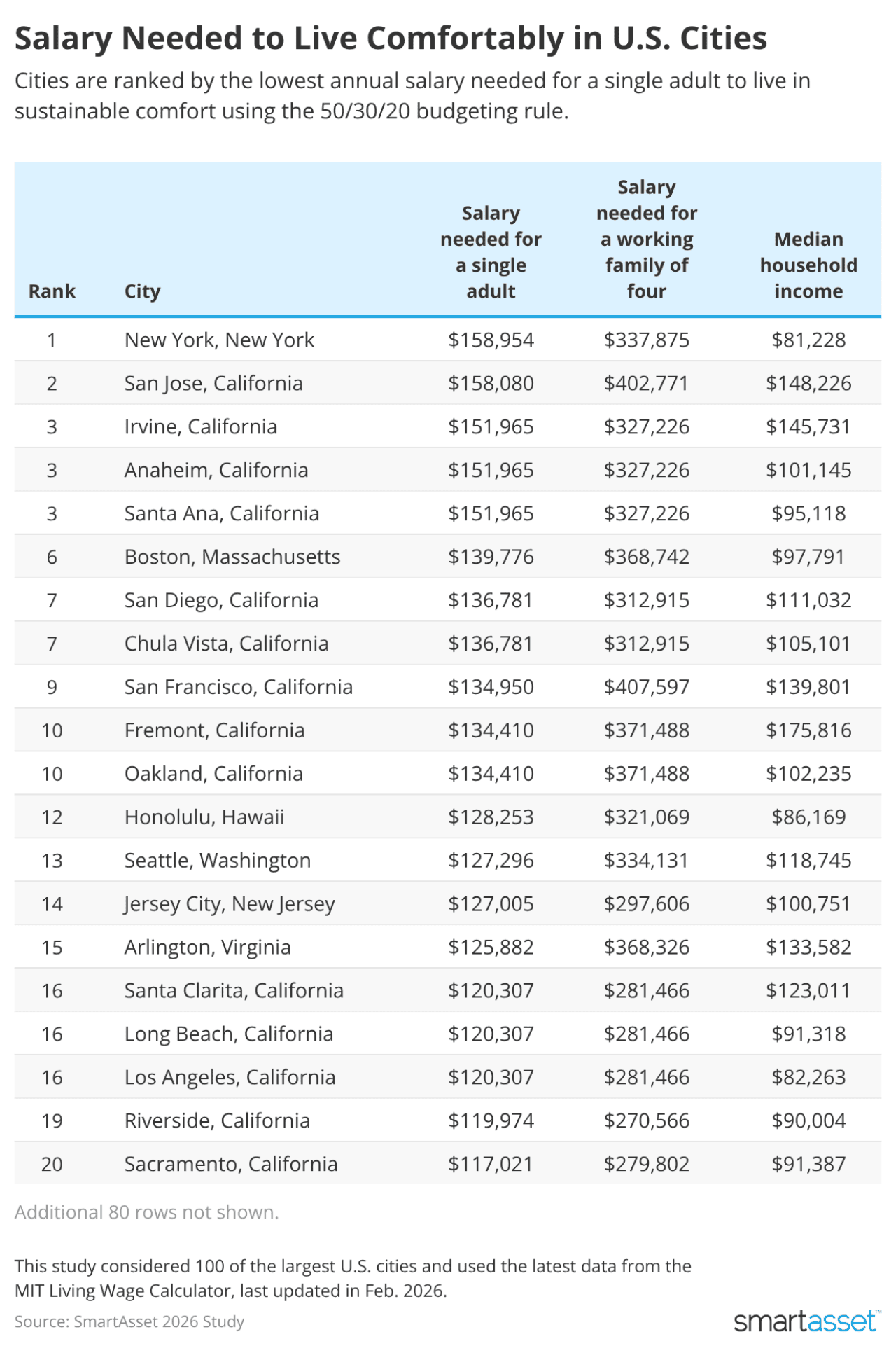
    Some Gen Zers pushed back pointing out that $75k in NYC with a roommate and no car is actually workable if you’re disciplined about it. “There are people making $20 or even less living in Manhattan,” one commenter noted. The city, for all its expense, at least gives you options for getting by without a car, which in a lot of American suburbs isn’t remotely possible. Another commenter made the sharper point: people who claim to live paycheck to paycheck on $100k in NYC are usually doing it because they’re trying to keep up with wealthier friends enjoying dinners out, Broadway shows, and cabs everywhere.

    But others had a different read entirely. In some high cost-of-living areas, a single person earning less than $80k is already classified as low income by local standards. “If you live in an HCOL area and have to pay every single one of your bills,” one commenter wrote, “then yes, you might be considered struggling.”

    The geographic reality of American wages is the whole story here. “Depends on the area. NYC? Yes. Nebraska? No.” That two-sentence comment got a lot of upvotes because it’s basically correct, and also kind of depressing that it needs to be said at all. The number that represents a comfortable life in one zip code represents genuine hardship in another, and the policies, conversations, and assumptions that get built around a single national salary figure tend to miss that entirely.

    What the thread really exposed wasn’t a generation with distorted expectations. It was a country where “how much is enough” doesn’t have a single answer anymore.

  • Illustrator says the best way to stay motivated when learning a new hobby is to spend money
    Photo credit: CanvaThere's a way to stay motivated while continuing to enjoy your hobby.

    Starting a hobby and keeping at it can be difficult. A person might feel discouraged because they aren’t good at it from the get-go. Another person might enjoy it fully but think their time and/or money could be put to better use. Embroidery illustrator and author Sara Barnes offers a tip that can help people stay motivated in their pastime: investing in professional resources and equipment.

    Barnes argues that, while experimenting with a new hobby on your own can be fulfilling, putting money towards classes taught by professionals can help a hobbyist stay motivated to grow and further enjoy it. Depending on your hobby, purchasing professional-grade equipment can keep you interested and invested. The thought process behind it is that, if a person spends money on a hobby, they’re more likely to stick with it to justify the cost.

    @artist.mackenzie

    Always buy the best art materials ❤️ Top tips for artists. Buy the best you can afford. Like all things in life there are levels and I truly believe that the better quality of tools can help in no end. There are times when I look at the colours I’m able to make with my pastels and think ‘how is that possible’ it amazes me. ❤️ Same goes for my paper, sculptures etc etc. ❤️ This if from a list in the book of top tips for artists ❤️ Art for all ❤️

    ♬ original sound – Artist Mackenzie

    Spending money literally makes you more invested

    A painting class taught by a pro means person-to-person input and lessons. These advantages expand your knowledge and skill, encouraging you to play around with more techniques as you learn and grow. After all, it’s hard to keep a hobby without a sense of growth or accomplishment attached to it.

    Signing up for professional boxing training forces you to get off the couch and grab your gloves. In return, you’ll learn more about boxing, get quality exercise, and have fun incorporated into your schedule. Also, investing in quality gloves will similarly motivate you to be intentional about your training.

    Purchasing expensive gear and supplies for a simple hobby you might not maintain may sound risky or foolish, especially given the current state of the US economy. On the contrary, it can be a quality investment of both money and time. During the peak of the COVID-19 pandemic and its economic uncertainty, hobbies were necessary investments to promote good physical, mental, and social health.

    @edwina.co

    JUNE 2025: hobby costs + me realising why I still need to work my corporate job 🫠 Money can’t buy happiness, but it can fund all your interests and hobbies #hobby #hobbies #corporatemillennial #adultmoney #corporategirlies #hobbygirlsummer

    ♬ Bossa Nova jazz that seems to fit in a cafe(1433079) – TAKANORI ONDA

    Pricier classes and equipment might actually save money on hobbies

    Even financial experts recommend investing in your hobbies as long as you’re not taking on debt to pursue them. They say it might even improve your budget. 

    After all, budgeting for an expensive pair of high-quality running shoes only once will end up being less expensive than paying for monthly streaming services you barely watch. Getting a pricier but sturdier table saw for woodworking will save money  compared to frequently buying replacement parts when cheaper models break. Taking a cooking class can encourage you to cook more at home and eat out less in the long term.

    On the surface, it may look silly to spend money on a weird color of paint, professional-grade ice skates, or a Thai recipe cooking class, but what you’re really spending money on is your well-being. Hobbies not only provide mental breaks from the stress in life, they offer opportunities to socialize with and befriend others who share your interests.

    With time and experience, the initial investment in your hobby will become cheaper. You’ll either already own the equipment needed to do the hobby, have enough expertise to pursue it without attending a class, or both. It depends on what hobbies you pursue and enjoy, but this philosophy can apply to almost anything.

    So, while figuring out where to invest your money, consider making your hobby a priority. It not only keeps you motivated, but can provide a positive impact on your body, mind, and long-term finances, too.

Explore More Money Stories

Money

Gen Z was asked if $75,000 a year counts as poor. Their answers say a lot about America right now.

Everyday Economics

Illustrator says the best way to stay motivated when learning a new hobby is to spend money

Everyday Economics

Driver breaks down how much he makes from Uber, enraging both drivers and passengers

Money

She tipped a dollar on a $5 coffee and the barista called her out in front of the whole café. The internet couldn’t agree on who was wrong.