Signs are meant to inform, warn, or direct, but sometimes, they unintentionally entertain. Whether due to poor wording, clever humor, or just plain absurdity, some signs end up being comedic gold.
Thanks to the internet, we no longer have to stumble upon them by accident—there’s even a whole subreddit, r/funnysigns, dedicated to collecting the most ridiculous ones.
Here are 25 of the funniest signs that prove not all signage is created equal.
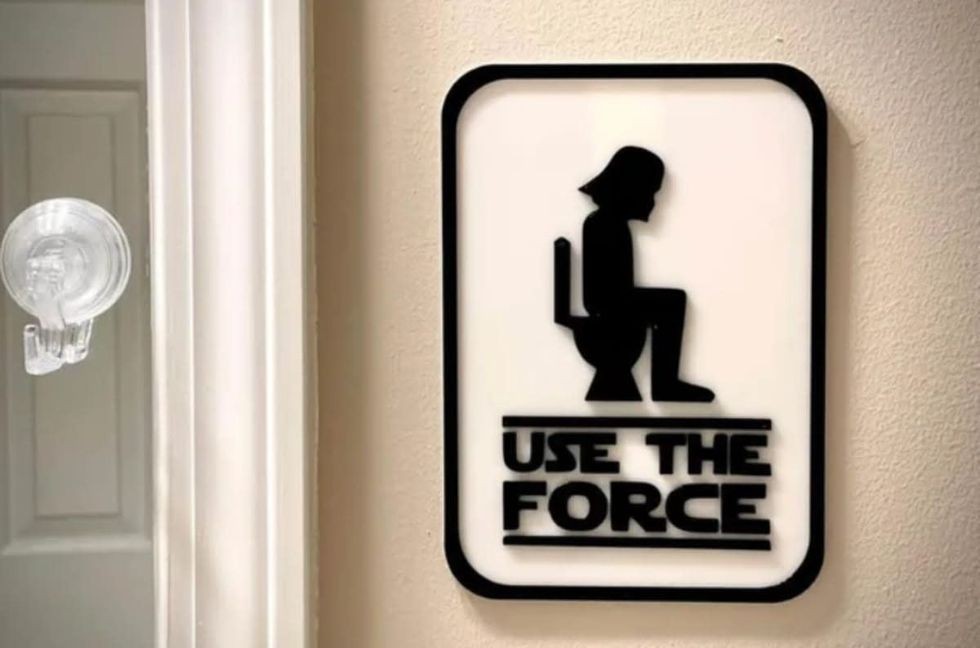
1. Some people might need this reminder
“Not knowing who Taylor Swift is doesn’t make you interesting.”Funny sign Reddit | u/Key_Shoe5850
Lecturer of Art, Rochester Institute of Technology
Glass as a material is full of contradictions. Depending on the form and use, glass can be fragile or strong, opaque or transparent, rough or smooth. The studios my colleagues and I teach and learn in, as glass instructors, echo this abundance of physical opposites. These environments are simultaneously immersive, complex, seductive and demanding.
When the studio is in action, you might hear glass breaking, hot metal being quenched in water, glassblowing pipes rolling on the workbench rails, and some good tunes on the stereo. You might smell hot beeswax and burning newspaper. You might feel a bit of waste glass under your shoe or the intense heat from the furnaces and a breeze from a well-placed fan. Glassblowers learn to listen, to feel and to find some focus within and among the kinetic.
The constant stimuli of the glass studio may not seem anything like a sterile science lab, and yet glass artists need to accrue knowledge of physics and chemistry to achieve any kind of control with this dynamic material. They must choose a material with the desired properties and during the process judge factors such as heat and malleability.
Glass as a material
At Rochester Institute of Technology, where I help run the glass program, we primarily use two types of glasses. In our hot glass studio we melt “soft” glass. This glass is specifically formulated to be melted in a furnace and used by the glassblower. It’s a combination of fine mesh silica sand, soda ash and lime, with small amounts of a few additional ingredients that keep the glass beautiful when it’s at its top temperature of 2,200 degrees Fahrenheit (1,204 degrees Celsius).
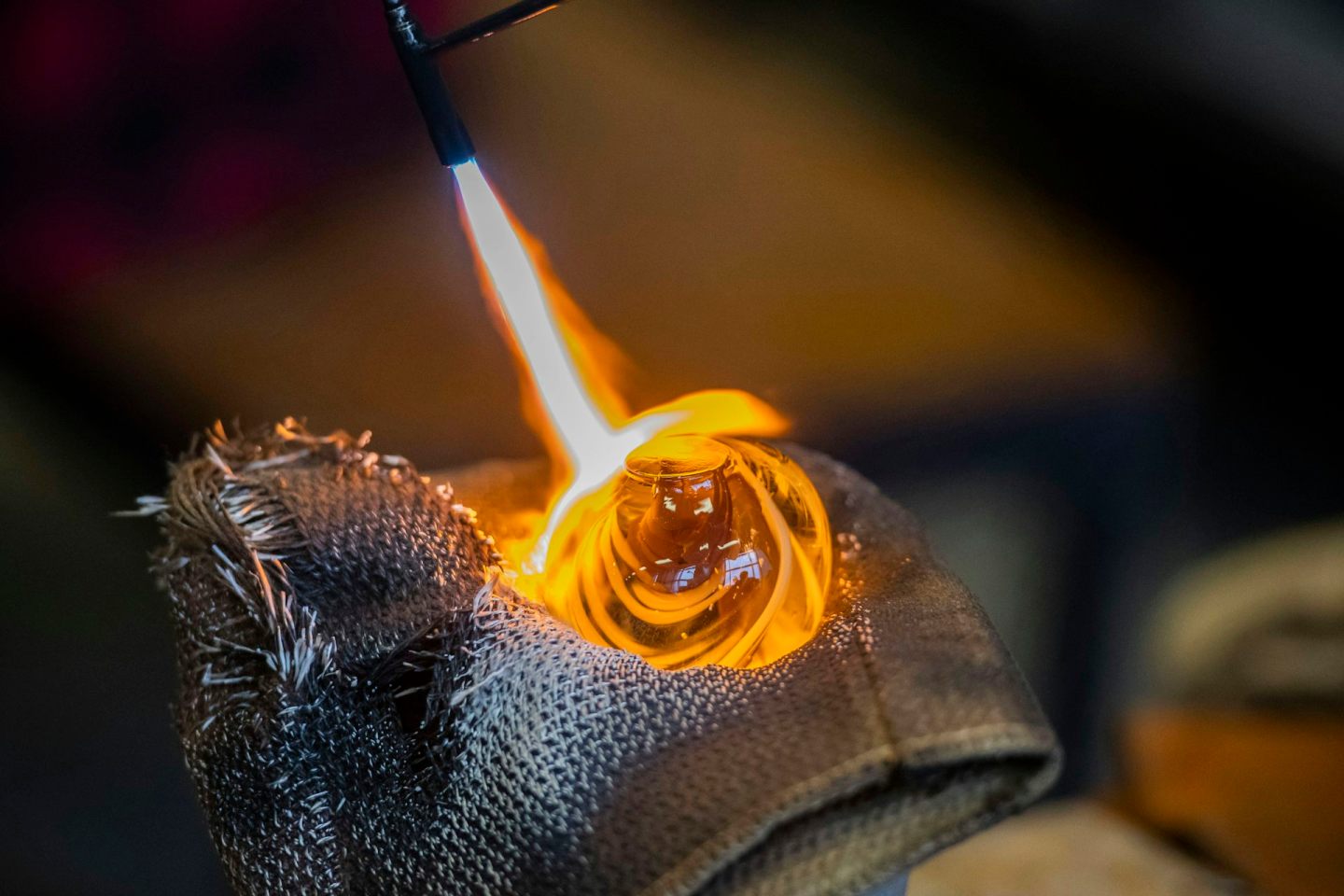
In our flameworking studio, we use a borosilicate glass. You might recognize this glass as the brand Pyrex made in Corning, New York. This is a super heat-resistant glass. It melts at a higher temperature than soft glass and arrives to our students in preformed rods that they can melt and shape by torch in our flameworking studio. The differences in chemistry really change how these glasses look and behave.
Pyrex cookware is made out of a specially formulated, heat-resistant type of glass called borosilicate.Picofluidicist/Wikimedia Commons
Glass, from a material science perspective, is categorized as an amorphous solid, meaning that glass’s molecules are arranged in a near-random pattern and there is no sharp melting point. Rather, glass gradually softens over a wide temperature range.
Gathering glass
Once you’ve adjusted to the chaos of the studio, it’s time to start working.
We have two furnaces in our hot glass studio, where we work with soft glass, so anytime during the school year there is between 700 to 1,200 pounds of glass. It’s kept in the furnace at its molten state (2,200 degrees F or 1,204 degrees C), ready to be gathered and transformed.
Glass artists heat up their glass in a furnace so that it’s molten and easy to mold.AP Photo/Keith Srakocic
When we work with the material, transforming it with tools and breath and heat, it needs to be kept in a workable heat zone – probably between 1,100 and 2,000 F (593 and 1,094 C). When the glass dips below that range, we perceive it as solid, though at the molecular level it is still dynamic and acting more like a liquid.
To make anything – a sculpture, a tumbler, a celestial magical orb or a pumpkin – you start by gathering glass out of the furnace on a metal rod. Once you’ve gathered your glass, you start making decisions.
An artist works in the Glass Hot Shop at RIT. When glass is in its molten state, the artist can shape it and blow into it.Elizabeth Lamark/RIT
You might ask yourself: What tools do I need to begin to shape and transform this glass into the object I have in mind? If you wait too long and the glass begins cooling down, you’ll need to reheat it to reintroduce malleability, allowing you to continue working it without breaking it.
A big part of glasswork is moving between the reheating chamber and the bench, where the artist uses tools to move and stretch the molten glass into the desired shape. You’ll need to alternate between these two stations many times.
Glassblowing is a team activity. I have physical and intellectual support from my colleagues: breath from their lungs, protection from the heat, additional bits of glass brought from the furnace to add to my object. We almost never work alone.
So, say I want to make a very basic clear tumbler. This is a simple conceptual object – utilitarian, domestic and intimate. It is also a tricky one to make well: too heavy and it feels bad in the hand, too thick at the lip and it dribbles when you drink, too thin at the bottom and it will break before it is complete.
Maybe I want to design it so it is slightly conical: wider at the bottom than the top, so it’s less likely to tip over. Maybe I want it to have a little indent for the user’s thumb as a gentle invitation to her hand. First I make my design: I draw it. I share it with my team so they can predict the process and the object’s needs. Then we begin.
Working with physics
I gather glass out of the furnace, let it cool a bit, then introduce a bubble in the glass by blowing into the pipe, the hollow rod that attaches to the object I’m making. I reheat, sit at the bench and begin to shape the glass using both gravity and the Jills, a cooling and shaping tool. The Jills is kind of like a large pair of tongs. It hasn’t changed much in design for 2,000 years.
I ask for some air from my teammate, and she blows into the pipe while I’m shaping the glass. The bubble transforms into a pill shape, slightly wider at the bottom. I constrict the area right in front of the pipe. I’m focusing on shape and heat, taking care to not let the glass get too cold. If the glass drops to about 1,000 F (538 C), it enters a danger zone. If it’s not yet finished, it needs to be warmed up in the reheating chamber; or if it is done, put away in a kiln to cool slowly.
If glass cools too quickly, the molecules freeze into a chaotic pattern, which causes stresses that result in fracture. To combat this volatility, when the glass object is done and ready to be cooled, we place the object in an annealer: a kiln set to a resting temperature of 930 F (500 C).
This temperature is like a Goldilocks zone for our glass: It’s not so hot that the glass will deform, but not so cool that the glass will stress and break. Once the kilns are full, a computer guide takes them down to room temperature over about 10 hours.
As I continue to work on my cup, I get more heat, focusing on the very end of the bubble – the part that will be the base of the cup. I then sit down and have another member of my team flatten the bottom with a wooden paddle while I tool the glass with the Jills to keep its shape. The cycle continues on and on.
The process is quick, but also there are so many little steps that it would take nearly a full-length book to describe them all. When asked how long it takes to make a tumbler, I’ll often answer, “About 10 years or 10 minutes, depending on how you think about time and material knowledge.” This is both glib and true. Glass demands attention, dedication and a willingness to make connections between physics and chemistry and your observable experiences. It is a highly challenging and equally rewarding material to work with and alongside. I count myself very lucky.
Photo credit: Yasin Akgul/AFP via Getty Images – Children look at developed film in a darkroom during an analog photography workshop held in southeastern Turkey on June 14, 2026.
Film photography is experiencing a resurrection, summoned by unlikely conjurers: Gen Z.
It wasn’t too long ago that analog photography – which uses photographic film and chemical processing – was declaredall but dead, relegated to the province of niche hobbyists and professional artists.
Digital cameras had taken over nearly all areas of photographic production. Film industry titans like Polaroidand Kodak had shrunk dramatically from their heyday, becoming shells of their former selves. Darkrooms, where students learned how to manually develop and print film, shutteredat high schools and college campuses across the country, replaced by digital labs. For most people, the spirit of analog photography was mainly channeled through Instagram filters.
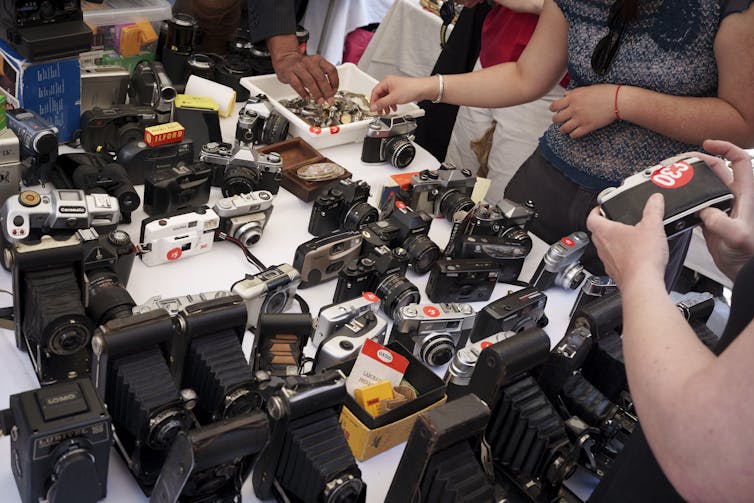
In 2025, 35% of the 42 million active film camera users worldwide were reported to be between the ages of 18 and 30. The year prior, online searches for analog photography saw a 41% rise.
Disposable camera sales have been steadily increasing since 2023. The photography journal PetaPixel went a step further and announced 2024 as “film’s best year in decades,” as major brands have introduced new cameras in response to renewed demand and revived classic models. More than 30% of respondents to a 2024 Ilford Photo survey on film photography were in the 25-34 age group.
As I’ve witnessed more and more of my undergraduate art and design students embrace analog photography, I’m not seeing this as a trend rooted in a nostalgic yearning for the past. Instead, I’m seeing it as young people rejecting algorithms, breaking free from the alienation of social media and reacting to childhoods spent on Zoom and TikTok – a deliberate move to redefine the future of art, social connection and engagement with the world.
Pining for a ‘third place’
In my work as a historian of photography and lecturer at the University of Southern California, I’ll often ask my students about how they take photos – whether they’re using digital cameras their smartphones or analog devices.
This year, for the first time, some of my students discussed images they’d printed and the physical photography albums they’d put together of their friends and family. They talked about how they’d also been sending postcards, writing letters and tacking photographs to their bedroom walls.
New York Knicks forward OG Anunoby snaps a photo with a disposable film camera during the team’s victory rally on June 18, 2026, after winning the NBA Finals. Craig T. Fruchtman/Getty Images
This was a rhetorical move by social media companies, likely designed to help people feel as though they were in a familiar terrain of social connection. Yet the underlying business model of these platforms depended more on maximizing engagement and advertising revenue than on nurturing authentic relationships.
Everyone knows what happened next: The more connected young people became online, the more isolated and detached they started to feel. The COVID-19 lockdown pushed social life online even further, and researchers are only now starting to see how the combination of increased screen time and isolation negatively affected adolescents’ mental health. By 2023, 51% of American teenagers reported they spend at least four hours a day on social media.
I see the attraction of analog photography as a response to life lived through screens, a pathway toward community engagement and the desire for what sociologists call “a third place.”
Coined by sociologist Ray Oldenburg in his 1989 book “The Great Good Place,” third places are meant as a space separate from home and work. They offer a reprieve for the in-between, generating the conditions needed for creative cross-pollination. They might include a local cafe, a neighborhood writing group, a weekly Magic: The Gathering game or a college fraternity – any space that allows for social interaction and personal growth.
These spaces also combat loneliness. They get people out of their heads and into a community. Oldenburg also referred to them as “havens of sociability,” places or gatherings where people can arrive alone to join others, and the atmosphere is “democratic and festive.”
Analog communities IRL
In April 2026, the inaugural AnalogCon took place in Los Angeles. Organized by the Los Angeles Center of Photography, where I serve as executive director and chief curator, it was a festival for all things analog photography. It didn’t just serve as a third place for photography enthusiasts; it also showed how analog photography – as a practice, ritual and community – is flourishing.
Vendors, industry leaders, artists and teachers participated in the two-day event, which included exhibitions, panels, demonstrations and guided photography tours around Little Tokyo. The excitement and thirst for similar events was palpable.
Photography now joins a broader trend of a generational preoccupation with physical cultural objects and media. Although music streaming represents 82% of revenues generated in the music industry, vinyl records sales have been rising for over a decade, crossing the US$1 billion threshold in the U.S. in 2025.
But beyond that, record stores and video rental shops have become third places in their own right. There’s a big difference between selecting a film to stream from your bed and getting out of the house, going to a store and talking about movies with a clerk and fellow film enthusiasts.
Think about the sound a tape cassette makes when you open and close it, or the vibrant graphics on the covers of DVDs or VHS tapes. Think about rewinding or making a mixtape for your recent crush. These are objects of belonging that signal specific cultural moments, rituals and aesthetics, and many young people today are starting to experience them for the first time.
Now, think about gently inserting a roll of film into a camera. Think about choosing an angle carefully when snapping a photo, because the number of frames is limited and you want to make them count. Think about the thrill of discovery when the pictures finally emerge as objects on paper.
To me, these are more than fleeting trends. They signal a push against a digital culture that is designed to cultivate envy and reward outrage, insults and humiliation.
Instead, armed with rolls of film, more and more Gen Zers appear to be opting out of their algorithmic feeds in favor of experiencing life in ways that feel more deliberate, personal and tangible.
Michelangelo’s fresco of “The Last Judgment,” covering the wall behind the altar of the Sistine Chapel in Vatican City, is being restored. The work, which started on Feb. 1, 2026, is expected to continue for three months.
The Sistine Chapel is one of the great masterpieces of Renaissance art. As the setting where the College of Cardinals of the Catholic Church meets to elect a new pope, it was decorated by the most prestigious painters of the day. In 1480, Pope Sixtus IV commissioned Domenico Ghirlandaio, Sandro Botticelli, Pietro Perugino and Cosimo Rosselli to paint the walls. On the south are six scenes of the “Life of Moses,” and across on the north are six scenes of the “Life of Christ.”
In 1508, Pope Julius II commissioned Michelangelo to paint the ceiling. The theme is the Book of Genesis, the first book of the Bible. The images show God creating the world through the story of Noah, who was directed by God to shelter humans and animals on an ark during the great flood. The ceiling’s most famous scene may be “God Creating Adam,” where Adam reaches out his arm to the outstretched arm of God the Father, but their fingers fail to meet.
At the sides, the artist juxtaposed the male Hebrew prophets and the female Greek and Roman sybils who were inspired by the gods to foretell the future. It was completed in 1512; then in 1536, Michelangelo was asked to create a painting for the wall behind the altar. For this immense work of 590 square feet (about square meters), filled with 391 figures, he labored until 1541. He was then nearly 67 years old.
As an art historian, I have been aware how, from the beginning, Michelangelo’s “The Last Judgment” sparked controversy for its bold and heroic portrayal of the male nude.
Many layers of meaning
Michelangelo liked to consider himself primarily a sculptor, expressing himself in variations of the nude male body. Most famous may be the Old Testament figure of David about to slay Goliath, originally made for the Cathedral of Florence.
The artist’s ceiling for the Sistine Chapel had included 20 nude males as supporting figures above the prophets and sibyls. Originally, Michelangelo’s Christ of “The Last Judgment” was entirely nude. A later painter was hired to provide drapery over the loins of Christ and other figures.
“The Last Judgment” scene also contains multiple references to pagan gods and mythology. The image of Christ is inspired by early Christian images showing Christ beardless and youthful, similar to the pagan god of light, Apollo.
At the bottom of the composition is the figure of Charon, a personage from Greek mythology who rowed souls over the river Styx to enter the pagan underworld. Minos, the judge of the underworld, is on the extreme right.
Giorgio Vasari, a fellow artist and historian who knew Michelangelo personally, later recounted the criticism by a senior Vatican official, Biagio da Cesena. The official stated that it was disgraceful that nude figures were exposed so shamefully and that the painting seemed more fit for public baths and taverns.
Michelangelo’s response was to place the face of Biagio on Minos, the judge of the underworld, and give him donkey’s ears, symbolizing stupidity.
Michelangelo included a reference to his own life in a detail connected to the Apostle Bartholomew, who is located to the lower right of Christ. The apostle was believed to have met his martyrdom by being flayed alive. In his right hand, he holds a knife and, in his left, his flayed skin whose face is a distorted portrait of the artist.
Michelangelo thus placed himself among the blessed in heaven, but also made it into a joke.
Thought-provoking imagery
The Last Judgment is a common theme in Christian art. Michelangelo, however, pushes beyond simple illustration to include pagan myths as well as to challenge traditional depiction of a calm, bearded judge. He uses dramatic imagery to provoke deeper thought: After all, how does anyone on Earth know what the saints do in heaven?
In these decisions, Michelangelo displayed his sense of self-confidence to introduce new ideas and his goal to engage the viewer in new ways.
A digital reproduction of the painting will be displayed on a screen for visitors to the Sistine Chapel during this period of restoration. Behind the screen, technicians from the Vatican Museums’ Restoration Laboratory will work to restore the masterpiece.