The pages of Sandow Birk’s American Qur’an are not adorned with gold filigree or ornate palmettes, as you might find in a more traditional version of the book. Instead, the text is set against rich, colorful paintings depicting everyday life in the U.S.—say, a beach bonfire or a car wash, a wedding or a funeral. Some of his images portray incredibly mundane scenes, like rain falling on an empty parking lot. Others are much more polarizing, like the image of prisoners blinded, muzzled, and handcuffed in a Guantanamo Bay prison yard. The words inscribed on the pages are not Arabic, but English—rendered in a script that emulates the graffiti lettering that marks Los Angeles streets.

This tome looks more like an art project than a holy book—one that took the California-based artist more than nine years to create. Now that Birk has completed illustrating all 114 surahs (chapters of the Qu’ran), his work will finally be released in printed form by W.W. Norton & Co. this September, accompanied by essays from religious scholar Reza Aslan and Yale professor Zareena Grewal.


“A lot of it was about my anger at the war in Iraq,” says Birk, sitting in his Long Beach studio apartment, where he creates much of his work. He shows me one of the Qur’an pages on his computer, one that bears the image of American soldiers in Afghanistan pointing their guns at civilians sitting on the ground.

For almost a decade, Birk has been touring the United States displaying his paintings at galleries and museums. The Southern California surfer first got the idea for American Qur’an while traveling the world for his surf trials, which frequently took him to countries with significant Muslim populations, like Morocco, Indonesia, India, and the Philippines. He had just finished painting a contemporary English-language version of Danté’s The Divine Comedy and was developing a film based on the paintings. “I sort of OD’d on Catholicism,” he says, laughing. “I was getting tired of it.”

At the same time, Birk witnessed the Bush administration’s war on terror unfold across Iraq, Afghanistan, and other places in the Middle East. He became increasingly frustrated with American political discourse, which had turned virulently Islamophobic in the wake of the September 11 attacks and subsequent bombings in London, Moscow and elsewhere in the Western world. “The way people were talking about Islam had nothing to do with the experiences that I had and the people I met or the way I saw them practicing their religion,” Birk says. “So I finally said, I’m sick of hearing people on the radio tell me what Islam is.” He read the Qur’an for himself from cover to cover and began researching historical versions of the holy book online. Immediately, the beauty of these manuscripts struck him, resplendent in intricately inked arabesques and geometric patterns.

Birk’s motivation to start creating his American Qur’an, however, came on a visit to the Chester Beatty Library in Dublin, which houses one of the largest collections of Qur’ans outside the Middle East and North Africa. “The Qur’ans are not as perfect as they look when they’re reproduced,” he says. “When you see them, you see the lines, you see where they erased, where they make a mistake, where they fixed it.” In person, the Qur’ans appeared more like the products of human creativity and art than inaccessible sacred texts. With each new era, the Qur’an’s designs evolved to reflect the style and aesthetics of the time. Birk felt that a project like his was not only feasible, but in line with the tradition of Qur’anic art.

When he got home, he painted about 10 to 15 pages of his own book, using a copyright-free translation written by an English clergyman named John Medows Rodwell in 1861. “Everyone is bummed that I used it, because it’s not very good and it was done by the British colonizers when they were in Egypt,” he says. “It’s biased, and it has little quirky things.” The Rodwell translation is widely regarded by scholars as an Orientalist interpretation of the Qur’an. Birk’s adviser, Grewal, urged him to look at other, more recent translations—by scholars like Muhammad Asad and Thomas Cleary—and incorporate some of those updates into Rodwell’s text.

The images, however, he chose all on his own, deriving inspiration from his L.A. neighborhood and the cities he visited around the country, with the understanding that these sacred texts might be applied to the course of everyday life. “You go to temple, church, mosque, you hear a sermon. How do you take that into your head and become a good person?” says Birk. “So you’re thinking about all this stuff, like the afterlife, but you’re going to have to go to the hardware store, and you have to do these mundane things. That’s what real daily life is about.” His depictions are largely quotidian representations of American life here in the U.S. and abroad—images of grocery stores, and local Mexican-American markets, and even of churches and homes illuminated by Christmas lights. In Birk’s America, homeless people push shopping carts overflowing with garbage bags past a brick wall wreathed with razor wire. Middle-aged men costumed in camo clothing aim their rifles at birds circling overhead. Two New Yorkers lie prostrate in prayer on a busy sidewalk.

Other scenes, however, are driven by a more explicitly political intent. For one surah detailing the story of Yusuf, or Joseph, Birk offers a scene in the yard of a California prison. Turn the page, and Mexican immigrants are seen being detained by border police as they attempt to cross over into the United States. “The images I chose were always metaphors,” Birk says, referencing a page about Noah’s ark, illustrated with scenes from New Orleans in the wake of Hurricane Katrina.

“I think that what he’s doing is so brilliant and syncretistic,” says Aslan, a fervent supporter of Birk’s project. He first encountered American Qur’an at a gallery in Pittsburgh. Years later, when W.W. Norton approached him to write the forward for the forthcoming book, Aslan was enthusiastic about participating. “The notion of the Qur’an as a physical object of beauty goes back nearly 1,500 years. So, artistically speaking, Birk is walking in very ancient footsteps, well-trod footsteps.”

And yet, when Birk put up his first show in San Francisco, at the Catharine Clark Gallery, a New York Times article on the project speculated about the possible repercussions he might face for illustrating the Islamic holy book, particularly in light of the Danish cartoon controversy. Birk had just finished his Danté film and was upset by his producers’ insistence on removing his depiction of the prophet Muhammad. Birk wanted to stay loyal to Danté’s vision. “I thought it was wrong to act out of fear,” he told The New York Times at the time. He expressed worry that his new project would incite anger, especially from the Muslim community. But as soon as his American Qur’an show went up, it was clear any fears he—or The New York Times—had were unfounded. Some Muslim leaders, called to comment on the project by journalists looking for worthy soundbites, murmured mild concerns over the implications of a Qur’an qualified by the word “American”—the Qur’an was meant to be universal, with no national or ethnic affiliations. Despite this, Birk’s show produced no considerable dissent from any Muslim groups or individuals. “The only real complaints that anyone got were some angry emails, and they were always from right-wing Christian groups, saying ‘you shouldn’t be reading the Qu’ran,’ or telling people to read it, or showing this work, or ‘take it down,’ ” says Birk.

If there is suspicion about Birk’s project, it’s only because the book, and its visual interpretation of the text, feels unfamiliar to the Qur’anic tradition because of its use of human images rather than abstract designs. A perusal of any historical Qur’an archive will turn up manuscripts embellished in extravagant lapis lazuli fleur-de-lis and bordered by elaborate geometric designs. But unlike the New and Old Testaments, or other religious texts, the Qur’an has only recently become subject to the study of Western literary criticism. “Once these scriptures begin to be viewed not just as sacred and divine but as having literary or artistic merit, regardless of their sacred status, then they can much more easily blend into Western culture, the fabric of Western culture,” says Aslan. “That process with the Quran is very new. The process with the Bible has been going on for about 200 years.” The hegemony of Judeo-Christian texts, too, makes them more conducive to artistic or academic appropriation. The Western art world, in particular, is awash in Judeo-Christian symbology. But the Qur’an is a new addition to this milieu, says Aslan, making Birk’s project a novelty.

“His only agenda is art,” says Aslan. “He is not proselytizing. He is not commenting. He is simply inserting himself as an artist in a thousand-year-old artistic tradition and, like all artists do, adding to that tradition in his own unique way, from his own unique perspective.” Despite Aslan’s insistence, Birk’s own stated intentions—to demonstrate compatibility between an American way of life and Islam—are inherently political.

The images he chooses, too, convey a leftist sensibility, one that is staunchly anti-war and critical of U.S. foreign policy. More than a decade has passed since the inception of the war on terror, but Islam remains an antagonist in the narratives used to justify military and political aggression in the Middle East and North Africa. “When I had the first show of this project, like seven years ago, people would come up and say, ‘Oh, this is so timely! It’s so important that you’re doing this today because of the things happening in the world,’ ” says Birk. “And then several years go by and people are like, ‘This is so timely!’ ” Islam remains culturally relevant to the U.S.—not because it is welcomed here, but exactly because it’s not. Consider this, and the very production of a Qur’an within a culture that wants to destroy it is rendered a political act.
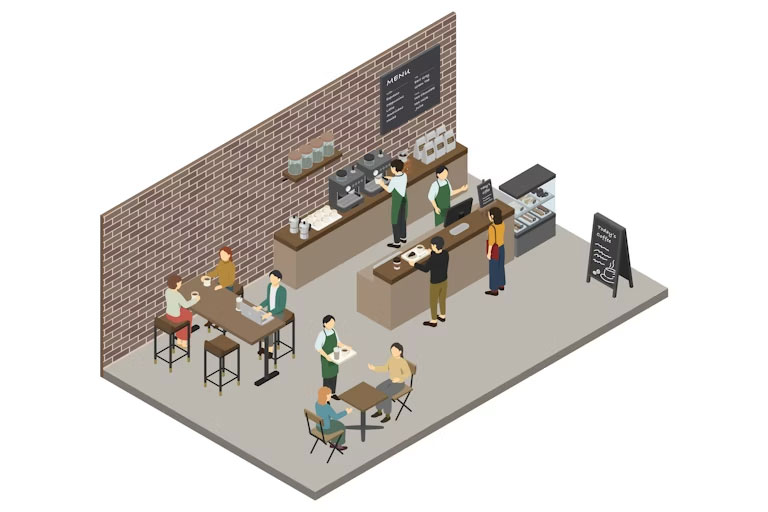

  • Indie coffee shops are meant to counter corporate behemoths like Starbucks – so why do they all look the same?
    Photo credit: stomy/iStock via Getty ImagesMany coffee shops today seem to be aesthetically divorced from time and place.

    Like many young, urban professionals, we run on coffee. We especially enjoy frequenting independently owned cafes that pride themselves on ethically sourced beverages, strong local ties and a hip aesthetic.

    They’re the kinds of places that sneer at the homogenization and predictability of Tim Hortons, Second Cup, Dunkin and Starbucks.

    But as public space and consumer culture researchers, we began noticing a pattern: While the invention of new, nondairy milks to mix into lattes continues to amaze us, many U.S. coffee shops seemed to share a similar aesthetic.

    What was up with all the exposed brick? Why did so many of the baristas look cooler than us, but also so similar to one another? And why did most menus appear on a chalkboard, as if we were still in kindergarten?

    Weren’t we supposed to be in one-of-a-kind, authentic settings that make us feel unique and, let’s admit it, slightly elevated?

    As it turns out, the visual patterns we noticed had never been backed up by research. So after a quick cortado, we set out to test our hunch that local coffee shops had adopted a uniform aesthetic.

    Measuring homogeneity

    We asked over 100 American and Canadian young professionals living in cities to share an interior image of their favorite independent coffee shop, describe why they liked the shop’s appearance, and document aspects of its interior design.

    They could select these interior design features from a list of 23 common elements that we had identified in a pilot study – brick walls, marble counters, indoor plants, local art, vintage furniture and even the look of the baristas. Respondents could also write down other details they noticed.

    The elements that they selected and wrote down showed a fascinating overlap.

    Baristas led the pack: Two-thirds of the participants’ favorite local coffee shops had staff with tattoos or piercings. Over half had baristas with beards. Well over half of the respondents noted that their favorite shop had chalkboards, reclaimed wood features, local art, milk foam designs on beverages, local event posters and exposed brick. A large share of the shops had vintage furniture, community message boards and free books available to patrons to read. One-third of the images had indoor plants, trees or greenery.

    Barista with a beard and tattooed hands pours boiling water over coffee grounds.
    Chances are your favorite local coffee shop has a barista with a beard and tattoos. Wera Rodsawang/Moment via Getty Images

    Next up, we challenged the participants to identify the city where these coffee shops were located.

    Using the images provided by the respondents from the initial survey, we asked 158 new and prior participants if they could match the location of the shops depicted in six photographs to Cincinnati, St. Louis or Toronto – cities chosen for their different architectural and aesthetic qualities.

    Not a single participant was able to correctly identify the correct city for all the photos.

    We gave respondents another chance by showing two pictures of coffee shops, one at a time. This time, the two shops were located in Chicago and San Francisco – again, places that pride themselves on their unique and recognizable design culture. They were now given the choice of these key cities to select from, as well as three wrong cities. Only 6% successfully located both coffee shops, and nearly 20% immediately gave up.

    As one participant conceded: “Honestly, these aesthetics are very transferable now … they were random guesses and they could have been in any of the cities mentioned.”

    In other words, independent coffee shops in North America have become so similar aesthetically that their location cannot be picked from a lineup. The purportedly unique and local feel of coffee shops has instead been homogenized into a singular, palatable, North American aesthetic.

    Ironically, these shops have narrowed their aesthetics like a de facto brand franchise – exactly like the chain stores that their patrons ostensibly reject.

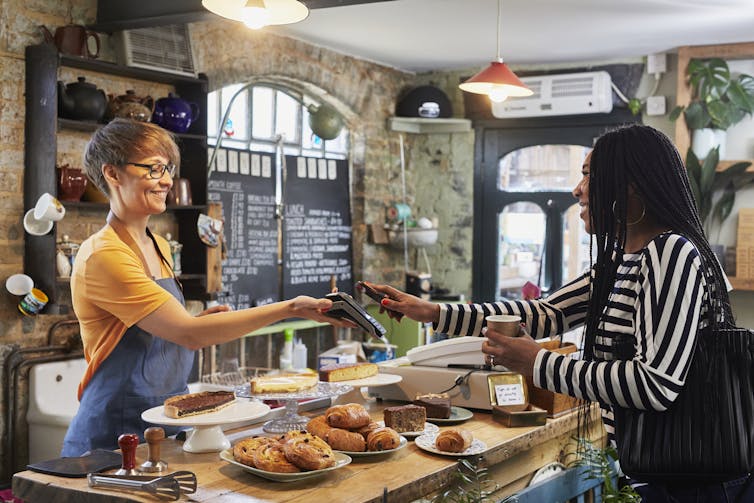
    A young woman with dreadlocks pays for her coffee as a smiling young female barista with short hair holds out a card reader.
    Exposed brick, check. Plants, check. Chalkboard, check. Tara Moore/Digital Vision via Getty Images

    Computers and capital

    So why is this happening?

    New Yorker cultural critic Kyle Chayka has attributed aesthetic homogenization to popular social media platforms like Instagram. He calls it the “tyranny of the algorithm”: Social media algorithms promote the visuals that users are most likely to engage with. This, in turn, causes the same types of visuals to be liked and shared, since users encounter them more often. Because the algorithm sees they’re popular, it continues to promote them, in a self-reinforcing cycle. In turn, coffee shop owners also see these online images and try to replicate them in their own establishments.

    Artificial intelligence will likely accelerate the digital homogenization of visual culture, since AI models are trained on massive datasets that feature widely circulated images. Whether it’s popular fashion, architecture or interior design, idiosyncrasies are collapsing into a generic, hegemonic aesthetic – what scholars Roland Meyer and Jacob Birken call “platform realism.”

    Finance plays a role as well. With the average cost of starting a new coffee shop between US$80,000 and $300,000, and with only a small share of coffee shops expected to stay open beyond five years, banks are keen to reduce their risk. Many of them will therefore ask aspiring coffee shop owners to opt for cheaper interior design choices that appeal to the broadest customer base.

    The consumer also plays a role

    But patrons of hip coffee shops may also be to blame.

    Decades before the rise of social media, AI and financial risk management, scholars such as Sharon Zukin revealed how young urban professionals paradoxically embrace the homogenization of their environment in their quest for authenticity.

    Those exposed brick walls? Zukin already described how Manhattan real estate brokers had marketed them to gentrifying SoHo yuppies in the early 1980s.

    Like their predecessors, today’s hipsters, creative professionals and knowledge workers are essentially cultural and aesthetic consumers. Many of them crave visuals – from fashion to architecture – that are different enough to feel cool and authentic, yet safe enough to match their lifestyle and their social status. They want a tasty latte as much as a palatable interior to drink it in.

    Businesses and developers are eager to appeal to these upwardly mobile consumers. At the same time, they want to reach the biggest number of customers. So they tend to create repeatable, homogenized environments in what Zukin describes as a “symbolic economy.”

    In coffee shops, patrons want more than a good espresso. They want to immerse themselves in a “scene” that matches their lifestyle and aspirations. And the exposed brick and the vintage furniture do just that – even if they’ve been copy-and-pasted in cities, small and large, across the nation.

    As we chase authenticity, we may just be finding comfort in carefully curated conformity.

    This article originally appeared on The Conversation. You can read it here.

  • Overpackers love this simple ‘5-4-3-2-1’ packing rule that makes travel way easier
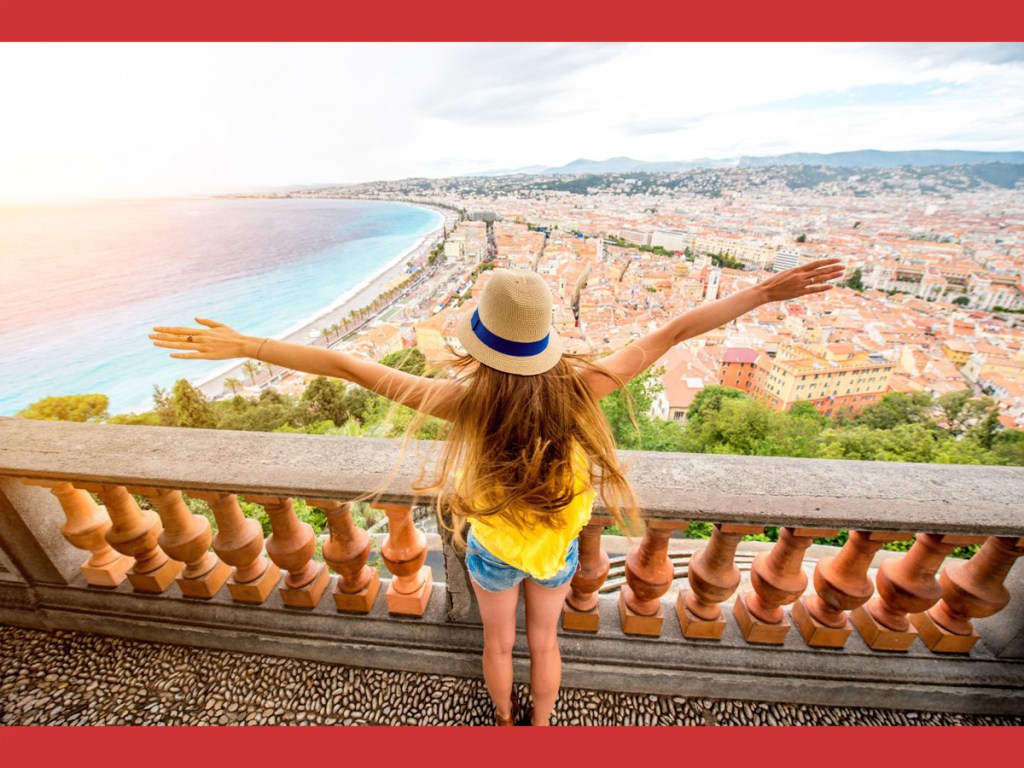
    Photo credit: CanvaAn obvious overpack for travel.
    ,

    Overpackers love this simple ‘5-4-3-2-1’ packing rule that makes travel way easier

    When it comes to travel, packing efficiently is a skill acquired through experience. Lifestyle and content creator Alison Lumbatis shares a helpful 5-4-3-2-1 method designed to take the stress out of packing for both seasoned travelers and first-timers. Trying to pack light while still remembering everything you need can feel a little daunting. A simple…

    When it comes to travel, packing efficiently is a skill acquired through experience. Lifestyle and content creator Alison Lumbatis shares a helpful 5-4-3-2-1 method designed to take the stress out of packing for both seasoned travelers and first-timers.

    Trying to pack light while still remembering everything you need can feel a little daunting. A simple trick is knowing exactly what’s necessary, making your bag lighter and more practical.

    @alisonlumbatis

    Calling all overpackers—this one’s for you! ✈️🧳 The 5-4-3-2-1 packing method is one of my favorites because it’s totally customizable. Prefer dresses? Swap a top and bottom for a dress. Love skirts? Sub them in for pants! These pieces should last you 1-2 weeks, depending on your access to laundry. 🔗’s to everything in bio! #outfitformulas #packinglight #styleconfidence #wardrobemadeeasy #travelcapsule #dailyoutfits #closetconfidence #vacationstyle #fashionover40 #smartstyle

    ♬ original sound – Alison Lumbatis

    Putting The ‘5-4-3-2-1 Packing Method’ Into Action

    In her trending TikTok post, Lumbatis shares a packing system she claims to be “as easy as it sounds.” Here are the basics of the 5-4-3-2-1 packing method:

    • 5 TOPS
    • 4 BOTTOMS
    • 3 SHOES
    • 2 LAYERS
    • 1 MISCELLANEOUS

    Lumbatis explains, “So all you got to do is pick out 5 tops, 4 coordinating bottoms, 3 pairs of shoes, 2 layering pieces, and 1 of anything else. Like a dress, pajamas, a hat, a belt, or any other accessories that you might need. And then of course pack as many undergarments and toiletries as you need.”

    The strategy isn’t just about simplifying and maximizing the number of items you bring on a trip. It’s also about function. “The key is to pick versatile pieces that can mix and match so you can pair them up for whatever activities you have planned for your trip.”

    minimalism, versatile pieces, functionality, packing
    Packing the necessary items
    Photo credit Canva

    Taking Pictures Can Help Plan Ahead

    Another helpful step is taking photos of your outfits to remember how everything fits together. Lumbatis offers, “You can even take pictures of the outfits with you wearing them or flat lays of the pieces and keep them on your phone or in your Notes App — So you can refer back to it on your trip.”

    Is the 5-4-3-2-1 packing method effective? These were some of the thoughts in the comments from readers hopeful to put the plan into action:

    “Great tip for me. Hate packing and never wear all the clothes I bring.”

    “Heading to Japan and I was just going to my closet to put it together. I overpack so this is sooo helpful.”

    “I’m dreading how to not over pack for such a variety of occasions, heat, and limited washing facilities. Ugh.”

    “I struggle with under packing so this is super helpful!”

    travel, adventure, alleviate stress, preparation
    Soaking up the adventure.
    Photo credit Canva

    The Science Behind Good Preparation

    Traveling is a great way to alleviate the stress and burdens of our daily lives. A 2025 study in Springer Nature Link showed travel helped people improve their long-term resilience by creating positive emotions while ecouraging self reflection. National Geographic found the benefits of travel begin even before the trip begins.

    However, preparation can have a powerful effect on the simple stresses a person might acquire during traveling. A 2025 study revealed that planning reduced anxiety and helped people prepare for delays or unexpected changes. Research in 2025 reported by AP News found that even making a simple checklist reduced anxiety and helped make for smoother trips.

    Lumbatis claims, “If you struggle with overpacking and want to create a great capsule wardrobe packing list, you’ve got to try this method.”

    People hope that traveling will relieve stress more than generate it. The 5-4-3-2-1 packing method offers a clear and simple way to pack just what you need. Careful preparation helps prevent last-minute chaos and produces a more enjoyable trip. Hopefully, this method can help you spend less time worrying and more time soaking in the adventure.

    Watch this YouTube video on incredible vacation destinations to inspire your next trip:

  • People are cheering woman’s refusal to accept the latest trend in hotel bathrooms
    Photo credit: @bring_back_doorsSadie has declared war on non-private hotel bathrooms.

    People are cheering woman’s refusal to accept the latest trend in hotel bathrooms

    “I HATE how hotels started thinking going to the bathroom is a shared experience.”

    It can be frustrating seeing change for change’s sake in the world. To be more specific, changes that are said to be done in the name of innovation and design, but are in truth ways for companies to save a buck.

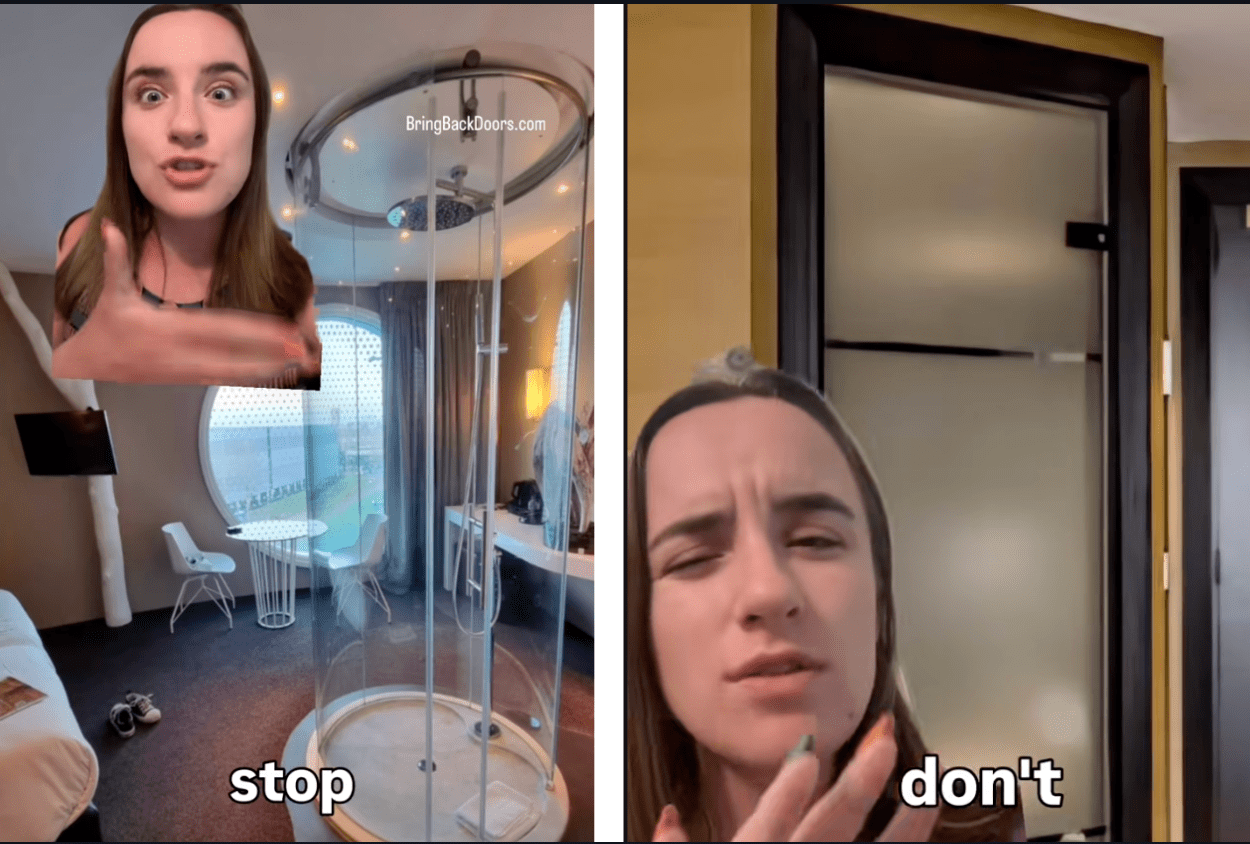
    One example that is getting attention is the bathroom doors in hotels… or the lack thereof, actually. One TikToker has had enough and has taken it upon herself to save regular bathroom doors in hotels and to point out why open-space bathrooms and glass doors just don’t cut it.

    On her @bring_back_doors TikTok account, Sadie has a collection of videos highlighting the flaws in hotel bathroom designs, with the most prominent being the lack of a regular door to the bathroom. In one viral TikTok, Sadie discussed a hotel that reached out to her, explaining that they have “foggy” glass doors to their bathroom to provide privacy. She was quick to point out that it still doesn’t provide adequate privacy. “Yes you can see through these,” Sadie said, adding that “glass doors do not close properly.”


    @bring_back_doors

    Hotel name: Alexander Hotel, Noordwijk aan Zee, Netherlands I need to be clear. Glass doors are not private. And making them foggy does not make them private. I am once again sitting here saying screw you to all bathroom doors that are not solid and close fully. And I am providing alternative hotels with guaranteed doors at bringbackdoors.com Check your hotels door situation before you book or risk your privacy. Door submitted by @mmargaridahb, DM me to submit your own bad doors. #bathroomdoors #hotel #travel #fyp Bathroom doors | bathroom design | hotel design | bad hotel design | travel fail | travel memories | travel inspo | door design | hotels with privacy

    ♬ original sound – Bring Back Bathroom Doors

    The comments rallied behind Sadie’s bathroom-door crusade

    The commenters joined in with Sadie, demanding the return of solid, closing, and lockable doors to bathrooms in hotels:

    “I HATE how hotels started thinking going to the bathroom is a shared experience.”

    “I hate how you can’t turn the bathroom light on without disturbing the other person in the room.”

    “The foggy ones are almost worse, you just get a hazy fleshy silhouette hunched over on the crapper like some kind of sack of ham.”

    “I just don’t get it, NOBODY wants this, even couples. I won’t be more likely to book two separate rooms for me and my friend/sibling/parent, I’ll just book another hotel.”

    “Love this campaign, I do not want a romantic weekend listening to the other person poo.”


    @bring_back_doors

    Hotel Names⬇️⬇️ Citizen M South Hotel (first pics) and Fletcher Hotel (third pic) both in Amsterdam. As part of this project, I’ve been emailing hotels around the world to put together an easy to reference list for people to find hotels with guaranteed doors at BringBackDoors.com And I did notice that in Amsterdam a lot of hotels were saying they don’t have doors. It wasn’t the worst city (that honor goes to Barcelona, so far I’ve only found TWO that have said yes to all doors), but it was still bad. Then I went into the comments. And kept getting people mentioning these hotels in Amsterdam. And I realized that clearly the city has a designer or architect on the loose who has a thing for test tubes. It’s horrible. Luckily, I was able to find 6 hotels in Amsterdam that all have bathroom doors in every room and have them all listed on BringBackDoors.com These hotels were submitted by so many people I couldn’t name them all. But to submit your own bad hotel bathroom send me a DM with hotel photo, name, and location! #hotel #bathroom #hoteldesignfail Bathroom doors | hotel bathrooms | hotel privacy | no privacy | travel problems | hotel issues | travel | hotel design | hotel design fail | hotel designers | design fail | hotel concept | bathrooms | Citizen M | Hotel Fletcher | Hotels in Amsterdam | Visit Amsterdam | Amsterdam

    ♬ original sound – Bring Back Bathroom Doors

    A great way to save a buck—er, I mean, ‘create a modern look’

    As many commenters asked, why do hotels have glass doors — or, worse, no doors at all—in their bathrooms? Well, this has been a growing trend in modern hotels over the past decade as a means to create a sleek aesthetic and to allow glass partitions to bring more daylight into otherwise darker sections of the room.

    At least that’s what’s being promoted to the customer. In reality, skimping on solid doors for glass ones or none at all gives the illusion that the room is bigger than it is while requiring fewer building materials. It does bring in more daylight, but mostly with the hope that you’ll cut down on electricity use for lights in an otherwise enclosed space. These reasons are also why some hotels don’t have solid walls around their bathroom areas at all.

    TikTok · Bring Back Doors

    TikTok u00b7 Bring Back Doors www.tiktok.com


    Tired of the lack of privacy? Check out the database

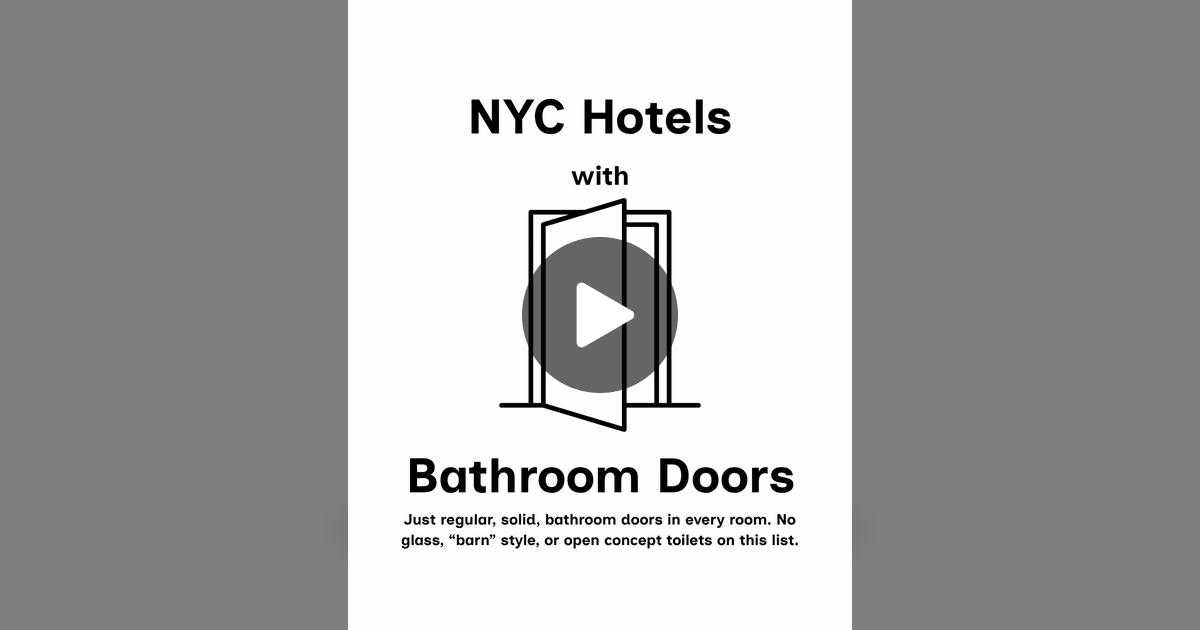
    To combat this trend, Sadie has developed a database at bringbackdoors.com for her and her followers to report which hotels have true, solid, private bathrooms in their accommodations and which ones do not, so people can properly plan where to stay and have true privacy during their most vulnerable moments.

    “I get it, you can save on material costs and make the room feel bigger, but what about my dignity?,” Sadie wrote on her website. “I can’t save that, when you don’t include a bathroom door.”

    Over time, the hope is that sanity and dignity can be restored as hotels realize that their glass “features” don’t have any real benefit when they don’t allow basic privacy.

Explore More Design Stories

Design

Indie coffee shops are meant to counter corporate behemoths like Starbucks – so why do they all look the same?

Culture

Overpackers love this simple ‘5-4-3-2-1’ packing rule that makes travel way easier

Design

People are cheering woman’s refusal to accept the latest trend in hotel bathrooms

Design

MIT’s super-fast camera can capture light as it travels