If a millennial ever made a time capsule, it would likely reveal an era filled with pixelated video games, vinyl records, chocolate chip cookies, and encyclopedias. While their baby boomer parents did their best to instill good habits, they also passed down plenty of misconceptions and imaginary boogeymen. Justin (@90skid4lyfe) captured this hilariously in a TikTok video titled “Lies parents told us in the 90s.”

Representative Image Source: Pexels | Kindel Media

In the 27-second video, Justin shared ten myths that boomer parents told their kids—some were old wives’ tales, while others held a bit of truth. Here’s the list Justin shared:

1. Don’t drink coffee, it’ll stunt your growth.


via GIPHY


2. If you pee in the pool, it will turn blue.


via GIPHY


3. Chocolate milk comes from brown cows.


via GIPHY


4. If you eat watermelon seeds, you’ll grow watermelon in your stomach.


via GIPHY


5. Don’t swallow that gum. If you do, it’ll take seven years to come out.


via GIPHY


6. You can’t drive with the interior light on. It’s illegal.


via GIPHY


7. Sitting too close to the TV is going to ruin your vision.


via GIPHY


8. If you keep cracking your knuckles, you’ll get arthritis.


via GIPHY


9. You gotta wait for 30 minutes before you go to swim.


via GIPHY


10. If you get a tattoo, you won’t find a job.

Image Source: TikTok | @devintweedy808
</p><h2 class=

In the comment section, @jmwoodman90 said with a laughter emoji, “I heard every single one of these, and now use them on my kids!” In other comments, people shared their takes and memories on different points from the list. For example, reading the point about watermelon seeds, @tapho.phil was reminded of “The Rugrats” episode where Chuckie swallows the watermelon seed and his friends shrink themselves to retrieve it. This episode was titled, “Aunt Miriam/The Inside Story,” which aired on November 28, 1992.


https://youtube.com/watch?v=gyTWG8njo1Q%3Fsi%3DnLGJGAao2C8gXtg7

For the point about interior dome lights of the car, people had mixed opinions. @justsomerandomguy1986 wrote, “The lights in the car are real. I was told it was illegal.” Whereas, @jess.sssme said, “The interior light is called the map light. It was made to be on when driving to see the map.” @mojave.wanderer said, “I got a ticket last week for the interior light BTW. $400 fine.” @x.queen.green.x affirmed that keeping interior lights on is indeed illegal. However, this is not true according to Corporate Driver Training Australia. There are no specific laws or legislation that forbids driving with interior lights on.


via GIPHY


The same was the case with the “cracking knuckles” point. @coloradonana2 and @marissashaffer89 said that they believed cracking knuckles could give people arthritis. But according to Dr. John Fackler, an orthopedic surgeon at Houston Methodist, “There are no known detrimental effects to cracking your knuckles.” He said that although knuckle-cracking may cause temporary swelling or a feeling of weakness in the hands, but not quite arthritis. He explained that the pressure applied to knuckles builds vapor pockets within the fluid inside the joints. This creates a vacuum that sucks the joint apart rapidly, causing a popping sound in the knuckles.

Representative Image Source: Pexels | Karolina Grabowska

Similarly, the point about “chocolate milk coming from brown cows” and “pool’s water turning blue due to urine” are just plain myths. According to America’s Swimming Pool Company, a swimming pool’s water does not change color when peed in. As for the swallowing gum thing, Elizabeth Rajan writes in the Mayo Clinic that it doesn’t remain in one’s stomach for years and years. “If you swallow gum, it’s true that your body can’t digest it. But the gum doesn’t stay in your stomach. It moves relatively intact through your digestive system and is excreted in your stool.”

Image Source: TikTok | @monsterfabfam

As for coffee resulting in disruption of one’s growth, that too, is not entirely true. According to WebMD, no scientific evidence supports that caffeinated drinks like coffee stunts a body’s growth. The myth about growth results from the fact that too much coffee can disrupt the sleep cycle. This lack of sleep prevents their bodies from producing the growth hormone that helps the body grow taller.

Image Source: TikTok | @bd22001

So, as it turns out, most of these things boomers told their children were just plain lies. “Parents were always lying,” he captioned the video. And these were not the only lies that millennials grew up with. In the comments, millennials shared other lies their parents told them. @amanda.johnson1313 said, “I heard all of these plus the classic, ‘If you keep making that face it will get stuck like that.’” @cloverhippiekitty85 recollected, “My mom used to tell me if I ate raw cookie dough I would get worms I believed her till I was 12.” 


You can follow Justin on TikTok and Instagram for millennial humor and 90s nostalgia!

  • Men were stunned when asked the same types of career questions women regularly face
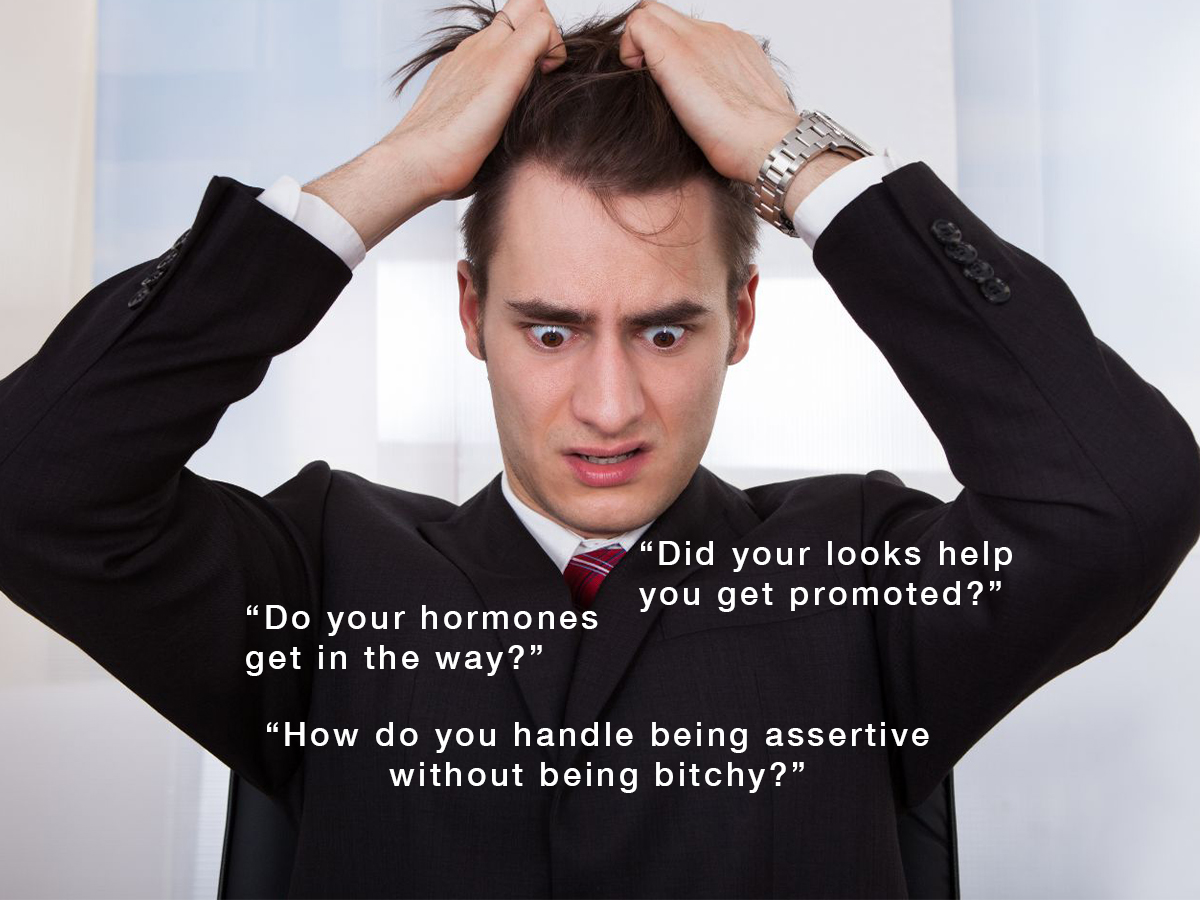
    Photo credit: CanvaUncomfortable man gets questions women often face during a job interview.

    “How much do you think your looks helped you get promoted to your position?” Unfortunately for many women, this isn’t a shocking question. Interviews, performance reviews, and typical professional interactions can reveal a double standard and workplace bias.

    In a social-experiment-style reel by lifestyle creator @bol.lifestyle, these questions were instead asked of men. Their discomfort and disbelief reveal why the standards women face regarding credibility are impossible to ignore.

    An experiment to reveal a double standard

    In the video, men are placed in an interview-style setup and asked a series of questions. Hearing these skewed questions for the first time, their expressions shift quickly from curious to confused and uncomfortable.

    Host: Have you ever been asked to just smile and look pretty or smile and say nothing in a meeting with a customer?

    One man appears somewhat shocked and uncomfortable. He quickly responds, almost dismissive at even being asked the question, “No.”

    Host: Do you think that your looks helped you getting promoted or moving up to your current position?

    Another man reflects and appears unable to answer the question.

    Host: Looking so good. By the way, I do love the shoes. Are these designer or your particular brand that you really like?

    A third man awkwardly smiles and vents some air, almost as if the ridiculous question doesn’t feel fitting at all. He doesn’t answer.

    Host: Do your hormones sometimes get in the way?

    A fourth man responds, “Hormones?” He awkwardly laughs and adds, “I don’t, I don’t know.”

    Host: Do you sometimes wonder whether you’ve been chosen for this position because you’re a man?

    Man 2 responds definitively, “No, not because I was a man.”

    Host: How do you handle in your job being assertive without being perceived as aggressive or bitchy?

    Man 1 tilts his head back and reflects on the question. “That’s uh, that’s a question that I find it very hard to relate to.” He then adds, “Because it’s not a situation I’ve been in.”

    women, career questions, role reversal, double standards
    Many microphones are held in front of a man.
    Photo credit Canva

    Real questions women face

    After this first series of questions, the video presents titles claiming: These were real questions asked to our female leaders throughout their careers.

    The host goes on to ask the men how they feel about this particular line of questioning. Their response is predictable.

    “It really, really, really feels uncomfortable. And I also feel it in my body,” said Man 3.

    “When hearing these things still happen, it makes me also feel that, hey, maybe I am more privileged than I thought I was,” added Man 1.

    At the end of the interview, the men seemed a little upset and surprised by the double standard. They collectively hoped for change, and some suggested they themselves were responsible for helping things get better.

    change, equality, career advancement, bias
    A man writes the word “change.”
    Photo credit Canva

    People advocate for change

    People seemed to really respond to the video. With over 6,000 comments, there was a consensus confirming the experience and advocating for change.

    “Men, our male privilege is real. How we use it is up to us, and hopefully we use it to protect and improve the experience of the women in our workplace.”

    “If you have sons, please prepare them to improve the way the world treats women.”

    “The man that felt it in his body… welcome to the life of a woman”

    “Perhaps the greatest privilege is never having to notice your own privilege.”

    “Oh my God. I have heard ALL of these questions. And more.”

    “Well done. We have to show a different way and we can do it with grace! We have to do it different.”

    “It’s not what we perceive , it’s what is .”

    “THIS experiment should be undertaken in workplaces all over the world…”

    perspective shift, workplace culture, office bias, normalized
    Women and men working together.
    Photo credit Canva

    It’s not about finger-pointing

    It can be easy to get lost in finger-pointing. Although at times the comments might feel like a pile-on, the success of the video lies in its simple setup. It takes a familiar experience and shifts the perspective so that people might hear it a little differently.

    Certain assumptions or expectations can become so normalized that people, maybe mostly men, stop noticing them altogether. Is it possible for workplace conversations to be more thoughtful, fair, and aware than they have been or, in some circumstances, still are?

    The intent of the video seemed less about provoking a fight. It demonstrated that some basic reflection and small shifts of awareness can lead to better experiences for everyone. There’s a familiar proverb that comes to mind: walk a mile in my shoes. These men seemed to gain some real perspective from the opportunity.

  • Young boy struggles through painful stutter until his singing videos change everything 
    Photo credit: WQAD News 8/YouTubeLando sings.
    ,

    Young boy struggles through painful stutter until his singing videos change everything 

    “One kids courage to show up, speak up, and sing his voice free.”

    A boy named Lando is gaining attention online after people started sharing and liking the two very different kinds of videos he creates. In one, he candidly speaks with a severe stutter. In the other, he sings smoothly, without the same pauses and repetitions that appear when he talks.

    Perhaps it’s the dramatic contrast that has people liking and clicking. For whatever reason, as Lando shares on his website, #stutterfreelando, he’s created an awareness movement around stuttering “born from one kid’s courage to show up, speak up, and sing his voice free.”

    The young entertainer is easy to like

    Finding a young person navigating his speech difficulties so charismatically and confidently is admirable. He’s not wavering under the spotlight. He’s shining.

    His family shares about their experience and the methods they’ve found helpful with his stutter on their website:

    “This is a family journey. We’re one of millions of families around the world navigating stuttering to learn what works, what doesn’t, and figuring it out as we go. Some of what we share helps Lando. Some might not. We’re learning that every stutterer is different. No more hiding.”

    Facing a severe stutter can be more complicated than practicing with a speech therapist.

    Traditional therapy hasn’t given us the breakthroughs we need. Therapists are trying. We are trying. But we refuse to sit quietly and hope it clicks. So we built this, a movement where our family shares what we’re learning out loud. Real strategies. Real techniques. Lando’s good days and the hard ones. Not a highlight reel. Not a gofund me. Real life.”

    It feels good to join a winning team

    After watching any of his videos, it’s clear why so many people keep coming back.

    In one clip, Lando talks about reaching 50,000 followers on Instagram and an upcoming interview with a local news outlet. The message expressed with gratitude and happiness is simple, but it takes time for him to get there. That process draws people in.

    “Congratulations on your followers, add one more”

    “Great work buddy!”

    “Ah Lando, I’m really enjoying your videos”

    “That excitement is so cute! I love how supportive everyone has been!”

    “Great job little man keep it going. You inspire a lot of people with the same problem.”

    “thankyou for sharing, your super cool.”

    Singing allows his words to come out in a continuous flow

    The difference isn’t subtle. In speech, words can stall and be difficult to get out. In song, they move by the rhythm that reduces stops. These are some of the comments you can find on just one of his singing videos posted above:

    “GOD BLESS YOU LANDO!!!!! YOU ARE ABSOLUTELY AMAZING!!!!!”

    “The eyebrows at the end was fire.”

    “You are an inspiration”

    “Brilliant buddy”

    “… sounding smooth.”

    “Lando with the great voice!!!”

    “Now … this kid has charisma!!!”

    A courageous little showman

    Lando’s videos stand out not just for singing or stuttering, but because both are available, openly shared, without one being hidden or edited out of view. There’s no attempt to turn it all into a single narrative of struggle or success. Instead, what people see is a boy using his voice as it is.

    There is something instinctive about the way people rally around a kid like Lando. Sharing the hard parts and the moments that come more easily gives everyone a clear way to respond. Cheering him on, leaving a positive comment, or even just watching and listening allows each of us to take a small part in that effort.

    It’s less about celebrating the win and more about recognizing the work and the courage to keep going. Lando is talking and singing it out loud.

  • Homeowners swear by this simple ice cold hack that thoroughly makes your toilets cleaner
    Photo credit: CanvaMany believe cleaning the toilet properly starts by filling it with ice cubes.

    Most people welcome a new cleaning hack, especially if it involves the bathroom. Cleaning the toilet isn’t a fun task and getting it thoroughly spotless can get stinky real quick. However, there’s one hack that many homeowners say gets their toilets cleaner with less elbow grease. It involves emptying your ice tray.

    There are experts who recommend putting ice cubes down the toilet whenever it is time to clean.

    Toilet cleaning starts with your freezer

    This understandably sounds weird. Many people might remember flushing ice cubes down the toilet as a superstitious ritual during the winter months to “summon” a snow day from school. But to clean the toilet? That sounds like just as much as a myth. 

    But there is a logic to it and many homemakers suggest it. First, let’s get this out of the way and say that ice cubes aren’t being flushed to replace regular toilet cleaner. It’s actually being used to help the cleaner be more effective.

    So…how could ice help clean my toilet?

    Ice in the toilet bowl acts as a support for the toilet cleaner. Often, toilet cleaner drips down the side of the toilet bowl into the water and down the pipe. The ice allows the cleaner to cling to the bowl and its sides for longer, penetrating filth and disinfecting it more effectively.

    Here’s the gist on how it works: first, take a bowl of ice cubes and pour them into the toilet. Make sure you’re not filling it to the brim. Next, take your preferred toilet cleaning solution and pour/spray it onto the ice. Let the mixture sit for about 15 minutes to allow the cleaning solution to cling and disinfect the bowl. After that, use a toilet brush to stir and agitate the ice, ensuring that it is scraping all sides of the bowl. By this time, the ice should have melted enough to flush. 

    There are additional bonuses to using ice with toilet cleaner. The ice can also act as an abrasive pumice stone in addition to your toilet brush, scraping off mildew, mineral build-up, or other yucky things that could be stubbornly clinging to the bowl. The flushed ice could help clean the pipe similarly, dislodging filth and grime in conjunction with the toilet cleaner on its way down.

    Another benefit is reducing odor. Ice is known to absorb smells and could make cleaning a little less smelly. It’s one of the reasons why many restaurants, clubs, and bars put ice in men’s urinals.

    Many people who frequently travel and live in an RV also recommend flushing ice down their toilets. This is not just to clean the bowl, but to have the ice jostle and scrape the nasty stuff out of the black tank. While this method’s effectiveness in cleaning a black tank is put into question, critics still say that ice can help reduce smells and keep water in the black tank during hot days.

    Final tips (specifically “don’ts”)

    If you plan on giving this hack a try, be sure not to overflow your toilet with ice. Along with that, while most forms of ice work (cubes, crushed, or chips), putting larger blocks of ice in the toilet won’t do any good and could clog things up if they’re too big.

    It’s also important to use one cleaning solution and not mix a bunch together. Mixing cleaning products together could create fumes that are dangerous to inhale. It’s best to use your preferred cleaner and choose a different one next time if you’re getting the results you want.

Explore More Ideas Stories

Impact

Men were stunned when asked the same types of career questions women regularly face

Voices

Young boy struggles through painful stutter until his singing videos change everything 

Ideas

Homeowners swear by this simple ice cold hack that thoroughly makes your toilets cleaner

Ideas

Facebook group helps families without a ‘village’ find surrogate grandparents