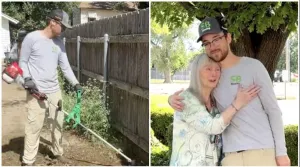
What’s better than a group of friends making and eating food together on a farm? Processing it all on site together. At least that’s what Brad and Amanda Kik, founder of ISLAND, thought when they first conceived the idea of a mobile processing kitchen a few years ago.

Inspired by their non-profit’s series of food preservation workshops that were gaining popularity around their small Bellaire, Michigan community, the Kik’s decided to take their arts and ecology center dedicated to “connecting people with nature, art and community,” out into the actual community.


While they currently run a mobile, MDA certified poultry processor that allows small farmers to process chickens, ducks and turkeys, the success of their preservation workshops made them think about how they could pack up their kitchen and take it out on the road. With that, they created a trailer that unpacks into a high-efficiency, three-season food preservation kitchen and workshop space.

Brad says there’s something about the combination of farm fresh food, old time skills and working together in the community that’s impossible to resist.

“I think the making movement and food share the appeal of getting back to using our hands and physical intelligence. We’ve figured out that the people who have claimed responsibility for leading us, feeding us and supposedly helping us preserve life, liberty and the pursuit of happiness have no clue how to create anything meaningful for us, and we’re reclaiming that for ourselves and our communities,” says Brad.

While ISLAND’s work is all about finding the hidden interconnections, “and food is ripe with relationship—to politics, to economy, to culture, to ecology, to history, to art,” says Brad, the mobile food preservation kitchen still needs funding to make it fully operable in the community.

They are currently one of five finalists for a community grant from Oryana, a natural foods co-op in Traverse City, Michigan, to get the preservation trailer funded. Voting runs through April 18th.

The Kiks envision the trailer at peak harvest, pulling up wherever it’s needed and unloading tents, tables and outdoor stoves with the interior containing equipment, sinks and workspace that can host up to a dozen people. ISLAND says beyond canning, the trailer will support drying, fermenting, smoking and meat curing. It will serve as a farm-based space to hold classes and community food preservation parties, “so that folks can learn the important techniques of food preservation, meet their farmers and enjoy shared work.”

Preserving, curing and drying are all important parts of our food history and how we’ve been able to survive through good and bad times. While mainstream society has become so far removed from the traditions (canning, curing, preserving) of their grandmothers and grandfathers, the Kik’s preservation trailer is a step back in time to preserve more than food.

Brad says the message of our culture over the last 50-60 years is that the work of the household economy is secondary to the work of the marketplace, and that the “homework” of our grandmothers was something to escape.

“If there are any advantages to the resurgence of these ‘lost’ skills, it’s that we no longer have to assign gender roles to the tasks of working at home, and that the interval of chasing fast food in the modern economy has helped to infuse these old tasks with new meaning,” says Brad.

While much of ISLAND’S work is about finding creative responses to global predicaments including climate change, alternative energy, and species extinction, Brad says bringing community together to create solidarity under food can begin with a single trailer.

“Responding to these issues would be one where, despite a wide difference of opinion in political, religious and other values, people would treat each other with respect and civility, and the word ‘economy’ would be used in reference to how a community lives responsibly within the ecology, history and limits of its small place,” says Brad.

Sound the cheering nationwide in hopes they get that trailer.

images courtesy of ISLAND

  • New York passes SAFE for Kids Act to protect children from social media addiction
    Photo credit: CanvaNew York hopes to improve children's usage of social media.
    ,

    New York passes SAFE for Kids Act to protect children from social media addiction

    New York hopes to curb social media’s access to young kids.

    “Kids and their phones these days” has been a complaint ever since the first cellular phone was introduced. However, there has been growing concern over the amount of time children spend not just on their phone, but scrolling through social media. The state of New York is hoping to address this issue through their finalized SAFE for Kids Act.

    The Stop Addictive Feeds Exploitation (SAFE) for Kids Act aims to hold social media companies more accountable for the time children spend on their apps. It also seeks to limit kids’ exposure to their algorithms. Officials believe that constantly scrolling through social media feeds negatively impacts a child’s sleep and overall mental health.

    What are the restrictions?

    The new law requires social media companies to obey the following rules:

    • No addictive, algorithm-driven feeds for minors without explicit parental consent
    • No notifications about addictive feeds to minors between midnight and 6 a.m. without parental consent
    • No tricky website designs, called “dark patterns,” that manipulate or nag parents into giving consent
    • No degrading service, increasing prices, or retaliating against minors who don’t have parental consent for addictive feeds
    • Use certified age-assurance methods to distinguish minors from adults
    • Immediately encrypt data collected for age verification, use it only for age determination, and delete it immediately after use
    • Hire an accredited, independent third party to test and certify age-assurance methods every year

    Social media companies have until January 25, 2027 to comply. Failure to do so may result in a $5,000 fine per violation.

    New York Governor Kathy Holchul and Attorney General Letitia James made a public announcement to social media companies affected by this law, specifically Instagram, TikTok, YouTube, Facebook, Snapchat, and X.

    “What changes is the default,” said James. “Platforms cannot automatically place minors into feeds engineered to maximize engagement. This is not a question of privacy, this is a question about content. This is not about the First Amendment. Again, this is about protecting children.”

    “Social media companies, you’re now on notice,” said Holchul. 

    Critics and the issues that still need to be addressed

    There are some criticisms of this law, particularly around age-verification. The law offers the option of using government-issued identification along with another proof of identity (such as an email address or an uploaded photo of the user). This complicates things aside from First Amendment rights. It would require millions of adults to share private information to scroll and post on social media after hours. While the law states that the companies must encrypt and erase such information upon age verification, that’s not guaranteed. This is especially concerning as social media companies already deal with users’ private information being hacked and leaked.

    Governor Holchul still believes this criticism isn’t a governmental issue but a business one that social media companies need to resolve.

    “Social media companies tell me, ‘We have no way of knowing whether someone’s under 18 or not,’” Holchul claimed. “I said, ‘You’re smart people. Use [artificial intelligence] to figure it out. Ask how you do it.’ And you’re not supposed to allow underage gaming anyhow—sports betting—so you must have some metric. So don’t tell me you can’t do it. Figure it out.”

    How parents can help their children on social media

    Regardless of where people stand on this law, experts offer some advice for parents who feel social media is negatively affecting their children. They recommend setting personal screen time limits for their children and taking advantage of built-in parental controls on their platforms. Parents limiting their own social media use can also influence how kids use it, too.

    Psychologists also recommend talking with children about how and why they use social media. Specifically, discuss the fantasy that social media showcases from influencers versus the real lives of those people. Talk about why there was a social media post (advertisement, sharing joy, hoping for engagement, etc.) along with the content of it. Asking how they feel after watching or reading content in their feed helps as well. Such practices, along with limiting exposure, creates trust between child and parent without judgement.

    Though how we fix screen and social media addiction is still largely in the air, take comfort knowing brilliant minds are exploring methods to address the growing issue.

  • New Russian research suggests that the human lifespan could be up to 156 years
    Photo credit: CanvaResearchers found what's preventing us from living longer.
    ,

    New Russian research suggests that the human lifespan could be up to 156 years

    Humans can live much longer if certain barriers are addressed.

    According to the Guinness Book of World Records, the oldest person lived to the ripe age of 122 years old. Such a lifespan is an incredible feat, but what if the average person could beat that record by 34 years? Recent research done in Russia has led scientists to believe that the average human lifespan could be up to 156 years.

    The researchers at Skoltech Biomed Technologies Center developed a mathematical model that allowed them to “switch on” a variety of aging mechanisms. This allowed them to calculate a human’s lifespan where mortality risk never increased with age. After experimenting with different scenarios and conditions, they found the biggest barriers to longevity were caused by non-renewable tissues and somatic mutations.

    What are these barriers against longer life?

    Somatic mutations are DNA changes within a cell. They accumulate over time during a human’s life and cannot be reversed with any existing therapy. These DNA errors that pile up in our cells contribute to the aging process.

    Many human organs like the liver and skin continually replace cells and regrow damaged portions of themselves. However, there are two organs that can’t do this: the brain and the heart. Brain tissue (neurons) and heart tissue (cardiomyocytes) cannot regenerate. This proves to be the most prominent biological limit that shortens our lifespans. This explains why issues like dementia and heart disease are prominent causes of death and morbidity later in life. Since those organs’ tissues don’t replace damaged cells, they’re prone to irrevocably decline over time.

    “The key finding of the study is the discovery of substantial differences between tissue types. Neurons and cardiomyocytes, which lack the ability to divide, turned out to be the main limiting factors: when all other causes of aging are eliminated, somatic mutations alone reduce the theoretical median lifespan from 1,759 years (for a hypothetical non-aging human organism) to 156 years,” said Evgeny Efimov, a research intern at the Skoltech Biomed Technologies Center, researcher at AIRI, and one of the key authors of the study.

    This suggests that somatic mutations and DNA damage is what ultimately prevents humans from living indefinitely, even if our brains and hearts regenerated cells like other organs.

    So what’s next?

    Now knowing these biological limitations, the researchers hope to study other areas of aging impacting the human lifespan that could plausibly be reversed. This includes mitochondrial dysfunction, telomere shortening, epigenetic drift, and loss of proteostasis. 

    The hope is to have a clearer priority list of issues for future therapies to tackle. This is not just to possibly extend life, but to improve lives in general. By developing a fully comprehensive theory of aging, Skoltech hopes to pinpoint which aspects of aging are within our scope to address. After all, thoroughly studying each puzzle piece that makes up human life gives us a better understanding of the whole.

    Of course, other impactful factors in a person’s lifespan can be addressed today. As most know, things like diet, sleep, and exercise are among them. A person’s living environment can also negatively impact their lifespan if it doesn’t have clean air, access to clean water, and so on.

    For now, the best method for living long is to follow instructions from your physician. Whether you make it to 156 years or not, living well is best for whatever time you’re given.

  • Woman documents her nephew’s late night culinary quests as the viral ‘Midnight Chef’
    Photo credit: @midnightchef_amir on InstagramAmir Jackson's late night cooking is going viral.
    ,

    Woman documents her nephew’s late night culinary quests as the viral ‘Midnight Chef’

    A 15-year-old cooking late night snacks is inspiring the Internet.

    One night in Apple Valley, California, Morgan Graham rose in the middle of the night. A smell had woken her up. It was pleasant, but at 11:28 p.m. she wasn’t expecting to smell delicious cooking. She went down into the kitchen to see her 15-year-old nephew, Amir Jackson, baking cookies.

    This was the first of several viral videos of Graham’s nephew cooking up a storm late at night. Jackson, who has been staying with his aunt during the summer, is taking advantage of her kitchen to whip up some sumptuous snacks.

    Birth of a Midnight Chef

    Nearly every night, Graham wakes up around midnight to the smell of cookies, cornbread, tacos, or whatever her nephew wants to prepare.

    “I don’t care,” said Graham in the initial video. “He’s very responsible. He’s not gonna burn the house down, so therefore, cook whatever you want.”

    Graham further explained in the video that Jackson looks at recipes daily. He also rummages through her pantry during the day to search for ingredients for his nightly cooking fest. 

    “In his world, he’s having the time of his life. In my world, I just want to stop waking up close to midnight to the smell of food,” Graham joked.

    Graham’s videos featuring her nephew have racked up millions of views on TikTok and Instagram. The commenters soon bestowed the nickname “Midnight Chef” upon Jackson, to general delight. In another video, Jackson explained he liked the peace and quiet of the night while preparing his dishes.

    “I was like, ‘Man, I could go for some cookies right now.’ I saw they had cookie dough, so I started just making them, just randomly,” Jackson told TODAY. “I was trying to make sure nobody was up. My thought process was just like, ‘Man, why not?’”

    Graham is encouraging her nephew to keep cooking even though it wakes her. In fact, Graham set up Jackson’s own Midnight Chef Instagram page for him to post his latest recipes.

    “I just want to experiment while I still got the chance to experiment. I’ll maybe like branch into different fields,” said Jackson. “Explore what I can do while I still got time to.”

    Why do we indulge in late night snacking?

    Jackson’s popularity has brought up a commonly asked question: Why do we crave food randomly in the middle of the night?

    Well, there’s actually a bit of science behind it. Turns out that late night snacking is a result of our circadian rhythm system. As part of our now-defunct survival mechanism, our ancestors would eat large meals at night to store energy in times of famine. This is also why most midnight snackers crave foods higher in fat, salt, and sugar compared to what they’d usually eat during the day. While there’s nothing inherently wrong with late night snacking, it could curb certain health goals if a person is trying to trim down.

    If you find yourself getting up in the middle of the night with a hankering for a snack, it may be worth taking a peek at Jackson’s videos. Who knows what kind of late night cooking it can inspire? Perhaps you’ll become a Midnight Chef yourself.

Explore More Stories

World

After 40 years in a Portuguese circus, elephant retires to become the first resident of a new sanctuary

Public Good

Oakland officials open ‘play-lending library’ to offset the cost of equipment for youth sports

Public Good

After a field trip for 100 low-income kids was canceled, police officer rents a whole movie theater for them

Local

14-year-old Montana kid rescues a drowning man with his lasso and rodeo skills