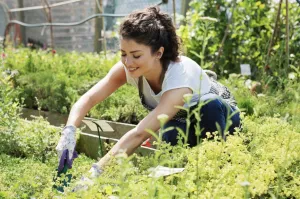
How school gardens might change not only the way kids eat, but also learn.
In a former New York City school parking lot, crumbling asphalt has been replaced with rich, dark soil. Some children tend to patches of dense, leafy greens while others harvest vibrantly colored carrots and beets. Just behind them, a kitchen awaits, where they’ll clean and prepare their bounty before sharing a nutritious meal at a communal table. When they’re finished, they’ll add organic waste to the composter and check on the chickens clucking away in a coop—all before returning to the main school building for classes that build upon their experience of working in the garden.
Such a scene may sound like the stuff of fantasy, but New York City’s first Edible Schoolyard is scheduled to begin taking shape this summer at P.S. 216 in Brooklyn. The $1.6 million facility, which will include a movable greenhouse, indoor kitchen, dining room, and chicken coop, not to mention solar panels and a rainwater collection system, slated to be the first northeast affiliate of a program first developed by Alice Waters, chef, activist, and owner of Chez Panisse, a restaurant in Berkeley, California.
In 1995, Waters founded the Edible Schoolyard at a single school in Berkeley—and after years of success, it’s now in the process of going national. Already, affiliates have sprouted up in cities like San Francisco, Los Angeles, New Orleans, and Greensboro, with interest continuing to pour in from communities across the country.
“We have an opportunity every school day to take the school lunch and turn it into something really nourishing, tasty, and positive,” says Waters, adding that the goal of the Edible Schoolyard goes well beyond health.
“Interactive education is a way to get kids to pay attention to lessons and have the information stick forever—that’s why doing math in the garden is genius,” she says. “They’re learning a hundred things at the same time, but mostly they’re opening their senses to smell, taste, and feel, and those are the pathways into our minds.”
Leading the charge for the New York affiliate is John Lyons, president of production at Focus Features and a Chez Panisse Foundation board member. Even though the garden and kitchen classroom will be built using private money gathered through fundraising, Lyons says he initially expected resistance to the idea from city officials. Much to his surprise, Mayor Bloomberg’s administration was supportive of the idea. “Both the departments of education and health are very proactive,” said Lyons, adding, “They’re doing everything they can to be part of this movement related to school lunches and sustainability, and looking at health, nutrition, and obesity.”
Cities across the country appear ready to bring sustainable food habits into schools. Manhattan borough president Scott M. Stringer recently called on New York schools to embrace the Meatless Mondays program for lunches, a national movement that encourages students to eat more vegetables, which has already been adopted in Baltimore schools. And then there are Trayless Tuesdays, which have been interpreted in a few different ways—with some schools removing Styrofoam trays from cafeterias to discourage students from taking more food than they need, with other schools use the day to pilot test biodegradable paper boats as a future replacement for wasteful trays.
These programs are not without criticism. Writing in The Atlantic this past January, journalist Caitlin Flanagan called the Edible Schoolyard program a “cruel trick” conjured up “by an agglomeration of foodies and educational reformers who are propelled by a vacuous if well-meaning ideology that is responsible for robbing an increasing number of American schoolchildren of hours they might other wise have spent reading important books or learning higher math.”
Rather than trying to help kids from all different backgrounds develop healthy eating habits at an early age, Flanagan opines: “The solution lies in an education that will propel students into a higher economic class, where they will live better and therefore eat better.”
But the survival-of-the-fittest approach to fixing America’s food habits is not shared by everyone. Consider First Lady Michelle Obama, who has made combating childhood obesity a personal priority, targeting school lunches as a key area for improvement. Proving that her focus on fresh food is more than just talk, last year she planted a vegetable garden on the White House’s South Lawn. At the same time, more high-profile supporters continue to stress the urgency of making significant changes, including British chef Jamie Oliver, who recently launched Food Revolution, a primetime television show aimed at American audiences.
Even with such progress, the drive to introduce healthier, more sustainable way of eating remains a daily battle for Waters. “I think of it like a war,” she says. “We’ve had 50 years of the devastating effects of fast food. Every day, you learn about the world by the way you eat, and the public school system is the only place we have that’s touching every child.”
Illustration by Parliament of Owls.