Unsurprisingly, given the sheer grandiosity of Queen—who notably titled their definitive album A Night at the OperaFreddie Mercury was always inspired by that musical form. He was especially taken by the renowned soprano of Spanish vocalist Montserrat Caballé, and, in 1988, the pair released the collaborative album Barcelona, a “dream come true” project that wound up being Mercury’s last.

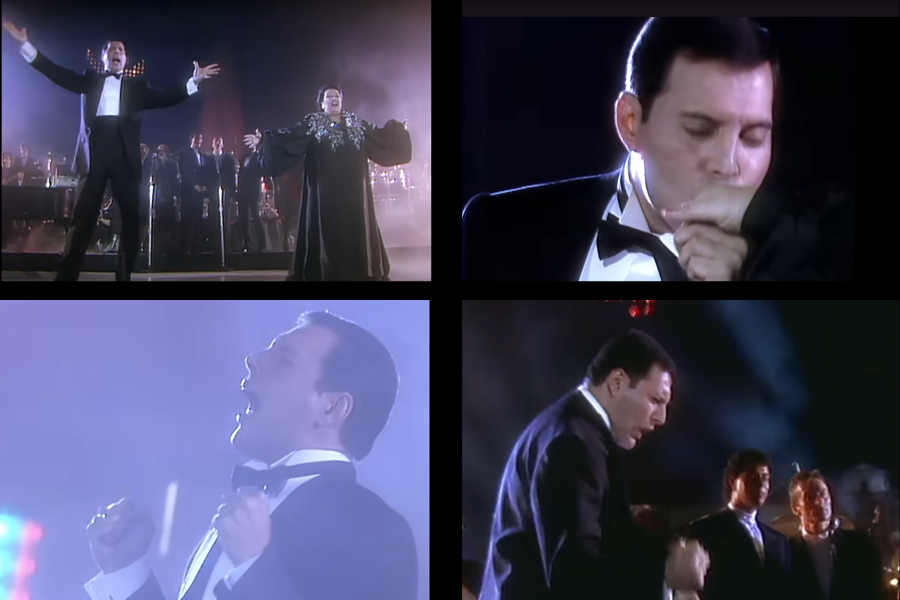
That record also led to the Queen singer’s reported final stage appearance in October of that year: a powerful (though possibly lip-synched) three-song presentation at Barcelona’s La Nit festival. It was a major moment for Mercury, who was diagnosed with AIDS the previous year and died in 1991, at the young age of 45, from complications of the disease.

The origins of Barcelona almost feel too good to be true. In a 1986 interview, Mercury mentioned his love of Caballé, enthusing, “She’s the best.” Later on, he looked back on that exchange, saying, “At that time, they asked me who was my favorite singer, and I said Montse. [O]f course, I thought about [a collaboration, and] I wondered if our voices would match or whether she would accept or anything. I think the rumor went around from the record company and friends and everything. And I think she was approached or asked or whatever. And she said yes, and then I came to Barcelona to see her for the first time and played her a few tunes, and she liked it. Now she’s a rock and roller.”

Caballé, already a Mercury fan, was excited about the collaboration. “No, I know his music [a] long time ago,” she said, according to a translation in the RTVE video. “My children are truly fans of him and his music too. At home, his music and his voice have always been heard. So his style and his vital melody were quite familiar to me. I was very impressed when he offered me this great opportunity. His music and his music on the piano were wonderful. I really think he’s a marvelous musician and composer.”

The duo created their first song, “Barcelona,” as a proposed theme for the 1992 Summer Olympics, which were held in the city. Mercury co-wrote the track with musician Mike Moran, initially experimenting by singing high to approximate Caballé’s parts. It was a challenging process but, ultimately, a profound one.

“It’s just a dream come true personally, you see?” he recalled. “It means a lot to me because I’ve finally done something I really wanted—to sing with her. To me, it’s blown my mind, and at the moment I still don’t believe it’s happening…I think career-wise, it really doesn’t matter. I’m just so proud of the fact that I’ve actually done it. Because I remember when we were actually rehearsing and doing things, I still thought, ‘It’s not happening.’ Finally, when she came to London and recorded and I finally got her voice on tape, I thought, ‘That’s it. I’ve got it.’”

Peter Freestone, Mercury’s personal assistant, recalled to The Guardian in 2012 that Caballé’s vocal sessions brought “tears” to his eyes. “The nearest I ever saw him to crying was when Montserrat came in and put the first vocal tracks down for the song ‘Barcelona,’” he said.

The bilingual “Barcelona” became the first of several collaborative tracks, with the duo releasing their album by that name in October 1988. The song, which peaked at No. 8 on the UK Singles chart, was featured in a montage that aired during the international Olympics broadcast. Sadly, Mercury died in November 1991, several months before the event.

But Mercury and Caballé still shared the spotlight during their beautiful appearance at La Nit festival, where they dramatized the song alongside an orchestra. The staging, full of fireworks and received with uproarious applause, is suitably operatic—the singers often locking hands and gazing into each others eyes. It ends with Mercury, arm outstretched in triumph, smiling sheepishly as he kisses his hero on the cheek.
  • Restaurant owner turns a fake 1-star tamale review into a social media frenzy
    (Left) Tamales in the corn husk. (Right) A woman works on a laptop. Photo credit: Canva

    A restaurant owner shared a strategic, fake one-star review that became a social media frenzy. Posing as Rebecca O., the first review described the tamale-eating experience as “absolutely awful tamale.” A second review followed, joking that Rebecca didn’t know to remove the husk before eating it.

    Restaurant owner Pauline Alvarado dreamed up the creative marketing tactic. She came up with the idea after a woman had expressed a similar experience just days before.

    One-star tamale review goes viral

    Located in Phoenix, Arizona, The Tamale Store is a family-owned Mexican restaurant. After Alvarado craftily posted the first one-star review, the second earned a full four stars. It read, “OK, I was just told I’m not supposed to eat the cornhusk. That just changed the whole experience. Seriously the best thing I’ve ever tried omg. Sorry I don’t know how to delete my other review, my bad.”

    The review has gone viral on multiple platforms, including Instagram and Facebook. The Internet delivered thousands of comments and a flood of exposure for the restaurant—an excellent outcome for any successful marketing strategy.

    In a 2026 article in Newsweek, Alvarado shared the story behind her winning idea:

    “The idea came from a woman who purchased a hot tamale the day before and came back to complain. When I went to see which one she had been eating, I realized she had eaten part of the corn husk. We both laughed, and I gave her another tamale on the house so she could try again. That moment inspired the Rebecca character. In our 18 years in business, I cannot count how many Rebecca O’s we have had. I wanted to showcase that in a lighthearted and funny way!”

    tamale, restaurants, Mexican food, husk, food preparation, funny story
    Unwrapping a tamale from the corn husk.
    Photo credit: Canva

    People share their thoughts with Rebecca

    One of the reasons behind the success of the fake one-star review was its relatability. Here are some of the comments shared on one of the Instagram posts:

    “Welcome to the wonderful world of tamales, Rebecca.”

    “Had a friend from Ohio also eat the husk and was trying to be polite and still said it was good. Such a good laugh lol.”

    “Like when my dad said he didn’t like mango and come to find out it’s because he ate it like an apple”

    “They really should tell people or give instructions not to eat the skin I had my first one a couple years ago and I didn’t know either.”

    “I didn’t eat a tamale until I was almost 30 and I was so confused about this too”

    crowd, community, relatability, social interactions, social media, events, viral
    A crowd doing the wave. Photo credit: Canva

    Why relatability sells

    Alvarado isn’t the first business owner to craft a successful sales and marketing tactic through social media. Credibility and engagement are often tied to relatability.

    A 2025 study published on Springer Nature Link revealed that “authentic” influencers drive stronger engagement and significantly affect consumer response and purchases. Similarly, a 2025 engagement study found that increased user interaction on platforms like Instagram suggested relatable content influenced sales.

    When studies reveal that relatable, story-driven content drives engagement, it’s easy to see why Alvarado’s fake one-star tamale review was so successful. Turning confusion into comedy and connection created real buzz. The idea, based on real-life experience, was simple, human, and funny.

  • These seven simple phrases could be the secret to deepening trust and romance in your relationship
    A happy couple enjoys coffee togetherPhoto credit: Canva
    , , ,

    These seven simple phrases could be the secret to deepening trust and romance in your relationship

    If you want a more secure relationship a Harvard expert recommends using these seven phrases.

    Maintaining a deep sense of connection and trust in a long term relationship is often easier said than done. Even for couples who have been together for years, the daily grind can sometimes dull the spark of romance. However, Dr. Cortney Warren, a psychologist trained at Harvard Medical School, has identified a specific set of verbal habits that distinguish highly successful, trusting couples from those who struggle.

    Dr. Warren recently shared seven phrases that secure partners use every day to reinforce their commitment. These small shifts in language are designed to foster vulnerability, safety, and a sense of shared purpose.

    The first few phrases focus on the core of any partnership: the belief that your partner is on your side.

    @drcortneywarren

    Feeling that twinge of jealousy or insecurity in your relationship? It happens to all of us, but how you respond can make all the difference. Instead of immediately reacting, try this: pause and ask yourself: What does my reaction to this situation say about me? Is it about fear of being unloved? A belief that you’re “not enough”? Often, our strongest emotional reactions are more about our own insecurities than about our partner’s actions. Taking the time to reflect on your triggers, where they come from, and how you can strengthen your self-esteem can help you communicate with your partner in a healthier, more productive way. This clip is from my recent conversation with Shanenn Bryant on the Top Self Podcast. #SelfAwareness #EmotionalIntelligence #HealthyRelationships #JealousyTriggers #TopSelfPodcast #RelationshipAdvice

    ♬ original sound – DrCortneyWarren – DrCortneyWarren

    1. “I trust you.”

    Simple, to the point, and clear. This communicates that you know your partner and that you believe they have your best interest in heart, even if you get into an argument. It also allows them to feel safe making some decisions on both of your behalf.

    2. “You see me as I am.”

    This not only tells your partner that they know all there is to know about you without fear of hiding parts of yourself, but that you’re comfortable being vulnerable should a difficult subject come up. It communicates that you trust your partner will respond with compassion, not judgment, while implying that they can trust you to do the same in return.

    Dr. Cortney Warren, relationship advice, Harvard psychologist, building trust, healthy communication, romance tips, non-verbal cues, marriage success, intimacy, partnership
    A couple on a romantic date. Credit: Canva

    3. “We’ll get through this.”

    Arguments, fights, and conflicts happen in even the most solid relationships. However, saying this phrase reinforces that while things still need to be sorted out, there is no intention of breaking the relationship over the disagreement. It allows more open communication and reiterates that it is you and your partner against the problem, not each other.

    4. “Go have fun with your friends/Thanks for giving me space!”

    If your relationship is solid, time apart shouldn’t be a threat. Alone time is natural and, frankly, healthy. Respecting your partner’s independence in turn respects yours.

    Dr. Cortney Warren, relationship advice, Harvard psychologist, building trust, healthy communication, romance tips, non-verbal cues, marriage success, intimacy, partnership. Credit: Youtube

    5. “I miss you.”

    As a counterbalance to the previous phrase, “I miss you” isn’t an indicator of being too clingy unless you’re not offering your partner the trust to have space. It’s just a nice way of saying that you look forward to being together and builds upon that when you reunite, whether it’s after a long business trip or later in the evening after work.

    6. “Let’s make a plan!”

    A growing relationship means mutually planning and investing in each other’s futures to further turn “your plans” and “my plans” into “our plans.” This phrase relays to your partner that you want them around for the long haul.

    7. “Can we talk?”

    Communication issues are one of the primary reasons relationships fail. Asking this simple and direct question accompanied with the previous phrases as foundations in your relationship will allow trust for you to ask and be asked when something troubling occurs with either of you.

    While verbal communication is important in sustaining relationships, it’s good to incorporate non-verbal gestures of support, love, and trust, too.

    Now, pairing these loving wordless gestures that expertscounselors, and psychologists recommend with the previous seven phrases could help your relationship develop deeper connection and trust.

    1. Eye contact

    Seeing eye-to-eye literally helps you both see eye-to-eye better when discussing a difficult topic or when you want to express loving attention to your partner.

    2. Smile

    Smiling is a nonverbal cue to reiterate that your partner’s presence is welcomed and safe. It also reminds your partner that you’re both okay, too.

    3. Supportive touch

    Caressing a shoulder, a peck on the forehead, holding hands, or a tight hug—any of these and all of these are ways to provide comfort and reassurance along with your words. It could also be a way to indicate your interest in further intimacy.

    4. Mirroring

    Matching your partner’s posture and pose helps foster connection while also indicating you’re absorbing what they’re verbally communicating to you. So, when you adjust your posture to meet theirs when they’re discussing something important to them, they’ll know you think it’s important, too. On the other end, if you match their relaxed pose, they’ll in turn feel more relaxed, too.

    5. Enjoy quiet time together

    Being able to enjoy the silence in the same room bolsters feelings of safety and comfort. It shows that you and your partner don’t feel panicked or stressed about the other feeling bored, awkward, and you don’t cary the pressure of needing to be entertained/entertaining. Shared silence is precious in a relationship.

    6. Handwritten notes

    Okay, this might be a cheat technically, but written notes and letters can be left for your partner to find when they wake up after you have left for work early, on the kitchen table, or on a bathroom mirror as ways to express those previous seven phrases. For some people, written communication is much easier for them than speaking, too, so there’s that factor to consider.

    7. Acts of service

    This is a bit of a grab bag as what acts of service are depends on who you are in the relationship with. It could be making them coffee each morning the way they like it so they don’t have to. It could be doing a chore they hate doing. It could be cooking them their favorite food after finding out that they had a long day. These acts remind your partner that they’re known and safe with you.

    This article originally appeared last year.

  • Local governments provide proof that polarization is not inevitable
    Local officials get to participate in events such as ribbon cuttings, celebrating projects they may have helped make happen.Photo credit: NHLI/Eliot J. Schechter via Getty Images
    ,

    Local governments provide proof that polarization is not inevitable

    From potholes to parks, shared priorities are bringing people together where they live.

    When it comes to national politics, Americans are fiercely divided across a range of issues, including gun control, election security and vaccines. It’s not new for Republicans and Democrats to be at odds over issues, but things have reached a point where even the idea of compromising appears to be anathema, making it more difficult to solve thorny problems.

    But things are much less heated at the local level. A survey of more than 1,400 local officials by the Carnegie Corporation and CivicPulse found that local governments are “largely insulated from the harshest effects of polarization.” Communities with fewer than 50,000 residents proved especially resilient to partisan dysfunction.

    Why this difference? As a political scientist, I believe that lessons from the local level not only open a window onto how polarization works but also the dynamics and tools that can help reduce it.

    Problems are more concrete

    Local governments deal with concrete issues – sometimes literally, when it comes to paving roads and fixing potholes. In general, cities and counties handle day-to-day functions, such as garbage pickup, running schools and enforcing zoning rules. Addressing tangible needs keeps local leaders’ attention fixed on specific problems that call out for specific solutions, not lengthy ideological debates.

    By contrast, a lot of national political conflict in the U.S. involves symbolic issues, such as debates about identity and values on topics such as race, abortion and transgender rights. These battles are often divisive, even more so than purely ideological disagreements, because they can activate tribal differences and prove more resistant to compromise.

    When mayors come together, they often find they face common problems in their cities. Gathered here, from left, are Jerry Dyer of Fresno, Calif., John Ewing Jr. of Omaha, Neb., and David Holt of Oklahoma City. AP Photo/Kevin Wolf

    Such arguments at the national level, or on social media, can lead to wildly inaccurate stereotypes about people with opposing views. Today’s partisans often perceive their opponents as far more extreme than they actually are, or they may stereotype them – imagining that all Republicans are wealthy, evangelical culture warriors, for instance, or conversely being convinced that all Democrats are radical urban activists. In terms of ideology, the median members of both parties, in fact, look similar.

    These kinds of misperceptions can fuel hostility.

    Local officials, however, live among the human beings they represent, whose complexity defies caricature. Living and interacting in the same communities leads to greater recognition of shared interests and values, according to the Carnegie/CivicPulse survey.

    Meaningful interaction with others, including partisans of the opposing party, reduces prejudice about them. Local government provides a natural space where identities overlap.

    People are complicated

    In national U.S. politics today, large groups of individuals are divided not only by party but a variety of other factors, including race, religion, geography and social networks. When these differences align with ideology, political disagreement can feel like an existential threat.

    Such differences are not always as pronounced at the local level. A neighbor who disagrees about property taxes could be the coach of your child’s soccer team. Your fellow school board member might share your concerns about curriculum but vote differently in presidential elections.

    Mayors can find themselves caught up in national debates, as did Minneapolis Mayor Jacob Frey over the Trump administrationu2019s immigration enforcement policies in his city. AP Photo/Kevin Wolf

    These cross-cutting connections remind us that political opponents are not a monolithic enemy but complex individuals. When people discover they have commonalities outside of politics with others holding opposing views, polarization can decrease significantly.

    Finally, most local elections are technically nonpartisan. Keeping party labels off ballots allows voters to judge candidates as individuals and not merely as Republicans or Democrats.

    National implications

    None of this means local politics are utopian.

    Like water, polarization tends to run downhill, from the national level to local contests, particularly in major cities where candidates for mayor and other office are more likely to run as partisans. Local governments also see culture war debates, notably in the area of public school instruction.

    Nevertheless, the relative partisan calm of local governance suggests that polarization is not inevitable. It emerges from specific conditions that can be altered.

    Polarization might be reduced by creating more opportunities for cross-partisan collaboration around concrete problems. Philanthropists and even states might invest in local journalism that covers pragmatic governance rather than partisan conflict. More cities and counties could adopt changes in election law that would de-emphasize party labels where they add little information for voters.

    Aside from structural changes, individual Americans can strive to recognize that their neighbors are not the cardboard cutouts they might imagine when thinking about “the other side.” Instead, Americans can recognize that even political opponents are navigating similar landscapes of community, personal challenges and time constraints, with often similar desires to see their roads paved and their children well educated.

    The conditions shaping our interactions matter enormously. If conditions change, perhaps less partisan rancor will be the result.

    This article originally appeared on The Conversation. You can read it here.

Explore More Culture Stories

Well-being

These seven simple phrases could be the secret to deepening trust and romance in your relationship

Culture

Local governments provide proof that polarization is not inevitable

Culture

His memory resets every 30 seconds. A look inside his 1990 diary shows what he never forgot.

Culture

How business students learn to make ethical decisions by studying a soup kitchen in one of America’s toughest neighborhoods