Given that fewer Americans are donating and volunteering and that people in the U.S. appear to be losing trust in one another, it may seem like generosity has eroded in the United States.

The nation’s political, social and economic divides might only strengthen that impression. But my recent research suggests that this belief would be misguided.

I’m a professor who teaches and conducts research about nonprofits and philanthropy. To understand the diversity of American generosity, I teamed up with Paige Rice and Veronica Selzler, two philanthropy consultants who contributed to the Generosity Commission’s report on U.S. generosity called “How and Why We Give.”

The Generosity Commission is a nonpartisan group of leaders from across the charitable sector. Its 2023 report shared the results of a national survey of 2,569 U.S. adults.

Multicolored hearts are scattered on a white background.
There are many ways to be generous. MirageC/Getty Images

Drawing on data from that study, we sought to understand how different kinds of people may be motivated to act generously for different reasons and, as a result, express their generosity differently.

The study defined generosity broadly in terms of efforts or gifts made to support people in need, charitable causes or philanthropic organizations through actions like giving and volunteering. Our study was published in March 2026 in Nonprofit Management & Leadership, a peer-reviewed academic journal.

The overall propensity to give was about 82% based on responses to this question in the Generosity Commission’s survey: “On average, how much money do you donate each year to people in need, charitable causes, or philanthropic organizations?”

The survey also asked Americans about how they express their generosity.

We found that Americans’ generosity varies according to their aspirations, motivations and demographic characteristics. In other words, different kinds of Americans are generous in different ways.

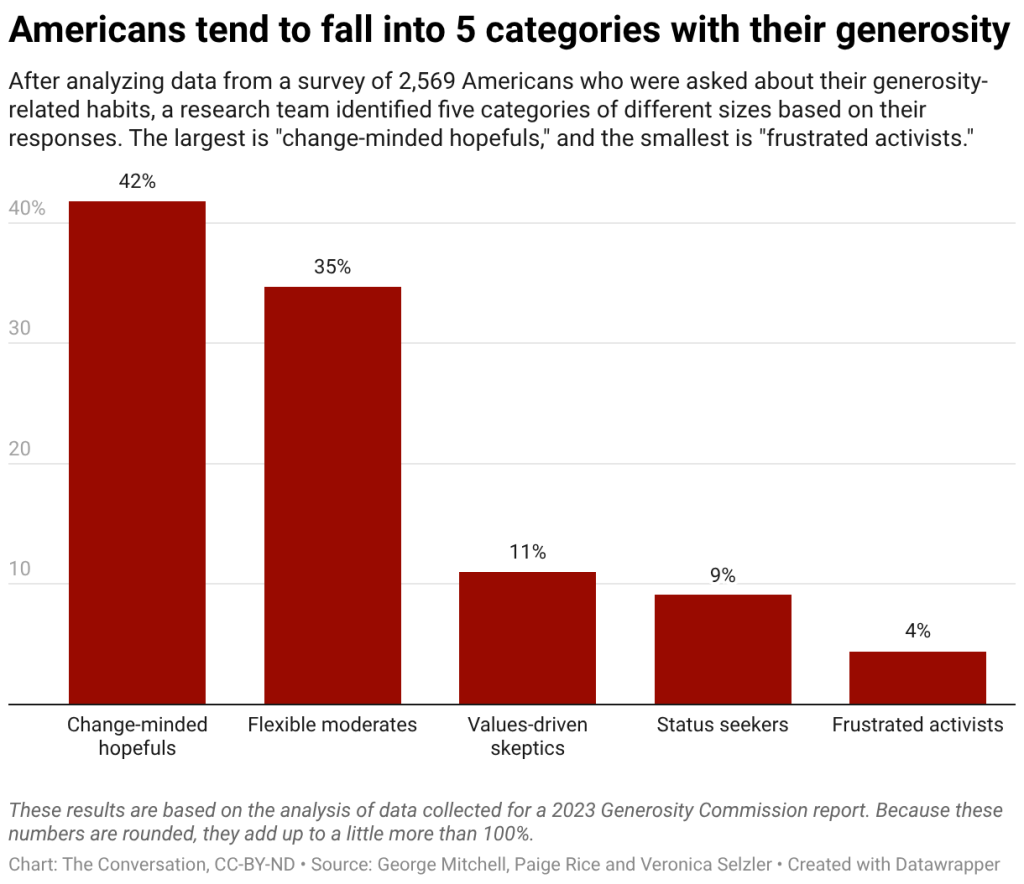
Using a statistical modeling technique called latent profile analysis, which can find hidden groups of people based on observed data, we identified five segments of American society. They come from the general population, not just existing donors or volunteers.

Change-minded hopefuls, about 42% of the total, are mostly women and people with low incomes. They genuinely want to help people but are held back mainly by not having enough money.

Flexible moderates, roughly 35% of the survey’s respondents, are a middle-of-the-road group without strong political or religious motivations. They are open to helping out in a wide variety of ways when given the opportunity.

Values-driven skeptics, around 11% of those surveyed, are mostly older, conservative, religious and male. They are willing to give money but are worried that charities might not make good use of it.

Status seekers, approximately 9% of the participants in the survey, are the most generous group. Affluent, educated and religious, they are highly active in giving and volunteering and are motivated by social recognition and personal benefits.

Frustrated activists, only about 4% of the total, are passionate, liberal and financially strapped. They are often women and people of color. They care deeply about causes and prefer to take direct action rather than giving money.
These results are based on the analysis of data collected for a 2023 Generosity Commission report.

Why it matters

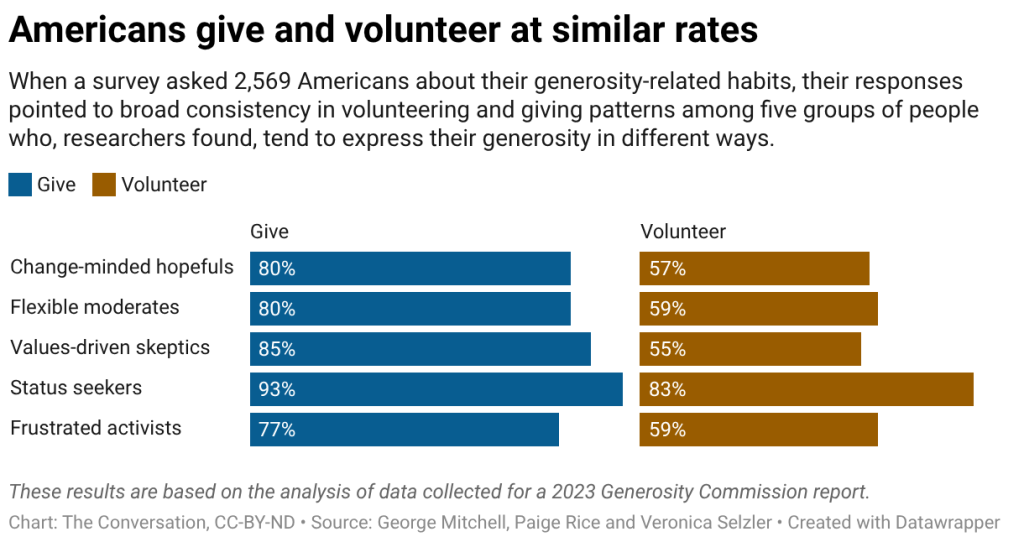
Each of these groups is relatively generous. For example, the percentage of people in each one donating to people in need, charitable causes or philanthropic organizations ranged from a low of 77% – the frustrated activists – to a high of 93% among the status seekers. This shows that Americans with different mindsets exhibit a willingness to help others, even if their aspirations, motivations and demographic characteristics differ.

For nonprofits looking to attract more donors and volunteers, it may help to understand that different groups of people may have different motivations and concerns. By appealing to each group’s distinct qualities, nonprofits may be able to garner more support for their causes.
These results are based on the analysis of data collected for a 2023 Generosity Commission report.

What other research is being done

Researchers with the Lilly School of Philanthropy at Indiana University and their partners are conducting numerous studies about American generosity.

For example, in a study published in 2019, those researchers found a sharp decrease in the percentage of Americans who gave to nonprofits following the Great Recession. And their ongoing research on global philanthropy tracks cross-border giving for 47 countries, including the U.S., to document global trends in generosity.

The Research Brief is a short take about interesting academic work.

This article originally appeared on The Conversation. You can read it here.

  • Young boy struggles through painful stutter until his singing videos change everything 
    Photo credit: WQAD News 8/YouTubeLando sings.
    ,

    Young boy struggles through painful stutter until his singing videos change everything 

    “One kids courage to show up, speak up, and sing his voice free.”

    A boy named Lando is gaining attention online after people started sharing and liking the two very different kinds of videos he creates. In one, he candidly speaks with a severe stutter. In the other, he sings smoothly, without the same pauses and repetitions that appear when he talks.

    Perhaps it’s the dramatic contrast that has people liking and clicking. For whatever reason, as Lando shares on his website, #stutterfreelando, he’s created an awareness movement around stuttering “born from one kid’s courage to show up, speak up, and sing his voice free.”

    The young entertainer is easy to like

    Finding a young person navigating his speech difficulties so charismatically and confidently is admirable. He’s not wavering under the spotlight. He’s shining.

    His family shares about their experience and the methods they’ve found helpful with his stutter on their website:

    “This is a family journey. We’re one of millions of families around the world navigating stuttering to learn what works, what doesn’t, and figuring it out as we go. Some of what we share helps Lando. Some might not. We’re learning that every stutterer is different. No more hiding.”

    Facing a severe stutter can be more complicated than practicing with a speech therapist.

    Traditional therapy hasn’t given us the breakthroughs we need. Therapists are trying. We are trying. But we refuse to sit quietly and hope it clicks. So we built this, a movement where our family shares what we’re learning out loud. Real strategies. Real techniques. Lando’s good days and the hard ones. Not a highlight reel. Not a gofund me. Real life.”

    It feels good to join a winning team

    After watching any of his videos, it’s clear why so many people keep coming back.

    In one clip, Lando talks about reaching 50,000 followers on Instagram and an upcoming interview with a local news outlet. The message expressed with gratitude and happiness is simple, but it takes time for him to get there. That process draws people in.

    “Congratulations on your followers, add one more”

    “Great work buddy!”

    “Ah Lando, I’m really enjoying your videos”

    “That excitement is so cute! I love how supportive everyone has been!”

    “Great job little man keep it going. You inspire a lot of people with the same problem.”

    “thankyou for sharing, your super cool.”

    Singing allows his words to come out in a continuous flow

    The difference isn’t subtle. In speech, words can stall and be difficult to get out. In song, they move by the rhythm that reduces stops. These are some of the comments you can find on just one of his singing videos posted above:

    “GOD BLESS YOU LANDO!!!!! YOU ARE ABSOLUTELY AMAZING!!!!!”

    “The eyebrows at the end was fire.”

    “You are an inspiration”

    “Brilliant buddy”

    “… sounding smooth.”

    “Lando with the great voice!!!”

    “Now … this kid has charisma!!!”

    A courageous little showman

    Lando’s videos stand out not just for singing or stuttering, but because both are available, openly shared, without one being hidden or edited out of view. There’s no attempt to turn it all into a single narrative of struggle or success. Instead, what people see is a boy using his voice as it is.

    There is something instinctive about the way people rally around a kid like Lando. Sharing the hard parts and the moments that come more easily gives everyone a clear way to respond. Cheering him on, leaving a positive comment, or even just watching and listening allows each of us to take a small part in that effort.

    It’s less about celebrating the win and more about recognizing the work and the courage to keep going. Lando is talking and singing it out loud.

  • Homeowners swear by this simple ice cold hack that thoroughly makes your toilets cleaner
    Photo credit: CanvaMany believe cleaning the toilet properly starts by filling it with ice cubes.

    Most people welcome a new cleaning hack, especially if it involves the bathroom. Cleaning the toilet isn’t a fun task and getting it thoroughly spotless can get stinky real quick. However, there’s one hack that many homeowners say gets their toilets cleaner with less elbow grease. It involves emptying your ice tray.

    There are experts who recommend putting ice cubes down the toilet whenever it is time to clean.

    Toilet cleaning starts with your freezer

    This understandably sounds weird. Many people might remember flushing ice cubes down the toilet as a superstitious ritual during the winter months to “summon” a snow day from school. But to clean the toilet? That sounds like just as much as a myth. 

    But there is a logic to it and many homemakers suggest it. First, let’s get this out of the way and say that ice cubes aren’t being flushed to replace regular toilet cleaner. It’s actually being used to help the cleaner be more effective.

    So…how could ice help clean my toilet?

    Ice in the toilet bowl acts as a support for the toilet cleaner. Often, toilet cleaner drips down the side of the toilet bowl into the water and down the pipe. The ice allows the cleaner to cling to the bowl and its sides for longer, penetrating filth and disinfecting it more effectively.

    Here’s the gist on how it works: first, take a bowl of ice cubes and pour them into the toilet. Make sure you’re not filling it to the brim. Next, take your preferred toilet cleaning solution and pour/spray it onto the ice. Let the mixture sit for about 15 minutes to allow the cleaning solution to cling and disinfect the bowl. After that, use a toilet brush to stir and agitate the ice, ensuring that it is scraping all sides of the bowl. By this time, the ice should have melted enough to flush. 

    There are additional bonuses to using ice with toilet cleaner. The ice can also act as an abrasive pumice stone in addition to your toilet brush, scraping off mildew, mineral build-up, or other yucky things that could be stubbornly clinging to the bowl. The flushed ice could help clean the pipe similarly, dislodging filth and grime in conjunction with the toilet cleaner on its way down.

    Another benefit is reducing odor. Ice is known to absorb smells and could make cleaning a little less smelly. It’s one of the reasons why many restaurants, clubs, and bars put ice in men’s urinals.

    Many people who frequently travel and live in an RV also recommend flushing ice down their toilets. This is not just to clean the bowl, but to have the ice jostle and scrape the nasty stuff out of the black tank. While this method’s effectiveness in cleaning a black tank is put into question, critics still say that ice can help reduce smells and keep water in the black tank during hot days.

    Final tips (specifically “don’ts”)

    If you plan on giving this hack a try, be sure not to overflow your toilet with ice. Along with that, while most forms of ice work (cubes, crushed, or chips), putting larger blocks of ice in the toilet won’t do any good and could clog things up if they’re too big.

    It’s also important to use one cleaning solution and not mix a bunch together. Mixing cleaning products together could create fumes that are dangerous to inhale. It’s best to use your preferred cleaner and choose a different one next time if you’re getting the results you want.

  • Facebook group helps families without a ‘village’ find surrogate grandparents
    Photo credit: CanvaSurrogate grandparents laughing with small child.

    Raising kids today doesn’t match the historical “it takes a village” experience many grew up with. Not because people don’t care, but because life doesn’t seem to line up that way anymore. Families are spread out across the country and sometimes the world. Few grandparents live just up the street. There’s no built-in help for childcare and no extra sets of hands when things get overwhelming.

    In response to that missing piece in raising kids, some people have looked for other ways to create something similar. One path is Surrogate Grandparents – USA, a Facebook-based community that connects older adults with families.

    surrogate grandparents, chosen family, connecting seniors, programs
    An older man helps a boy water the plants.
    Photo credit Canva

    Missing out on grandparents nearby, some find new ones online

    Founded in 2015, Surrogate Grandparents – USA offers a platform that works like a community bulletin board. The goal is to bring together families bereft of nearby grandparents with older adults looking to share that kind of family role.

    Over 14,000 members hope to make a surrogate family connection and the possibility of building real love. They describe the opportunity on their Facebook page as follows:

    “A surrogate grandparent is a volunteer or mentor who forms a supportive, grandparent-like relationship with a child or family who may not have local grandparents. These relationships can begin online or in person, often through platforms designed to connect families and older adults.”

    The typical online pattern might look like a family posting on the page that their children don’t have nearby grandparents and would love a consistent older presence in their lives. Someone responds. They all start talking. Then, they meet in person.

    Those introductions can turn into something steady with regular check-ins. Children receive the face-to-face guidance and experience that an older generation can offer. The surrogate grandparents gain a sense of purpose they hadn’t anticipated at this stage of their lives.

    support system, children bonding, mentorship, extended family
    A family picnic.
    Photo credit Canva

    Surrogate grandparent success stories

    One success story was shared in Newsweek. In 2019, Deborah Whatley, then aged 64, joined the Facebook group with her husband. Hoping to fill a need within their own lives, they connected with the Nelsons, and a beautiful relationship quickly blossomed.

    The families share photos, meet in person about every month, and text regularly. “We’ve met up more times than I can count,” explained Whatley. “I just wanted to feel included. I have the time, the energy, and the desire. Discovering the surrogate grandparents group instantly brought light back into a part of my life that had turned dark,” she added.

    CBS News reported that Anteres Anderson Turner and Louis Turner wished to extend their own family while raising twin boys. Janet Firestein Daw welcomed the idea of grandchildren in her life, saying, “I was getting older and I wanted to get down on the floor and play Legos and trains and read books.”

    After meeting through the Facebook group, the relationship between the two families really worked. Daw continued, “It’s indescribable for me, because I haven’t had that experience before to be that grandparent, and I love it.”

    Facebook closes the page

    Earlier this year, the Facebook group became inaccessible. There haven’t been any publicly reported reasons from Facebook itself. However, an administrator for the page shared, “Surrogate Grandparents-USA group was unfortunately erroneously removed by Meta. We are actively working to have it reinstated.”

    Thankfully, the page was reopened in time. In an Instagram post dated April 11, 2026, they said, “This morning, my Surrogate Grandparents-USA group was officially reinstated.” The post continues, “What a journey this has been—stressful, emotional, and at times incredibly disheartening. But I never stopped believing in the purpose of this community…and the power of speaking up when something isn’t right.”

    community, kindness, parenting support, family structures
    An extended family at the park.
    Photo credit Canva

    A shift in how family works

    The structures that used to hold families together aren’t as automatic as they once were. For a long time, grandparents lived nearby. Neighbors remained for decades. Communities were tighter, and lives were more interwoven. Support existed from a simple proximity.

    But families move. Relationships change. Career and circumstance have stretched people farther apart. Places like Surrogate Grandparents – USA fill roles that certain families are missing. It may not work for everyone, but for many, it’s a chance to build community in a whole new way.

Explore More Ideas Stories

Voices

Young boy struggles through painful stutter until his singing videos change everything 

Ideas

Homeowners swear by this simple ice cold hack that thoroughly makes your toilets cleaner

Ideas

Facebook group helps families without a ‘village’ find surrogate grandparents

Voices

Husband steals the spotlight picking up PR packages for wife who became an influencer at 80