
It takes a significant amount of confidence for a child to correct an educator, but one 8-year-old girl from Birmingham, England, recently did so with just seven letters. Yasmine, a young student whose quick wit is currently circulating online, was faced with a seemingly simple English assignment that carried a heavy dose of outdated gender bias.
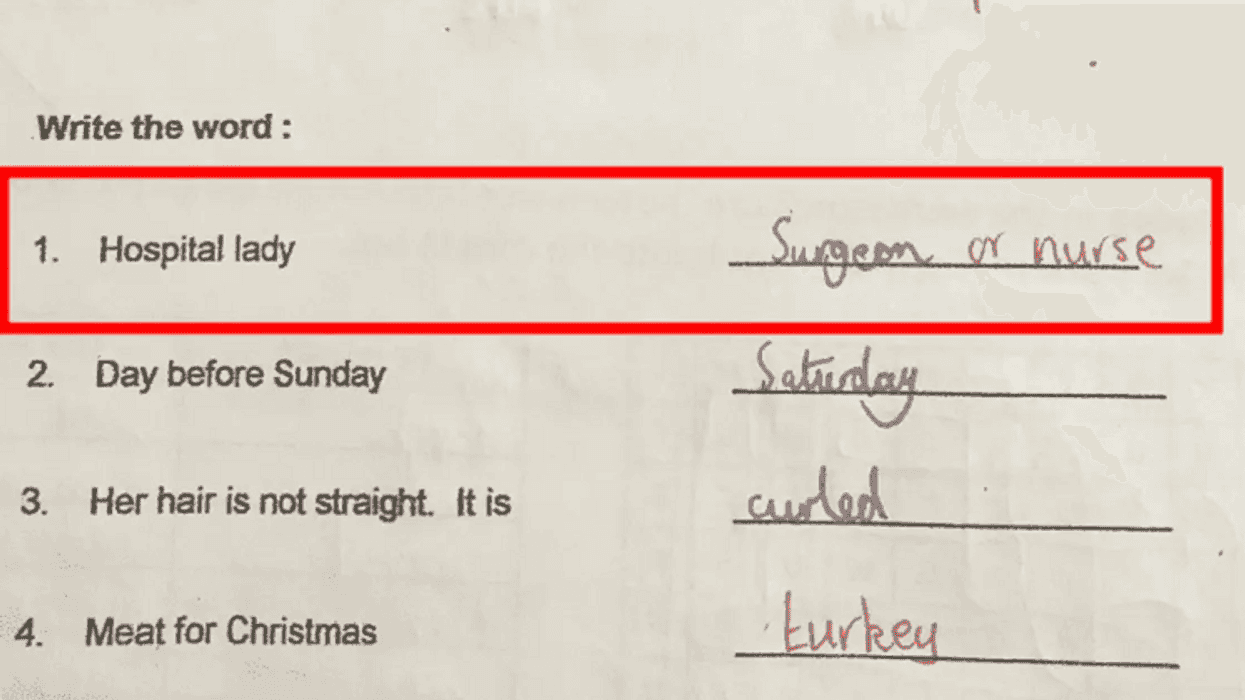
The homework in question was a word puzzle designed around the letters “UR.” One of the clues provided by the teacher was the phrase “Hospital Lady.” The intended answer, which fit the puzzle’s constraints, was “nurse.” While most children might have filled in the expected term without a second thought, Yasmine had a different perspective: she wrote “surgeon.”
Her father, Robert Sutcliffe, shared a photo of the assignment on X (formerly Twitter), and the post quickly caught the eye of thousands. The image revealed that even after Yasmine provided a factually correct and ambitious answer, the teacher still felt the need to scribble “or nurse” next to her work. This small, red-inked correction sparked a massive debate across social media about the biased expectations often baked into early childhood education.
The Power of Seeing Is Believing
For Yasmine, the answer was not about making a political statement; it was simply her reality. Both of her parents are surgeons, meaning she has grown up in an environment where women in high-level medical roles are the norm. Her response highlights a critical point about how representation shapes a child’s ambition. When children are repeatedly shown that women are primarily nurses and men are primarily doctors, they begin to internalize those limits.
Writing for The Guardian, Rebecca Brand explained the danger of these subtle messages. “Their developing minds are that little bit more unquestioning about what they see and hear on their screens. What message are we giving those impressionable minds about women? And how might we be cutting the ambitions of little girls short before they’ve even had the chance to develop properly?” she asked.
A Global Cycle of Stereotypes
This incident is more than just a viral moment; it is a reflection of a systemic issue. Research shared by various academic reports confirms that children as young as four years old begin to associate specific jobs with gender. In these studies, young girls often choose roles traditionally labeled as “feminine,” such as nursing, while boys gravitate toward “masculine” fields like engineering.
This early conditioning has long term consequences. Data from 50 different countries reveals that by the time girls reach age 15, they disproportionately begin to move away from math and science. Conversely, boys often avoid caregiving fields such as teaching and nursing. This segregation creates a cycle where women remain underrepresented in STEM and men remain underrepresented in caregiving, limiting the potential of both genders before they even enter the workforce. By challenging a single line in a word puzzle, Yasmine reminded the world that the next generation is watching, and they are ready to see a much bigger picture.
This article originally appeared two years ago.