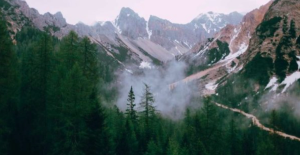
In northern Madagascar, the village of Anketrakabe lies 60 kilometers from the nearest paved road. There, farmers without running water or electricity grow cocoa beans that, unlike most of Madagascar’s cocoa harvest, will not be sent to far away Europe for processing.
These farmers partner with the Brooklyn-based chocolate company Madécasse (pronounced mah-DAY-cas) and ship their cocoa to the capital city—still a three-day journey at best—where it is transformed into chocolate bars before being shipped to retailers across the globe.
“If you really want to do something that benefits people long term and is sustainable,” Tim McCollum, one of Madécasse’s co-founders says, “it needs to involve trade, and that’s when we started this company. We’ve been able to get good relationships with farmers and offer them better payment and terms because our supply chain is so much shorter.”
McCollum and co-founder Brett Beach both served as Peace Corps volunteers in Madagascar from 1999 to 2001. Afterward, McCollum worked in New York for American Express, while Beach stayed in Madagascar working at the U.S. Embassy and later with the U.S. Agency for International Development. In 2006, the two started discussing a potential business in the island country.
In Madagascar, 80 percent of people are small farmers who grow crops like rice, vanilla, and cocoa. Seventy percent of the world’s cocoa beans come from Africa, but less than one percent of the world’s chocolate is produced there. Most African cocoa winds up in chocolate factories in Belgium, Switzerland, and France. McCollum and Beach believed producing chocolate on the island instead of shipping beans abroad would keep more money in the local economy, and that a shorter supply chain might let them compensate farmers more handsomely than their competitors.
Madagascar’s cocoa varieties are genetically distinct, and the island’s inherent isolation combined with its rich biodiversity yield a terroir unlike any other place on earth. Connoisseurs regard Malagasy chocolates as among the best, which allows the company to charge a premium and ultimately makes its business model viable.
Madécasse, an early French name for the island, started out of Beach’s basement in Lawrence, Kansas. The founders racked up credit card debt and borrowed money from friends and family to formally establish the brand in 2008, the year it produced its first chocolate bar. In 2011, sales exceeded $1 million, and McCollum estimates sales of $2.5 million this year. About 1,200 retailers sell Madécasse products in the United States, including 250 Whole Foods stores.
One of the biggest challenges it faces is meeting quality standards of Western markets. The company’s first chocolates weren’t quite up to par. Blogging for The New York Times Magazine, Jill Santopietro noted that Madécasse chocolate she tasted in December 2008 was “a bit astringent” and “the raw beans need[ed] improved fermentation.”
Prime chocolate-making cocoa needs to ferment for at least six days and dry for six more. Madécasse’s partner farmers don’t have enough cash flow to hold onto their crop for nearly two weeks—they want to sell immediately after harvest. Furthermore, farmers had no frame of reference for quality control in the beginning. “You have farmers farming cocoa,” McCollum says, “who have never eaten chocolate.”
So Madécasse created an incentive structure to improve their lagging quality. The company offered a 50 percent bonus for delivery of high-quality beans and agreed to give farmers a portion of their payments up front and pay the rest upon delivery, and provided farmers financing for storage sheds, fermentation vats, and drying trays.
“The bars have improved twofold,” Santopietro wrote only seven months after first tasting Madécasse. “I’m awestruck.”
The company works with six cocoa co-ops of about 30 members each, and McCollum estimates that they provide work for up to 250 farmers during the high season in December. Four managers and 14 quality control officers monitor farming operations, and the company employs 30 people at its partner factory in the capital, Antananarivo.
“Before Madécasse, the factory only produced like 15,000 bars per year,” Michaël Chauveau, director of operations in Madagascar, says via email. “Now they do like 40,000 bars per month … Because of a big demand from Madécasse, the factory will make some investments in a few months to increase its capacity. It will help the factory to grow, hire more technicians.”
Madécasse’s high-quality export model is reminiscent of Rwanda’s coffee sector. For years, Rwandan coffee was stuck in what Karol Boudreaux, a USAID researcher, has called a “low-quality/low-quantity trap.” Over the past decade, the Rwandan government removed various trade barriers, hundreds of co-ops developed coffee washing stations to add value to their crop in country, and the sector transitioned from low-quality output to high-quality, high-priced bean production. Rwandan coffees are now known as specialty brews and marketed at high-end cafes like Bourbon Coffee in Washington, D.C.
“The idea is to add more of the value locally,” says Boudreaux, “so that more of the benefits are retained locally, and those benefits then are circulating within the local economy, as is the case in Rwanda.”
During their two years in Peace Corps, McCollum and Beach learned the local Malagasy language. When they visit to check on local operations, the pair can speak to rural farmers in the local dialect, which earns and demonstrates a great deal of respect. McCollum credits this sort of local knowledge—a capacity most potential competitors lack—for much of the progress Madécasse has made with farmers and product quality.
But there are downsides to working in a place where most outsiders would feel like a lemur out of the forest. Prospective investors have told the owners that if their factory was in Albany, New York, instead of Antananarivo, Madagascar, they’d gladly put down $5 million.
Madécasse exports to North America, Europe, Australia, and South Africa. After Wine Spectator covered the company, a South African retailer inquired about importing its products. “I didn’t realize what an appetite there is in Africa to consume products that are made in Africa,” McCollum says. A recent report by The Economist highlighted the “genuine middle class” emerging across the continent, with 100 million households expected to earn annual incomes greater than $3,000 by 2015.
“I get the sense that people are starting to wake up,” says McCollum, “and realize that for 100 years they’ve been exporting about 65 percent of the world’s cocoa to France, and then importing the chocolate that France makes with their cocoa. There’s this appetite for it to work in Africa as well.”
While Malagasy cocoa is top-shelf, the country’s output is small beans—Madagascar doesn’t even appear on many worldwide production maps. The two entrepreneurs see an opportunity to apply their model to a much larger market. “Sixty percent of the world’s vanilla beans come from Madagascar, yet they’ve never exported a drop of vanilla extract, and every home in America has a 2 oz. jar of McCormick’s vanilla extract,” says McCollum. “We basically want to replicate what we’ve done with the chocolate supply chain and production model in the vanilla sector.”
“The big thing it’s showing is that Madagascar can make high-quality goods,” says Joe Salvatore, Madécasse’s marketing director. “Don’t count Africa out, and don’t count Madagascar out of making amazing products, just like anywhere else can.”
Photo courtesy Madécasse Chocolate Co.