I have a theory that every person is constantly pulled—almost by some invisible magnetic force—to one particular place that feels safe and magical and misty with nostalgia. Maybe it’s the gazebo where you got married or the garage where you started your first band. It feels like, if you just get back there, the white noise will gently dim and life will briefly make sense again.

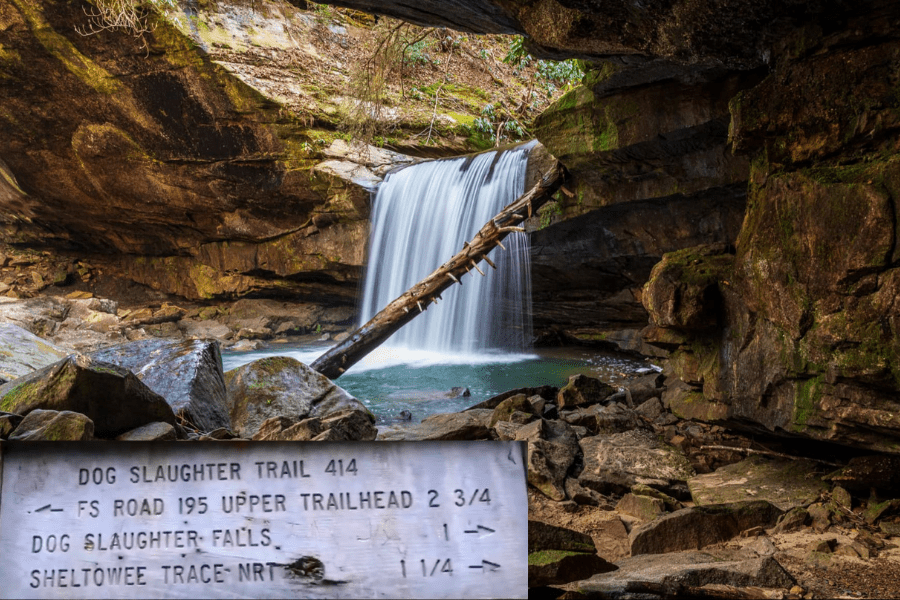
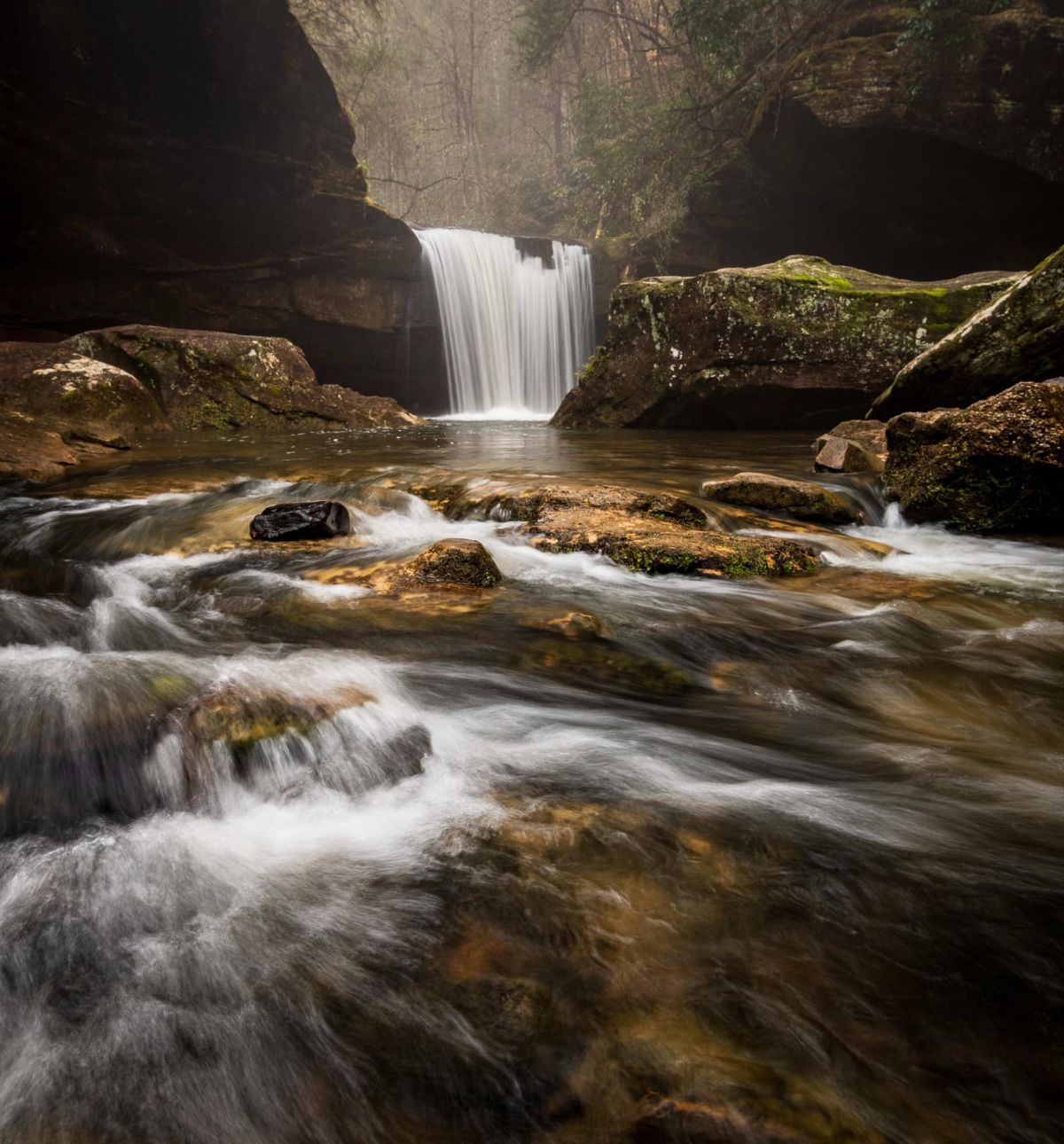
For me, that place is the flat part of a nondescript boulder positioned opposite a 15-foot waterfall with a very disturbing name.

I first visited Dog Slaughter Falls as a middle-schooler, and I was adamantly not stoked about the idea. At that time, I was a shy, somewhat artsy kid searching for meaning in the conservative Bible Belt town of Williamsburg, Kentucky. I was still a lump of unformed human clay—largely consumed by rock music and entirely disinterested in matters relating to the shoebox church my parents drug me to each Sunday. But I was also a Certified Strait-Laced Good Boy, so I entertained my mom’s pitch: an afternoon of hiking with a group of older folks, guided by the botanical knowledge of a nature-loving priest.

Turns out this was more of a demand than an invitation, so I invited my friend Tyler along for this frolic from hell—at least I could suffer alongside a kindred spirit. I wasn’t expecting to enjoy this foolishness, let alone have it alter my brain chemistry in a real, profound way. But life is strange.

Dog Slaughter Falls is located within Daniel Boone National Forest, which sprawls across 708,000 acres and 21 counties in Eastern Kentucky. But even if you’re not from the area, you still might be familiar with its star attraction: the massive and majestic Cumberland Falls, one of the only places on Earth where you can regularly see a “lunar rainbow”—a phenomenon created by moonlight rather than sunlight.

Visiting the so-called “Niagara of the South” was a staple of my formative years. Outside of buying scratch-off tickets and meandering around Wal Mart, there really wasn’t much to do in Williamsburg, so we frequently made the 20- or 30-minute trip up to Corbin, windows rolled down, cranking whatever new indie-rock album we were obsessed with. I vividly remember road-testing Modest Mouse’s Good News for People Who Love Bad News as we navigated those windy roads late at night, my senses heightened by the darkness and perpetual motion. One time, my friend Calep showed up with a burned copy of Brand New’s The Devil and God Are Raging Inside Me—hearing “Jesus Christ” in that setting felt legitimately cinematic. During that era, my friend Rishi and I, having borrowed an unwieldy camcorder from a classmate, trekked down to the Falls’ beach area and, utilizing a form of forced perspective, staged a tragic suicide scene from our (still-unfinished) amateur film It’s Great to Be in Cincinnati.

I’ve always felt a restorative force at Cumberland Falls, and I know a lot of people who feel similarly. Also, as a restless kid with big-city dreams, I felt trapped in my hometown, but living near the Falls was a badge of honor—something I could name-drop to a stranger in conversation and feel vaguely proud. But…it was also a state park swarmed with tourists—it belonged to everyone. Dog Slaughter, on the other hand, felt like a secret.


Let’s talk about the name—or, more specifically, how little we know about it. According to Kentucky State Parks, the origin of the grisly “Dog Slaughter” moniker “remains a mystery,” despite regular questions from visitors. The Independent Herald, a newspaper located in nearby Oneida, Tennessee, has a couple theories: One, which I also heard as a kid, is that “unwanted pets were once killed there.” Yeah, pretty horrifying! Another: “that hunting dogs were once slain by a beast unknown at this site—maybe a wolf, maybe a bear … some even say Bigfoot.” (This also calls to mind the local legend: the Mulberry Black Thing, but we’ll save that one for another day.)

I reached out to some local experts, thinking maybe, just maybe, they knew a deeper truth obscured from the general public. The responses varied.

Jehan Abuzour, parks program services supervisor (previously park naturalist) at Cumberland Falls State Resort Park since September 2023, is aware of two stories. (Dog Slaughter is technically not located on park property, though there is a connecting trail.) “I’ve heard that [frontiersman] Daniel Boone wrote in his journal about how he brought his hunting dogs with him in the area and they chased a raccoon, and the raccoon went under the lip of the Dog Slaughter Falls waterfall,” she says. “The hunting dogs didn’t see the cliff, and they went over it and died. Daniel Boone supposedly named it Dog Slaughter Falls. The other story is pretty broad: Basically there was a group of early settlers of Kentucky, and they encountered a pack of wild dogs out there at the falls.“

Pamela Gibson, former trails maintenance supervisor and volunteer coordinator at Cumberland Falls State Park, calls Dog Slaughter a “local landmark”—but with a name that invites a lot of complaints. “According to what the Park had written, Dog Slaughter Falls was named for an incident that happened before the area was very populated,” she says. “Story goes, the locals were out hunting [raccoons] in the area using dogs. The dogs had the coons pinned in the creek, when the raccoon got one of the dogs in the water, drowning several dogs. Everyone knows dogs do not stand a chance with a raccoon in the water.”

Connie Howard has been hiking there for over four decades and lives in a cabin near the trailhead. (Speaking of which, she’s had “many hikers who have gotten lost knock on [her] door during the night.”) But she doesn’t think “anyone is sure” how Dog Slaughter got its name. “The old timers, long deceased, told me it was because of hunting dogs being killed by a mysterious beast that lived in the area,” she says. “Who knows?”

The whole “slaughter” branding may intimidate some people from venturing out there—notably, on the horror front, it even inspired a Creepypasta involving a camping trip, a little girl’s diary, and a mysterious creature. But the hike, at least in my travels, has been the opposite of unsettling. Then again, I’ve always been out there with at least one other person—or, in the case of my first time, with a large group of people I mostly wanted to avoid.
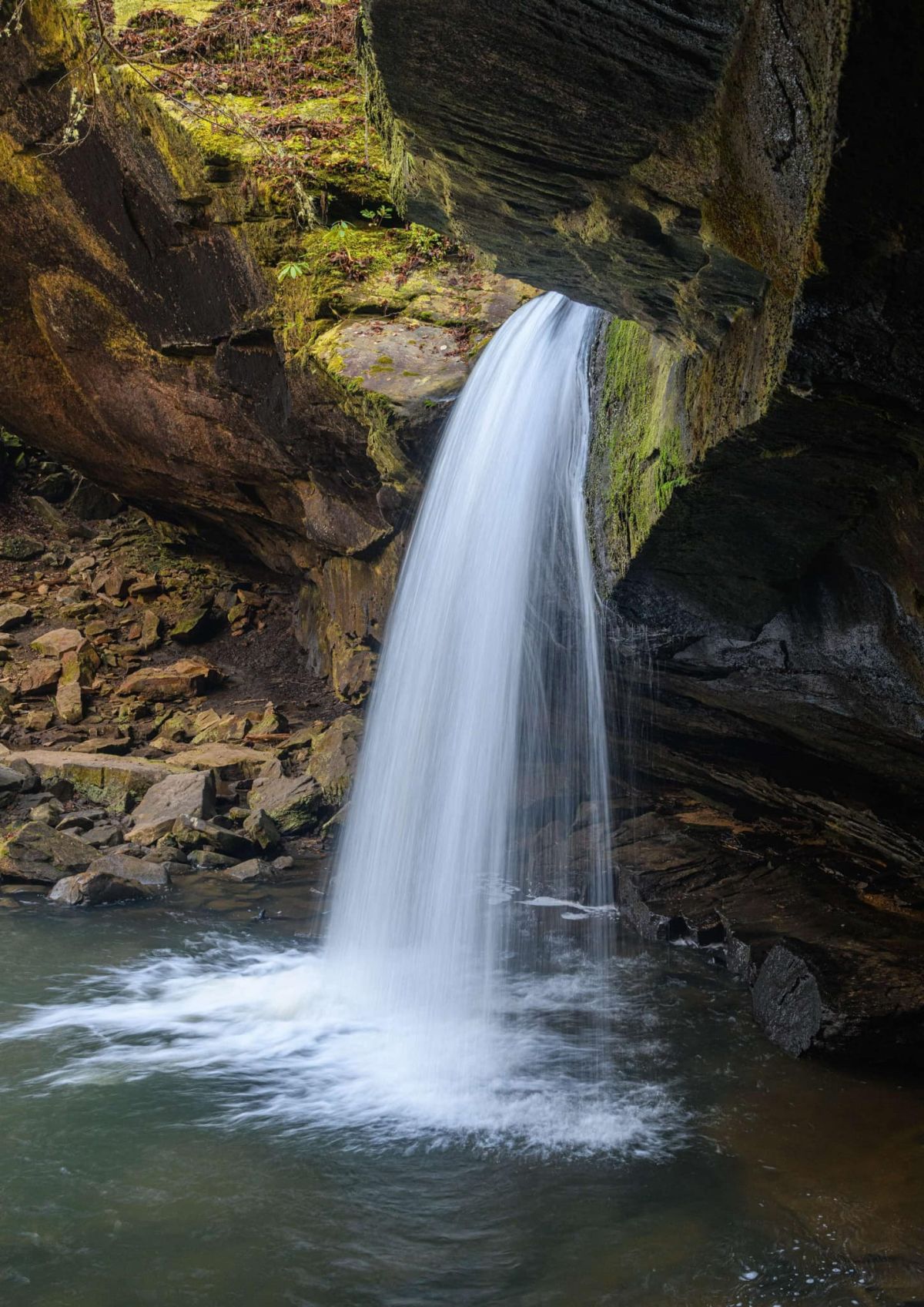

Tyler and I jostled in my family’s minivan as it slowly rumbled roughly three miles down a gravel road. I remember Shania Twain’s country-pop hit “Man! I Feel Like a Woman” playing on the radio, its signal shifting more to static with each bump—it felt like an omen, but I wasn’t sure what kind. We arrived at an unmarked pull-off area overseen by a huge rock, and all of the churchgoers piled out of their cars and onto the trail, with Tyler and I shuffling to the rear. Sensing our awkwardness, a rowdy (and, frankly, somewhat frightening) 50-something man we’ll call Jerry decided to become our unofficial tour guide.

As the rest of the hikers moseyed along the shady, ultra-green, 2.5-mile path, stopping periodically to gaze at flowers, our out-of-nowhere buddy countered that peacefulness with lots of antics. Multiple times, he shouted caveman gibberish with a cavernous roar; at one point, he frantically jumped on a downed tree that crossed along Dog Slaughter Creek, almost daring it not to break; and, in what remains the funniest thing I’ve ever seen, he tripped over a rock, his body soaring a Superman-like free-fall before smoothly skidding into fresh mud. He arose, wiped his eyes, and shouted manically. Jerry was having himself a day.

Meanwhile, I was falling in love—even if I was embarrassed to admit it at the time. Despite the chaos, I felt serene among the fizzy creek sounds and creeping moss and cold rocks. During a picnic lunch, we all gathered on that massive boulder, a short swim away from the base of the falls, and I was hypnotized by the unending rush of water. “This is always just…out here,” I thought. And I’ve dusted off that disbelief every time I’ve returned over the following two-plus decades, often joined by my wife (Jen) and our Brittany Spaniels (Tegan and the late Gabriel).

I’m an anxious, depressive person by nature—I have trouble slowing down, living in the now, savoring the good moments before they slip through my fingers. But I crave the zen-like tranquility I feel at Dog Slaughter. I always leave feeling blissfully still—as if I’ve stopped the flood, even momentarily, to gaze at one outside myself.

  • Wildlife reserves and gardens alike can be regrown thanks to dogs wearing backpacks with seeds
    Photo credit: Photo credt: @wilderlife8107 on YouTubeNative plants can be regrown thanks to dogs.

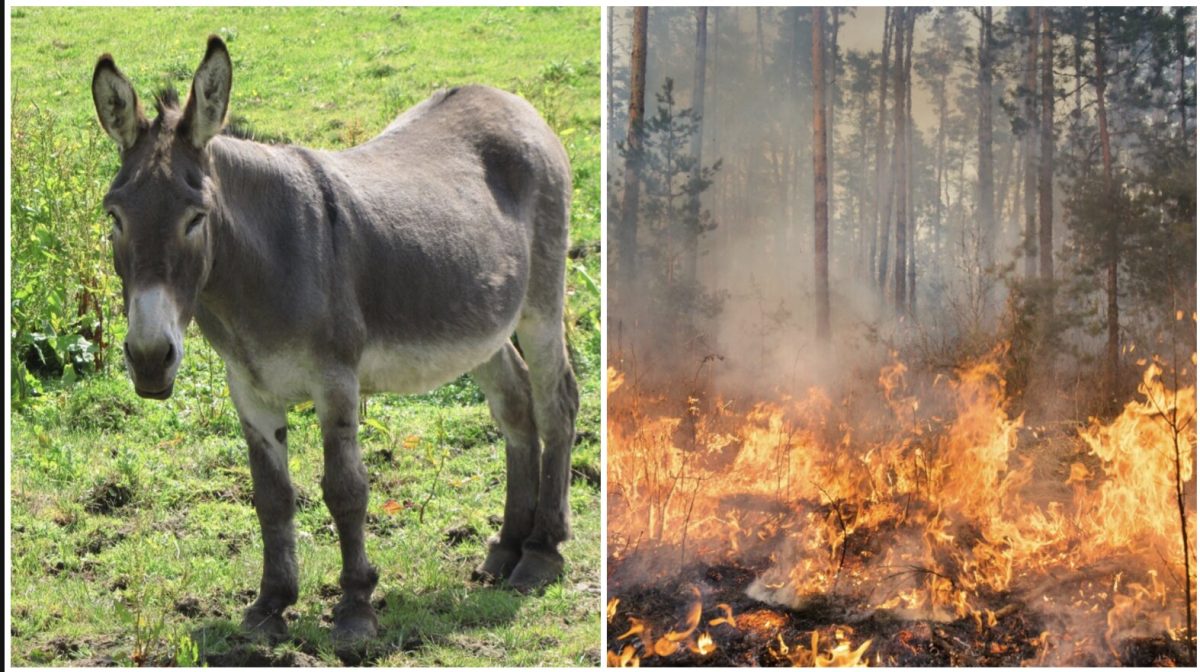
    Whether it’s a forest recovering from a wildfire or our own backyards, nature can use some help. Spreading seeds to ensure grass or wildflower growth can be a time-intensive process. However, there is one way that can be fun, quick, and help your dog get some exercise: strapping a backpack full of seeds onto them.

    The practice has been popularized internationally by sisters Francisca and Constanza Torres with their three dogs. Many forested areas of their native Chile were devastated by wildfires. The sisters came up with a plan to help reseed and regrow what had been burned down. The two would strap backpacks filled with grass and wildflowers seeds onto their border collies. The backpack had a small opening that would allow the seeds to fall out and spread as their dogs ran, jumped, and played throughout the area. 

    This helped the forests regrow while also providing the dogs exercise. The dogs were also able to walk into nooks and crannies human planters normally can’t access.

    An idea goes international

    The idea spread past countries and coastlines as a nature reserve in Lewes, East Sussex, England offered dog walkers backpacks with seeds. The walkers would strap the packs onto their furry friends as they went on nature walks to help rewild the area.

    “We’re really interested in rewilding processes, but they often involve reintroducing big herbivores like bison or wild horses,” said the project’s manager Dylan Walker to The Guardian in 2024. “In a smaller urban nature reserve it’s really hard to do those things. So, to replicate the effect that those animals have on the ecosystem we aimed to utilize the vast number of dog walkers that are visiting the nature reserve daily.”

    The concept itself was taken from nature. For centuries, wolves would have seeds caught in their fur. Over time, movement, and grooming, the seeds would be spread throughout other areas of the forest. The wolves acted as natural carriers for seeds much like bees are for pollen.

    Reseed your garden with Rover

    This technique doesn’t have to be reserved for wildfire recovery or regrowing public gardens. Your yard could benefit from it, too. While you could find a pack for your pup and fill it with seeds, there’s another way. Gardener Patrick Vernuccio suggests just filling a tea strainer with seeds and clipping it onto your dog’s collar. It should perform the same effect.

    If you have your dog help seed your yard, be sure that the plants you hope to grow are dog-friendly. Use non-toxic seeds for dogs such as roses, marigolds, and pansies among others. The ASPCA has a full list of plants that are unsafe for dogs to refer to when you’re unsure.

    Man’s best friend can also be man’s best gardening buddy.

  • How the ‘fog harvesting’ women of Morocco are influencing how desert areas get drinking water
    Photo credit: Canva/Liu277339840 via Wikimedia CommonsClean drinking water can be collected from fog.

    According to UNICEF, over two billion people live in an area with water scarcity. Climate change, data centers, and other factors are impacting the amount of drinkable water available. However, for the last ten years the women of Morocco have been implementing a water collecting technology that could be useful in other dry areas.

    For centuries, the people of Aït Baamrane in Morocco relied on rain and groundwater from wells for drinking and irrigation. It is reported that women of the town would walk four hours to fetch 50-gallon drums of water to carry back. However, intense drought and desertification have made the region even more difficult to live in. Now, they primarily rely on “fog harvesting” for water, with technique showing remarkable success since they started in 2010.

    The women-led NGO Dar Si Hmad built what is now the world’s largest operational fog-water harvesting system. This not only has successfully provided an average of 6,300 liters of potable water for more than 400 people in five villages in the area, but significantly reduced the time and physical cost of carrying water.

    How fog harvesting works

    Fog harvesting is the collection of water droplets from wind-driven fog. While Morocco is a dry area, it does have fog near its mountains and coastal regions. The fog collection system is typically constructed in the form of a mesh net set up and pulled taut between two posts. The net is spread out at an angle that’s perpendicular to the direction of the wind carrying the fog. Freshwater droplets are formed as the fog passes through the net, dripping into a gutter that leads to a storage tank.

    The fog-water collected in this particular system goes through a thorough UV, sand, and cartridge filtering process. The system is also solar powered, making it environmentally sound and cheaper than other methods. Since the collected water is pure from the sky, it is free of most contaminants and pollutants.

    Fog harvesting expanding

    Fog-harvesting/fog-catching has since expanded to other areas of the world. Movimiento Peruanos Sin Agua (Movement of Peruvians without Water) haven’t just built fog-catching nets in Peru, but in rural communities in Colombia, Bolivia, and Mexico. Fog-collectors in Spain collect droplets and water to help offset dry vegetation wildfires on the Canary Islands. Chilean fog harvesters are looking into expansion to help provide water for the poorest communities and dry urban areas.

    Other water collecting methods are being tested

    Scientists are also trying to find other methods to quickly and effectively draw water from the atmosphere. Researchers at MIT have developed a salt-based hydrogel that collects moisture from water vapor at night between glass panels. These panels create condensation of pure water when they are heated by sunlight. There is also research going into a sonic device that can quickly “shake water out of the atmosphere.”

    While scientists are in the midst of finding ways to obtain and conserve water in our future, there are steps people can take today. In terms of water conservation in the United States, the Environmental Protection Agency has some resources that can help. Like collecting fog, collecting folks willing to pitch in can do wonders for the community.

  • How much is a bat worth? Protecting these tiny insect‑eaters isn’t just good for farms – their deaths cost taxpayers and the wider economy
    Photo credit: Liz Hamrick/TVAA healthy bat hangs in a cave, resting up to eat its weight in bugs at dusk.

    Most Americans tend to think about bats only around Halloween, but the U.S. economy benefits from these furry flying mammals every day.

    Bats pollinate plants, including many important food crops, when they stop by flowers to drink nectar. Their guano is mined from caves for fertilizer. And they eat a lot of bugs – the kinds that bother people (think mosquitoes) and others that destroy crops that humans depend on for food.

    Sadly, bat populations are declining rapidly in North America. A driving force is a fungal disease known as white-nose syndrome, which has spread among bats throughout the United States. When a bat population crashes, fewer bats are around to eat bothersome insects. All those additional insects can do serious damage.

    So, when bats disappear, farms become less productive, and that has broad implications for the agricultural economyhuman health, rural governments and even financial markets.

    Bats love to eat the bugs that bother people

    First, consider how many insects bats eat.

    A reproductive female big brown bat can eat its body weight in insects every night in the summer, precisely when farmers are growing food.

    Hundreds of bats fly out of a cave.
    Mexican free-tailed bats head out of Bracken Bat Cave, near San Antonio, Texas, for an evening of feasting on insects. In summer, the cave is home to the largest bat colony in the world. Ann Froschauer/U.S. Fish and Wildlife Service

    One of those insects is the cucumber beetle, which matures from rootworm – a scourge of U.S. cornfields. Rootworm destroys more than 340 million bushels of corn across the U.S. Midwest and South each year, even as farmers spend US$1 billion annually on pesticides to control outbreaks.

    A colony of 150 big brown bats can consume 600,000 cucumber beetles in a single year. If each female cucumber beetle – assuming half are female – had 110 rootworm larvae, the typical brown bat colony would prevent the production of 33 million rootworms.

    Farmers experience economic damage when rootworm concentrations exceed about 0.5 per corn plant. Typical planting densities exceed 30,000 corn plants per acre in the Midwest. Therefore, the rootworms that would have hatched could damage more than 2,000 acres of corn – if bats weren’t around to eat the cucumber beetles first.

    That is a significant amount of pest control provided by bats!

    The disaster known as white-nose syndrome

    In the winter of 2006, the fungus that causes white-nose syndrome, the aptly named Pseudogymnoascus destructans, was first detected in the U.S. near Albany, New York.

    From there, it spread across the country, infecting 12 species of bats, three of which are listed as endangered under the Endangered Species Act. A 2010 study found white-nose syndrome had killed between 30% and 99% of the bats in infected colonies.

    A little brown bat with the telltale signs of white-nose syndrome
    A little brown bat with the telltale signs of white-nose syndrome, a fungal infection that saps the bats’ energy. Ryan von Linden/New York Department of Environmental Conservation

    As of March 2026, the fungus causing white-nose syndrome had been detected in 47 states, reaching as far west as California, Washington and Oregon. White-nose syndrome spreads primarily through bat-to-bat contact, though humans also contribute to the spread when cave explorers carry the fungus from one cave to another.

    Despite coordinated efforts by state and federal wildlife agencies to limit access to caves where bats live and slow the transmission, white-nose syndrome continues to spread rapidly. When bats get infected, they wake up early from hibernation and use more energy over the winter. This depletes their fat reserves and causes them to die of starvation, leading to plummeting populations.

    Bats’ role in food production

    After white-nose syndrome arrives in an area, the loss of bats has significant consequences for farmers.

    Yields fall as pests consume crops. To protect their crops, farmers purchase more chemical pesticides, so their costs rise as yields decline. The estimated agricultural losses from white-nose syndrome exceeded $420 million per year as of 2017.

    A bat hovers by a large flower as it feeds on nectar.
    A lesser long-nosed bat (Leptonycteris curasoae) feeding on an agave blossom in Arizona, spreading the flower’s pollen in the process. Rolf Nussbaumer/imageBROKER

    Greater pesticide use is also associated with human health problems that can be avoided if bat populations remain healthy.

    Losing bats hurts local governments financially

    The story does not stop at the farm.

    Counties in all U.S. states tax agricultural land based on its “use value” – in other words, based on how profitable the land is in agriculture. Without healthy bat populations, lower profits shrink the tax base, leaving county governments with less revenue.

    Those governments must respond by reducing services, raising taxes or increasing how much money they borrow – often at a greater cost of borrowing. The effect is especially pronounced in rural counties, where agriculture makes up a large share of property tax revenue.

    Our recent research finds that rural county governments lost almost $150 per person in annual revenue after the arrival of white-nose syndrome. For an average-size rural county, that is nearly $2.7 million in lost revenue each year.

    How losing bats can hit the bond markets

    The loss of county revenue makes municipal bond investors nervous. Buying a municipal bond is a bit like lending money to the county, and the interest rate is what the county pays you for taking on that risk.

    When bats disappear, the risk goes up, and the county has to pay about 11.47 hundredths of a percentage point more in interest. That may sound small, but it is 27% larger than the typical risk premium investors already demand from county governments.

    The higher interest rate raises borrowing costs for county governments. For example, the borrowing costs on a typical 15-year, $1 million bond would increase by more than $33,000.

    Two bats hanging in a cave.
    Bats snuggle up in a cave. Liz Hamrick/TVA

    Higher yields also mean lower bond prices for investors, including retirement funds. For example, our research suggests that investors would discount a $1 million bond issued by a rural county by nearly $14,000 if that county’s bats have become infected by white-nose syndrome.

    Economic benefits of saving bats

    The good news is that the benefits from healthy bat populations create opportunities to make money from bat conservation.

    Farmers can increase their incomes. Local governments can recover property tax revenue to fund public services, such as road maintenance, health infrastructure and public schools. Bond investors can earn financial returns from healthier bat populations.

    No silver bullet exists for protecting or restoring bat populations affected by white-nose syndrome, but promising efforts are underway.

    fungal vaccine is being tested by the U.S. Geological Survey and partners. Designing artificial roosts and adding cave protections can also help preserve healthy bat populations. Researchers are also working to better understand bat resistance to the disease to explore whether improving resistance alone can stabilize bat populations.

    As these solutions develop, opportunities will emerge for farmers, local governments and investors to earn financial returns through bat conservation. In other words, saving bats isn’t just good ecology – it’s good economics.

    This article originally appeared on The Conversation. You can read it here.

Explore More Environment Stories

Science

How much is a bat worth? Protecting these tiny insect‑eaters isn’t just good for farms – their deaths cost taxpayers and the wider economy

Science

Pocket gardens: The tiny urban oases with surprisingly big benefits

Environment

America’s next big critical minerals source could be coal mine pollution – if we can agree on who owns it

Science

Don’t just plant trees, plant forests to restore biodiversity for the future