
I have been a dog lover ever since I was a kid and have spent years learning about the temperaments and histories of different dog breeds, as well as famous dogs and their adventures. I have attended a variety of dog shows to meet various breeds and talk with their owners, and I’ve also lived with several dogs – including a dachshund, otterhound, German shepherd, Indian spitz and Labrador retriever – over the course of my life.

Beyond my canine concerns, I’m a professor of management who loves teaching courses and conducting research on leadership. So, it was a no-brainer for me to combine my two interests to write a book, “Learning Leadership from Dogs.” Various dog breeds embody distinct traits and behaviors that we humans can emulate to become better leaders.

Here are five qualities dogs model that any leader, at work or in life, can learn from.

Dog lying down and wearing a cap looks at the camera
The author’s own otterhound Fiona was always up for a good time. Aditya Simha

Joie de vivre

Happy-go-lucky hounds have an abundance of joie de vivre, a French phrase that refers to a cheerful and exuberant enjoyment of life. My own otterhound, Fiona, amply embodied this trait. A simple walk in the woods or hike on the beach was all she ever wanted.

This kind of optimism and cheerfulness can make leaders more empathetic and pleasant to work with, partly because psychology research finds that positive moods increase helping, generosity and interpersonal understanding. Those are key ingredients of empathy.

Followers feel and perform better when led by good-natured, enthusiastic leaders who look on the bright side. A leader’s joie de vivre can be passed on to the team. Scholars of positive leadership call this process emotional contagion – how a mood or emotional tone can spread through a group.

Courage

Who wants to follow a timid leader, right? Most people want a leader who is brave and who walks the talk – someone who’s courageous enough to do the right thing under all circumstances, not just when it’s convenient to do so.

dog looks at attention with person in military garb holding its leash
Some Dutch shepherds are military working dogs with the U.S. Army. Defense Visual Information Distribution Service

While there are many dog breeds that embody courage, I want to single out the Dutch shepherd. Smaller than the German shepherd and the Belgian Malinois, the Dutch shepherd is used in police and military work because of its athleticism, trainability and strong work ethic. Just like how Dutch shepherds run toward danger to protect others, courageous leaders take risks for their values and to support their team.

Intelligence

Leaders must not only know about their domain, they also need to be able to understand which of their followers needs to be treated or led differently. Both emotional and cognitive intelligence are essential for effective leadership and have positive consequences for their followers’ attitudes and performance.

Black and white dog looks at three sheep standing on grass
Border collies are great at herding and know the best ways to keep different sheep in line. Fernando Lavoz/Nur Photo via Getty Images

I point to the border collie as a dog that exemplifies both forms of intelligence. The border collie not only knows how to herd sheep, but also which sheep to herd with patience and which sheep need a bit more sharpness.

This intelligence is something that needs to be guided and channeled. Border collies left without enough work or stimulation are famous for finding their own “jobs,” such as herding the human children, chasing shadows or inventing new mischief around the house.

Without proper direction, even brilliance can become counterproductive – another lesson leaders can keep in mind when managing their own flocks.

Kindness

Kindness is one quality that is sadly not given the amount of attention it merits in the world of management, even though it can shape whether followers feel respected, trusted and willing to contribute.

Big black dog nuzzles face of a woman kneeling in a field who is petting it
Newfoundlands are kind, gentle giants. kozorog/iStock via Getty Images Plus

Displaying kindness is a canine specialty. The dog breed that comes to mind for me here is the Newfoundland. First bred in Canada and known as a fine water rescue dog, these gentle giants are supremely kind to everyone and display a benevolent, protective nature.

Leaders similarly need to be kind to their followers, even if a team member has failed at a task. A kind response does not mean ignoring mistakes; it means correcting them in a way that preserves dignity, making followers more likely to learn, speak up and try again. Together those patterns facilitate work environments that promote what researchers call psychological safety: a shared belief that people can ask questions, admit mistakes and raise concerns without fear of embarrassment, rejection or punishment.

Resilience

Resilience is not just toughness; it is the ability to recover from setbacks, adapt under pressure and keep moving forward when things don’t go as planned. Leaders rely on it during crises, failed projects, public criticism or periods of organizational change, all moments when uncertainty is high and confidence can falter.

Brown dog looks alertly to the distance while standing in a field
A Rhodesian ridgeback bounces back from failure in order to be ready for the next challenge on the horizon. Ines Arnshoff/iStock via Getty Images Plus

Any leader can look to the Rhodesian ridgeback as a resilience role model. This breed hails from South Africa and was originally used to assist in lion hunting – an activity fraught with peril and with high prospects of failure. Rhodesian ridgebacks are dauntless dogs, always ready to try another dangerous hunt even in the wake of repeated failures.

Like these dogs, leaders often must confront perilous tasks with a high likelihood of failure, and they must be ready to bounce forward so they can eventually seize success. Without resilience, leaders may panic, withdraw or become overly reactive, especially during a crisis. When that happens, uncertainty spreads, confidence erodes and teams are less likely to stay focused or move forward effectively.

Portrait against a white background of a group of dogs of many sizes
Different breeds have different personalities – but they’re all good boys and girls. Compassionate Eye Foundation/David Leahy/Digital Vision via Getty Images

Dogs are the most popular choice of pet in the United States and worldwide. You probably don’t need to look far to find some furry friends who can inspire you with their admirable characteristics. Dogs may never author a leadership book, but they live out leadership lessons in courage, kindness and joy every day.

This article originally appeared on The Conversation. You can read it here.

  • Foreign aid’s hidden benefit: Recipients are more likely to pay the generosity forward
    Photo credit: Kim Hong-Ji/Getty ImagesSouth Korean soldiers oversee the arrival of a batch of Johnson & Johnson’s Janssen COVID-19 vaccines donated by the U.S. government on June 5, 2021.

    Foreign aid may not improve how recipients view donor countries – but it can set off a chain of goodwill that spreads far beyond the original act of giving.

    That is what a colleague and I found when we studied how South Koreans responded to COVID-19 vaccines donated by the United States.

    The South Korean government reserved donated Johnson & Johnson vaccines for military reservists and, for medical reasons, excluded anyone under 30. As a result, we could compare the views of South Koreans just above and below that threshold.

    We found that the donated vaccines did not improve people’s views of the United States. South Koreans who received American vaccines reported similar views of the U.S. as those who had not been vaccinated.

    Yet the results were striking in another way. Those who received donated American vaccines became more supportive of their own government sending aid abroad. Recipients shifted from neutrality on the matter to expressing moderate support for foreign aid, scoring about one point higher on a seven-point scale than those who didn’t make the eligibility cutoff.

    There is also evidence that these effects extend beyond direct recipients. South Koreans who were simply told that the U.S. was providing vaccine aid to developing countries also became more supportive of their own government doing the same – though this effect was concentrated among political moderates.

    Together, these patterns point to what social scientists call “generalized reciprocity” – the impulse not to repay kindness directly but to pass it on. In this way, one act of aid can prompt another, and spread across borders.

    Why it matters

    From Washington and London to Berlin and Tokyo, foreign aid budgets have been cut. In November 2020, former U.S. Agency for International Development Administrator Samantha Power invoked a common assumption when she argued that providing vaccines abroad would restore American leadership – that the value of aid lies in the goodwill it generates toward the donor.

    Our findings suggest this is one way aid can matter, but not necessarily the most important.

    Instead, aid may foster a form of international cooperation that does not depend on treaties or direct reciprocity between nations but emerges from ordinary people’s willingness to pass on goodwill.

    A nurse administers a vaccine shot to an elderly lady.
    A South Korean woman receives a COVID-19 vaccine on April 1, 2021. Chung Sung-Jun/Getty Images

    If aid can trigger chains of giving across borders, then how we assess its value may need to change. Current frameworks tend to emphasize donor nations’ direct returns or strategic benefits, but the cooperative effects we identify are largely invisible to those metrics.

    This suggests that current cuts may be shutting down effects that policymakers have not yet learned to measure – a form of international cooperation that, once set in motion, can generate cascading effects well beyond what any single donor nation could achieve alone.

    What we don’t know

    Important questions remain: Do similar patterns emerge with other forms of aid – such as disaster relief, food assistance or long-term development programs? And how long do these effects last?

    There are also hints that the threshold for triggering this response may be lower than previously thought. The effect persisted even when using eligibility for donated vaccines, rather than actual receipt, as the measure – suggesting proximity to aid, not just receipt, may be enough to activate the impulse to give.

    If evidence that past recipients of aid have themselves become donors strengthens public support for giving in donor countries, then aid may be more self-sustaining than critics assume – reinforced not just by its immediate effects, but by the example it sets.

    This article originally appeared on The Conversation. You can read it here.
  • This elementary school banned screens in the middle of the year. Will it solve their reading crisis?
    Various books for middle graders.

    Lily Altavena for Chalkbeat

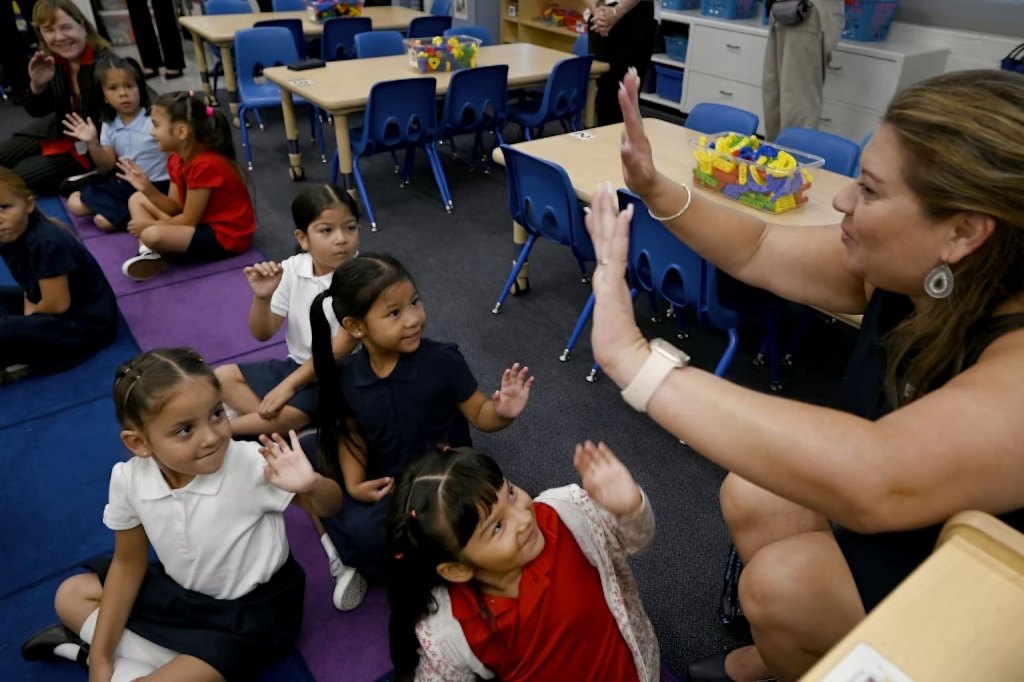
    Chromebooks are scattered all around the classrooms of Floyd M. Jewett Elementary School in Mesick, Michigan.

    Towers of them are teetering atop bookshelves. They’re piled up in corners of classrooms. They’ve even cropped up in one classroom’s dish rack.

    But there’s one place you won’t find them: in students’ hands.

    Last month, Mesick Consolidated Schools banned digital devices in its elementary school of about 250 students. The decision wasn’t an agonizing one. The ban came at astonishing speed, almost overnight, after a conversation between Mesick Superintendent Jack Ledford and Jewett Principal Elizabeth Kastl.

    Ledford recalled asking Kastl how much teachers read to students in grades K-5. And he recalled her reply: “That has almost vanished.” Kastl’s response helped seal the deal.

    Teachers had to have students off devices by the end of the week. School printers went into overdrive. Then the district went cold turkey, Chalkbeat reports.

    Mesick’s midyear ban underscores a growing backlash against screen time in school, a battle that parents and educators are taking up nationwide. Fears about digital devices’ impact on learning have fused with ongoing concerns about a multiyear decline in national test scores that predates the pandemic. A stream of government hearings, op-eds, and social media posts has only magnified the sense of urgency.

    Ledford and Kastl think the need for drastic action is warranted. About 18% of Jewett’s third graders scored proficient or higher on the state reading test last spring — half the state average and half what it was a decade ago.

    In Mesick, a rural town known for its annual mushroom festival, 66% of students are economically disadvantaged. The district has done all the “normal things” to improve persistently low reading scores, Ledford said, like switching to an evidence-based curriculum. But he now views screens as an adversary to learning.

    “When we’re competing with screens, we’re going to lose,” he said.

    But blanket bans at school won’t affect kids’ screen time at home. And research about how screens affect students is inconclusive, although it does suggest that teachers should exercise caution. Not everyone is convinced that a complete prohibition on screens is the best way to help struggling learners.

    Morgan Polikoff, a professor at the University of Southern California’s education school, said he understands the appeal of an all-or-nothing approach, but it avoids the reality that some technology does have a place in the classroom.

    “It’s like taking a hammer when you need a scalpel,” he said. “A lot of the use of technology in schools is not appropriate. But rather than sitting down and thinking about, ‘What are appropriate uses of technology in classrooms serving young children,’ this approach would just obliterate all uses.”

    Lawmakers in at least 16 states have proposed bills that would limit education technology in public schools, following a spate of state-approved cellphone bans for schools.

    Ledford said he’s been influenced by writers like Jonathan Haidt, a New York University psychologist who is a prominent supporter of school cellphone restrictions and has more recently criticized the proliferation of tech in education. At the same time, a mid-March visit to Mesick’s classrooms shows the ed-tech backlash can be somewhat divorced from the reality of a school day.

    For some at Jewett, the school day doesn’t feel that different. A few teachers said they hadn’t used screens very much. For others, the routine has changed substantially — and for the better, they believe, with students more engaged and learning less “gamified.”

    When asked about her school’s screen ban, a girl wearing a “Lilo & Stitch” shirt in an intervention class for struggling readers just growls. But her intervention instructor, Julie Kearns, said the students are simply adjusting.

    The student “definitely seems like she enjoys” reading a book more than wearing headphones and peering at a screen, Kearns said.

    As Kearns watched, the girl bounced in her chair while reading a passage about soccer.

    Why a school banished screens and bought books

    In classrooms, a screen ban for students doesn’t mean all screens are gone.

    One Friday in March, third-grade teacher Hanna Brechenser presented images on the Smartboard — the modern-day version of a projector — of Indigenous communities to help foster a classroom conversation. Teachers also still have desktop computers.

    This is Brechenser’s fifth year teaching and her second in Mesick. She said she had already tried to limit screentime in the classroom before the ban. Her class mostly used their Chromebooks a few times a week for a math fluency exercise and digital library access.

    Both Kastl and Ledford believe teachers may not have been aware of just how much of a crutch screens were in some classes.

    Mesick went 1:1 with students and devices around 2015, Ledford said, when schools were under pressure by tech evangelists and politicians to add more technology so students would be prepared for jobs in the digital world. That was the argument at the time, anyway.

    “I had started in my walkthroughs just noting, what are the students doing?” Kastl said. “More often than not, I was coming back with a list of students on devices. So the perception of how your day actually looks versus what we were seeing on the data piece are probably disjointed.”

    Mesick’s new policy has been helpful for Brechenser because she doesn’t have to police students so much on their devices.

    Brechenser’s students have physical books from the “Diary of a Wimpy Kid” series, “Twilight,” and “The Baby-sitter’s Club” stacked on their desks. That’s the other side of Mesick’s new screen ban: The district has set aside $30,000 for physical books to bulk up classroom libraries, along with beanbag chairs so students will have special spaces to read.

    Students adjusted quickly, Brechenser said. “At first, they were kind of shocked, but we just have a lot more silent reading time.”

    Still, it’s hard to miss signs of the amount of time students spend on screens outside of school: A “K-Pop Demon Hunters” water bottle. A Sonic the Hedgehog T-shirt. The image of a snake Brechenser put on the Smartboard prompted one student, Alaric, to say it reminded him of one in a “Harry Potter” movie he watched before school.

    Alaric, who’s 9, said he doesn’t really miss his Chromebook, though he’d been reading something on the online library he can no longer access thanks to the screen ban.

    He gets plenty of screen time at home playing Xbox, he said. He hasn’t thought about cutting down on that.

    “Because I love Fortnite,” he giggled.

    In reading instruction, students get a digital detox

    Where Mesick’s screen-free initiative feels most significant is in the 30-minute small group sessions for Jewett’s struggling readers.

    Mesick uses Read Naturally, an intervention program designed to build fluency. Before the screen ban, students would read a short passage aloud from a computer, then listen through bulky headphones as the software read the passage back to them. Students would then read the passage to themselves three times before reading it aloud again. Paraprofessionals would go from student to student to assist.

    Now, Sharon Brown and other literacy aides sit with their students and work through printed reading passages together. Brown can more easily point out when students stop tracking words with their fingers. She can help sound out words. Though she closely helped students on the computers, she finds herself more thrilled to engage this way, to see progress up close. This is why she is in education.

    “It’s our passion to sit and watch these kids go from struggling readers to eventually testing out … and not having to come back and see us,” she said.

    With one second grader, she has an engaging conversation about the reading’s topic, mammals, before they begin. He asks if a shark is a mammal and if it evolved from dinosaurs.

    Brown can see improvements, particularly with some of her first graders. Students are reading more words per minute, based on data they track every session.

    “They are so engaged,” she said. “It’s been amazing to us that we’re going, ‘Wow, this has actually been so fun.’”

    The way students use technology is an important consideration when thinking about limiting or banning screens, said Dr. Joanna Parga-Belinkie, a pediatrician and a spokesperson for the American Academy of Pediatrics.

    Educators and parents should focus on using technology in ways that are interactive and in group settings, instead of having students looking at screens on their own.

    “When you are focusing on screens and technology and the use of them you might be not focusing on human relationships,” she said.

    Samantha Daniels, the mother of three children in the district, said that last school year, some of the software the district used would offer students games if they read enough.

    She’d watch her son, a first grader, try to rush through the reading to get to the game. He struggled a lot with reading, becoming easily frustrated like many young readers.

    “It would be about getting to that, versus us enjoying what we’re reading and what we’re learning,” she said.

    But now, he’s starting to pick up books on his own.

    There are some difficult practical adjustments to a midyear change as big as this one. A lot of classroom resources are based online or have some kind of online component. Kastl asked teachers to stop using those components.

    Ultimately, every hour of screen time represented “an hour that we’ve lost direct teacher instruction where they’re actually getting that responsive feedback from a human,” Kastl said.

    “That’s when you move the needle.”

    Will eliminating screens help young readers?

    Ledford doesn’t think he’s taking a gamble by eliminating screens at the elementary school, even though students take state assessments on computers. He thinks it’s much easier to teach students technology skills than social skills.

    In fact, he already has plans to scale back technology use by older students, too.

    Ledford moved rapidly to ban screens, but he expects improvements in reading scores to happen more gradually. Still, he’s laser-focused on the connection between screens and literacy. To him, education should unlock the ability to read for students, because it affects everything else the district is trying to do for kids.

    “We’re failing in literacy,” Ledford said. “If we fail in literacy, how can we effectively teach science or social studies or any of the subjects?”

    Getting rid of screens will not solve all of Mesick’s problems, like a leaky roof or clapped-out HVAC system. Kastl has also observed a deeper potential issue: a drop-off in parent involvement after schools closed during the pandemic.

    In many cases, Kastl said, “Parents don’t know what actually happens inside their kids’ school building.”

    But parents know about the screen ban, and they’re excited about it. They’ve said they’ve noticed their children take more interest in reading.

    Kids are also socializing more during free periods, a bright spot for the principal’s son, Sam Kastl.

    Sam, 11, used to spend indoor recess — a regular occurrence in northern Michigan’s severe winters — playing games on his Chromebook. He thought the screen ban was “going to be annoying.” Classmates who used to ask him if his mom would declare a snow day started asking him to convince her to bring back devices.

    But those requests went away pretty quickly. Students now play board games together instead of games on their Chromebooks alone — just like how reading intervention students now study in a group instead of solo. Another student taught Sam how to draw. Everyone’s adjusted pretty well, from his vantage point.

    On the day Chalkbeat visited their school, Sam and his fifth-grade classmates built a fort out of blankets during class time. Then they climbed inside to read with flashlights.

    This story was produced by Chalkbeat and reviewed and distributed by Stacker.

Explore More Work Stories

Society

This elementary school banned screens in the middle of the year. Will it solve their reading crisis?

Society

10 conversation starters that actually work, according to communication experts

Society

Worrying about being a perfect mother makes it harder to be a good parent

Society

Are women board members risk averse or agents of innovation? It’s complicated, new research shows